CATL(300750)

Search documents
电池板块2月3日涨1.4%,华自科技领涨,主力资金净流入5.08亿元
Zheng Xing Xing Ye Ri Bao· 2026-02-03 09:03
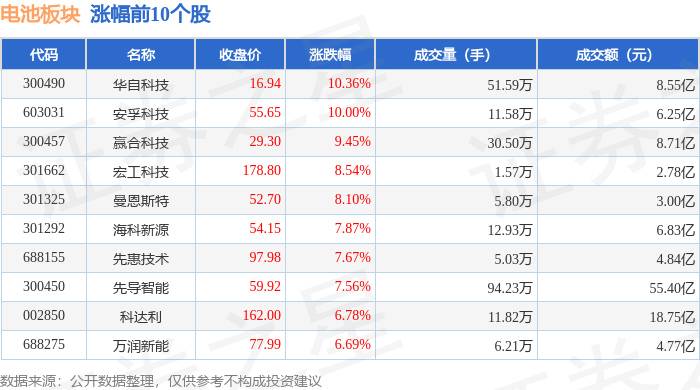
Market Overview - The battery sector increased by 1.4% compared to the previous trading day, with Huazi Technology leading the gains [1] - The Shanghai Composite Index closed at 4067.74, up 1.29%, while the Shenzhen Component Index closed at 14127.1, up 2.19% [1] Individual Stock Performance - Huazi Technology (300490) closed at 16.94, up 10.36% with a trading volume of 515,900 shares and a transaction value of 855 million [1] - Anfu Technology (603031) closed at 55.65, up 10.00% with a trading volume of 115,800 shares [1] - Yinghe Technology (300457) closed at 29.30, up 9.45% with a trading volume of 305,000 shares [1] - Honggong Technology (301662) closed at 178.80, up 8.54% with a trading volume of 15,700 shares [1] - Manns Tech (301325) closed at 52.70, up 8.10% with a trading volume of 58,000 shares [1] - Haike Xina (301292) closed at 54.15, up 7.87% with a trading volume of 129,300 shares [1] - Xianhui Technology (688155) closed at 97.98, up 7.67% with a trading volume of 50,300 shares [1] - Xian Dao Intelligent (300450) closed at 59.92, up 7.56% with a trading volume of 942,300 shares [1] - Keda Li (002850) closed at 4162.00, up 6.78% with a trading volume of 118,200 shares [1] - Wanrun New Energy (688275) closed at 77.99, up 6.69% with a trading volume of 62,100 shares [1] Capital Flow Analysis - The battery sector saw a net inflow of 508 million from institutional investors, while retail investors contributed a net inflow of 594 million [2] - Retail investors experienced a net outflow of 1.1 billion, indicating a mixed sentiment in the market [2] Detailed Capital Flow for Selected Stocks - Xian Dao Intelligent (300450) had a net inflow of 3.80 billion from institutional investors, but a net outflow of 2.50 billion from retail investors [3] - Tianhua New Energy (300390) saw a net inflow of 1.33 billion from institutional investors, with retail investors experiencing a net outflow of 765.46 million [3] - Anfu Technology (603031) had a net inflow of 631.24 million from institutional investors, while retail investors faced a net outflow of 571.16 million [3] - Keda Li (002850) recorded a net inflow of 503.07 million from institutional investors, with retail investors seeing a net outflow of 617.04 million [3]




特来电入股一汽解放与宁德时代合资公司,后者增资至4.9亿
Qi Cha Cha· 2026-02-03 08:18
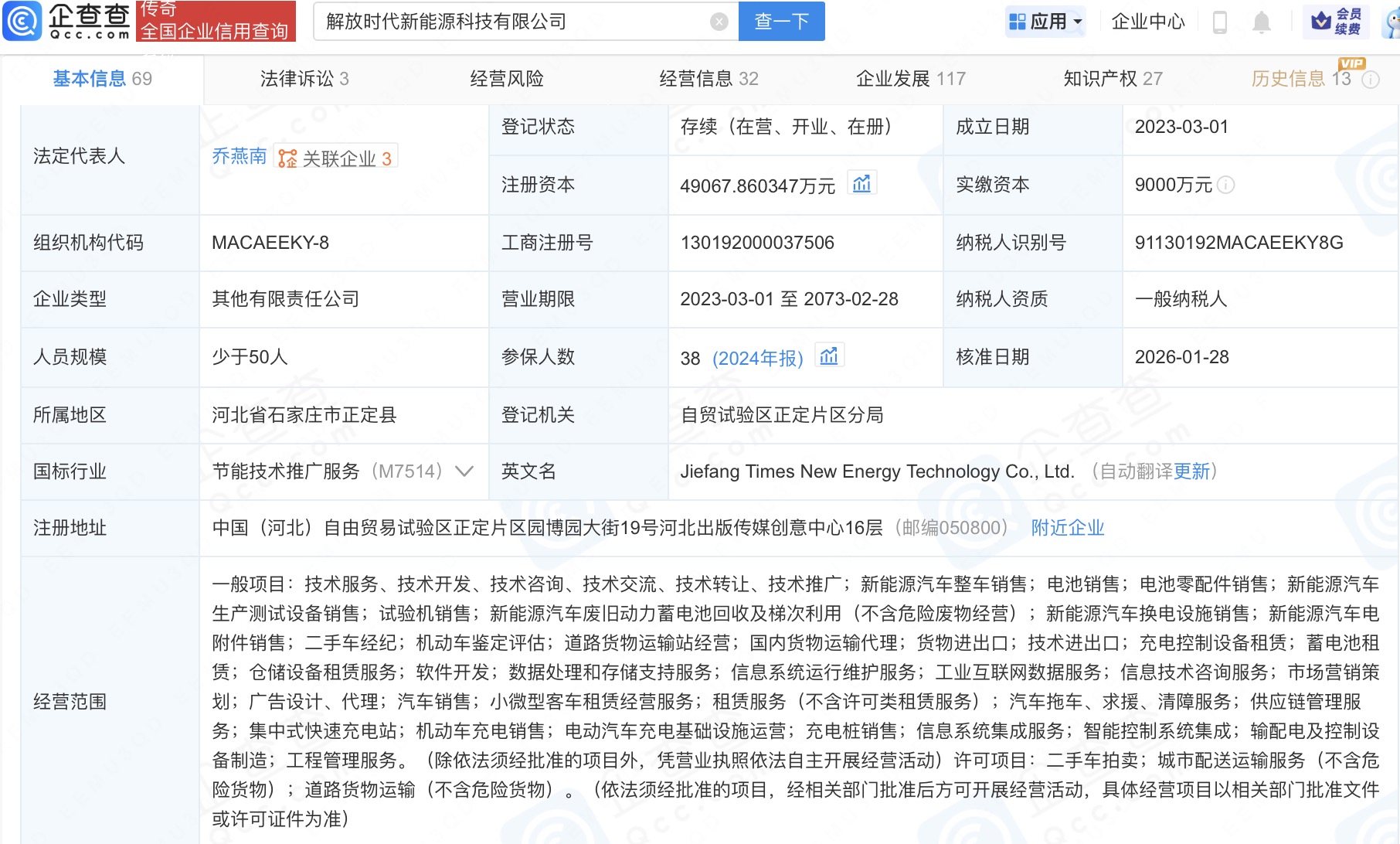
Group 1 - Jiefang Times New Energy Technology Co., Ltd. has undergone a business change, adding Teld New Energy Co., Ltd. as a shareholder and increasing its registered capital from 90 million to approximately 490 million yuan [1] - The company was established in 2023 and its business scope includes sales of new energy vehicles, battery sales, and sales of battery accessories [1] - The current shareholders include FAW Jiefang (a wholly-owned subsidiary of FAW Group), CATL, and the newly added shareholder Teld New Energy [1] Group 2 - The registered capital of Jiefang Times New Energy is now approximately 490.68 million yuan [2] - The company is classified as a limited liability company and is located in the Hebei Free Trade Zone [2] - The business operations include a wide range of services such as technology services, sales of testing equipment, recycling of used power batteries, and operation of electric vehicle charging infrastructure [2]


宁德时代签约泉州!
鑫椤锂电· 2026-02-03 08:07
关注公众号,点击公众号主页右上角" ··· ",设置星标 "⭐" ,关注 鑫椤锂电 资讯~ 本文来源:宁德时代 ICC 鑫椤资讯年终盘点: 鑫椤报告预售: 2025-2029年全球锂电池应用市场运行趋势及竞争策略研究报告 2025年碳酸锂市场盘点: 2025年电解液市场盘点: 2025年铜箔市场盘点: 2025年钴酸锂市场盘点: 2025年三元材料市场盘点: 2025年磷酸铁锂市场盘点: 2025年三元前驱体市场盘点: 2025年六氟磷酸锂市场盘点: 2025年磷酸铁市场盘点: 2025年添加剂VC市场盘点: 2025年钠离子电池市场盘点: 2025年新型锂盐LIFSI市场盘点: 2025年隔膜市场盘点: 2025年锂电池市场盘点: 2025年铝箔市场盘点: 2025年储能电池市场盘点: 2025年储能系统市场盘点: 2025年磷酸锰铁锂市场盘点: 2025年负极材料市场盘点: 2月2日,泉州市人民政府与宁德时代正式签署新能源电池生产基地项目合作协议。 据介绍,双方将围绕新能源电池的研发与制造开展深度合作,运用先进绿色制造技术, 建设智能化、零 碳化现代工厂 ,完善产业链配套,带动上下游企业协同发展,共同壮大 ...
富临精工被责令改正 实控人安治富去年共套现4.88亿元
Zhong Guo Jing Ji Wang· 2026-02-03 07:18
Core Viewpoint - Fulin Precision (300432) has been subjected to regulatory measures by the Sichuan Securities Regulatory Bureau due to various compliance violations, including governance, internal control, financial accounting, and information disclosure issues [1][2]. Group 1: Compliance Violations - The company governance issues include missing individual votes from board resolutions and lack of signatures from insiders on confidential information records [1]. - Internal control problems involve related party transactions where contracts were signed after the work commenced, and some revenue recognition documents were not retained [1]. - Financial accounting irregularities include misreported income from outsourced processing materials, premature revenue recognition for exports, and unaccounted inventory depreciation [1]. - Information disclosure failures consist of untimely and inaccurate disclosures regarding related party transactions and bad debt provisions [1]. Group 2: Regulatory Actions - The Sichuan Securities Regulatory Bureau has mandated corrective actions for Fulin Precision and issued warning letters to key executives, including the chairman and general manager [2]. - The company is required to rectify the identified compliance issues as part of the regulatory measures [2]. Group 3: Fundraising Activities - Fulin Precision announced a plan to raise approximately 3.18 billion yuan through a private placement, with proceeds allocated to various projects, including high-end lithium iron phosphate production and key components for electric vehicles [2][3]. - The placement involves a significant investment from CATL, which will acquire over 5% of Fulin Precision's shares, constituting a related party transaction [3]. Group 4: Shareholder Actions - The actual controller, An Zhifu, has completed a share reduction plan, selling a total of 17,097,476 shares at an average price of 15.48 yuan per share, amounting to approximately 265 million yuan [3]. - An Zhifu's total cash raised from share reductions in 2025 reached approximately 488 million yuan [5].

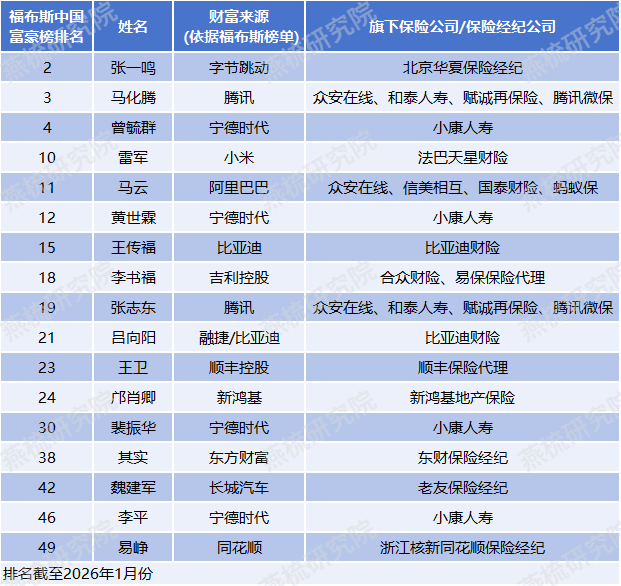
2026福布斯中国富豪榜揭晓,超三成头部富豪扎堆布局保险业
Jin Rong Jie· 2026-02-03 06:43
Core Insights - The Forbes China Rich List reveals that tech, new energy, and consumer sectors continue to lead, with many billionaires diversifying into the insurance industry, indicating its potential [1] - Over one-third of the top 50 billionaires have ventured into insurance, with 17 having established or invested in insurance companies or brokerage licenses [1][2] Group 1: Tech Giants' Insurance Strategies - Tencent has built a comprehensive insurance ecosystem through multiple platforms, including ZhongAn Online and WeChat Insurance, covering product development to sales [4] - Alibaba has also established a strong presence in insurance with entities like ZhongAn Online and Ant Insurance, simplifying the insurance purchasing process for users [4] - ByteDance, while entering the insurance space later, leverages its user base and algorithmic capabilities to create a unique competitive edge in the insurance market [4] Group 2: New Energy and Automotive Sector Involvement - New energy and automotive billionaires are increasingly participating in the insurance sector, aiming to create a full lifecycle management system from car sales to insurance services [5] - Companies like BYD and Geely have established their own insurance entities, integrating insurance with automotive services to enhance value [5] - The collaboration between insurance and the new energy sector is expected to open new growth opportunities, reflecting a long-term recognition of insurance's value [5] Group 3: Other Industries' Insurance Integration - Other industry billionaires are also penetrating the insurance market by integrating it with their core business scenarios, such as logistics and real estate [6] - SF Express has launched insurance products tailored to logistics, embedding insurance into its business model [6] - Real estate firms like New World Development are providing various insurance products to protect their assets, demonstrating a dual empowerment of their main business and insurance [6] Group 4: Trends in Insurance Industry - The insurance industry is becoming a standard for billionaires due to its stable cash flow and risk management capabilities, making it an attractive long-term investment [7] - The integration of insurance into various business ecosystems allows companies to enhance user engagement and reduce operational risks [7] - The ongoing trend of cross-industry collaboration is reshaping the competitive landscape of the insurance sector, pushing traditional insurers to accelerate digital transformation [7]




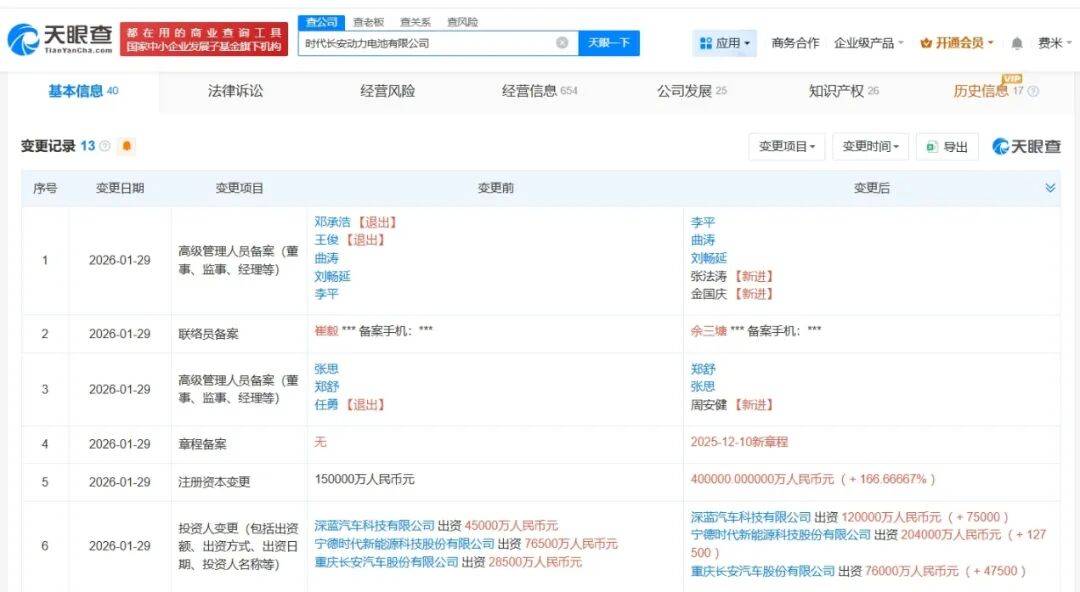
40亿注册资本落地!电池技术迭代前夕,时代长安如何卡位?
Sou Hu Cai Jing· 2026-02-03 06:26
时代长安动力电池有限公司成立于2023年6月,法定代表人为朱云峰,经营范围包括电池制造、电池销售、新兴能源技术研发、新材料技术研发等。股东 信息显示,该公司由宁德时代(300750)、深蓝汽车科技有限公司、长安汽车(000625)共同持股。 | 直关系 | 营风险 | 查公司 直去板 | 都在用的商业查询工具 | 大限宣 | න | 天殿一下 | 器应用 - | 时代长安动力电池有限公司 | 商务合作 企业级产品、 ★开通会员、■ 费米· | 国家中小企业发展了县全旗下机构 | | --- | --- | --- | --- | --- | --- | --- | --- | --- | --- | --- | | 法律诉讼 | 经营风险 | 历史信息 17 3 | 基本信息 40 | 经营信息 654 | 公司发展 26 | 知识产权 26 | | | | | | 变更记录 13 0 | 变更项目, | 变更时间, | 7天眼查 | 电 营品 | | | | | | | | 变更日期 | 变更前 | 变更后 | 序号 | 变量项目 | > | | | | | | | 邓承浩 【退出】 | 李平 | 王俊【唱 ...

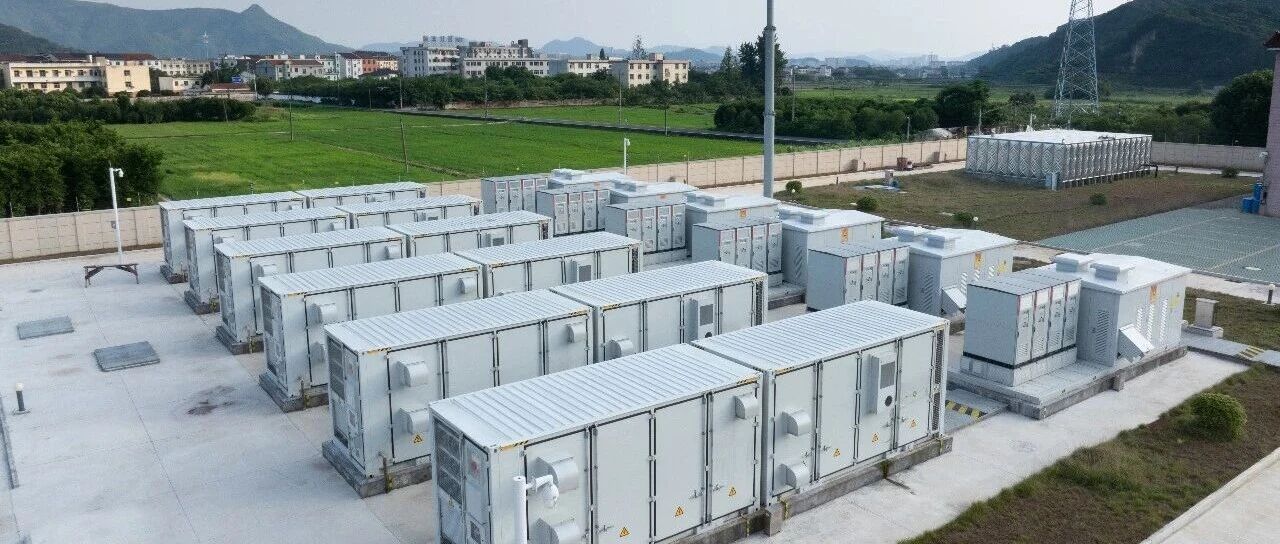
10GWh!宁德时代签欧洲储能大单
鑫椤储能· 2026-02-03 06:25
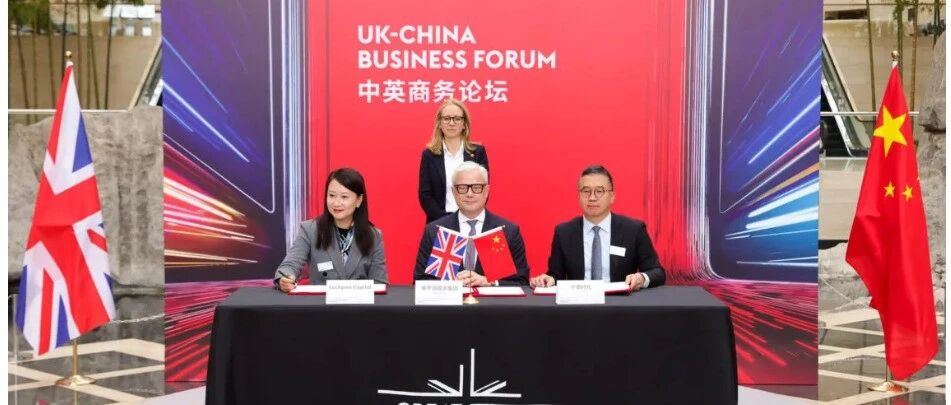
Core Viewpoint - The collaboration between Schroders Greencoat, CATL, and Lochpine Capital aims to explore, develop, and invest in battery storage projects in Europe, contributing to the region's transition to net-zero energy [1][2]. Group 1: Strategic Collaboration - The strategic memorandum signed by the three parties focuses on building an investment platform for battery storage systems in Europe, with CATL serving as the battery supplier [2]. - This partnership is part of a broader initiative led by Richard Alderfield, CEO of Schroders, to enhance business, trade, and investment ties between the UK and China [1]. Group 2: Market Potential and Capacity - The collaboration aims to develop renewable energy storage projects with a total capacity of up to 10 GWh, supporting Europe's net-zero energy transition [1]. - Schroders Greencoat manages approximately $111 billion in private market assets and has extensive experience in energy transition, managing around 450 renewable energy infrastructure assets with a total net generation capacity exceeding 7.7 GW [2]. Group 3: Investment Opportunities - The partnership is expected to provide investors with more opportunities to enter the energy storage sector, which is crucial for achieving net-zero emissions goals [2]. - Lochpine Capital's investment strategy focuses on global battery energy storage systems (BESS) and renewable energy solutions, including funds and platforms utilizing CATL's battery technology [2].
华能水电、宁德时代在昌都成立合资公司,注册资本48亿
Zhong Guo Neng Yuan Wang· 2026-02-03 06:12
天眼查App显示,近日,华能澜沧江(昌都)水电有限公司成立,法定代表人为李然,注册资本48亿人民 币,经营范围包括水力发电、供电业务、太阳能发电技术服务等。股权全景穿透图显示,该公司由华能 水电(600025)旗下华能澜沧江上游水电有限公司、宁德时代(300750)共同持股。 ...

华能澜沧江(昌都)水电有限公司成立,注册资本48亿
Xin Lang Cai Jing· 2026-02-03 06:04
Group 1 - Huaneng Lancang River (Changdu) Hydropower Co., Ltd. was established on February 2, with a registered capital of 4.8 billion RMB [1] - The company's business scope includes hydropower generation, power supply services, and solar power technology services [1] - The company is jointly owned by Huaneng Hydropower's upstream subsidiary and CATL [1]
超10GWh!宁德时代、远东股份又签储能大单
行家说储能· 2026-02-03 04:21
Group 1 - The energy storage industry has shown strong market vitality at the beginning of 2026, with significant developments including a strategic partnership between CATL, Schroders Greencoat, and Lochpine Capital to develop energy storage projects in Europe, targeting a total capacity of 10GWh [2][3][5] - The collaboration aims to create a complete closed loop of "technology + capital + projects," with CATL providing battery technology support, Schroders leveraging its asset management expertise in renewable energy, and Lochpine focusing on project development and fund operations [3][5] - CATL's order capacity for energy storage projects is projected to exceed 300GWh in 2025, making it the leading company in terms of annual order capacity in the energy storage sector [5] Group 2 - Far East Holdings announced it has won contracts totaling approximately 5.94 billion RMB for energy storage systems, with a year-on-year increase of 115.57% in contract orders exceeding 10 million RMB [6][7] - The contracts involve projects in both China and Europe, with specific amounts of 5.8 billion RMB and 14.32 million RMB for different contracts [6][7] - Far East Holdings expects to achieve profitability in 2025, with a projected net profit of 45 million to 65 million RMB, attributed to improvements in its "smart battery" business segment [7]