
CATL(300750)

Search documents
康迪科技与宁德时代旗下时代骐骥达成战略合作
Bei Jing Shang Bao· 2026-01-29 14:14
Core Viewpoint - Kandi Technologies Group announced a three-year strategic cooperation agreement between its wholly-owned subsidiary, Zhonghuan Electric (Zhejiang) Technology Co., Ltd., and Times Kijiji Green Energy Technology (Shenzhen) Co., Ltd. to focus on the mass production of heavy-duty electric vehicle battery swap stations [1] Group 1 - The partnership will involve comprehensive collaboration across the entire supply chain, including production, delivery, commissioning, and after-sales maintenance [1] - The collaboration aims to promote the large-scale development of the new energy vehicle charging market [1]


华为向宁德时代出售数字能源业务?双方均未正面回应
Nan Fang Du Shi Bao· 2026-01-29 12:13
Core Viewpoint - There are rumors regarding Huawei's digital energy business being sold, potentially to CATL and local state-owned enterprises, but no official confirmation has been provided [1][3][4] Group 1: Huawei's Digital Energy Business - Huawei's digital energy business is considered a key growth area, with projected revenue of 68.68 billion yuan in 2024, reflecting a 24.4% year-on-year increase [3] - The business has shown resilience against sanctions, maintaining a leading position in the global market for smart photovoltaic inverters for ten consecutive years [4] - Huawei has made significant investments in digital energy projects, including a 4 billion yuan investment in a headquarters for digital energy technology [4] Group 2: CATL's Strategic Needs - The rumors of CATL acquiring Huawei's digital energy business stem from its need to address competitive pressures in the energy storage industry and to fill gaps in its business model [7][9] - CATL holds a dominant position in the battery and energy cell market, with a 25% market share, but lacks a strong presence in the energy system integration sector [7] - The trend of "integrated solar and storage" is becoming crucial, and CATL risks falling behind if it does not enhance its system integration capabilities [8][9] Group 3: Market Dynamics - The energy storage market is experiencing rapid growth, with global energy storage cell shipments reaching 410.45 GWh in the first three quarters of 2025, a 98.5% increase [7] - Companies like Trina Solar and JinkoSolar are rapidly expanding their energy storage businesses, posing a challenge to current market leaders [8] - Huawei's digital energy business could provide CATL with the necessary technology and market access to enhance its competitive position in the integrated energy solutions market [9]
宁德时代与宿迁公交达成战略合作
Xin Lang Cai Jing· 2026-01-29 11:41
Core Insights - Suqian Public Transport Company has signed a strategic cooperation framework agreement with CATL to explore new models of "transportation + energy" integration [1] Group 1 - The collaboration will focus on the implementation of "Ningjia Service," vehicle-to-grid (V2G) technology applications, and vehicle aftermarket services [1]
2025Q4打新基金持仓和收益分析:未盈利新股显著增厚打新收益
GUOTAI HAITONG SECURITIES· 2026-01-29 11:07
Group 1: IPO Performance and Fund Analysis - In Q4 2025, the average first-day increase of new stocks reached 176%[10] - The median return for IPO funds in Q4 2025 was 0.45%[15] - A total of 297 IPO funds were analyzed, with total assets of 208.9 billion and net assets of 190.4 billion, remaining stable compared to Q3[10] Group 2: Contribution of Unprofitable IPOs - Six unprofitable IPOs were issued in 2025, contributing nearly 1% to the A2 account of a 500 million product[10] - The A2/B class accounts' new stock subscription returns were estimated at 14.98 million and 10.92 million respectively, with yield rates of 2.09% and 1.72%[10] Group 3: Fund Size and Sector Analysis - Funds with over 1 billion in assets performed better, with median returns of 1.19% for funds between 10-20 billion[15] - The top five sectors for IPO funds were electronics, non-ferrous metals, power equipment, non-bank financials, and communications, with significant reductions in non-ferrous metals[17] Group 4: Risk Factors - The report highlights risks associated with the pace and magnitude of new stock issuances not meeting expectations[44]





全球储能_超级工厂军备竞赛内幕_ Global Energy Storage_ Inside the gigafactory arms race
2026-01-29 10:59
Summary of Global Energy Storage and Battery Manufacturing Insights Industry Overview - The global energy storage and battery manufacturing industry is experiencing significant growth, driven by increasing demand for electric vehicles (EVs) and energy storage systems (ESS) [1][2][10]. Key Insights on Battery Demand and Supply - In 2025, battery demand growth outpaced supply growth, with total battery demand expanding to 592 GWh, a 58% increase, while supply from Tier 1 companies grew by 28% to 509 GWh [1]. - Global battery manufacturing capacity is projected to grow by 33% year-over-year in 2026, reaching 5.3 TWh, aligning closely with demand growth of 32% [2]. - Despite a perceived surplus of capacity (2.9 TWh) compared to projected demand (2.4 TWh) for 2026, excess supply is concentrated in lower-quality manufacturers in China [2]. Company-Specific Developments - CATL is set to expand its battery capacity by 70% over the next two years, with a forecasted capacity of 1.7 TWh by 2027, significantly outpacing other manufacturers [3][27]. - Other major players like BYD and LGES are expected to grow at lower rates of 17% and 14% CAGR, respectively [3][35]. - The U.S. is anticipated to surpass Europe as the second-largest battery manufacturing country by capacity, with a projected growth of 73% to 0.51 TWh by 2026 [4]. Battery Chemistry Trends - There is a notable shift towards lithium iron phosphate (LFP) batteries among both Chinese and non-Chinese producers, with higher nickel content batteries expected to grow at a CAGR of 29% from 2025 to 2028 [5]. - U.S. ESS capacity is projected to fall short of domestic demand by 2026, positioning manufacturers like LGES and Samsung SDI as key beneficiaries [5]. Market Share and Competitive Landscape - CATL maintains a dominant position, accounting for 43% of Tier 1 battery capacity in 2025, with expectations of maintaining or increasing market share due to aggressive capacity expansion [8]. - Tier 1 battery makers, including CATL, LGES, and BYD, accounted for 76% of global battery supply in 2025, although this is expected to decrease to 52% by 2030 [31]. Regional Capacity Growth - By 2027, China is expected to account for 75% of total global battery capacity, while the U.S. and Europe will see faster growth rates [10][15]. - The U.S. battery capacity is projected to grow at a CAGR of 56%, while Europe is expected to grow at 36% [15]. Investment Implications - CATL is identified as the top pick in the battery sector despite potential near-term margin pressures due to rising raw material costs [8]. - The overall capacity outlook for 2026-2030 has been revised upward by 8% compared to previous estimates, indicating a more optimistic view of the industry's growth potential [21]. Conclusion - The global battery manufacturing landscape is characterized by rapid growth, with CATL leading the charge in capacity expansion. The shift in battery chemistry and regional dynamics highlights the evolving nature of the industry, presenting both opportunities and challenges for investors and manufacturers alike.
大摩:予宁德时代目标价490港元 评级“增持”
Zhi Tong Cai Jing· 2026-01-29 09:15
摩根士丹利发布研报称,预期宁德时代(300750)(03750)股价将在未来15天内相对于行业平均水平上 涨,机率约70%至80%。对该股评级"增持",目标价490港元。大摩指,宁德时代近期股价已出现回 调,使短期估值更具吸引力。该行认为市场过度担忧成本通胀对公司利润率的压力,而这些成本终将转 嫁出去。宁德时代在前次锂价上行周期中已证明其成本转嫁能力,并预期其锂矿将于短期内恢复生产。 同时,公司2026年第一季仍保有充足的低成本库存。 ...
电池板块1月29日跌0.92%,骄成超声领跌,主力资金净流出39.27亿元
Zheng Xing Xing Ye Ri Bao· 2026-01-29 09:03
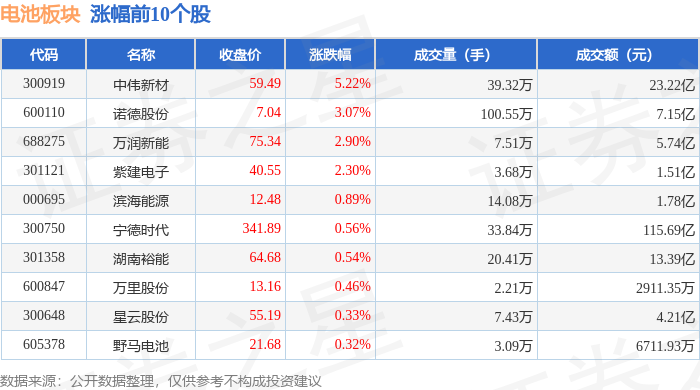
Market Overview - The battery sector experienced a decline of 0.92% compared to the previous trading day, with Jiao Cheng Ultrasonic leading the drop [1] - The Shanghai Composite Index closed at 4157.98, up 0.16%, while the Shenzhen Component Index closed at 14300.08, down 0.3% [1] Stock Performance - Notable gainers in the battery sector included: - Zhongwei New Materials: closed at 59.49, up 5.22% with a trading volume of 393,200 shares [1] - Nord Shares: closed at 7.04, up 3.07% with a trading volume of 1,005,500 shares [1] - Wanrun New Energy: closed at 75.34, up 2.90% with a trading volume of 75,100 shares [1] - Major decliners included: - Jiao Cheng Ultrasonic: closed at 141.00, down 7.54% with a trading volume of 30,300 shares [2] - Jin Yinhe: closed at 51.40, down 6.82% with a trading volume of 154,300 shares [2] - Daoshi Technology: closed at 29.91, down 5.94% with a trading volume of 758,300 shares [2] Capital Flow - The battery sector saw a net outflow of 3.927 billion yuan from institutional investors, while retail investors contributed a net inflow of 2.931 billion yuan [2][3] - Key stocks with significant capital flow included: - Ningde Times: net inflow of 16.9 million yuan from institutional investors, but a net outflow of 1.57 billion yuan from retail investors [3] - Nord Shares: net inflow of 1 billion yuan from institutional investors, with a net outflow of 46.646 million yuan from retail investors [3] - Wukuang New Energy: net inflow of 79.102 million yuan from institutional investors, with a net outflow of 1.2041 million yuan from retail investors [3]


康迪科技与宁德时代换电公司达成三年战略合作
Cai Jing Wang· 2026-01-29 09:00
Group 1 - Kandi Technologies has entered into a three-year strategic partnership with CATL's battery swapping company to jointly promote the mass production of heavy-duty truck battery swapping stations [1] - The collaboration will involve Kandi's wholly-owned subsidiary, Zhonghuan Electric (Zhejiang) Technology Co., Ltd., working closely with CATL's subsidiary, Times Qiji Green Energy Technology (Shenzhen) Co., Ltd., covering the entire supply chain from production and delivery to operational debugging and after-sales maintenance [1] - CATL has proposed the "Ten Thousand Stations Plan," aiming to establish a standardized battery swapping service network across the country, with plans to build 900 battery swapping stations for heavy-duty truck chassis solutions by 2026 [1]
深度丨超900万吨锁单背后:磷酸铁锂“卡位战”愈演愈烈,高端产能争夺白热化
证券时报· 2026-01-29 08:55
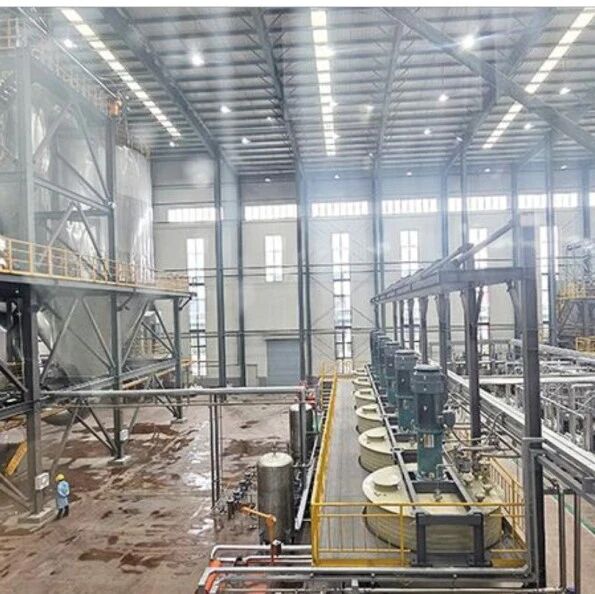
Core Viewpoint - The lithium battery industry is experiencing a strong recovery driven by explosive downstream demand, with a significant focus on long-term contracts between battery manufacturers and lithium iron phosphate (LFP) suppliers, indicating a shift towards value competition in the industry [3][5]. Group 1: Market Dynamics - The total disclosed sales contracts for lithium iron phosphate have reached 9.3694 million tons since last year, with many contracts extending to 2030 or beyond [3][6]. - Major contracts include a 305,000-ton agreement between CATL and Rongbai Technology, estimated at 120 billion yuan, highlighting the trend of long-term supply agreements [8]. - The industry is witnessing a structural imbalance, with severe overcapacity in low-end products while high-end products remain in short supply [4][18]. Group 2: Competitive Landscape - CATL has emerged as the largest buyer, signing contracts for over 7.5306 million tons of lithium iron phosphate since 2025, indicating a strong market position [8]. - Chuangneng New Energy has also made significant strides, securing a 130,000-ton order from Longpan Technology, making it the second-largest buyer after CATL [9]. - Hunan Youneng, previously a leading player, has not disclosed any long-term contracts recently, raising questions about its competitive strategy amidst the ongoing contract frenzy [10][12]. Group 3: Product Development and Innovation - The focus of long-term contracts is shifting towards high-pressure dense lithium iron phosphate products, which offer advantages in energy density and cycle life [15][16]. - The fourth-generation high-pressure dense lithium iron phosphate is expected to enhance battery performance significantly, with a projected energy density increase of 15%-20% compared to third-generation products [16]. - Companies like CATL and BYD are actively developing high-pressure dense lithium iron phosphate technologies to maintain competitive advantages in the market [17][19]. Group 4: Future Outlook - The global demand for lithium batteries is projected to grow significantly, with an expected increase in output from 186 GWh in 2020 to 3,540 GWh by 2030, indicating robust market growth [9]. - The industry is entering a new phase of expansion, with multiple companies announcing plans to increase production capacity for high-end lithium iron phosphate products [19]. - The competition for high-end lithium iron phosphate is intensifying, with companies needing to keep pace with rapid product iterations from battery manufacturers to avoid being left behind [19].



康迪科技与宁德时代旗下换电公司达成战略协议
Di Yi Cai Jing· 2026-01-29 08:09
Core Viewpoint - Kandi Technologies (KNDI.US) has entered into a three-year strategic partnership with CATL's battery swapping company to jointly promote the mass production of heavy-duty truck battery swapping stations [1] Group 1: Partnership Details - Kandi's wholly-owned subsidiary, Zhonghuan Electric (Zhejiang) Technology Co., Ltd., will collaborate closely with CATL's subsidiary, Times Kijiji Green Energy Technology (Shenzhen) Co., Ltd. [1] - The cooperation will cover the entire supply chain, including production manufacturing, delivery, debugging operations, and after-sales maintenance [1] Group 2: Strategic Plans - CATL has proposed the "Ten Thousand Station Plan," which aims to establish a standardized battery swapping service network across the country [1] - The heavy-duty truck battery swapping solution is planned to have 900 battery swapping stations completed by 2026 [1]