
CATL(300750)

Search documents
2025年固态电池市场回顾:从“概念狂飙”走向“产业落地”
鑫椤锂电· 2026-01-26 08:03
Core Viewpoint - The year 2025 is recognized as the "year of solid-state battery industrialization," marking a significant transition from experimental technology to mass production, reshaping the energy storage industry at an astonishing pace [1]. Group 1: Technological Breakthroughs and Capacity Implementation - In 2025, solid-state batteries achieved substantial breakthroughs in energy density and industrialization processes, with CATL's sulfide solid-state battery reaching an energy density of 500Wh/kg, and EVE Energy's first solid-state battery successfully rolling off the production line [3][4]. - Major companies like GAC Group and EVE Energy are establishing production lines for solid-state batteries, with GAC's line capable of producing batteries over 60Ah and EVE's Chengdu base being unveiled [3]. Group 2: Beneficiary Segments: Equipment and Materials - The demand for solid-state battery-specific equipment is surging due to the need for new manufacturing processes, leading equipment manufacturers like Xian Dai Intelligent and Winbond Technology to launch dedicated production lines [5]. - The solid-state battery industry is witnessing a critical period for pilot lines from 2025 to 2026, with equipment orders expected to be fulfilled ahead of schedule [5]. Group 3: Industry Development Anchors: Policies, Standards, and Leading Enterprises - Solid-state batteries are included in China's "New Energy Storage Manufacturing Industry High-Quality Development Action Plan," with support for R&D and pilot verification, while global competitors like the EU and the US are also accelerating their efforts [12]. - The first national standard for solid-state batteries is set to be published in September 2026, establishing China's leadership in the next generation of battery technology [13]. - Leading companies like CATL and BYD are planning to demonstrate small-scale production by 2027, indicating a strategic approach to validate technology feasibility [14]. Group 4: Future Application Rhythm: Gradual Penetration from Specialized to Mass Markets - From 2025 to 2027, solid-state batteries are expected to first penetrate specialized and high-end markets, including drones and high-end electric vehicles, which are sensitive to weight, safety, and energy density [16]. - Between 2027 and 2030, solid-state batteries will gradually enter high-end consumer and luxury electric vehicles, paving the way for broader market adoption [17]. - Post-2030, solid-state batteries are anticipated to flourish in mainstream passenger vehicles and general energy storage, leveraging cost control and supply chain scale effects [18]. Conclusion - The year 2025 marks a pivotal transition for solid-state batteries from "technically feasible" to "commercially visible," indicating a significant shift in the industry landscape [19][20].






全球首份动力电池循环经济研究报告发布 “全球能源循环计划”敲定行动路线图
Zhong Guo Qi Che Bao Wang· 2026-01-26 07:50
Core Insights - The report titled "Leading the Future of Circularity: Unlocking the Circular Economic Value of Power Batteries and Key Minerals" was released by the Ellen MacArthur Foundation during the World Economic Forum, providing an actionable roadmap for the circular development of global power batteries [1] - The report emphasizes the shift in the automotive industry value chain from a fuel-centric model to a material-centric model, highlighting the need for a systemic transformation towards a circular economy to reshape the battery value system and enhance economic value [1] Group 1: Leadership Actions - The report outlines five leadership actions aimed at providing practical and commercially viable strategic guidance for the industry [2] - Design for circularity by integrating easy disassembly, diagnostics, repairability, and remanufacturing into battery design to extend lifespan and improve recycling rates [2] - Optimize transportation and energy systems to reshape battery value, including enhancing charging infrastructure and shared mobility networks to alleviate range anxiety [2] - Promote scalable circular business models, such as Battery-as-a-Service (BaaS), to transform batteries into long-term operational assets for multiple cycles of use [2] - Co-invest and build regional circular infrastructure through joint investments and long-term collaborations to create efficient, stable, and traceable material flows [2] - Drive efficient operation of circular systems by promoting digital tools like battery passports to enhance transparency and streamline cross-border circulation [2] Group 2: Industry Response - The five leadership actions have received positive responses from the industry, with Volvo's global sustainability head highlighting the necessity of aligning electrification with circular economy principles to reduce systemic risks and ensure resource stability [3] - The company Ningde Times has already begun implementing the five leadership actions, establishing a complete circular closed-loop system that encompasses the entire lifecycle of battery research, material use, commercial application, recycling, and reuse [3]
【快讯】每日快讯(2026年1月26日)
乘联分会· 2026-01-26 07:40
Domestic News - The total number of motor vehicles in China reached 469 million, with 43.97 million being new energy vehicles [2] - Beijing's new energy vehicle ownership exceeded 1.3 million, with over 80% of vehicles meeting the "National V" emission standard [3] - FAW-Volkswagen plans to launch 13 new models in 2026, including 6 fuel vehicles and 7 new energy vehicles [4] - Ledao Auto aims to complete the investment of over 8,000 new battery packs within January, achieving a progress rate of 91.36% as of January 24 [5] - BAIC Blue Valley is investing 1.991 billion yuan to upgrade its Xiangjie Super Factory, with construction expected to start in March 2026 [6] - Chery has signed a strategic cooperation agreement with Yihaichuxing, delivering 5,000 new vehicles [7] - GAC Aion and Didi have partnered to deliver the Robotaxi R2, marking a significant step in autonomous vehicle commercialization [8] - CATL and Minyun Group have deepened their strategic cooperation to promote the electrification of public transportation [9] Foreign News - India and the EU have reached an agreement to significantly reduce automotive import tariffs, with tariffs on cars priced over €15,000 dropping from 110% to 40% immediately, and eventually to 10% [10] - The Philippines is projected to reach 491,395 vehicle sales in 2025, a 3.7% increase from 2024 [11] - The UAE is accelerating the commercialization of autonomous driving, with Abu Dhabi launching public autonomous operations and Dubai issuing its first autonomous driving test license [12] - Tesla has initiated a fully autonomous taxi service in Austin, Texas, without a safety driver present [13] Commercial Vehicles - Dongfeng Commercial Vehicle has launched the world's largest medium and heavy-duty commercial vehicle smart factory in Shiyan, Hubei [14] - CATL has released the first mass-produced sodium-ion battery for light commercial vehicles [15] - Yuchai has introduced the world's first flywheel range extender technology brand, marking a significant innovation in commercial power systems [16] - Henan Province has implemented 21 measures to support truck drivers, enhancing service quality and operational efficiency [17]


宁德时代高管解读轻商电动化:技术创新回归场景本质
Zhong Guo Jing Ying Bao· 2026-01-26 07:37
Core Insights - The company aims to make lithium-ion batteries more economical in the next 2 to 3 years, focusing on technological innovations that address real operational pain points in the new energy light commercial vehicle sector [1][4] - The electric logistics market, particularly intercity freight, presents a significant opportunity, with current electrification rates below 12% despite over 45% of light trucks being used for this purpose [1][2] Technological Innovations - The company has developed a hybrid battery system that balances energy density between lithium iron phosphate and ternary lithium batteries, achieving 800 km of real-world range while keeping cost increases minimal [2] - The newly launched sodium-ion battery, with a capacity of 45 kWh, retains over 92% usable capacity at -20°C and can be charged even after being frozen at -30°C, addressing low-temperature operation challenges [2][3] Market Opportunities - The domestic market for new energy light commercial vehicles is projected to exceed 900,000 units by 2026, indicating a major opportunity for large-scale electrification [4] - The company plans to establish 3,000 battery swap stations by the end of 2026, enhancing the infrastructure needed for electric logistics [5] Competitive Landscape - The competition in the new energy commercial vehicle battery market is intensifying, with second-tier battery manufacturers gaining market share as main manufacturers seek cost-effective solutions [6] - The company emphasizes value competition over price competition, focusing on transforming cutting-edge technology into practical, replicable solutions for users [6] Strategic Goals - The company aims to achieve cost parity between sodium-ion and lithium-ion batteries within 2 to 3 years, while also enhancing the energy density of sodium batteries to match current lithium iron phosphate levels [3] - The company is committed to providing a comprehensive value system for users, including battery health transparency and lifecycle management to enhance the resale value of electric vehicles [3][5]
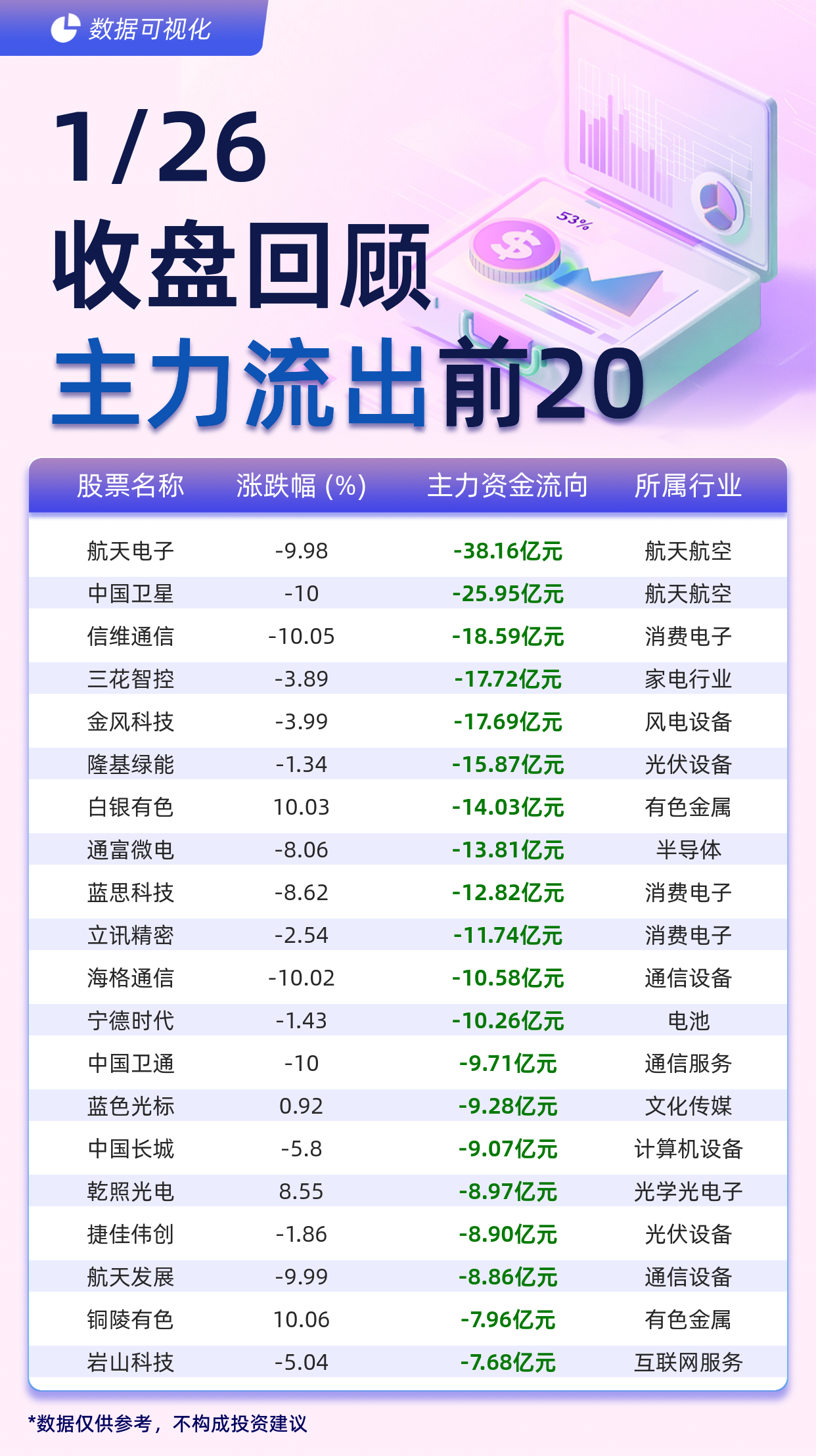
主力个股资金流出前20:航天电子流出38.16亿元、中国卫星流出25.95亿元
Jin Rong Jie· 2026-01-26 07:37
Core Viewpoint - The data indicates significant outflows of main funds from various stocks, particularly in the aerospace and consumer electronics sectors, reflecting a bearish sentiment among investors. Group 1: Stock Performance and Fund Flow - Aerospace stocks, such as Aerospace Electronics and China Satellite, experienced the largest fund outflows, with -38.16 billion and -25.95 billion respectively, and declines of -9.98% and -10% in their stock prices [1][2] - Other notable stocks with significant outflows include Xinwei Communication (-18.59 billion, -10.05%), Sanhua Intelligent Control (-17.72 billion, -3.89%), and Goldwind Technology (-17.69 billion, -3.99%) [1][2] - The outflow from Longi Green Energy was -15.87 billion with a stock price decrease of -1.34%, indicating a relatively smaller decline compared to others in the same sector [1][2] Group 2: Sector Analysis - The consumer electronics sector saw major outflows, particularly from companies like Xinwei Communication and Lens Technology, with outflows of -18.59 billion and -12.82 billion respectively [1][2] - The wind power equipment sector, represented by Goldwind Technology, also faced significant outflows, reflecting potential challenges in the renewable energy market [1][2] - The communication equipment sector, including companies like Haige Communication and China Satellite, showed substantial fund outflows, indicating investor caution in this area [1][3]



107只个股获机构控盘超10%,科技医药板块成资金“蓄水池”
Huan Qiu Wang· 2026-01-26 07:16
Core Insights - The report highlights the significant presence of public funds in the stock market, with 2,977 stocks appearing in fund heavy positions as of the end of Q4 last year, indicating a clear trend in institutional investment strategies [1] - A total of 107 stocks have a fund holding ratio exceeding 10%, showcasing the high influence and control of institutional funds over these stocks [1] Group 1: Fund Holdings and Stock Performance - Among the 107 stocks with over 10% fund holdings, 56 saw increased investments in Q4, with notable increases in holdings for ShenGong Co., Tianhua New Energy, and Maiwei Co., with increases of 59,020.96%, 15,808.35%, and 959.13% respectively, indicating strong institutional confidence in their fundamentals [2] - Conversely, 48 stocks experienced reductions in fund holdings, with notable decreases for Nuocheng Jianhua-U, Kaiter Co., and Keda Li, with reductions of 43.91%, 41.04%, and 39.95% respectively [2] - Three new stocks entered the heavy holding category, with Baiao Saitu, Litong Technology, and Xingtou Measurement Control having fund holding ratios of 21.55%, 12.60%, and 10.03% respectively [2] Group 2: Institutional Investment Trends - The phenomenon of institutional clustering remains significant, with over 100 funds holding 42 of the 107 stocks, and 29 stocks held by 50 to 99 funds, indicating a strong consensus among institutional investors [4] - Notably, Ningde Times, despite a holding ratio of 11.63%, has the highest number of fund holders at 2,056, followed by Zhongji Xuchuang, Zijin Mining, and Xinyi with over 1,300 fund holders each [4] - The stocks with high fund holdings are predominantly in the "hard technology" and "innovation" sectors, with 42 from the Sci-Tech Innovation Board, 27 from the Growth Enterprise Market, and 31 from the Shanghai and Shenzhen main boards, reflecting a focus on growth sectors [4] Group 3: Performance Expectations - Among the 107 stocks, 26 have released performance forecasts for 2025, with 18 expecting profit increases, 4 expecting declines, and 2 forecasting losses, indicating a generally positive outlook [5] - The highest expected profit growth is for Baiwei Storage at 473.71%, followed by Changxin Bochuang and Baiao Saitu with expected growths of 378.70% and 303.57% respectively, providing strong support for long-term fund holdings [5] - The concentration of fund holdings in the electronics and biopharmaceutical sectors suggests an increased market expectation for technological innovation and consumer recovery [5]




大摩、小摩、贝莱德等9大外资公募最新持仓曝光!CPO龙头均被重仓!
私募排排网· 2026-01-26 06:59
Group 1 - The core focus of the article is on the investment strategies and stock holdings of nine major foreign public funds, highlighting a strong consensus on AI and technology sectors throughout 2025 [3][4][9] - Morgan Stanley's fund has a significant focus on AI, with its top holdings showing an average increase of 138.03% in 2025, indicating a robust performance in the AI sector [7][8] - Morgan Chase Fund's total asset size reached 240.57 billion, with a notable increase in holdings in non-ferrous metals and a reduction in holdings of CATL [4][6] Group 2 - Morgan Chase's top three holdings include CATL, Zhongji Xuchuang, and Xinyi Technology, with respective annual growth rates of 42.02%, 396.38%, and 424.03% [4][6] - Morgan Stanley's first major holding is Zhongji Xuchuang, with a market value of 569 million, reflecting a significant increase in the AI sector [7][8] - Manulife Fund's top three holdings are Xinyi Technology, Zhongji Xuchuang, and Yuanjie Technology, all showing annual growth rates exceeding 300% [9][10] Group 3 - BlackRock Fund has shifted its focus by reducing bank stocks and significantly increasing its holdings in Baosteel and China Ping An [12][13] - The top holding of BlackRock is CATL, with a market value of approximately 185 million, showing a slight reduction compared to the previous quarter [13] - The article notes that the overall performance of the top twenty holdings across various funds has been strong, with many stocks showing significant growth [12][13] Group 4 - The article mentions that the Schroders, Allianz, and Legg Mason funds have also revealed their holdings, with respective asset sizes of 3.76 billion, 503 million, and 408 million [21][22] - Allianz Fund, being a new entrant, holds 18 stocks with a total market value of approximately 231 million [22] - The article emphasizes the ongoing trend of foreign funds focusing on technology and AI sectors, indicating a long-term investment strategy [19][21]

国泰海通:锂电材料价格环节迎来上涨 26年需求周期有望开启
智通财经网· 2026-01-26 06:20
Core Viewpoint - The report from Guotai Junan highlights the significant growth in global energy storage battery shipments, projecting a total of 640 GWh in 2025, which represents an 82.9% year-on-year increase. Domestic manufacturers are expected to ship 621.5 GWh, also reflecting an 82.8% growth, while overseas shipments are anticipated to reach 18.5 GWh, marking an 85% increase [1][2]. Group 1: New Energy Vehicles and Energy Storage - The global sales of new energy vehicles (NEVs) are projected to reach 23.54 million units in 2025, a 29.1% increase year-on-year, with China accounting for 70.3% of the total sales. Sales in Europe and the US are expected to be 3.77 million and 1.6 million units, respectively, showing growth rates of 30.5% and 1.72% [1]. - For energy storage, the forecast for 2026 indicates that global shipments of energy storage batteries could reach 1,090 GWh, representing a 70% year-on-year increase [2]. Group 2: Price Trends and Material Supply - Starting from June 2025, a tightening supply-demand situation for domestic energy storage cells has initiated a price increase cycle, with prices for lithium hexafluorophosphate and lithium carbonate rising since September. The underlying logic for these price increases is driven by supply-demand dynamics, where strong downstream demand leads to improved profitability in the materials sector [3]. - The lithium battery industry is experiencing an improved supply-demand balance, with major battery manufacturers like CATL ramping up production. However, the materials sector faces significant financial pressures due to high debt levels and the need for capital turnover amidst new capacity releases [3]. Group 3: Future Demand and Policy Support - The demand cycle for 2026 is expected to be bolstered by continued domestic policies such as trade agreements in Europe and China, as well as the reintroduction of electric vehicle purchase subsidies in Germany. The Chinese market is projected to see a 94% year-on-year increase in new energy storage orders and collaborations, reaching 35.3 GWh in 2025 [4]. - The updated export tax rebate policy for battery products, effective from January 2026, is anticipated to advance overseas demand for new energy products [4]. Group 4: Investment Recommendations - The report suggests focusing on lithium-related materials such as lithium iron phosphate, lithium carbonate, and lithium hexafluorophosphate, as well as heavy asset-related sectors like separators. Recommended stocks include Shengxin Lithium Energy (002240.SZ) and others in the lithium materials sector [5]. - Additionally, leading battery manufacturers with strong pricing power and supply-demand imbalances are highlighted, with recommendations for stocks like CATL (300750.SZ) and others [5].





动力锂电:告别过剩思想,拥抱锂电材料大周期
GUOTAI HAITONG SECURITIES· 2026-01-26 04:35
Investment Rating - The report assigns an "Overweight" rating for the lithium battery materials industry [1] Core Insights - The report emphasizes the shift away from excess supply mentality, highlighting the potential for non-linear profit growth among leading companies in the lithium battery materials sector due to rigid supply against continuously growing demand [3][4] - It suggests a focus on lithium-related materials such as lithium iron phosphate, lithium carbonate, hexafluorophosphate, and aluminum foil, while also considering heavy asset-related materials like separators [4] - The report forecasts significant growth in the electric vehicle (EV) market and explosive growth in energy storage, with global EV sales expected to reach 23.54 million units in 2025, a 29.1% increase year-on-year [4] - It notes that the energy storage battery shipments are projected to reach 640 GWh in 2025, marking an 82.9% year-on-year growth [4] - The report anticipates a demand cycle to commence in 2026, supported by favorable domestic and international policies [4] Summary by Sections Investment Recommendations - The report recommends focusing on leading companies in the lithium battery materials sector, including 盛新锂能 (Shengxin Lithium Energy), 湖南裕能 (Hunan Youneng), 天赐材料 (Tianci Materials), and others, while also highlighting battery leaders like 宁德时代 (CATL) and 亿纬锂能 (EVE Energy) [4][7] Market Data - The report provides operational data for several listed companies in the lithium battery sector, indicating varying levels of profitability and cash flow, with 宁德时代 (CATL) showing a net profit of 49 million in Q3 2025 and a debt-to-asset ratio of 61% [6] - It includes a table summarizing earnings per share (EPS) and price-to-earnings (PE) ratios for key companies, with 宁德时代 (CATL) having an EPS of 14.90 for 2025E and a PE ratio of 23.29 [7]

储能电池:2025 财年出货量约 640GWh,同比增 90%;12 月出货量回顾-ESS Battery_ ~640Gwh FY25 shipment, _90% y_y; December shipment review
2026-01-26 02:50
Summary of ESS Battery Industry Conference Call Industry Overview - **Global ESS Battery Demand**: The demand for Energy Storage Systems (ESS) batteries is projected to accelerate significantly, with shipments expected to reach approximately 640 GWh in FY25, reflecting a year-over-year growth of over 90% [2][5][37]. - **China's Role**: China's domestic demand is a primary growth driver, with shipments surging over 100% year-over-year in 4Q25 due to supportive policies [2][11]. The country accounts for about 97% of global ESS battery supply [41]. Key Insights - **December Shipment Performance**: December 2025 shipments were robust at 85 GWh, marking a 34% month-over-month increase and a 90% year-over-year increase [2][21]. - **Future Projections**: The base case model anticipates global ESS battery shipments to grow over 40% to around 900 GWh in 2026, driven by policy support from China and strong order momentum from Europe [3][37]. - **Policy Changes**: China's Ministry of Finance announced a reduction in VAT export rebates from 9% to 6% starting April 2026, which is expected to optimize capacity structure and reduce market involution, benefiting leading players like CATL [2]. Company Highlights - **CATL**: As the largest ESS battery maker globally, CATL is well-positioned to gain market share with new capacity releases. It is projected that ESS will account for 20% of CATL's total battery production volume in FY26 [12][14][109]. - **Sungrow**: Recognized as the largest solar inverter producer, Sungrow is expected to benefit from rising ESS demand, particularly in emerging markets [4][12]. - **LGES**: LG Energy Solution is well-positioned to capture growth in the US ESS market, having commenced production of LFP ESS batteries in Michigan [12][14]. - **BYD**: ESS accounts for 17% of BYD's total battery production volume in FY25, indicating a growing focus on this segment [106]. Market Dynamics - **Export Trends**: Chinese ESS battery exports to the US saw a significant increase of 126% year-over-year in FY25, driven by rush purchases ahead of tariff hikes [48]. However, shipments to the US slowed to 9% year-over-year in 4Q25 due to tariff shifts [13]. - **Price Trends**: ESS battery prices from Chinese manufacturers increased by 1-2% in 4Q25, following a rebound of 5-10% earlier in the year [13][100]. Competitive Landscape - **Market Share**: CATL's global market share fell by 10 percentage points in FY25 due to capacity constraints, while competitors like Hithium and BYD gained market share [72][99]. CATL holds nearly 50% of the US market share and about 20% in the EU [50]. - **Emerging Competitors**: Companies like Gotion and Narada are gaining traction in the telecom ESS market, with Gotion achieving a 5 percentage point market share increase [99]. Conclusion The ESS battery market is poised for substantial growth, driven by strong demand in both domestic and international markets, particularly in China and the US. Leading companies like CATL, Sungrow, and LGES are well-positioned to capitalize on these trends, although they face increasing competition and market dynamics that could impact their market shares.
