ASML Holding(ASML)

Search documents
每经热评|英伟达不甘心,阿斯麦不安心 安世中国不屈服
Mei Ri Jing Ji Xin Wen· 2025-10-27 14:18
Group 1: Nvidia's Challenges - Nvidia's CEO expressed regret over losing access to the Chinese market, stating that U.S. policies have led to a significant decline in their market share from 95% to 0% in AI chips [3][4] - Nvidia's revenue from the Chinese market dropped to $2.769 billion in Q2 2026, a decrease of nearly $900 million compared to the same period in 2025 [4] - The company faces increasing competition from domestic Chinese firms, particularly from Cambrian, which reported a 1332.52% year-on-year revenue increase in Q3 2025 [4][6] Group 2: ASML's Market Position - ASML reported that its sales in the Chinese market reached a record high of 42% in Q3 2025, but the CEO anticipates a significant decline in 2026 [5][6] - ASML's reliance on DUV lithography machines, which account for 70% of its revenue in China, poses a risk due to U.S. export restrictions [6] - The company is experiencing a shift in the Chinese semiconductor landscape, with local firms making significant advancements in technology [7] Group 3: Nexperia's Resistance - Nexperia, a subsidiary of China's Wingtech Technology, is facing severe restrictions due to U.S. export controls, which have led to asset freezes and management changes imposed by the Dutch government [8][9] - The company has publicly condemned the Dutch government's actions and is pursuing legal recourse, emphasizing its commitment to operate within Chinese laws [9][10] - Nexperia's strong local production capabilities, accounting for 70% of the group's output, provide it with a competitive edge in the face of geopolitical challenges [10]


纳米压印光刻_别再说它会取代极紫外光刻(EUV)了-Nanoimprint Lithography_ Stop Saying It Will Replace EUV
2025-10-27 12:06
Summary of Nanoimprint Lithography Conference Call Industry Overview - The discussion centers around the **Nanoimprint Lithography (NIL)** technology and its comparison with **Extreme Ultraviolet Lithography (EUV)**, particularly focusing on Canon's developments in this area [1][3][5]. Core Points and Arguments - **NIL vs. EUV**: There is a recurring narrative that NIL will disrupt EUV technology, but this is deemed misleading. NIL has valid applications but cannot match EUV's capabilities in practice [5][6]. - **NIL Basics**: NIL uses a patterned stamp to imprint designs onto resin, which is a different approach compared to traditional photolithography [6][15]. - **Market Players**: Canon is the only advanced commercial player in NIL, having acquired Molecular Imprints Inc. in 2014. Other competitors like Prinano and Nanonex are less mature [9][13][14]. - **Tool Architecture**: Canon's NIL tool, referred to as "J-FIL," is noted for its advanced capabilities, including high precision and the ability to perform alignment metrology during patterning [34][38]. Key Challenges - **Mask Lifetime**: The durability of NIL masks is a significant issue, with current estimates suggesting a lifespan of about 50 wafers, compared to over 100,000 for photolithography masks. This raises concerns about defectivity and inspection costs [49][50]. - **Defectivity**: High defect rates in NIL processes have been reported by potential customers like Kioxia and Micron, indicating that NIL is not yet ready for advanced chip production [62][63]. - **Overlay Issues**: The alignment of patterns on wafers is currently inadequate, with overlay errors being four times larger than desired. This is a critical factor for achieving nanometer-level precision [54][58]. Potential Applications - Despite challenges, NIL may find success in specific applications that require complex 3D patterns and have high fault tolerance, such as: - **Bit Patterned Media**: A method for HDD production that could improve density and performance [68]. - **MEMS Devices**: Certain designs in this category could benefit from NIL's capabilities [68]. - **AR/VR Metalenses**: These lenses require small, complex structures and are relatively defect-tolerant, making them a promising application for NIL [68]. Export Controls - The technology is subject to U.S. export controls, which may limit its deployment in advanced chip manufacturing, particularly in China. This creates a potential gap in the market for companies like SMIC or Huawei to explore NIL technology [65][66]. Conclusion - The consensus is that while NIL has theoretical advantages over EUV, practical challenges such as mask durability, defectivity, and overlay precision hinder its current viability for advanced semiconductor manufacturing. However, there are niche applications where NIL could succeed, providing a potential revenue stream for Canon [63][68].
How Investing Has Changed in the Last 5 Years
Yahoo Finance· 2025-10-27 11:39
Group 1: Meme Stocks and Market Dynamics - Heavily shorted stocks have outperformed the market four to one over the past five years, raising questions about whether this trend represents a meme bubble or a new investment paradigm [1] - The rise of meme stocks has complicated long-term investing strategies, as non-fundamental factors can drive stock prices significantly higher in a short time [3][4] - Companies like GameStop and AMC illustrate the dual nature of meme stocks, where initial value can be overshadowed by speculative trading, leading to varying outcomes for their business models [5][6] Group 2: Investment Strategies and Profit-Taking - Investors face challenges in deciding when to take profits from rapidly appreciating meme stocks, balancing short-term gains against long-term potential [8][9] - Management's response to increased stock prices is crucial; companies that capitalize on high valuations to raise capital can strengthen their business models [10][11] - The example of Rocket Lab demonstrates how a company can maintain focus on long-term goals despite significant stock price fluctuations [11] Group 3: Semiconductor Industry Insights - TSMC reported a 40% revenue increase in the most recent quarter, indicating strong demand for chips, while ASML's growth appears more constrained due to production capacity limitations [13][19] - Concerns about geopolitical risks affecting TSMC's operations highlight the complexities of investing in companies reliant on specific regions [20][21] Group 4: Banking Sector Analysis - Recent bank earnings reports revealed underlying issues, with concerns about potential hidden risks in consumer credit and auto loans, particularly in a high-interest rate environment [22][23] - The banking sector's health remains a focal point, with analysts noting that while current conditions are stable, there are signs of increasing caution among investors [22] Group 5: AI and Technology Developments - Google's announcement regarding its Gemini model for understanding human cell language represents a significant potential advancement in drug discovery, although the practical application remains uncertain [49][50] - The use of AI in healthcare could reduce costs and improve success rates in drug trials, but the transition from model predictions to clinical validation will take time [51][52] Group 6: Stock Picks and Market Trends - Booz Allen Hamilton is viewed as a long-term investment opportunity despite current headwinds, with a focus on government contracts and IT services [55] - Sterling Infrastructure is positioned to benefit from the growing demand for data centers, reflecting the broader trend of increased investment in technology infrastructure [56]


ASML: I'm Selling 60% After A Beautiful Trade
Seeking Alpha· 2025-10-27 09:59
Core Insights - ASML Holdings is currently viewed positively, with a "strong buy" rating noted in a previous analysis from March 29, 2025, indicating strong investor confidence in the stock's performance [1] Company Analysis - The stock of ASML was noted to be in a grinding process, suggesting a period of steady performance or gradual price movement [1] - The company is part of a broader market analysis strategy that has been developed over more than two decades, indicating a well-established approach to investment and trading [1] Market Context - The analysis reflects a comprehensive understanding of various asset classes, which may provide insights into ASML's positioning within the semiconductor industry [1]

3 Artificial Intelligence Stocks to Buy and Hold Through 2035
Yahoo Finance· 2025-10-27 09:45
Group 1: Nvidia - Nvidia holds a remarkable 94% market share in the GPU market, which is essential for AI infrastructure [3] - The company's competitive advantage stems from its CUDA software platform, which facilitates programming for its chips beyond their original graphics rendering purpose [4] - Nvidia strategically introduced CUDA in universities and research labs, leading to foundational AI code being developed on its platform, creating a strong dependency among developers [5] - The company developed NVLink, a proprietary interconnect system that enhances chip performance by allowing them to function as a single unit, and its acquisition of Mellanox has expanded its networking capabilities [6] - With increasing AI infrastructure spending anticipated over the next decade, Nvidia is well-positioned for significant growth [7] Group 2: ASML - ASML possesses a monopoly on extreme ultraviolet lithography (EUV), a critical technology for manufacturing advanced chips, which are vital for AI and smartphone applications [8] - The semiconductor equipment manufacturing sector can experience volatility, but ASML is expected to see robust growth over the next decade due to the rising demand for advanced chips and the introduction of high numerical aperture (high-NA) EUV technology [9] - ASML's unique position in the market underscores its importance to the semiconductor industry and its role in supporting companies like Nvidia [10]
3 Unstoppable Artificial Intelligence (AI) Stocks to Buy Right Now
The Motley Fool· 2025-10-27 08:20
Core Insights - The article highlights three companies that present strong investment opportunities despite rising valuations in the AI sector [1][2] Company Summaries Amazon - Amazon's cloud computing division, Amazon Web Services (AWS), is experiencing significant growth, with AI services becoming a multibillion-dollar business growing at triple-digit rates year over year [5][8] - AWS revenue grew 17% year over year last quarter, although some analysts express concerns about its growth rate compared to competitors [5] - The company is investing heavily in AI infrastructure, with capital expenditures expected to exceed $100 billion this year, impacting free cash flow, which fell to $18.2 billion from $53 billion in the previous year [7] - Amazon's retail operations are also thriving, with North America operating margin increasing by 190 basis points to 7.5% and international margin expanding by 290 basis points to 3.4% [8] EPAM Systems - EPAM Systems focuses on platform and application engineering and has restructured its workforce to mitigate risks from political turmoil in Belarus, Russia, and Ukraine [9][10] - The company has seen a turnaround with 18% year-over-year revenue growth in the second quarter, marking the third consecutive quarter of sequential growth [11] - EPAM is positioned to benefit from the rising demand for AI services, with expectations of 13% to 15% growth for the full year [11][12] - The stock is trading at 12.5 times analysts' estimates for 2026 earnings, indicating it is undervalued [12] ASML - ASML manufactures essential equipment for advanced semiconductor production, crucial for AI applications [14] - The company has strong demand for its extreme ultraviolet (EUV) machines, with management expecting 2026 sales to exceed 2025 levels despite challenges in the Chinese market [15][19] - ASML's stock trades at around 34 times 2026 earnings expectations, reflecting its long-term growth potential in the semiconductor industry [19]


欧洲科技股业绩“碾压”预期,AI浪潮成最强引擎
智通财经网· 2025-10-27 07:05
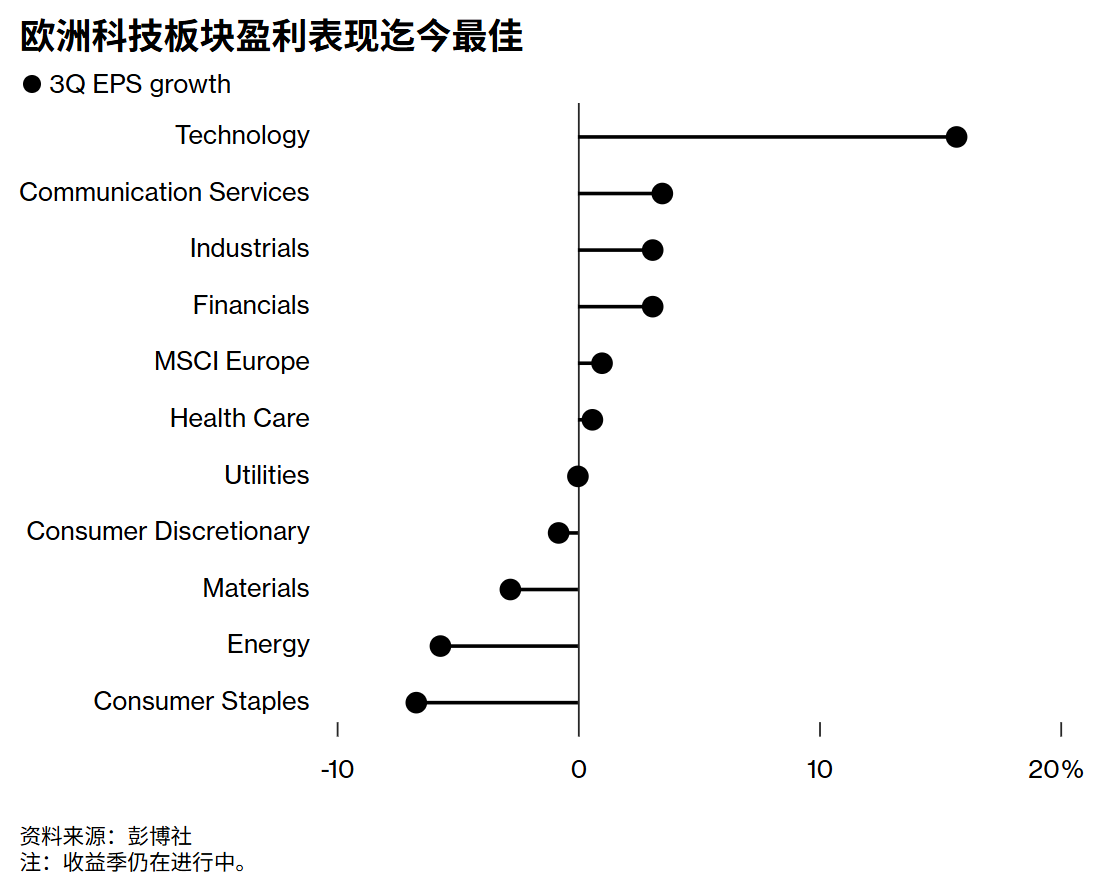
Group 1: Core Insights - The expansion of artificial intelligence (AI) investments is reshaping the European technology landscape, with companies reporting third-quarter earnings significantly exceeding market expectations [1] - The MSCI Europe Technology Index shows a 16% year-over-year increase in earnings per share for its constituents, with over 86% of the reported earnings surpassing the previous quarter's expected growth of 4.2% [1] Group 2: Company Performance - ASML, a leading semiconductor equipment manufacturer, reported a substantial increase in orders due to accelerated AI infrastructure spending, alleviating market concerns about an economic slowdown [3] - BE Semiconductor Industries NV also exceeded expectations in orders and profits, driven by AI-related demand in Asia [3] - SAP SE provided a mixed outlook for its core cloud business but reassured investors with discussions on the growing application of AI, emphasizing its role as a key growth enabler [3] - Ericsson's profit surged due to the divestment of its call routing business, while Nokia's third-quarter profits exceeded expectations, primarily benefiting from AI and cloud customer demand [3] Group 3: Market Trends - Analysts believe that the AI supercycle is driving demand for fiber access, data center connectivity, and transmission networks, improving Nokia's sales outlook, with the U.S. market emerging as a key growth area [4] - The market's bullish sentiment towards AI is spilling over into Europe, leading to upward revisions in earnings expectations for companies directly benefiting from AI infrastructure investments [4] Group 4: Challenges and Outlook - European tech giants face supply chain challenges due to escalating U.S.-China trade tensions, which have disrupted the semiconductor supply chain and worsened the operating environment [8] - Companies like STMicroelectronics and Texas Instruments indicated that automotive and industrial customers are delaying orders, with potential impacts from the Dutch government's takeover of the Chinese chipmaker Nexperia [8] - Despite these challenges, AI is still viewed as a core driver of long-term growth, with expectations that announced AI chip deals will gradually penetrate the supply chain and convert into actual orders, sustaining growth momentum beyond 2026 [8]


阿斯麦公司前CEO承认把中国逼上了自主道路,最终将反噬自身
Sou Hu Cai Jing· 2025-10-27 01:40
Core Viewpoint - The article discusses the critical role of ASML's extreme ultraviolet (EUV) lithography machines in the global semiconductor industry and highlights China's response to technology restrictions by accelerating its own innovation efforts [1][3][9]. Group 1: Technology Restrictions and Responses - The U.S. government pressured the Dutch government to prevent ASML from selling advanced EUV machines to China, leading to increasing sanctions over the years [3]. - By 2024, ASML's CFO indicated that advanced lithography machines for 7nm processes and above were no longer sold to China, with the first second-generation lithography machine sold to Intel in 2025 [3][5]. - ASML's CEO noted that completely excluding China from the technology landscape is impossible due to its vast talent pool [3][9]. Group 2: China's Innovations in Lithography - Despite technology restrictions, China has made significant advancements in lithography technology, with Shanghai Micro Electronics being the only domestic company capable of producing high-end lithography machines [5]. - The Chinese Academy of Sciences announced a breakthrough in all-solid-state deep ultraviolet light source technology, which is smaller and more energy-efficient, theoretically suitable for 3nm chip manufacturing [5]. - Companies like Jingrui Materials and Nanda Optoelectronics have developed photoresists suitable for 7nm processes, demonstrating progress in critical components [5]. Group 3: Market Growth and Future Trends - The demand for lithography machines in China is expected to grow rapidly, with the market projected to exceed 60 billion yuan by 2025 and an annual compound growth rate of over 30% [7]. - The competition in the lithography sector between China and the U.S. will focus on domestic substitution and achieving breakthroughs in advanced processes [7]. - China's initiatives, including the "Belt and Road" strategy, may help establish a more independent semiconductor ecosystem by promoting mid-to-low-end production capabilities [7].

EUV很难被颠覆,纳米压印也不行
半导体行业观察· 2025-10-27 00:51
Core Viewpoint - The article discusses the potential of Nano Imprint Lithography (NIL) technology as a competitor to Extreme Ultraviolet (EUV) lithography, highlighting its theoretical advantages but also significant practical challenges that hinder its adoption in advanced semiconductor manufacturing [2][30]. Group 1: NIL Technology Overview - NIL technology uses patterned "stamps" to imprint designs onto resin, aiming to transfer patterns from masks to wafers, similar to ASML's lithography technology [3]. - The most promising NIL technology was invented in 1996 and commercialized in 2001 as Molecular Imprints Inc. (MII), later acquired by Canon in 2014 [5]. - Canon positions NIL as the next-generation patterning technology following DUV, claiming it to be the only technology that can surpass KrF scanners [8]. Group 2: NIL Process and Mechanism - Canon's NIL process, termed "J-FIL," involves applying photoresist, imprinting with a mask, and curing with ultraviolet light, optimizing the coating process to enhance throughput [9][11]. - The imprinting process is designed to minimize defects and improve efficiency, with a total cycle time of approximately 1.3 seconds per wafer [28]. Group 3: Comparison with EUV - Theoretically, NIL can achieve higher resolution than EUV, with significant cost and power consumption advantages, as NIL's operational power is claimed to be reduced by 90% compared to EUV [30]. - Despite these advantages, the industry is cautious about adopting NIL due to unresolved practical challenges [30]. Group 4: Key Challenges - The lifespan of NIL masks is a critical issue, with current estimates suggesting they can only be used for about 50 wafers, compared to over 100,000 for traditional lithography masks [32]. - Overlay accuracy and the ability to align printed patterns with existing layers on the wafer present significant technical hurdles [34]. - Customer feedback indicates that NIL technology is not yet ready for advanced chip manufacturing, with concerns about resolution limits and mask roughness affecting performance [37].

Top 10 Buzzing Stocks to Watch as Analysts Predict AI-Led Bull Market Will Continue
Insider Monkey· 2025-10-26 16:31
Group 1: Market Overview - Analysts believe the AI-led bull market has potential for further growth, supported by catalysts such as the Fed's rate cuts and strong earnings from major companies [1][2] - The current bull market is primarily driven by tech companies with strong profits, indicating that it is not in a bubble phase [1][2] Group 2: Company Insights - Adtran Holdings Inc (NASDAQ:ADTN) is highlighted as a promising small-cap stock, particularly in the rural broadband buildout sector, with expectations of increased investment [6] - Badger Meter Inc (NYSE:BMI) has shown a revenue compound annual growth rate of 14% over the last five years, driven by technological advancements in water metering solutions [8] - Generac Holdings Inc (NYSE:GNRC) is favored for its backup power generation products, with anticipated growth due to increasing demand in data centers [9][10] - ASML Holding NV (NASDAQ:ASML) is recognized as a critical player in the semiconductor industry, providing essential lithography machines for advanced chip fabrication [11][13] - Snowflake Inc (NYSE:SNOW) is positioned as a leader in data infrastructure, benefiting from the integration of AI-driven insights, although caution is advised regarding its long-term evolution [16]