
BABA(BABA)

Search documents
阿里巴巴-W:FY2026Q3业绩前瞻:闪购投入延续加码,AI云保持快速增长-20260120
Soochow Securities· 2026-01-20 00:24
Investment Rating - The report maintains a "Buy" rating for Alibaba-W (09988.HK) [1] Core Insights - The company is expected to continue its investment in flash sales while maintaining rapid growth in AI cloud services [1] - Revenue for FY2026Q3 is projected to reach 292.9 billion yuan, with a year-on-year growth of 4.6%, primarily due to a slowdown in e-commerce revenue growth [7] - The report anticipates that Alibaba Cloud's revenue will grow by 35.0% year-on-year, reaching 42.85 billion yuan in the same quarter, driven by strong demand for AI computing power and services [7] - The company aims to become the absolute leader in the instant retail market through its flash sales initiative, with improvements in GMV and AOV expected [7] - Non-GAAP net profit forecasts for FY2026, FY2027, and FY2028 are set at 101.53 billion, 141.56 billion, and 184.65 billion yuan respectively, with corresponding PE ratios of 28.4, 20.4, and 15.6 times [7] Financial Projections - Total revenue projections for FY2024A to FY2028E are as follows: 941.17 billion, 996.35 billion, 1,068.58 billion, 1,158.75 billion, and 1,269.02 billion yuan, with year-on-year growth rates of 8.34%, 5.86%, 7.25%, 8.44%, and 9.52% respectively [1] - The report forecasts a decline in attributable net profit for FY2026 to 82.64 billion yuan, a decrease of 36.49% year-on-year, followed by a recovery in FY2027 and FY2028 [1] - The latest diluted EPS for FY2026 is projected at 4.33 yuan per share, with a P/E ratio of 34.94 times [1]

阿里巴巴-W(09988):FY2026Q3业绩前瞻:闪购投入延续加码,AI云保持快速增长
Soochow Securities· 2026-01-19 23:40
Investment Rating - The investment rating for Alibaba-W (09988.HK) is "Buy" (maintained) [1] Core Insights - The report anticipates that Alibaba's total revenue for FY2026Q3 will reach 292.9 billion yuan, representing a year-on-year growth of 4.6%, primarily due to a slowdown in e-commerce revenue growth. The company is expected to continue investing in flash sales, which will pressure profits, with an adjusted EBITA forecast of 30.61 billion yuan and an EBITA margin of 10.5% for the quarter [7] - Alibaba Cloud is projected to achieve a revenue of 42.85 billion yuan in the same quarter, reflecting a robust year-on-year growth of 35.0%, driven by strong demand for AI computing power and services. The EBITA margin for Alibaba Cloud is expected to remain stable at around 9.0% [7] - The report maintains Non-GAAP net profit forecasts for FY2026, FY2027, and FY2028 at 101.53 billion yuan, 141.56 billion yuan, and 184.65 billion yuan, respectively, with corresponding PE ratios of 28.4, 20.4, and 15.6 times [7] Financial Projections - Total revenue projections for Alibaba are as follows: - FY2024A: 941.17 billion yuan - FY2025A: 996.35 billion yuan - FY2026E: 1,068.58 billion yuan - FY2027E: 1,158.75 billion yuan - FY2028E: 1,269.02 billion yuan - Year-on-year growth rates for total revenue are expected to be: - FY2024A: 8.34% - FY2025A: 5.86% - FY2026E: 7.25% - FY2027E: 8.44% - FY2028E: 9.52% [1][8] - The projected net profit figures are: - FY2024A: 80.01 billion yuan - FY2025A: 130.11 billion yuan - FY2026E: 82.64 billion yuan - FY2027E: 122.87 billion yuan - FY2028E: 166.01 billion yuan [1][8]
Alibaba (BABA) Turns Qwen Into an All-in-One AI Assistant
Yahoo Finance· 2026-01-19 20:43
Core Viewpoint - Alibaba Group Holding Limited (NYSE:BABA) is being closely monitored by analysts as a significant player in the AI sector, with a focus on its Qwen AI assistant and its potential to enhance the company's offerings in consumer applications and agentic AI developments [1][2][3] Group 1: AI Developments and Applications - Morgan Stanley analyst Gary Yu has reiterated an Overweight rating on Alibaba with a price target of $180.00, highlighting the importance of Qwen's AI assistant in the company's strategic pivot towards agentic AI [1] - The Qwen AI assistant has integrated with the Alibaba ecosystem to perform over 400 daily tasks, achieving over 100 million monthly active users (MAU) within two months of its launch [1] - The company anticipates that 60-70% of digital-world tasks will be completed by AI in the next two years, significantly improving efficiency for the remaining tasks [2] Group 2: Market Position and Competitive Landscape - Qwen is expected to evolve into an all-in-one superapp and life assistant within Alibaba's ecosystem, leveraging various platforms such as Taobao, Eleme, Fliggy, Amap, and Alipay [3] - Competitors like Tencent are also enhancing their AI models, although their product launches may lag behind Alibaba's developments [3] - The expected growth in daily active users (DAU) and improvements in Qwen's capabilities, including the use of external tools, are anticipated to drive share price growth alongside cloud revenue, estimated to grow by over 35% in F3Q and over 40% in F27 [3]
Alibaba Pushes Quick Commerce Hard: Is Margin Pressure Mounting?
ZACKS· 2026-01-19 19:00
Core Insights - Alibaba (BABA) is focusing on quick commerce as a significant growth driver, with revenues increasing by 60% year-over-year in Q2 of fiscal 2026, attributed to strong order momentum and the expansion of Taobao Instant Commerce [1][9] - The company is facing challenges in profitability due to heavy spending on subsidies, logistics, and user experience, particularly in the China e-commerce segment, which saw EBITA decline by 76% year-over-year in Q2 of fiscal 2026 [2][9] - Sales and marketing expenses have surged to nearly 27% of revenues, reflecting intense competition in the instant delivery and local commerce markets, while cash flow has deteriorated due to ongoing investments in quick commerce [3][9] Financial Performance - The adjusted EBITA is expected to fluctuate in the coming quarters due to high competition and investment levels, indicating that margin pressure may persist longer than anticipated [4] - BABA shares have increased by 37.5% over the past six months, outperforming the Zacks Internet – Commerce industry growth of 3.1% and the Zacks Retail-Wholesale sector growth of 6.4% [7] - The current forward 12-month Price/Earnings ratio for BABA is 20.04X, compared to the industry's 24.97X, with a Value Score of F [11] Competitive Landscape - JD.com poses significant competition to Alibaba with a self-operated, price-competitive model, achieving a revenue growth of 14.9% to RMB299.1 billion in Q3 of 2025, despite higher logistics costs [5] - PDD Holdings intensifies competition through a low-cost, social commerce model, demonstrating strong revenue growth and net income gains, which pressures Alibaba's core platforms [6] Earnings Estimates - The Zacks Consensus Estimate for fiscal 2026 earnings is $6.10 per share, reflecting a 32.3% year-over-year decline and a 5% decrease over the past 30 days [14]


大摩深度解析:中国互联网公司海外收入占比超10%,AI与出海成投资新焦点
傅里叶的猫· 2026-01-19 15:39
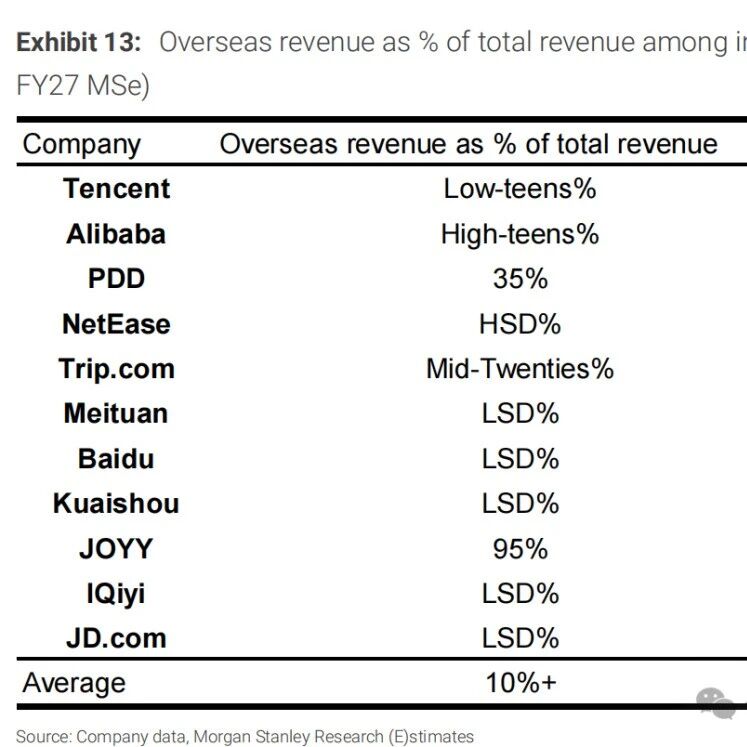
Core Insights - The article emphasizes the significance of AI in investment decisions, particularly in the context of Chinese internet companies and their overseas revenue potential [2][3]. Group 1: Overseas Revenue of Chinese Internet Companies - Chinese internet companies have an average overseas revenue exceeding 10%, with Pinduoduo leading at 35% [3]. - Companies like Tencent and Alibaba have low to high teens percentages of overseas revenue, indicating a growing trend towards international markets [3]. Group 2: Cloud Computing Sector - Alibaba Cloud and Tencent Cloud are rapidly expanding their international presence, with Alibaba planning new business regions in Brazil, France, and the Netherlands, and Tencent deploying services in 22 regions globally [4]. - Morgan Stanley projects that Alibaba Cloud's revenue growth will exceed 40% by FY2027, while Tencent's enterprise service revenue is expected to grow by 25% by FY2026 [5]. Group 3: Autonomous Driving Services - Baidu's autonomous driving service, "Luobo Kuaipao," is a leader in the sector, achieving over 250,000 weekly orders in fully autonomous mode as of Q3 2025, and has expanded to 22 cities including Dubai and Switzerland [7]. - Despite its leadership, Morgan Stanley anticipates that Baidu's revenue from this service will remain low and require continued investment [9]. Group 4: AI Models and Applications - Alibaba's Tongyi Qianwen model has gained significant traction globally, becoming the most downloaded AI model with over 700 million downloads by January 2026 [11]. - Kuaishou's Keling is expected to generate substantial revenue from overseas markets, with projections indicating an 80% year-on-year growth to reach $270 million by 2026, driven by B2B customer expansion [14].



Alibaba-backed startup Moonshot AI's valuation is up $500 million, sources say, after its rivals IPO in Hong Kong
CNBC· 2026-01-19 13:36
Company Overview - Moonshot AI, an Alibaba-backed AI startup, is currently valued at $4.8 billion in a new funding round, up from $4.3 billion previously [1][2] - The company is known for its Kimi chatbot, which gained significant popularity in China prior to the release of DeepSeek [1] Funding Details - The latest funding round is expected to close soon due to high demand, with a valuation at least $500 million higher than the previous round in December [2] - The previous funding round, announced on December 31, included participation from IDG, Alibaba, and Tencent [4] Market Context - Interest in Chinese AI companies has surged, particularly as U.S. AI chatbots like OpenAI's ChatGPT are not available in mainland China due to government restrictions [3] - Competitors Zhipu and MiniMax have seen significant market valuations, with Zhipu valued at $13 billion and MiniMax at $15.2 billion as of the latest data [4] Future Prospects - There is potential for Moonshot AI to be valued even higher in future funding rounds due to increasing interest in Chinese AI IPO candidates [3]

高盛眼中的2026年中国互联网:AI超级入口争夺战全面打响,三大主题锁定阿尔法机会
Hua Er Jie Jian Wen· 2026-01-19 13:25
Core Viewpoint - Goldman Sachs predicts that 2026 will be a strategic turning point for Chinese internet giants, with increased investment in consumer-facing AI and competition around "AI super entry" while focusing on defending their core market positions [1] Group 1: Industry Transition - The industry transition in 2026 is fundamentally driven by ByteDance's comprehensive breakthroughs, which are reshaping competitive dynamics [2] - ByteDance is projected to achieve a profit of $50 billion in 2025, significantly surpassing Tencent's $36 billion and Alibaba's $15 billion [2] - In the AI sector, ByteDance's Doubao app has over 100 million daily active users and is the leading consumer-level AI application in China [2] Group 2: Strategic Responses from Giants - In response to ByteDance's advancements, Alibaba and Tencent are compelled to pivot their strategies, increasing AI investments to over $60 billion collectively by 2026 [3] - Alibaba aims to maintain its leading position in e-commerce GMV, while Tencent accelerates AI features in WeChat and explores social AI applications through QQ [3] - The competitive landscape is expected to rationalize, improving unit economics in sectors like food delivery [3] Group 3: Key AI Themes Restructuring the Industry - Six key AI themes identified by Goldman Sachs will reshape the industry ecosystem in 2026, including advertising transformation, model competition, and the emergence of consumer AI entry points [4] - The advertising budget is shifting towards ROI-driven ads, with new strategies like AEO and GEO gaining traction [4] - The competition in AI models is intensifying, focusing on long context, multi-modal, and low-cost architectures [4] Group 4: Investment Framework - The investment landscape is shifting from a "broad market rally" to an "alpha era" focused on selective stock picking, emphasizing EPS delivery/growth, AI, and globalization narratives [6] - Companies benefiting from improving order trends and rationalized competition, such as Alibaba and JD.com, are highlighted for their potential in profit growth [7] - The focus is also on AI technology breakthroughs and global business expansion, with companies like Kuaishou and Baidu identified as key players [8] Group 5: Shareholder Returns - Companies with stable cash flows and strong shareholder return capabilities are prioritized, particularly those with sufficient net cash and potential for dividend increases [9]


Alibaba Stock Drops After a Blistering AI Rally. These 2 Worries Are Rattling Investors.
Barrons· 2026-01-19 12:57
Group 1 - Alibaba Group stock experienced a significant decline on Monday, which impacted the recent positive momentum in its share price [1] - The drop in Alibaba's stock price indicates potential volatility in the Chinese online retail sector [1] - This decline follows a period of rally, suggesting that investor sentiment may be shifting [1] Group 2 - The recent stock performance of Alibaba reflects broader trends in the Chinese e-commerce industry [1] - Market reactions to Alibaba's stock may influence investor confidence in other companies within the sector [1] - The fluctuation in Alibaba's stock could signal underlying challenges facing the online retail market in China [1]

AI硬件需求碎片化 都想取代手机 谁能定义下一代超级入口
Nan Fang Du Shi Bao· 2026-01-19 12:44
Core Insights - Alibaba has integrated its Qianwen App into its ecosystem, including Taobao, Alipay, and other services, positioning it as a "super agent" to differentiate from competitors like Doubao and Yuanbao [1] - The year 2025 is referred to as the "AI Hardware Year," marking a surge in AI hardware products like AI glasses and headphones, aiming to replace smartphones as essential devices [3][4] - Major tech companies are actively investing in AI hardware, with products like ByteDance's Doubao and ZTE's nubia M153 generating significant buzz [1][9] Trend 1: Hardware Manufacturers Competing in AI Vertical Market - The AI hardware market is experiencing intense competition, with various companies launching products aimed at becoming essential devices [2][3] - Plaud, an AI hardware company, has successfully sold over 1 million units by targeting high-decision, high-dialogue, and high-knowledge-density users [3] - The trend of vertical market products achieving commercial viability is notable, as companies leverage AI to enhance hardware functionality [4] Trend 2: Major Companies Stirring the Hardware Market - Internet giants are diversifying into hardware, with companies like ByteDance and Alibaba launching AI products to complement their existing software ecosystems [9][10] - The strategies include direct hardware development and providing foundational models for other hardware manufacturers [10][11] - Tencent is focusing on robotics and has launched a modular platform for intelligent robots, indicating a shift towards hardware integration [11] Trend 3: Ecosystem Integration of Super Applications - Alibaba's Qianwen App has been upgraded to support over 400 tasks, integrating with various services to enhance user experience [15][17] - Tencent is betting on WeChat as a super application, aiming to create an AI assistant that can understand user needs and execute tasks within its ecosystem [17][18] - The competition among major companies is intensifying as they seek to create comprehensive user experiences through integrated applications [19] Trend 4: New Competitive Logic from Emerging AI Models - Emerging AI model companies, referred to as the "Six Little Tigers," are positioning themselves alongside major tech firms in the race for super applications [22][23] - These companies are focusing on high-value sectors like healthcare, with products that aim to redefine user engagement and application functionality [23][24] - The competition is shifting from traditional metrics of success to a focus on model capabilities and user experience [24][25] Predictions: Who Will Define the Super Entry? - The battle for the next generation of "super entry" is ongoing, with hardware and software companies vying for dominance [29][30] - Challenges remain in the AI hardware sector, including user privacy and the clarity of business models for AI applications [30][31] - The concept of a "super entry" may evolve, with the potential for more neutral and open platforms to emerge as key players [31]

12月电商大盘增速放缓,阿里千问打通生态业务
国投证券(香港)· 2026-01-19 11:15
Investment Rating - The report suggests a cautious outlook on the e-commerce sector, indicating a slowdown in growth due to macroeconomic factors and high base effects from previous years [5]. Core Insights - In December, the online retail sales of physical goods grew by 0.8% year-on-year, with a total of 1.3 trillion yuan, marking a significant slowdown compared to previous months [2][5]. - Alibaba's Qianwen app has integrated various services within its ecosystem, potentially enhancing user engagement and transaction efficiency, with expectations that AI will handle 60-70% of digital tasks in the next two years [3][5]. - The overall e-commerce market is projected to grow by 5.2% year-on-year in 2025, with specific categories like food seeing a growth of 14.5% [2][5]. Summary by Sections E-commerce Market Performance - December's online retail sales reached 1.3 trillion yuan, with a year-on-year growth of 0.8%, a decline from 4.9% in October and 1.5% in November [2]. - For the entire year of 2025, online retail sales are expected to total 13.1 trillion yuan, reflecting a 5.2% increase compared to previous years [2]. Alibaba's Ecosystem Development - Alibaba's Qianwen app has connected with various services, launching over 400 AI functionalities, which allows users to complete transactions seamlessly [3]. - The monthly active users (MAU) of the Qianwen app surpassed 100 million, indicating rapid user growth [3]. Competitor Updates - Pinduoduo is testing a new "Billion Supermarket" initiative and has launched shared warehouse services to improve delivery efficiency [4]. - JD.com reported that its Plus members saved nearly 30 billion yuan in 2025, while Douyin e-commerce helped merchants save over 32 billion yuan in operational costs [4]. Investment Recommendations - The report emphasizes the importance of companies with strong AI capabilities and platform ecosystems, suggesting that the profit uplift from AI tools will outweigh revenue impacts in the current macroeconomic environment [5].