
BABA(BABA)

Search documents
俞敏洪聘请陈行甲为新东方总顾问,年薪150万元;马斯克称推动特斯拉转型为机器人公司,估值25万亿美元;SK海力士发放巨额年终奖丨邦早报
创业邦· 2026-01-21 00:08
Group 1 - New Oriental Education Technology Group has appointed Chen Xingjia as a senior consultant with an annual salary of 1.5 million RMB, following public scrutiny over his previous salary exceeding 700,000 RMB [2][3] - New Oriental commits to donating no less than 1 million RMB annually to the Henghui Foundation, which focuses on the health and growth of Chinese youth [2][3] Group 2 - SK Hynix announced a record performance bonus of over 1.36 million KRW (approximately 640,000 RMB) per employee, marking the highest in the company's history, with a stock option plan for employees [4] - The stock option plan allows employees to receive up to 50% of their bonuses in company stock, with additional cash rewards for holding the stock for a year [4] Group 3 - Gree Electric Appliances is set to mass-produce silicon carbide chips for various applications, including photovoltaic storage and logistics vehicles, with plans to supply half of the chips for GAC Group's vehicles [7] - The company aims to enhance its semiconductor capabilities in the growing electric vehicle market [7] Group 4 - iQIYI announced the resignation of CFO Wang Jun for personal reasons, with senior vice president Zeng Ying taking over as acting CFO [11] - iQIYI is in the process of selecting a suitable candidate for the CFO position [11] Group 5 - The AI companionship company Nature Select has raised over 30 million USD in a recent funding round, with investments from Alibaba and Ant Group among others [13] - The funding will support the development of AI companionship products [13] Group 6 - Tesla's CEO Elon Musk is pushing for the company to transition into a robotics firm, with the Optimus humanoid robot as a key focus, despite production challenges [9] - The company aims for a valuation of 25 trillion USD based on its robotics division, which is expected to surpass its current automotive business [9]



美股大跌,科技股全线下挫,热门中概股普跌
Di Yi Cai Jing Zi Xun· 2026-01-20 23:31
Group 1 - The global market risk appetite has significantly decreased following President Trump's renewed tariff threats towards Europe, leading to a sell-off in major stock indices [2][3] - The Dow Jones Industrial Average fell by 870.74 points, a decline of 1.76%, closing at 48,488.59 points; the S&P 500 dropped by 143.15 points, down 2.06%, at 6,796.86 points; and the Nasdaq Composite decreased by 561.07 points, a 2.39% drop, ending at 22,954.32 points, marking the worst single-day performance since October 10 of the previous year [2] - Major tech stocks experienced declines, with Nvidia down 4.32%, Apple down 3.45%, and Microsoft down 1.16%, among others [2] Group 2 - The CBOE Volatility Index (VIX), often referred to as the "fear index," rose to a two-month high, reflecting increased market anxiety [3] - Trading volume on U.S. stock markets reached approximately 20.6 billion shares, significantly above the 20-day average of 17.01 billion shares, indicating concentrated selling pressure [3] - Analysts suggest that the current geopolitical tensions regarding tariffs are more of an emotional shock rather than a fundamental change that would trigger a deep market correction [3] Group 3 - The global bond market is also experiencing spillover effects, with upward pressure on some European government bonds due to potential increases in defense spending [4] - The yield on the U.S. 10-year Treasury note reached a high of 4.313%, the highest since late August, closing at 4.287% after a rise of 5.6 basis points [5] - Market expectations for interest rate cuts by the Federal Reserve have been adjusted downward, with projections for a reduction of approximately 47 basis points in 2026, down from 53 basis points at the end of the previous year [5] Group 4 - Netflix reported fourth-quarter revenue of $12.1 billion, exceeding market expectations of $11.97 billion, with adjusted earnings per share of $0.56, also slightly above forecasts [6] - The company anticipates full-year revenue for 2026 to reach between $50.7 billion and $51.7 billion, with expectations for advertising revenue to potentially double in the future [6] - Following the announcement, Netflix's stock price fell by 4.9% in after-hours trading, influenced by merger financing and market sentiment [7] Group 5 - Gold prices surged significantly, with spot gold rising approximately 2% to $4,757.33 per ounce, reaching a historical high of $4,756.93 during the session [7] - Silver prices experienced a slight decline of 0.3%, settling at $94.38 per ounce, after hitting a record high of $95.87 [7] - Oil prices showed volatility, with light crude oil futures for February delivery rising by $0.90 to $60.34 per barrel, a 1.51% increase [8]


记者体验不如预期 “AI办事闭环”利在厂商?
Mei Ri Shang Bao· 2026-01-20 23:23
Core Insights - The competition for AI "super entry" is intensifying among major tech companies like Alibaba, ByteDance, and Tencent, focusing on user engagement and service integration [1][2][3] - The effectiveness of AI applications in consumer markets remains uncertain, as companies strive to shift user habits and achieve widespread adoption [1][2] Group 1: Company Strategies - Alibaba's Qianwen App aims to create an "AI service closed loop" by integrating various services such as food delivery, flight bookings, and hotel reservations, addressing the challenge of converting technical advantages into user engagement [2] - ByteDance's Doubao has surpassed 100 million daily active users, leveraging its content and traffic distribution strengths to seamlessly integrate ordering and local services [2] - Tencent has incorporated "Yuanbao" into its WeChat ecosystem, enhancing its AI entry point by utilizing its vast user base [2] Group 2: Market Dynamics - The competition for AI "super entry" is not exclusive to tech giants; pure AI model companies like Zhiyu have also entered the market, offering services like ordering and ticket booking through third-party ecosystems [2] - The strength of AI entry points and the fluidity of service integration depend on the overall strength of a company's supply chain and ecosystem [3] - Industry experts predict that 2026 will mark the beginning of the "general AI entry year," as AI transitions from a technology validation phase to a commercial application phase [3]
台湾青年探访北京知名科企
Bei Jing Ri Bao Ke Hu Duan· 2026-01-20 22:40
Group 1 - The Taiwan Youth AI Technology Training Camp aims to promote cross-strait youth exchanges through a combination of professional courses, corporate visits, and cultural experiences [1][2] - The training camp, held from January 10 to 23, 2026, attracted over 30 young students and teachers from Taiwan [1] - Participants engaged in AI technology applications and marketing courses, with lectures from well-known companies such as ByteDance and Alibaba [1] Group 2 - The camp included visits to companies like iFlytek and Leyard, as well as significant locations in Beijing, showcasing the city's technological advancements and cultural heritage [1] - Future initiatives will focus on leveraging Beijing's technological, industrial, and cultural resources to create more youth exchange programs, fostering collaboration and talent development between the two regions [2]


2 Chinese Stocks With Big Upside
247Wallst· 2026-01-20 19:37
Core Viewpoint - Chinese stocks have transitioned from being considered uninvestable to potentially worth exploring due to discounted valuations in several internet stocks, particularly those making significant advancements in AI [1] Group 1 - The current market conditions present an opportunity for investors to consider Chinese internet stocks [1] - Many of these stocks are experiencing substantial developments in artificial intelligence, which could drive future growth [1]

2026年第3周计算机行业周报:看好AI应用及国产算力两条主线-20260120
Changjiang Securities· 2026-01-20 14:11
Investment Rating - The report maintains a "Positive" investment rating for the software and services industry [7] Core Viewpoints - The report expresses optimism regarding AI applications and domestic computing power investment opportunities, highlighting the acceleration of AI applications and the potential for industry upgrades in the long term [6][40] - The introduction of the Universal Commerce Protocol (UCP) by Google is seen as a significant development that could reshape the e-commerce landscape, facilitating seamless transactions and enhancing user experience [21][24][28] - The report emphasizes the importance of data element value release in 2026, marking it as a pivotal year for the digital economy and data market reforms [30][35][38] Summary by Sections Market Performance - Last week, the computer sector experienced a high and then a pullback, with an overall increase of 4.14%, ranking first among major industries in the Yangtze River region, and accounting for 11.21% of total market turnover [2][4][15] Key Recommendations - The report recommends focusing on: 1. Domestic large model manufacturers 2. Major domestic cloud service providers 3. Vertical scenario agent manufacturers 4. The domestic computing power supply chain, particularly AI chip companies like Haiguang Information and Cambrian [6][40] AI and E-commerce Developments - The UCP aims to create a standardized communication framework for AI agents, merchants, and platforms, potentially transforming the e-commerce industry by reducing decision-making time and enhancing transaction efficiency [21][24][28] - The report notes that AI-assisted shopping is expected to become mainstream, with significant growth projected in the AI e-commerce market from 23.93 billion yuan in 2020 to 50.44 billion yuan by 2024, with a compound annual growth rate of 20.50% [29] Data Element Value Release - The report highlights that 2026 is designated as the "Year of Data Element Value Release," with a focus on market-oriented reforms and the establishment of data standards to facilitate the flow and utilization of data [30][35][38] - The establishment of a data property rights registration system is anticipated to enhance data circulation and unlock value within the data economy [37][38]



投入近20亿元 淘宝闪购联合阿里生态推出城市骑士春节关怀举措
Xin Lang Cai Jing· 2026-01-20 13:39
Core Insights - Taobao Flash has launched "Eight Spring Festival Care Measures" to support urban riders during the holiday season, investing nearly 2 billion yuan in incentives [1][2][3] Group 1: Investment and Incentives - The company is investing approximately 2 billion yuan to enhance incentives for urban riders [1][2] - Initiatives include collaboration with Alipay to implement the "Tap to Enter" feature in communities and subsidies for train tickets for riders returning home [1][2] Group 2: Service Enhancements - Taobao Flash is offering various services such as tier protection, New Year gift packages, free smart locker meal storage, and a 45 million yuan subsidy for upgrading rider equipment [1][2] - The aim is to create a more systematic and warm support system for urban riders during the Spring Festival [1][2] Group 3: Community Engagement - Various government departments, including labor unions and civil affairs, will collaborate with Taobao Flash to conduct site visits, distribute supplies, and organize events for riders across multiple locations [3] - The initiative aims to foster a social atmosphere that respects and cares for new employment forms [3] Group 4: Future Plans - The company plans to continue enhancing care and support measures for urban riders, in collaboration with Alibaba's ecosystem partners [2][3] - The "Urban Riders. Orange Intent Plan" was announced to comprehensively upgrade the support and incentives for urban riders [2][3]
OpenAI的不归路:关于ChatGPT加入广告的五个冷思考
Sou Hu Cai Jing· 2026-01-20 13:33
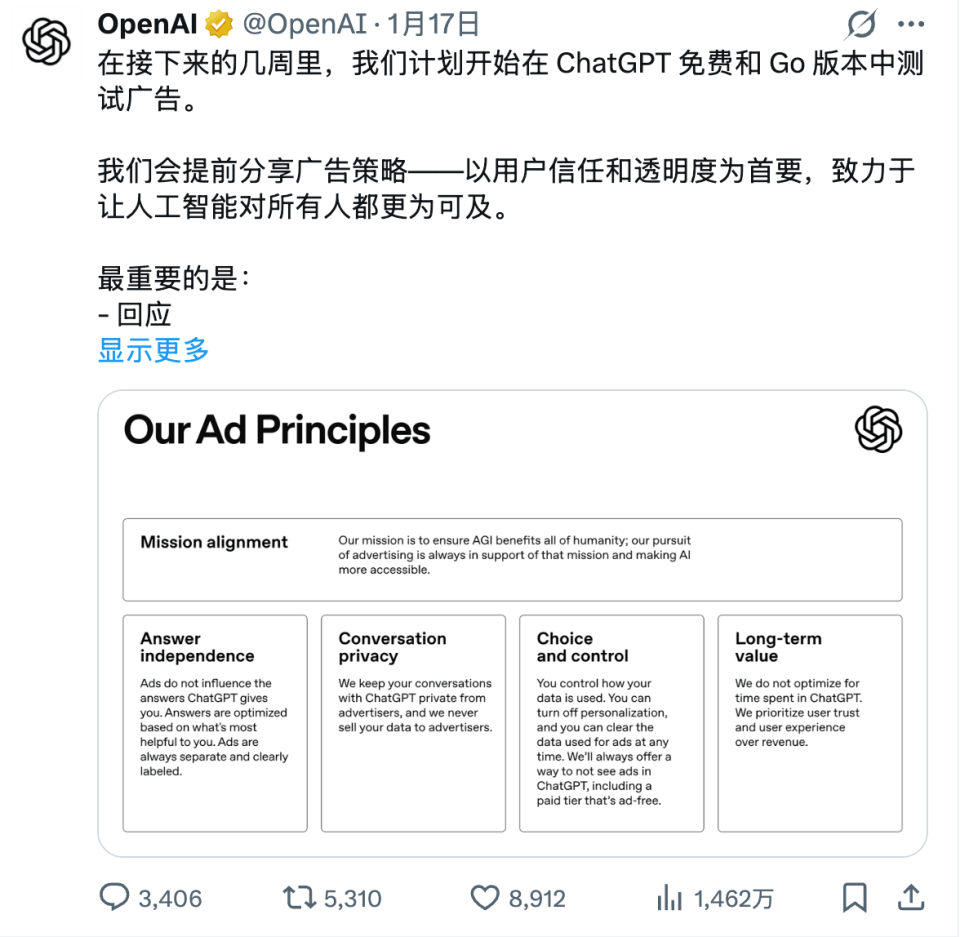
Core Insights - The article discusses the evolving advertising strategy of OpenAI, highlighting the pressure for monetization and the shift in leadership attitudes towards advertising as a viable business model [1][3][4]. Group 1: OpenAI's Advertising Strategy - OpenAI's decision to launch advertising just over a month after a "Code Red" alert indicates significant pressure to monetize its products [2][5]. - The recruitment of executives with strong advertising backgrounds, such as Fidji Simo and Kevin Weil, suggests a strategic pivot towards generating revenue through advertising [2][3]. - Sam Altman's changing perspective on advertising—from viewing it as a last resort to considering it a potential revenue stream—reflects a pragmatic approach to business [5][6]. Group 2: Cautious Implementation of Advertising - OpenAI is taking a cautious approach to advertising, ensuring that ads are clearly marked as "Sponsored" and do not interfere with the content of ChatGPT responses [7][10]. - Users have the option to disable personalized ads and provide feedback, indicating an effort to maintain user trust [9][10]. - Despite this cautious start, there are concerns about how long OpenAI can maintain this approach without succumbing to commercial pressures [11][14]. Group 3: Implications for Google - The introduction of advertising in ChatGPT could potentially divert ad revenue from Google, which relies heavily on its advertising business [19][21]. - Some analysts believe that Google's core advertising revenue is at risk if OpenAI successfully demonstrates higher ROI for conversational ads compared to traditional search ads [19][21]. - Conversely, others argue that Google's established advertising infrastructure and experience may give it an advantage in the competitive landscape [20][22]. Group 4: Revenue Projections for OpenAI - Initial revenue estimates for OpenAI's advertising model suggest it could generate between $2 billion and $7.2 billion in its first year, which would significantly contribute to its overall revenue [30][35]. - This revenue could help alleviate OpenAI's substantial operational costs, although it remains a small fraction of its projected infrastructure investments [36]. - Analysts predict that advertising could become OpenAI's largest revenue source within three years, potentially capturing a significant share of the global search advertising market [36]. Group 5: Broader Industry Context - Other AI companies, including Google and Baidu, have already begun integrating advertising into their AI products, indicating a trend towards monetization in the industry [38][40]. - The article suggests that many domestic AI companies have yet to adopt advertising due to competitive market conditions, but this is expected to change in the near future [45][50]. - The overall willingness to pay for AI services in domestic markets is lower than in international markets, making advertising a more viable monetization strategy [51].



昆仑万维周亚辉投资笔记:AI时代的Super App之战打响|甲子光年
Sou Hu Cai Jing· 2026-01-20 13:15
Core Viewpoint - The analysis suggests that Zhang Yiming will be the richest person in China and Asia in the next ten to twenty years due to his strong motivation, learning ability, execution power, and the resources of ByteDance [1]. Group 1: ByteDance's Strategic Position - ByteDance is expected to accelerate its international expansion, particularly with the launch of the Doubao phone and its entry into the automotive sector, aiming for a position in autonomous driving [2]. - The future of AI will see a significant reduction in the number of Super Apps, with only 3-4 likely to exceed 500 million monthly active users (MAU), compared to 10+ in the mobile internet era [2][3]. - The value of Super Apps in the AI era is projected to be several times greater than in the mobile internet era, with higher daily active users (DAU) to MAU ratios [2]. Group 2: Competitive Landscape - The competition for Super App dominance is intensifying, with Alibaba's Qwen positioned as a strong competitor to Doubao, marking a significant face-off between Zhang Yiming and Jack Ma [7]. - Other contenders for the Super App battle include Tencent, Meituan, Pinduoduo, JD.com, and Baidu, while smaller players like Xiaohongshu may struggle to compete effectively [7]. - The market for AI Super Apps is anticipated to be worth 1 trillion RMB, necessitating significant investment from companies with substantial cash reserves [7]. Group 3: Industry Insights - Huawei is unlikely to enter the Super App market due to its strategic focus on becoming a leading automotive group in China, while Tencent is seen as a stable player with a strong product matrix [8]. - The potential shift in user engagement from WeChat to Doubao could significantly alter the competitive dynamics in the app ecosystem, with Doubao's influence expected to grow rapidly [8].





计算机行业周报:AI应用行情演绎,关注场景变革和大厂链-20260120
East Money Securities· 2026-01-20 13:07
Investment Rating - The report maintains an investment rating of "Outperform the Market" for the computer industry [4] Core Insights - The computer industry index rose by 3.82% this week, ranking first among 31 industries, with a year-to-date increase of 12.64% [13][18] - The overall dynamic price-to-earnings ratio (PE-TTM) for the computer sector is 96.40, which is at a historical median level [20] - Major companies in the sector are accelerating product iterations and capital expenditures, with AI applications transitioning from capability validation to high-frequency usage [7][26] - AI is making significant inroads in healthcare and marketing, with companies like Alibaba, ByteDance, and Tencent leading the charge in integrating AI into their ecosystems [7][30][34] Summary by Sections Market Review - The computer industry index increased by 3.82% this week, outperforming other sectors [13] - A total of 249 companies in the computer sector saw their stock prices rise, while 105 experienced declines [18] Industry Dynamics - Major tech companies are rapidly iterating their products, with Alibaba's Qianwen App integrating over 400 AI functionalities into its ecosystem [26] - AI applications are being embedded in healthcare services and marketing strategies, with a focus on compliance and data integration [37][40] - The report highlights specific companies to watch in AI healthcare, including Jingtai Holdings and Yuyuan Network, and in AI marketing, such as Focus Technology and Guangyun Technology [7][56] Configuration Recommendations - The report suggests focusing on companies within the AI healthcare sector and those involved in AI marketing, as well as major players in the industry chain like Alibaba and Tencent [56]