
BABA(BABA)

Search documents
中国核电、阿里巴巴等在象山成立核能公司
2 1 Shi Ji Jing Ji Bao Dao· 2026-01-21 03:18
Core Viewpoint - Recently, China Nuclear (Xiangshan) Nuclear Energy Co., Ltd. was established with a registered capital of 250 million RMB, focusing on power generation, transmission, and distribution services, among other activities [1][2]. Company Information - The legal representative of the company is Zhong Hua, and it is registered under the supervision of Xiangshan Market Supervision Administration [2]. - The company has a business scope that includes power generation, transmission, distribution, radiation monitoring, inspection and testing services, thermal production and supply, business training, and investment activities using its own funds [1][2]. Shareholder Information - The shareholders of China Nuclear (Xiangshan) Nuclear Energy Co., Ltd. include China Nuclear Power's subsidiary, China Nuclear Zheneng Energy Co., Ltd., Hongrun Construction (002062), Youngor Group Co., Ltd., and Alibaba's Shanghai Yiqi Network Technology Co., Ltd. [1][3].


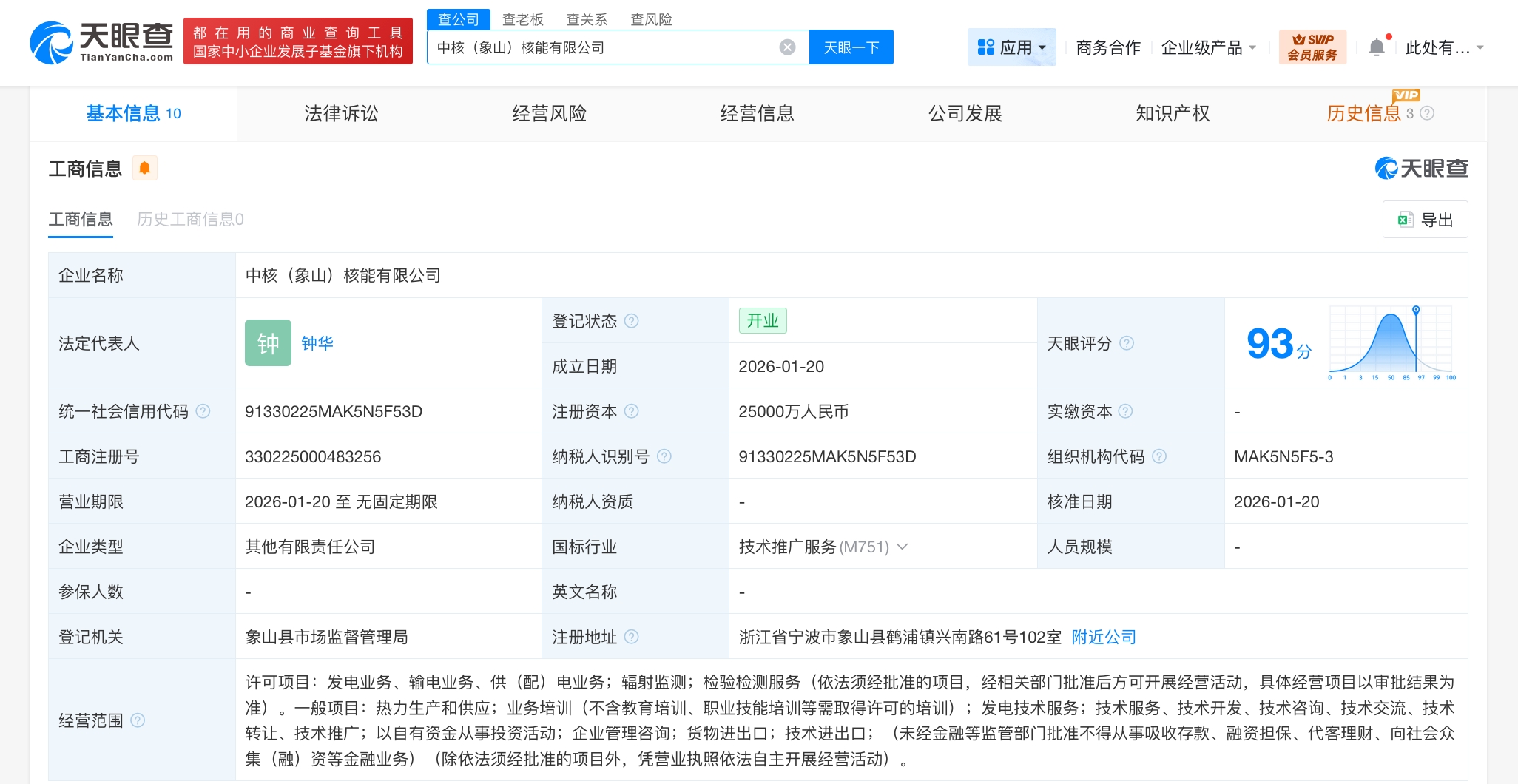
中国核电、阿里巴巴等在象山成立核能公司,注册资本2.5亿
Zhong Guo Neng Yuan Wang· 2026-01-21 03:16
Core Viewpoint - Recently, China Nuclear (Xiangshan) Nuclear Energy Co., Ltd. was established with a registered capital of 250 million RMB, focusing on various energy-related services and investments [1] Company Information - The legal representative of the newly established company is Zhong Hua [1] - The registered capital of the company is 250 million RMB [1] - The business scope includes power generation, transmission, distribution, radiation monitoring, inspection and testing services, heat production and supply, business training, and investment activities using self-owned funds [1] Shareholder Composition - The company is jointly held by China Nuclear Power (601985) subsidiary China Nuclear Zheneng Energy Co., Ltd., Hongrun Construction (002062), Youngor Group Co., Ltd. (600177), and Alibaba's Shanghai Yiqi Network Technology Co., Ltd. [1]

IDC招采规模和节奏解读
2026-01-21 02:57
2025 年互联网大厂在 ITC 招采方面的规模如何? 2025 年,互联网大厂在 ITC 招采方面的规模较 2024 年有显著增长。整体市 场招采规模超过 4GW,主要集中在第一季度,占全年一半以上。部分招采计划 是在第四季度制定,并在第一季度推进。字节跳动的资本开支计划从预期的 1,800 亿上调至 3,000 亿,阿里巴巴则从 1,600-1,800 亿上浮至接近 2000 亿。这两家公司的 ITC 招标规模接近 5GW,加上腾讯和其他企业,预计 2026 年数据中心招采规模将达到 6GW。 2025 年字节跳动、阿里巴巴、腾讯和百度四大互联网公司在国内及东南亚地 区的 ITC 具体招采规模如何? 2025 年,字节跳动和阿里巴巴占据了绝对头部位置,每家公司分别达到了 1.6-1.8GW,总计约 3-3.2GW。腾讯相对较少,大约为 600-700MW,而百 2026 年 ITC 市场预计在核心城市如北京和上海会有退租现象,续租率 预计在 70%到 80%之间,但价格可能随行就市或略有上浮。云资源池 业务预计不会迁走。 降低 PUE 是增加数据中心建设数量的关键。淘汰高 PUE 老旧数据中心, 采用液冷 ...


2026年最有“钱途”的行业,最爱应届生
Xin Lang Cai Jing· 2026-01-21 02:00
文 | 每日人物社 徐晴 编辑 | Yang 运营 | 步鸟 2026年一开年,AI行业的新闻频出。做大模型的智谱和MiniMax上市了;AI应用Manus卖给了Meta,核心团队直接实现 财富自由;具身智能迎来一笔笔融资;AI硬件创业者挤满深圳的咖啡馆。在这样的繁盛中,人才被哄抢,隔三差五, 就出现一位年薪百万甚至千万的AI高级人才,被各大公司争夺。 肖玛峰是一家国内头部猎头公司的创始人——这家公司在过去的几年服务了1400多家AI企业,从大厂到创业公司,从 大模型到自动驾驶、机器人。AI的风口如何刮起来,哪家公司拿到了新融资,哪家最近被收购,哪家招人最多,哪位 人才拿到了最天价的薪酬……他们全都知道。 从AI人才的走向和企业们争夺的焦点里,我们可以看到这一年的AI赛道到底发生了什么。 以下是肖玛峰的讲述: 大厂争夺AI人才 现在的就业市场,可以说是冰火两重天。最顶级的人才,尤其是AI领域,大家手上都有很多个offer。应届毕业的博士生 薪资300万,这不是传说,是真的。 争抢AI人才的,国内分这么几类:一类是非常有钱的互联网大厂,比如字节、腾讯、阿里、华为;第二梯队是美团、 京东、小红书。大厂都有专门针对 ...
计算机行业周报:AI应用行情演绎,关注场景变革和大厂链
东方财富· 2026-01-21 00:30
Investment Rating - The report maintains an investment rating of "Outperform the Market" for the computer industry [4] Core Insights - The computer industry index rose by 3.82% this week, ranking first among 31 industries, with a year-to-date increase of 12.64% [13][18] - The overall valuation of the computer sector is at a historical median level, with a dynamic price-to-earnings ratio (PE-TTM) of 96.40 as of January 16, 2026 [20] - Notable stock performances include Tongda Hai, Haohan Deep, and Jiechuan Intelligent, with weekly increases of 39.73%, 30.57%, and 28.95% respectively [18][20] Industry Dynamics - Major companies are accelerating product iterations and focusing on new capital expenditure, with Alibaba's Qianwen App integrating over 400 AI service functions into its ecosystem [26][30] - AI applications are gaining traction in healthcare and marketing, with significant investments and developments in AI medical services and generative AI marketing strategies [37][46] - The report highlights the importance of AI infrastructure investments as a key competitive variable in the upcoming phase of industry development [35] Configuration Recommendations - For AI healthcare, companies such as Jingtai Holdings, Yingshi Intelligent, and Meinian Health are recommended for investment [56] - In AI marketing, firms like Maifushi, Focus Technology, and Guangyun Technology are suggested as potential investment opportunities [56] - The report advises monitoring capital expenditure trends from major companies, with specific recommendations for Alibaba's chain (Guangyun Technology, Shiji Information, etc.), ByteDance's chain (Hand Information, Runze Technology), and Tencent's chain (Fanwei Network, Xinghuan Technology) [56]
TMT行业周报(1月第2周):阿里巴巴举办千问产品发布会
Century Securities· 2026-01-21 00:25
Investment Rating - The report does not explicitly state an investment rating for the industry, but it suggests a positive outlook for Alibaba and related sectors, indicating a favorable investment environment [2]. Core Insights - Alibaba's "Qianwen" product launch signifies a shift in AI capabilities from a "Q&A assistant" to a "task executor," integrating over 400 functions across its ecosystem, which is expected to enhance user engagement and commercial viability [3][5]. - The emergence of the GEO (Generative Engine Optimization) business model is transforming marketing strategies, shifting focus from SEO to GEO, which is anticipated to benefit marketing agencies and authoritative media platforms while traditional traffic platforms may face challenges [3][5]. - The TMT sector showed a strong performance in the week of January 12-16, with notable gains in sub-sectors such as portal websites and semiconductor equipment, outperforming the broader market [3][5]. Market Weekly Review - The TMT sector's performance from January 12-16 showed a rise in the computer sector by 3.82%, electronics by 3.77%, media by 2.04%, and communication by 1.42%, collectively outperforming the CSI 300 index, which fell by 0.57% [3][5]. - The top-performing sub-industries included portal websites (17.69% increase), integrated circuit packaging and testing (14.47% increase), and semiconductor equipment (9.31% increase) [3][5]. Industry News and Key Company Announcements - Alibaba's "Qianwen" product launch on January 15 is a significant event, showcasing its AI capabilities and integration with various services [3][5]. - The report highlights the rapid growth of the "Qianwen" app, which achieved over 100 million monthly active users within two months of launch, indicating strong market acceptance [3][5]. - The report notes that the GEO model is expected to enhance the profitability of marketing agencies and elevate the status of authoritative media platforms, while traditional traffic platforms may experience a decline [3][5].
俞敏洪聘请陈行甲为新东方总顾问,年薪150万元;马斯克称推动特斯拉转型为机器人公司,估值25万亿美元;SK海力士发放巨额年终奖丨邦早报
创业邦· 2026-01-21 00:08
Group 1 - New Oriental Education Technology Group has appointed Chen Xingjia as a senior consultant with an annual salary of 1.5 million RMB, following public scrutiny over his previous salary exceeding 700,000 RMB [2][3] - New Oriental commits to donating no less than 1 million RMB annually to the Henghui Foundation, which focuses on the health and growth of Chinese youth [2][3] Group 2 - SK Hynix announced a record performance bonus of over 1.36 million KRW (approximately 640,000 RMB) per employee, marking the highest in the company's history, with a stock option plan for employees [4] - The stock option plan allows employees to receive up to 50% of their bonuses in company stock, with additional cash rewards for holding the stock for a year [4] Group 3 - Gree Electric Appliances is set to mass-produce silicon carbide chips for various applications, including photovoltaic storage and logistics vehicles, with plans to supply half of the chips for GAC Group's vehicles [7] - The company aims to enhance its semiconductor capabilities in the growing electric vehicle market [7] Group 4 - iQIYI announced the resignation of CFO Wang Jun for personal reasons, with senior vice president Zeng Ying taking over as acting CFO [11] - iQIYI is in the process of selecting a suitable candidate for the CFO position [11] Group 5 - The AI companionship company Nature Select has raised over 30 million USD in a recent funding round, with investments from Alibaba and Ant Group among others [13] - The funding will support the development of AI companionship products [13] Group 6 - Tesla's CEO Elon Musk is pushing for the company to transition into a robotics firm, with the Optimus humanoid robot as a key focus, despite production challenges [9] - The company aims for a valuation of 25 trillion USD based on its robotics division, which is expected to surpass its current automotive business [9]



美股大跌,科技股全线下挫,热门中概股普跌
Di Yi Cai Jing Zi Xun· 2026-01-20 23:31
Group 1 - The global market risk appetite has significantly decreased following President Trump's renewed tariff threats towards Europe, leading to a sell-off in major stock indices [2][3] - The Dow Jones Industrial Average fell by 870.74 points, a decline of 1.76%, closing at 48,488.59 points; the S&P 500 dropped by 143.15 points, down 2.06%, at 6,796.86 points; and the Nasdaq Composite decreased by 561.07 points, a 2.39% drop, ending at 22,954.32 points, marking the worst single-day performance since October 10 of the previous year [2] - Major tech stocks experienced declines, with Nvidia down 4.32%, Apple down 3.45%, and Microsoft down 1.16%, among others [2] Group 2 - The CBOE Volatility Index (VIX), often referred to as the "fear index," rose to a two-month high, reflecting increased market anxiety [3] - Trading volume on U.S. stock markets reached approximately 20.6 billion shares, significantly above the 20-day average of 17.01 billion shares, indicating concentrated selling pressure [3] - Analysts suggest that the current geopolitical tensions regarding tariffs are more of an emotional shock rather than a fundamental change that would trigger a deep market correction [3] Group 3 - The global bond market is also experiencing spillover effects, with upward pressure on some European government bonds due to potential increases in defense spending [4] - The yield on the U.S. 10-year Treasury note reached a high of 4.313%, the highest since late August, closing at 4.287% after a rise of 5.6 basis points [5] - Market expectations for interest rate cuts by the Federal Reserve have been adjusted downward, with projections for a reduction of approximately 47 basis points in 2026, down from 53 basis points at the end of the previous year [5] Group 4 - Netflix reported fourth-quarter revenue of $12.1 billion, exceeding market expectations of $11.97 billion, with adjusted earnings per share of $0.56, also slightly above forecasts [6] - The company anticipates full-year revenue for 2026 to reach between $50.7 billion and $51.7 billion, with expectations for advertising revenue to potentially double in the future [6] - Following the announcement, Netflix's stock price fell by 4.9% in after-hours trading, influenced by merger financing and market sentiment [7] Group 5 - Gold prices surged significantly, with spot gold rising approximately 2% to $4,757.33 per ounce, reaching a historical high of $4,756.93 during the session [7] - Silver prices experienced a slight decline of 0.3%, settling at $94.38 per ounce, after hitting a record high of $95.87 [7] - Oil prices showed volatility, with light crude oil futures for February delivery rising by $0.90 to $60.34 per barrel, a 1.51% increase [8]


记者体验不如预期 “AI办事闭环”利在厂商?
Mei Ri Shang Bao· 2026-01-20 23:23
Core Insights - The competition for AI "super entry" is intensifying among major tech companies like Alibaba, ByteDance, and Tencent, focusing on user engagement and service integration [1][2][3] - The effectiveness of AI applications in consumer markets remains uncertain, as companies strive to shift user habits and achieve widespread adoption [1][2] Group 1: Company Strategies - Alibaba's Qianwen App aims to create an "AI service closed loop" by integrating various services such as food delivery, flight bookings, and hotel reservations, addressing the challenge of converting technical advantages into user engagement [2] - ByteDance's Doubao has surpassed 100 million daily active users, leveraging its content and traffic distribution strengths to seamlessly integrate ordering and local services [2] - Tencent has incorporated "Yuanbao" into its WeChat ecosystem, enhancing its AI entry point by utilizing its vast user base [2] Group 2: Market Dynamics - The competition for AI "super entry" is not exclusive to tech giants; pure AI model companies like Zhiyu have also entered the market, offering services like ordering and ticket booking through third-party ecosystems [2] - The strength of AI entry points and the fluidity of service integration depend on the overall strength of a company's supply chain and ecosystem [3] - Industry experts predict that 2026 will mark the beginning of the "general AI entry year," as AI transitions from a technology validation phase to a commercial application phase [3]
台湾青年探访北京知名科企
Bei Jing Ri Bao Ke Hu Duan· 2026-01-20 22:40
Group 1 - The Taiwan Youth AI Technology Training Camp aims to promote cross-strait youth exchanges through a combination of professional courses, corporate visits, and cultural experiences [1][2] - The training camp, held from January 10 to 23, 2026, attracted over 30 young students and teachers from Taiwan [1] - Participants engaged in AI technology applications and marketing courses, with lectures from well-known companies such as ByteDance and Alibaba [1] Group 2 - The camp included visits to companies like iFlytek and Leyard, as well as significant locations in Beijing, showcasing the city's technological advancements and cultural heritage [1] - Future initiatives will focus on leveraging Beijing's technological, industrial, and cultural resources to create more youth exchange programs, fostering collaboration and talent development between the two regions [2]

