BABA(BABA)

Search documents
跳出手机屏幕,千问正在改变物理世界
Jing Ji Guan Cha Wang· 2026-01-12 10:19
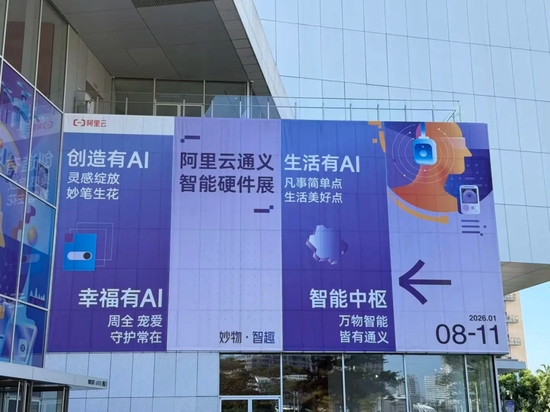
Core Insights - The CES 2026 highlighted the arrival of the "Physical AI" era, with a shift from AI generating text and images to interacting with the real world [1] - The Alibaba Cloud Tongyi Intelligent Hardware Exhibition showcased over 1,500 AI-integrated hardware products, emphasizing practical applications rather than theoretical concepts [1][3] - The focus of hardware manufacturers is on embedding AI capabilities into everyday products, transforming how people live and work [3][6] Group 1: AI Hardware Development - The exhibition featured 76 categories and over 200 brands, including major players like Honor and OPPO, as well as innovative startups [1] - AI hardware is moving beyond traditional smartphone applications, with products capable of tasks such as driving, assisting the visually impaired, and adjusting lighting [1][3] - Companies are leveraging the Qianwen model to enhance their products, enabling functionalities like health monitoring and automatic report generation [3][4] Group 2: Market Trends and Innovations - The focus is on practical AI applications that address specific needs, such as the YoooTek AI ONE device that captures voice notes and organizes information [4][6] - The shift towards AI hardware is supported by a new multi-modal interaction development kit, allowing even non-coders to integrate AI into their devices [6] - The competitive landscape is evolving, with a focus on reducing costs and improving efficiency in AI hardware development [6][7] Group 3: Industry Dynamics - The integration of AI into hardware is seen as a way to enhance productivity and redefine interactions in various sectors, including automotive and healthcare [10][11] - The Chinese manufacturing ecosystem is characterized by low trial costs and a willingness to innovate, positioning it as a leader in AI hardware development [11][12] - The Qianwen model's open-source strategy is enabling a broader range of developers to create AI hardware, democratizing innovation [8][12]
美股中概股盘前多数上涨,阿里巴巴涨4%


Jin Rong Jie· 2026-01-12 09:19
Core Viewpoint - The majority of Chinese concept stocks in the US pre-market are experiencing gains, indicating positive market sentiment towards these companies [1] Group 1: Company Performance - Alibaba's stock has increased by 4% [1] - Baidu's stock has risen by 3% [1] - NIO's stock has gone up by 2% [1] - Pinduoduo's stock has seen a modest increase of 0.8% [1] - Pony.ai's stock remains unchanged [1]
美股热门中概股盘前集体上涨,金山云涨超14%


Ge Long Hui A P P· 2026-01-12 09:19
格隆汇1月12日|美股市场热门中概股盘前集体上涨,其中,金山云涨超14%,脑再升科技涨超6%,阿 里巴巴涨超4%,哔哩哔哩、百度涨超3%,小鹏汽车、蔚来涨超2%。 ...
2025年Q4电商平台商家投诉数据报告
网经社电子商务研究中心· 2026-01-12 07:59
Investment Rating - The report does not explicitly provide an investment rating for the e-commerce industry Core Insights - The fourth quarter is the most critical operational peak for e-commerce merchants, supported by various platforms like JD, Taobao, Pinduoduo, and Douyin through promotional activities and resources [5] - Intense competition for advertising during key events like "Double 11" and "New Year Goods Festival" may increase customer acquisition costs and marketing expenditures [5] - Merchants face pressure on profit margins due to fierce price competition and evolving platform policies, requiring continuous adaptation to maintain traffic support [5] - A significant complaint from merchants involves issues like arbitrary refunds and excessive consumer protection measures, leading to widespread dissatisfaction [5][6] Overall Data Complaint Platform Distribution - The distribution of complaints across platforms in Q4 is as follows: Douyin E-commerce (38.75%), Pinduoduo (33.55%), Taobao (10.92%), JD (2.08%), and others [7] Complaint Issue Type Distribution - The main types of complaints include: arbitrary refunds (37.09%), excessive consumer protection (19.97%), withholding deposits (9.99%), arbitrary fines (9.73%), arbitrary store closures (2.72%), and mandatory shipping insurance (0.52%) [10] Complaint Regional Distribution - The top 10 regions for merchant complaints are Guangdong (23.86%), Zhejiang (14.53%), Shandong (11.80%), Hebei (6.10%), Jiangsu (5.71%), Henan (5.45%), Fujian (3.76%), Shaanxi (3.50%), Anhui (3.37%), and Hunan (2.72%) [12] Complaint Business Category Distribution - The top 10 business categories for complaints are: apparel (15.95%), 3C digital products (10.64%), fresh food (9.08%), outdoor products (6.49%), home goods (6.36%), personal care (3.89%), home appliances (3.50%), maternal and infant products (2.98%), jewelry (2.46%), and pet supplies (2.33%) [14] Complaint Amount Distribution - The majority of complaint amounts are concentrated in the range of 0-50,000 (95.07%), with smaller percentages in higher ranges [16] Complaint Merchant Responsible Gender Distribution - The gender distribution of complaint merchants shows 70.78% are male and 29.22% are female [17] Platform Data Douyin E-commerce - In Q4, Douyin E-commerce had 298 merchant complaints, with the highest issue being arbitrary refunds (46.64%) [18] Taobao - For Taobao, the main complaint issues are arbitrary refunds (30.95%), excessive consumer protection (28.57%), arbitrary fines (13.10%), withholding deposits (8.33%), and arbitrary store closures (2.38%) [25] Typical Cases - The report includes ten typical complaint cases involving various platforms, highlighting issues such as arbitrary fines, unreasonable penalties, excessive consumer protection, and arbitrary store closures [31]
华强北迎来第二春,这次不靠苹果,是千问!
Xin Lang Cai Jing· 2026-01-12 07:25
Core Insights - The article discusses the transformation of Huaqiangbei from a hub for counterfeit mobile phones to a center for AI-driven smart hardware, driven by the introduction of the Qianwen AI model [1][32][34] Group 1: Industry Transformation - Huaqiangbei, once thriving on counterfeit mobile phones, has pivoted to become the "global 3C accessories center" after the advent of the iPhone [1][32] - The recent AI hardware exhibition showcased over 1,000 AI hardware products, indicating a significant shift towards AI integration in traditional hardware [32][34] - The Qianwen AI model is the backbone of many innovative products, enabling ordinary hardware to be transformed into intelligent devices [34][39] Group 2: Product Innovations - The article highlights several innovative products, such as a blood pressure smartwatch that generates health reports and a pet translator that can interpret animal sounds with a 94.6% accuracy [5][9][38] - The Qianwen AI model supports various applications, including professional translation for cross-border business, enhancing communication for merchants [37][39] Group 3: Qianwen AI Model Features - Qianwen is the first open-source model capable of processing text, images, audio, and video, with over 200 model variants to cater to different hardware needs [12][40][41] - The model's pricing structure is based on the number of hardware terminals rather than token usage, making costs predictable for manufacturers [17][44] - Qianwen's popularity is attributed to its comprehensive support from Alibaba Cloud, which provides a complete solution from chips to applications [22][48] Group 4: Future Implications - The integration of Qianwen AI is expected to democratize innovation, allowing small and medium enterprises to compete on equal footing with larger companies [26][52] - The technology is reshaping the relationship between humans and hardware, moving towards a model where devices can understand and respond to human needs [28][52] - The ongoing development of the AI ecosystem in Huaqiangbei may lead to the emergence of more groundbreaking smart products in the future [30][53]

华泰证券今日早参-20260112
HTSC· 2026-01-12 07:22
Group 1: Macroeconomic Insights - The forecast for the US GDP growth in 2026 has been raised to 2.6%, up from a previous estimate of 2.3%, driven by factors including the upcoming midterm elections and potential policy changes from the Trump administration [2][3] - The report highlights a potential rebound in inflation in the second half of 2026, despite a slight downward adjustment in inflation predictions due to various economic factors [2][3] - Structural issues in the US economy, such as asset price inflation and income inequality, are expected to worsen, indicating a "K-shaped" recovery [2][3] Group 2: Real Estate Policies - The Trump administration has announced a series of real estate policies aimed at stimulating demand, including a $200 billion mortgage-backed securities purchase plan and restrictions on large institutional investors in the single-family housing market [3][4] - These measures are expected to provide marginal support to the real estate market but may not effectively address housing affordability issues [3][4] Group 3: Employment Data - In December, the US added 50,000 non-farm jobs, falling short of the Bloomberg consensus estimate of 70,000, with the unemployment rate decreasing to 4.4% [5] - The labor participation rate declined to 62.4%, while hourly wage growth showed a slight increase, indicating a mixed employment landscape [5] Group 4: Sector Performance - The report suggests that the A-share market is experiencing a "spring rally," with a focus on sectors such as gaming, duty-free, batteries, engineering machinery, and agricultural chemicals for potential investment opportunities [7] - The Hong Kong stock market is expected to benefit from a combination of factors, including improved liquidity and upward revisions in profit expectations [8] Group 5: REITs Market - Recent policies from the China Securities Regulatory Commission and stock exchanges are expected to enhance the REITs market, promoting high-quality development amid OCI disturbances [22] - The report indicates that the REITs market may experience improved sentiment and quality as it enters a new phase of development [22] Group 6: Semiconductor Industry - The report emphasizes the growing demand for cleanroom facilities in the semiconductor industry, driven by increased capital expenditure from global tech giants [23] - The cleanroom engineering services sector is expected to see a rise in order rates, benefiting from the demand for advanced manufacturing processes [23]


具身智能开年最大融资,字节红杉领投10亿
量子位· 2026-01-12 06:25
Core Viewpoint - The article highlights the ongoing momentum in the field of embodied intelligence, particularly focusing on the recent A++ funding round of X Square Robot, which raised 1 billion yuan, indicating strong investor confidence in the company's technology and market potential [2][8]. Funding and Investment - X Square Robot recently completed a 1 billion yuan A++ funding round led by ByteDance and Sequoia China, with participation from top institutions and local platforms [2]. - The company has received investments from major players like Meituan and Alibaba, making it the only embodied intelligence company backed by these three internet giants [3]. - Over the past year, X Square Robot has completed multiple funding rounds, including A+, A, Pre-A++ and Pre-A+++ rounds, showcasing a clear upward trend in financing as technology and products advance [4][5]. - The total funding raised by X Square Robot has exceeded 3 billion yuan across 9 rounds since its establishment, reflecting strong recognition of its independent foundational model technology in embodied intelligence [15]. Technology and Product Development - X Square Robot focuses on self-developed "general embodied intelligence models," with a clear technological path established from the outset [16][17]. - The company has developed the WALL-A series of VLA operational models, integrating perception, understanding, decision-making, and action output into an end-to-end model [20][21]. - The WALL-A model was released in October 2024 and became one of the largest end-to-end unified embodied intelligence models globally, with the WALL-OSS model ranking third in a recent RoboChallenge [22]. - On the hardware side, X Square Robot is advancing two generations of embodied robots, Quantum One and Quantum Two, designed for different operational capabilities [23][25]. Business Strategy - The company adopts a sustainable evolution approach, focusing on building a foundational model that learns in the real physical world, with hardware supporting the model and data feeding back into model iterations [27]. - This strategy has garnered continuous attention and investment from the capital market and industry, indicating a strong belief in the company's long-term vision and capabilities [28].

天猫2025年度新品牌发展报告:276个新品牌年成交破亿
Feng Huang Wang· 2026-01-12 06:05
Core Insights - Tmall's 2025 New Brand Development Report indicates that over 150,000 quality new merchants opened stores on the platform in the past year, setting a historical record for new brand creation [1] - The number of brands achieving over 100 million yuan in sales in their opening year increased by over 40% year-on-year, with 276 new brands reaching this milestone within three years and 5,026 brands surpassing 10 million yuan in annual sales [1] Industry Distribution - The sectors with the highest number of new brands achieving over 10 million yuan in sales include apparel, home appliances, home decoration, 3C digital products, health, sports and outdoor, maternal and infant products, home goods, food and fresh produce, and jewelry [1] - Notable new brands include Ten Qintian, Tongping, Xu Cuihua, Kutaike, Xiaohan Furniture, Junpei, LiberLive, Juequling, PANE, and CrzYoga, which are recognized as representatives of the "new force" brands for the year [1] Emerging Brands - A number of emerging brands are rapidly rising in niche markets through differentiated products, such as LiberLive with its "stringless guitar," XREAL focusing on AR glasses, and Xu Cuihua specializing in plant-based cat litter [1] Regional Distribution - The cities with the highest number of new merchants include Guangzhou, Shenzhen, Jinhua, Hangzhou, and Quanzhou, with Guangzhou maintaining its position as the "brand creation city" for three consecutive years, and the number of new stores opened in 2025 is expected to double compared to 2023 [1] Strategic Initiatives - Tmall will continue to implement its "supporting excellence" strategy in 2025, providing tiered support for new brands at different growth stages, including the "Blue Star Plan" for new merchants, "Treasure New Brand" support for those in growth stages, and the "Thousand Star Plan" targeting potential market segments [2] - The report also highlights 50 promising blue ocean opportunity sectors for 2026, covering areas such as smart robotics, AI glasses, skin science, and outdoor pet products [2]

观察 | 阿里双线作战:押注闪购与AI,不是左右互搏是大棋?
未可知人工智能研究院· 2026-01-12 05:02
Core Viewpoint - Alibaba is strategically focusing on both instant retail and AI, aiming to establish a strong user mindset and market position in the evolving landscape of consumer services [1][12][68]. Group 1: Market Positioning - Alibaba plans to invest heavily in instant retail, targeting to become the leader in this sector by 2026, indicating a rare assertive stance [1][12]. - The primary competition is not with Meituan or ByteDance, but rather in capturing user attention and decision-making processes [6][8]. - The instant retail market is projected to exceed 1 trillion by 2026 and reach 2 trillion by 2030, highlighting the significant growth potential [13]. Group 2: Strategic Resource Allocation - Alibaba's strategy involves concentrating resources on key areas during critical market phases, with over hundreds of billions allocated to instant retail in 2025 [19][20]. - The company is currently in a pivotal phase where its market share in instant retail has reached 42%, narrowing the gap with the leader [20][21]. - By focusing on instant retail, Alibaba aims to leverage this sector to enhance its overall local service ecosystem [23]. Group 3: Dual Focus on AI and Instant Retail - The simultaneous investment in AI is not a distraction but a strategic combination of short-term and long-term initiatives [30][41]. - AI is seen as a tool to reconstruct the consumer decision-making process, potentially increasing efficiency significantly [35][36]. - The integration of AI into various service scenarios aims to create a comprehensive ecosystem that connects shopping, delivery, and local services [40][62]. Group 4: Long-term Vision and Strategy - Alibaba's approach is to maintain a balance between immediate market needs and future technological advancements, avoiding a binary choice between focusing solely on instant retail or AI [45][68]. - The company is adopting a "rural encirclement of cities" strategy, starting with AI tools to capture users and gradually expanding into broader service areas [63]. - The success of Alibaba's strategy will be evident by 2026, depending on its ability to lead in instant retail and establish a strong user base for its AI initiatives [70].


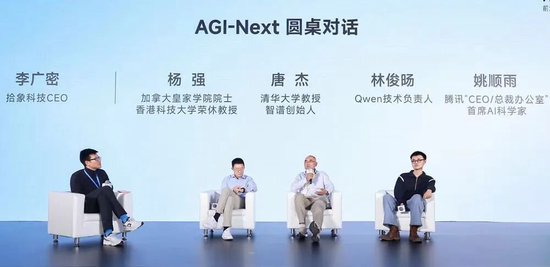
张钹、杨强与唐杰、杨植麟、林俊旸、姚顺雨(最新3万字发言实录)
Xin Lang Cai Jing· 2026-01-12 04:37
Core Insights - The AGI-Next conference highlighted the current challenges and future opportunities in AI development, particularly focusing on the capabilities and limitations of large models [3][4][5]. Group 1: Key Discussions on AGI and AI Development - Zhang Bo emphasized five fundamental deficiencies in current large models, advocating for a definition of AGI that includes executable and verifiable capabilities [3]. - Yang Qiang discussed the differentiation of agents based on their ability to autonomously set and plan goals, rather than relying on human-defined parameters [3]. - Tang Jie noted that while scaling remains a valid approach, the true exploration should focus on enabling models to possess autonomous scaling capabilities [4]. Group 2: Scaling and Model Capabilities - Yang Zhilin explained that the essence of Scaling Law is to convert energy into intelligence, emphasizing the importance of efficient approaches to reach the limits of intelligence [4]. - Lin Junyang expressed optimism about the potential for Chinese teams to achieve global leadership in AI within the next 3-5 years, estimating a 20% probability of success [4]. - Yao Shunyu highlighted the differentiation between vertical integration and layered model applications, suggesting that model companies may not necessarily excel in application development [4]. Group 3: Future Directions and Challenges - The discussion pointed out that the path from scaling to genuine generalization capabilities remains a core challenge for AI models [12][14]. - The need for models to develop memory and continuous learning structures akin to human cognition was identified as a critical area for future research [35][36]. - The exploration of self-reflection and self-awareness capabilities in AI models was deemed a significant yet controversial topic within the academic community [36][47]. Group 4: Technical Innovations and Model Architecture - The introduction of new optimization techniques, such as the Muon optimizer, was highlighted as a means to enhance token efficiency and overall model performance [55][58]. - The development of the Kimi Linear architecture aims to improve linear attention mechanisms, making them more effective for long-context tasks [64]. - The integration of diverse data sources and the enhancement of model architectures are seen as essential for achieving better agent capabilities in AI [67].