BABA(BABA)

Search documents
大行评级丨里昂:预计今年中国互联网行业涨势延续,首选腾讯、小米和阿里等
Ge Long Hui· 2026-02-05 03:24
里昂发表研报指,中国互联网行业在2025年表现强劲,随着DeepSeek引领国内AI趋势,预计2026年涨 势将延续,尤其在代理AI和生成式视频应用的竞争将加剧。中国与美国将在全球范围内的AI模型、应 用、云服务及自动驾驶(Robotaxi)领域展开正面竞争。 尽管面临地缘政治挑战,中国游戏和电商在海外市场持续快速增长,但该行对国内电商板块的前景持谨 慎态度。在投资策略上,里昂偏好AI、游戏及健康相关板块,并认为中国有望在全球引领AI应用落 地。里昂列出2026年六大首选股,包括腾讯、小米、阿里巴巴、网易、快手及京东健康,并特别指出看 好阿里巴巴的云业务、腾讯的AI应用,以及小米的消费级AI设备。 ...




中国AI产业创新步伐加快
Zhong Guo Jing Ji Wang· 2026-02-05 03:07
Core Insights - The AI industry in China is experiencing intensified competition, with major players like Baidu, Alibaba, and DeepSeek rapidly launching new technologies and products to capture the innovation high ground [1][4] - Baidu's Wenxin Model 5.0, featuring a native multimodal architecture, leads technological innovation and has achieved top rankings in both domestic and international benchmarks [1][3] - Alibaba's Qwen3-Max-Thinking model enhances reasoning efficiency and integrates deeply with its ecosystem, leveraging its traffic advantages across various platforms [2][3] - DeepSeek focuses on open-source advantages and innovative model capabilities, recently launching the DeepSeek-OCR-2 model, which improves image processing through dynamic rearrangement [2][3] Company Developments - Baidu has launched the Wenxin Model 5.0, which supports multiple data types and has achieved significant performance metrics, ranking first in domestic text and visual understanding categories [1][3] - Alibaba's Qwen3-Max-Thinking model utilizes a new testing expansion mechanism for more efficient reasoning, and it integrates with its platforms like Taobao and Alipay to enhance application scenarios [2][3] - DeepSeek's DeepSeek-OCR-2 model employs the DeepEncoder V2 method for smarter image processing, showcasing unique technical innovations [2][3] Industry Trends - The evolution of foundational large models is crucial for determining the upper limits of AI application capabilities, with a clear trend towards a three-way competitive landscape in the Chinese AI sector [1][4] - The AI industry in China is transitioning from a "catch-up" phase to a "leading" phase, driven by technological advancements and the realization of AI's value in driving industrial transformation [4]

2025胡润中国500强:最具价值国企前三名为农业银行、工商银行、国家电网
Xin Lang Cai Jing· 2026-02-05 03:06
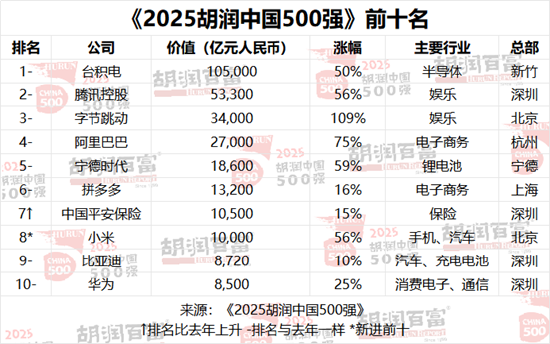
Core Insights - The "2025 Hurun China 500" report highlights TSMC as the highest-valued private enterprise in China, with a valuation increase of 3.5 trillion RMB, reaching 10.5 trillion RMB [1][4] - Tencent follows as the second highest, with a valuation growth of 1.9 trillion RMB, totaling 5.3 trillion RMB [1][4] - ByteDance ranks third, increasing its value by 1.8 trillion RMB to 3.4 trillion RMB [1][4] - Xiaomi enters the top ten for the first time, with a valuation increase of 357 billion RMB, reaching 1 trillion RMB [1][4] Top Ten Private Enterprises - TSMC: Valuation of 105,000 million RMB, growth of 50% [2][5] - Tencent: Valuation of 53,300 million RMB, growth of 56% [2][5] - ByteDance: Valuation of 34,000 million RMB, growth of 109% [2][5] - Alibaba: Valuation of 27,000 million RMB, growth of 75% [2][5] - CATL: Valuation of 18,600 million RMB, growth of 59% [2][5] - Pinduoduo: Valuation of 13,200 million RMB, growth of 16% [2][5] - Ping An Insurance: Valuation of 10,500 million RMB, decline of 15% [2][5] - Xiaomi: Valuation of 10,000 million RMB, growth of 56% [2][5] - BYD: Valuation of 8,720 million RMB, growth of 10% [2][5] - Huawei: Valuation of 8,500 million RMB, growth of 25% [2][5] Top Ten State-Owned Enterprises - Agricultural Bank: Valuation of 202,000 million RMB [3][6] - Industrial and Commercial Bank: Valuation of 274,000 million RMB [3][6] - State Grid: Valuation of 266,000 million RMB [3][6] - China National Railway Group: Valuation of 224,000 million RMB [3][6] - China Construction Bank: Valuation of 203,000 million RMB [3][6] - Kweichow Moutai: Valuation of 182,000 million RMB [3][6] - China Petroleum: Valuation of 176,000 million RMB [3][6] - Bank of China: Valuation of 170,000 million RMB [3][6] - China Mobile: Valuation of 175,000 million RMB [3][6] - CITIC Group: Valuation of 156,000 million RMB [3][6]




米兰冬奥基于阿里千问打造官方大模型
Di Yi Cai Jing· 2026-02-05 03:05
2月5日,国际奥委会正式发布基于阿里千问打造的首个奥运官方大模型。该模型将在米兰冬奥会上投入 使用,首批服务各个国家和地区的奥委会工作人员,提供多语言的官方AI助手,并计划随后向全球公 众开放。 (文章来源:第一财经) ...
2025胡润中国500强发布:寒武纪价值增长3700亿元,位列第16
Xin Lang Cai Jing· 2026-02-05 03:04
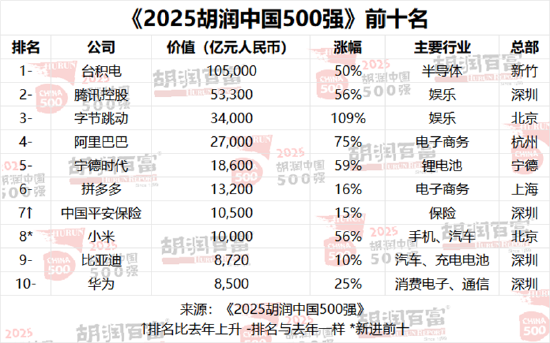
来源:5D调查 胡润研究院发布2月5日发布《2025胡润中国500强》,台积电价值增长3.5万亿元,以10.5万亿元再度蝉 联中国价值最高的民营企业。腾讯价值增长1.9万亿元,以5.3万亿元稳居第二。字节跳动价值增长1.8万 亿元,以3.4万亿元保持第三。小米新进前十,价值增长3570亿元,以1万亿元位列第八。 | | | | 《2025胡润中国500强》 前十名 | | | | | --- | --- | --- | --- | --- | --- | --- | | 排名 | 公司 | 价值(亿元人民币) | | 涨幅 | 三是得行业 | SHI | | | 合肥皂 | alle Par 200 - 100, 000 | | 50% | | | | 2- | 腾讯控股 | 53,300 | | 56%500 | 娱乐 | 深圳 | | 3- | 字节跳动 | 34,000 | | 109% | 娱乐 | 北京 | | 4- | 阿里巴巴 | 27,000 | | 75% | 电子商务 | 杭州 | | | 宁德时代 | 18,600 | 1981-1991 | 59% | 一理申池 | 宁德 | | | ...


2025胡润中国500强发布:美团退出前十,位列第17位
Xin Lang Cai Jing· 2026-02-05 02:56
胡润研究院发布2月5日发布《2025胡润中国500强》,台积电价值增长3.5万亿元,以10.5万亿元再度蝉 联中国价值最高的民营企业。腾讯价值增长1.9万亿元,以5.3万亿元稳居第二。字节跳动价值增长1.8万 亿元,以3.4万亿元保持第三。小米新进前十,价值增长3570亿元,以1万亿元位列第八。美团退出前 十,位列第17位。 从价值上涨的绝对数额来看,过去一年中增长最多的是台积电,其价值增长了3.5万亿元,主要原因是 人工智能需求的强劲拉动、先进的制程技术以及稳固的市场地位。其次是腾讯,价值增长了1.9万亿 元,主要是由于其在游戏、广告、金融科技三大主业的出色表现,推动了公司整体业绩的提升。位列第 三的是字节跳动,价值增长了1.8万亿元,得益于AI业务的进展推动公司估值持续走高。 阿里巴巴价值增长1.2万亿元,主要因为阿里巴巴在人工智能和云计算领域的战略投入取得了高速增 长,以及传统电商基本盘企稳回升。 宁德时代价值增长6900亿元,主要得益于新能源汽车市场需求的持续增长。2025年5月,宁德时代在港 交所二次上市,募资超325亿元人民币,成为2025年港股最大IPO。 有着"中国的英伟达"之称的寒武纪,价值 ...

2025胡润中国500强发布:台积电、腾讯、字节跳动位列前三
Xin Lang Cai Jing· 2026-02-05 02:27
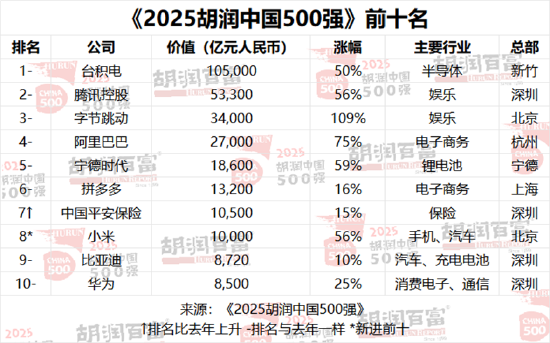
Core Insights - The 2025 Hurun China 500 list shows significant growth in company valuations, with TSMC leading as the highest valued private enterprise in China at 10.5 trillion RMB, followed by Tencent and ByteDance [1][9]. Company Performance - TSMC's value increased by 3.5 trillion RMB, driven by strong demand for artificial intelligence, advanced process technology, and a solid market position [3][11]. - Tencent's valuation rose by 1.9 trillion RMB, attributed to strong performance in gaming, advertising, and fintech [3][11]. - ByteDance's value grew by 1.8 trillion RMB, benefiting from advancements in AI [3][11]. - Alibaba's value increased by 1.2 trillion RMB, due to strategic investments in AI and cloud computing, alongside a recovery in traditional e-commerce [4][12]. - CATL's valuation rose by 690 billion RMB, supported by sustained demand in the electric vehicle market [4][12]. - Xiaomi entered the top ten with a valuation increase of 357 billion RMB, driven by growth in its automotive business and premium smartphone sales [4][12]. - Other notable companies include Cambricon, which saw a valuation increase of 370 billion RMB, and NetEase, which grew by 238 billion RMB due to strong gaming performance [4][12]. Industry Trends - The total value of the Hurun China 500 companies increased by 21 trillion RMB (38%) to reach 77 trillion RMB [2][10]. - The semiconductor industry experienced the most significant growth, surpassing the life sciences sector to become the second-largest industry in the list, while industrial products remained the largest [2][10]. - The real estate sector faced the largest decline, followed by retail [2][10]. - The average age of the top 500 companies is 29 years, indicating a relatively young corporate landscape [11]. Geographic Insights - Beijing, Shanghai, and Shenzhen are the top three cities with the most companies on the list, housing 59, 57, and 49 companies respectively [2][10]. - Suzhou emerged as the preferred manufacturing base with 68 companies, while Shanghai was the leading research and development hub with 101 companies [2][10]. New Entrants and Market Dynamics - A total of 95 companies (19%) made it to the list for the first time, with seven companies valued over 100 billion RMB [2][10]. - The threshold for entry into the 2025 Hurun China 500 increased by 7.5 billion RMB to 34 billion RMB, reflecting a 28% rise [2][10].


中国互联网行业展望 - 回应投资者关切:聚焦 AI 投资策略、监管与政策等核心领域-Navigating China Internet_ Addressing investor questions_focus areas around AI investment strategies, regulations and policies
2026-02-05 02:22
Summary of Key Points from the Conference Call Industry Overview - The focus is on the **China Internet** sector, particularly regarding **AI investments** and the competitive landscape among major players like **Tencent**, **Alibaba**, and **ByteDance** [1][3]. Core Insights and Arguments - **AI Investment Strategies**: 2026 is expected to be a pivotal year for AI investments, with increased capital expenditures (capex) and operational expenditures (opex) from major internet companies [1][3]. - **Competition**: There is an intensified competition for consumer AI super apps, with seamless transaction capabilities being crucial for user retention [1][3]. - **Regulatory Concerns**: Investors are worried about potential regulatory tightening similar to the 2020-21 cycle, which has contributed to a recent decline in sector share prices (HSTECH down by 10% in the past week) [1][9]. - **Tax Policies**: Recent changes in VAT and income tax rates are expected to impact profit growth and sector valuations. A sensitivity analysis indicates that a 1% increase in VAT could reduce pre-tax profits for major companies like Alibaba and Tencent by approximately 0.4% to 0.8% [31][34][41]. Upcoming Catalysts - Key events to watch include further AI model launches around the **Chinese New Year (CNY)**, developments in **anti-trust investigations** by SAMR, and the upcoming earnings season [2][3]. Stock Recommendations - **Valuation Metrics**: The median P/E ratio for China Internet companies is noted at 17X for 2026E, which is lower compared to US peers like META and GOOG [3][56]. - **Top Picks**: Alibaba and Tencent are highlighted as the best-positioned mega-cap stocks for long-term growth. Other recommended stocks include GDS, VNET, and Kuaishou, focusing on themes like EPS growth and shareholder returns [8][3]. Regulatory Landscape - Ongoing investigations by SAMR into the food delivery sector are aimed at promoting fair competition and may impact profit margins for companies like Meituan, Alibaba, and JD [45][46]. - The government is expected to support the healthy development of industries, particularly small to medium-sized enterprises (SMEs) [9]. Financial Performance and Projections - **Capex Forecasts**: Significant increases in capex are anticipated for Alibaba (Rmb454 billion) and ByteDance (Rmb300 billion) due to AI advancements [50][51]. - **Profitability Trends**: Tencent's cloud business has achieved profitability, and the company is optimistic about its Interactive and Entertainment Group's performance [27]. Conclusion - The China Internet sector is at a critical juncture with substantial investments in AI, regulatory challenges, and evolving competitive dynamics. Companies are advised to navigate these complexities while focusing on innovation and user engagement strategies to maintain market leadership [1][3][9].
如何看待目前的计算机与AI应用
2026-02-05 02:21
Summary of Key Points from Conference Call Records Industry Overview - The conference discusses the current state of the AI application and computer hardware industry, highlighting a divergence in stock prices due to performance differences and market concerns, such as AbbVie's market cap decline despite a 68% revenue growth and 82% adjusted net profit margin in Q3 2025 [1][3][4]. Core Insights and Arguments - AI applications are expected to see significant growth in 2026, termed the "year of AI applications and intelligent agents," driven by technological breakthroughs and the emergence of new applications like Claude Bot [2]. - Major companies like ByteDance, Alibaba, and Tencent are intensifying their investments in AI, leading to increased competition. ByteDance is leveraging its partnership with the Spring Festival, while Alibaba is integrating its ecosystem, and Tencent is focusing on talent acquisition [7][8]. - Domestic AI application companies face challenges from insufficient domestic demand and slowing growth in traditional businesses. For instance, Salesforce's stock price nearly halved, with Q3 revenue growth at only 8.3% [5]. Performance of Key Companies - Among 238 computer companies, 36% expect positive net profits, with over 60% anticipating profit growth. Leading firms like iFlytek and Deepin Technology are performing well, indicating a positive trend in the AI sector [6]. - Palantir reported Q4 revenue of $1.41 billion, a 70% year-over-year increase, but faced challenges with only 8% growth in overseas B-end revenue, leading to varied market expectations [4]. Emerging Trends and Investment Opportunities - Investors should focus on two main investment themes: clear and actionable super industry trends such as AI programming and personal intelligent assistants, and long-term collaboration opportunities within large tech company ecosystems [9]. - Companies like Zhuoyue Information and Zhiyu Technology are highlighted as core players in the AI programming sector, showing significant progress and growth potential [10]. Importance of Network Services - NetEase Technology's role in the AI era is emphasized due to its low latency, high interaction frequency, and massive data processing capabilities, which are crucial for AI applications [14]. - The demand for CDN services is expected to rise significantly, with projections indicating a "volume and price rise" scenario, making it an attractive investment opportunity [15][16]. Multi-modal Development - The development of multi-modal applications, such as AI short dramas and comics, is identified as a key growth area, with companies like Zhaochi and Wanxing Technology leading the charge [12]. Conclusion - The conference highlights the dynamic landscape of the AI and computer hardware industry, with significant opportunities for growth and investment, particularly in AI applications and network services, as major companies ramp up their efforts in this space.


30亿请客 vs 社交派对:这个春节,AI在如何“算计”你的生活?
Huan Qiu Wang· 2026-02-05 02:09
Core Insights - Major Chinese internet companies are shifting their focus to AI applications during the Spring Festival, aiming to dominate the AI assistant market and establish a strong ecosystem for the future [1][15] - The competition has evolved from a parameter-based race to a practical application phase, with the Spring Festival serving as a critical testing ground for user acceptance and engagement with AI products [1][15] Group 1: Tencent's Strategy - Tencent launched its AI assistant "Yuanbao" and introduced the "Yuanbao Party," integrating AI deeply into its social platforms QQ and WeChat, aiming to enhance user interaction and engagement [2][6] - The company seeks to leverage its extensive social network to provide a strong initial user base for AI, positioning itself as a leader in redefining social interactions in the AI era [6] Group 2: Alibaba and Ant Group's Approach - Ant Group's "Qianwen" app is investing 3 billion yuan in a "Spring Festival Treat" initiative, promoting its AI capabilities to streamline consumer experiences and encourage direct interactions with AI for transactions [7][9] - The integration of health-focused AI services into traditional activities like the "Ji Fu" event reflects a strategic move to address public health concerns while embedding AI into familiar user experiences [10][12] Group 3: Baidu and ByteDance's Tactics - Baidu is offering a 500 million yuan red envelope campaign to encourage users to engage with its AI features, aiming to solidify its position in the AI and information retrieval space [13] - ByteDance is partnering with major events like the CCTV Spring Festival Gala to showcase its AI capabilities, focusing on brand positioning and technology leadership in the AI sector [13][14] Group 4: Industry Trends and Future Challenges - All companies recognize the shift of AI from a novelty to a necessity in digital life, with the Spring Festival providing an optimal opportunity for user education and habit formation [15] - The challenge lies in retaining users post-subsidy, ensuring that AI products deliver unique value that transcends traditional offerings [15] - Future competition will revolve around defining the next generation of human-computer interaction, with various companies exploring different paradigms of AI engagement [15]