
BIDU(BIDU)

Search documents
李彦宏《人民日报》撰文,提出内化AI能力“三步走”
Nan Fang Du Shi Bao· 2025-11-20 02:07
Core Viewpoint - The article emphasizes the importance of internalizing AI capabilities across various industries to enhance productivity and drive high-quality development [1][3]. Group 1: Internalizing AI Capabilities - Companies face the challenge of internalizing AI capabilities, which can be addressed by driving innovation through new scenarios and enhancing AI application capabilities [3][4]. - Specific AI technologies such as digital human technology, code intelligence, and autonomous driving have shown effective results in various applications [3][4]. - AI can help companies reduce costs, increase profits, optimize decision-making, and discover new growth points, particularly in scenarios with repetitive labor, labor shortages, high-risk jobs, bottlenecks, and complex decision-making [4][5]. Group 2: Industry Integration and AI Growth Engine - Internalizing AI capabilities in key industries like mining, chemicals, light industry, and shipping can strengthen the foundation of the real economy [5][6]. - The example of Baidu's algorithmic intelligence tool "Famu" demonstrates significant efficiency improvements in complex systems such as traffic and logistics [5]. - The integration of AI capabilities tailored to industry characteristics can enhance overall productivity and innovation capacity across sectors [5][6]. Group 3: Strategic Planning for AI Empowerment - There is an urgent need to explore new organizational and management models that facilitate human-machine collaboration in the context of systemic and structural changes brought by AI [6]. - Companies must ensure that AI capabilities permeate every aspect of production, operation, and service, from decision-making to execution [6]. - Baidu plans to increase investment in building advanced intelligent infrastructure and developing cutting-edge large model technologies to support the internalization of AI capabilities across industries [6].


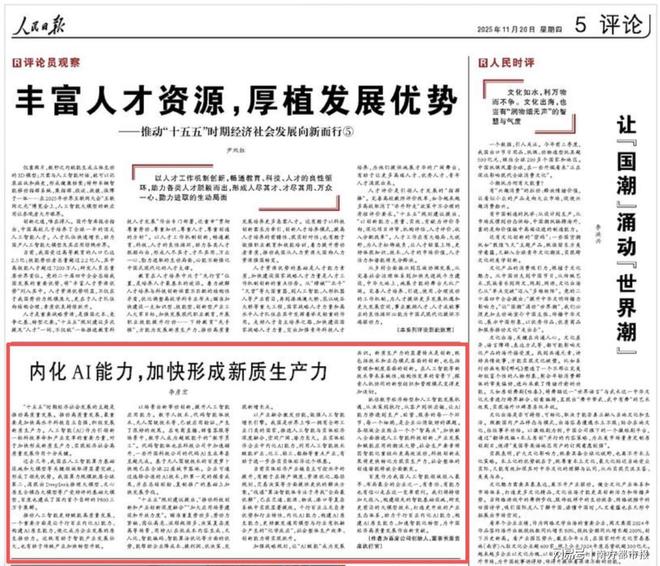
李彦宏人民日报撰文
Sou Hu Cai Jing· 2025-11-20 01:25
Core Viewpoint - The article emphasizes the importance of high-quality development driven by technological self-reliance and innovation, particularly through the integration of artificial intelligence (AI) into various industries [1][2][3] Group 1: AI Development and Infrastructure - China has made significant breakthroughs in AI infrastructure and large models, achieving a leading position globally, with its computing power ranking second in the world [1] - Notable AI models such as DeepSeek and Wenxin have been developed, alongside the establishment of the P800 self-researched cluster by Baidu [1] Group 2: Integration of AI in Industries - The integration of AI capabilities into various industries is crucial for enhancing productivity and driving transformation in traditional sectors [2] - AI technologies can optimize production scheduling, resource allocation, and decision-making processes, thereby improving the autonomy of industrial supply chains [2] Group 3: Strategic Planning and Innovation - The article highlights the need for strategic planning to make "AI empowerment" a common development consensus, focusing on both technological and managerial innovations [2] - Companies are encouraged to embed AI capabilities into every aspect of their operations to enhance efficiency and innovation [3] Group 4: Baidu's Role in AI Advancement - Baidu is positioned as a leader in the AI sector, committed to investing in advanced infrastructure and model technologies to support the integration of AI across various industries [3] - The company aims to accelerate the intelligent transformation of industries, contributing to China's high-quality economic development [3]
From Search Engine to AI Engine: Baidu's Rise at the Center of China's AI Future
The Motley Fool· 2025-11-20 01:16
Core Insights - Baidu is transitioning from a search engine to an AI engine, positioning itself at the forefront of China's AI boom [1][12] - Contrarian Capital Management has acquired a new stake in Baidu, indicating investor confidence in the company's evolving trajectory [2][11] Company Overview - Baidu's market capitalization is $40.75 billion, with a revenue of $18.72 billion and a net income of $3.93 billion for the trailing twelve months [4] - The company's stock price as of November 12, 2025, is $128.94, reflecting a 52.05% increase over the past year, outperforming the S&P 500 by 31.90 percentage points [9] Business Model and Strategy - Baidu operates a diversified business model that includes advertising, cloud services, and digital content, making it a key technology provider in China [6][10] - The company's focus on AI and content innovation is enhancing its competitive advantage in the digital economy [6] Recent Developments - The new position in Baidu by Contrarian Capital Management accounts for 3.3961% of the fund's U.S. equity assets, suggesting a significant interest in Baidu's potential [2][8] - Baidu's evolution is marked by its AI-native cloud platform and advancements in autonomous driving, indicating a shift from its traditional search and advertising business [12][13] Future Outlook - The growth in AI cloud services and the adoption of Baidu's ERNIE models are expected to drive the company's long-term growth [13][14] - Investors will be closely monitoring how Baidu balances investment in generative AI and autonomous driving with profitability [14]

From Search Engine to AI Engine: Baidu’s Rise at the Center of China’s AI Future
Yahoo Finance· 2025-11-20 01:16
Core Insights - Baidu, Inc. is evolving from being known primarily as "China's Google" to a more diversified technology provider, focusing on AI and cloud services, which are expected to redefine its long-term trajectory [4][5]. Company Overview - Baidu is a leading internet and AI company in China, utilizing its search and cloud platforms to provide digital marketing and cloud solutions [1]. - The company's business model includes advertising, cloud services, and digital content, positioning it as a key player in the Chinese technology market [1]. Financial Performance - As of November 12, 2025, Baidu shares were priced at $128.94, reflecting a 52.05% increase over the past year, outperforming the S&P 500 by 31.90 percentage points [2]. - Contrarian Capital Management reported a new stake in Baidu, acquiring 102,139 shares valued at approximately $13.46 million, which represents 3.3961% of its U.S. equity assets [2][3]. Strategic Developments - Baidu's growth is increasingly driven by its AI-native cloud platform and ERNIE language models, which are expanding enterprise use cases [5]. - The company is also making strides in autonomous driving through its Apollo project, indicating a shift in its foundational business model [4][5]. Future Outlook - The development of Baidu's cloud and AI businesses, along with the adoption of ERNIE across various industries, will be critical in determining its next growth phase [6]. - Balancing investment in generative AI and autonomous driving with profitability will be essential for Baidu's long-term success [6].
日本债券遭遇市场抛售,谷歌Gemini3正式发布 | 财经日日评
吴晓波频道· 2025-11-20 00:30
Group 1: Japan's Economic Outlook - Japan's 10-year government bond yield reached a 17-year high of 1.765%, driven by expectations of significant fiscal spending under Prime Minister Kishida [2] - The 40-year bond yield hit a historical peak of 3.695%, while the 20-year yield reached 2.815%, marking the highest levels since 1999 [2] - The anticipated fiscal expansion is expected to lead to increased government borrowing, contributing to the sell-off in Japanese bonds [2] Group 2: French Investment in China - Approximately 2,800 French companies have established operations in China, making France the largest European investor in the Chinese market [3] - China is the fourth-largest trading partner for France, with French investments in China accounting for one-third of the total [3] - The "France 2030" investment plan aims to inject €54 billion over five years to promote re-industrialization, benefiting foreign investors [3] Group 3: Xiaomi's Financial Performance - Xiaomi reported a total revenue of 113.1 billion yuan for Q3 2025, a year-on-year increase of 22.3%, with adjusted net profit rising 80.9% to 11.3 billion yuan [7] - The smart electric vehicle and AI segment achieved a record revenue of 29 billion yuan, growing 199.2% year-on-year, marking its first profitable quarter [7] - The smartphone and AIoT segments showed modest growth, with challenges anticipated in the automotive sector due to reduced subsidies and increased competition [7] Group 4: Pinduoduo's Revenue Growth - Pinduoduo's Q3 revenue reached 108.28 billion yuan, reflecting a 9% year-on-year growth, with net profit increasing 17% to 29.33 billion yuan [8] - The growth was primarily driven by online marketing services and transaction service revenues, although the pace of growth has slowed [8] - Increased R&D expenses, up 41% year-on-year to 4.33 billion yuan, are aimed at enhancing the company's competitive edge in AI and overseas markets [8][9] Group 5: Baidu's AI Business Performance - Baidu's total revenue for Q3 was 31.2 billion yuan, a 7% decline, while net profit fell 36% to 3.77 billion yuan [10] - The AI business saw over 50% growth, with AI cloud revenue up 33% and AI native marketing services skyrocketing 262% to 2.8 billion yuan [10] - Despite the decline in traditional advertising revenue, Baidu's AI initiatives are showing promise, although profitability remains a concern [10][11] Group 6: Nvidia and Microsoft's Investment in Anthropic - Nvidia and Microsoft announced a collaboration with Anthropic, involving investments of up to $100 billion and $50 billion, respectively [12] - Anthropic plans to purchase $30 billion worth of Azure cloud capacity, indicating strong demand for AI services [12] - The investment cycle raises concerns about potential financial losses if AI products do not generate sufficient returns, despite ongoing advancements in AI technology [13]




百度AI业务单季收入96亿增超50% 投入超千亿加速大模型商业化落地
Chang Jiang Shang Bao· 2025-11-19 23:48
Core Insights - Baidu's AI business shows strong growth, with total revenue reaching 96 billion RMB, a year-on-year increase of over 50%, becoming a key driver for long-term growth amid traditional business pressures [1][3] Financial Performance - Baidu reported total revenue of 312 billion RMB for Q3 2025, a year-on-year decline of 7%. The net profit attributable to Baidu under non-GAAP was 37.7 billion RMB, down 36% [2] - Core revenue was 247 billion RMB, also down 7% year-on-year, with non-GAAP net profit for core operations at 38 billion RMB, a decrease of 32% [2] AI Business Segments - The AI business consists of three categories, with revenue of 96 billion RMB, showing a year-on-year growth of over 50% [3] - AI infrastructure revenue reached 42 billion RMB, a 33% increase year-on-year, with high-performance computing subscription revenue growing by 128% [3] - AI applications generated 26 billion RMB in revenue, while AI-native marketing services achieved 28 billion RMB, a remarkable growth of 262% [3] User Engagement and Market Position - Baidu AI search has a monthly active user base of 3.82 billion, reflecting an 18.63% quarter-on-quarter increase, maintaining its leading position in the AI search industry [3] - The total monthly active users for Baidu's flagship AI applications, including Baidu Wenku and Baidu Wangpan, are nearing 300 million [3] Other Business Highlights - The "Luobo Kuaipao" service saw a significant increase in global ride service instances, reaching 3.1 million, a 212% year-on-year growth [4] - The service has expanded its global footprint, covering 22 cities and achieving over 1.4 billion kilometers in autonomous driving mileage [4] - Baidu's founder highlighted the transformative value of AI in business, emphasizing the robust growth of AI cloud and the rapid expansion of the "Luobo Kuaipao" service [5]
两个月回撤超15%!恒科指数长期逻辑不改,市场关注AI落地效果
Zheng Quan Shi Bao· 2025-11-19 23:48
Core Viewpoint - Since 2025, the Hong Kong stock market, led by technology and innovative pharmaceuticals, has experienced a bull market, with the Hang Seng Index rising over 30% and the Hang Seng Tech Index exceeding 50%. However, since October, the Hang Seng Tech Index has seen a significant pullback of over 15% in less than two months, with a recent streak of four consecutive declines. Analysts believe that this short-term adjustment does not alter the long-term investment logic for leading tech stocks in Hong Kong, especially with the gradual implementation of AI technologies by companies like Tencent and Alibaba, which is expected to drive a second growth phase for internet enterprises. The long-term investment value of the Hang Seng Tech Index remains promising due to valuation advantages, funding support, and AI-driven industrial upgrades [1][3][4]. Group 1: Market Performance - Before October, Hong Kong tech stocks were performing well, with 9 out of 30 constituents of the Hang Seng Tech Index rising over 100%, and the top performer, Hua Hong Semiconductor, increasing nearly 270%. Other notable stocks like Tencent, Baidu, and Xiaomi also saw gains exceeding 50%, while only Meituan and Haier Smart Home experienced declines, with Meituan dropping over 30% [1][2]. - After October, the situation changed dramatically, with only 4 stocks rising, while 7 stocks fell over 20%, including Li Auto and Sunny Optical Technology, which both dropped over 27%. Tencent and Meituan also saw declines of around 5% [2]. Group 2: Fund Flows and Market Sentiment - There has been a noticeable outflow of southbound funds from certain Hang Seng Tech constituents, with Alibaba experiencing the highest net sell-off of 2.5 billion HKD, followed by Li Auto and Sunny Optical Technology with net sell-offs of 1.2 billion HKD and several hundred million HKD, respectively [2]. - The recent downturn in the Hang Seng Tech Index is attributed to three main factors: excessive prior gains leading to profit-taking, the U.S. imposing tariffs and tightening software export controls, and a mini-crash in U.S. AI stocks resulting in a significant drop in global tech risk appetite [2][3]. Group 3: Long-term Investment Logic - Despite short-term volatility, the long-term investment logic for the Hang Seng Tech Index remains intact, as it comprises internet giants and companies in semiconductors and electric vehicles that are considered scarce assets for both domestic and global investors [3][4]. - Analysts suggest that the current valuation of the Hang Seng Index and Hang Seng Tech Index is still significantly lower than their peaks in 2021, indicating potential for recovery and growth in the coming years [3]. Group 4: AI and Market Revaluation - The market is increasingly focused on the tangible effects of AI implementation, moving from a narrative-driven approach to one that emphasizes financial performance. Companies like Tencent and Alibaba are seeing revenue growth attributed to AI applications, with Tencent reporting a 15% year-on-year revenue increase and Alibaba planning substantial investments in AI and cloud infrastructure [5][6]. - The structural revaluation driven by AI and robotics is expected to benefit comprehensive platforms like Tencent, Alibaba, and Baidu, while smaller companies lacking their own ecosystems may face marginalization during the global de-bubble process [6].



李彦宏人民日报撰文
财联社· 2025-11-19 23:29
Core Viewpoint - The article emphasizes the importance of artificial intelligence (AI) in driving high-quality economic development and the need for industries to internalize AI capabilities to enhance productivity and innovation [2][5]. Group 1: AI's Role in Economic Development - AI is identified as a key driver of a new round of technological revolution and industrial transformation, crucial for achieving high-quality economic development [2]. - China has made significant advancements in AI infrastructure and large models, ranking second globally in computing power and developing notable models like DeepSeek and Wenxin [2][3]. Group 2: Application of AI in Various Industries - AI technologies such as digital humans, code intelligence, and autonomous driving have been successfully applied in various sectors, enhancing operational efficiency [3]. - The article highlights the successful deployment of Baidu's autonomous driving technology in 22 cities globally, showcasing the practical applications of AI [3]. Group 3: Integration of AI in Traditional Industries - The integration of AI into traditional industries is seen as essential for enhancing productivity and driving transformation, particularly in sectors like mining, chemicals, and light industry [4]. - The article discusses the importance of optimizing production scheduling, resource allocation, and decision-making through AI solutions to improve the autonomy of industrial chains [4]. Group 4: Strategic Planning and Organizational Change - The need for strategic planning to make "AI empowerment" a common development consensus is emphasized, highlighting the importance of innovation in technology, business models, and management practices [4]. - Companies are encouraged to integrate AI capabilities across all operational aspects, from decision-making to supply chain management, to enhance efficiency and innovation [4]. Group 5: Baidu's Commitment to AI Development - Baidu is positioned as a leading player in the AI sector, committed to investing in advanced infrastructure and model technology to support the internalization of AI capabilities across various industries [5]. - The company aims to contribute to China's high-quality economic development by fostering an open industrial ecosystem and accelerating the intelligent transformation of industries [5].

【早报】英伟达,业绩全面超预期;中金公司,拟收购两家上市券商
财联社· 2025-11-19 23:10
Industry News - CICC, Dongxing Securities, and Xinda Securities announced a major asset restructuring plan, with CICC planning to absorb Dongxing and Xinda through a share exchange, leading to a trading suspension [4] - The price of Flash memory wafers has increased significantly, with the highest rise reaching 38.46% as of November 19 [5] - The semiconductor industry is expected to see a 50% increase in memory prices by the second quarter of 2026 due to critical chip shortages [6] - The Ministry of Agriculture and Rural Affairs and the Xinjiang government issued a plan to modernize agricultural facilities, aiming to upgrade 30,000 acres by the end of 2028 [4] Company News - Nvidia reported Q3 revenue of $57.01 billion, a 62% year-over-year increase, and provided a Q4 revenue outlook of approximately $65 billion, exceeding market expectations [16] - Kuaishou Technology's Q3 revenue reached 35.55 billion yuan, a 14.2% year-over-year increase, with adjusted net profit growing by 26.3% [7] - Huaneng Group announced a collaboration with a major automotive manufacturer for a smart cockpit project worth 4.2 billion yuan [10] - Baidu disclosed its AI business revenue for Q3, showing over 50% growth, with AI cloud revenue increasing by 33% [18]




外资机构三季度加仓中国资产
Shen Zhen Shang Bao· 2025-11-19 23:08
Core Insights - Foreign institutions significantly increased their holdings in Chinese assets during the third quarter, with major players like Goldman Sachs, Morgan Stanley, and Merrill Lynch raising their A-share positions by over 20% [1][3] - The China Overseas Internet ETF (KWEB) saw substantial investment from foreign institutions, with its size growing from $6.373 billion at the end of the first half to $9.793 billion by the end of the third quarter [2] Group 1: Foreign Investment Trends - Major foreign institutions such as Bank of America, UBS, Morgan Stanley, and Millennium Management have increased their holdings in the China Overseas Internet ETF, with share counts rising by 215.89%, 35.29%, 24.76%, and 307.44% respectively [2] - As of the end of the third quarter, 3,554 A-share companies had foreign institutional holdings, totaling approximately ¥2.73 trillion, reflecting a 12.4% increase from the previous quarter [3] Group 2: Specific Stock Increases - Citigroup held 3.83 million shares of Alibaba, with a market value of $684 million, showing a quarter-on-quarter increase of 5.63% in shares and 66.45% in market value [3] - JPMorgan held 5.58 million shares of Pinduoduo, with a quarter-on-quarter increase of 17.5% in shares and 48.38% in market value [3] - Citigroup held 350,000 shares of Baidu, with a quarter-on-quarter increase of 6.75% in shares and 64% in market value [3] Group 3: Institutional Insights - Notable foreign institutions such as Morgan Stanley, Goldman Sachs Asia, and Merrill Lynch significantly increased their A-share holdings, with Morgan Stanley's increase exceeding 30% at 33.1% [3] - As of the third quarter of 2025, foreign institutional investors further increased their holdings in Chinese stocks, with the top 40 global investment institutions' holdings rising to 1.1%, the highest level since the first quarter of 2023 [3]


