
BIDU(BIDU)

Search documents
全球资本疯狂调仓!三大板块引发A股预期,科技牛行情能否再现?
Sou Hu Cai Jing· 2026-01-04 04:23
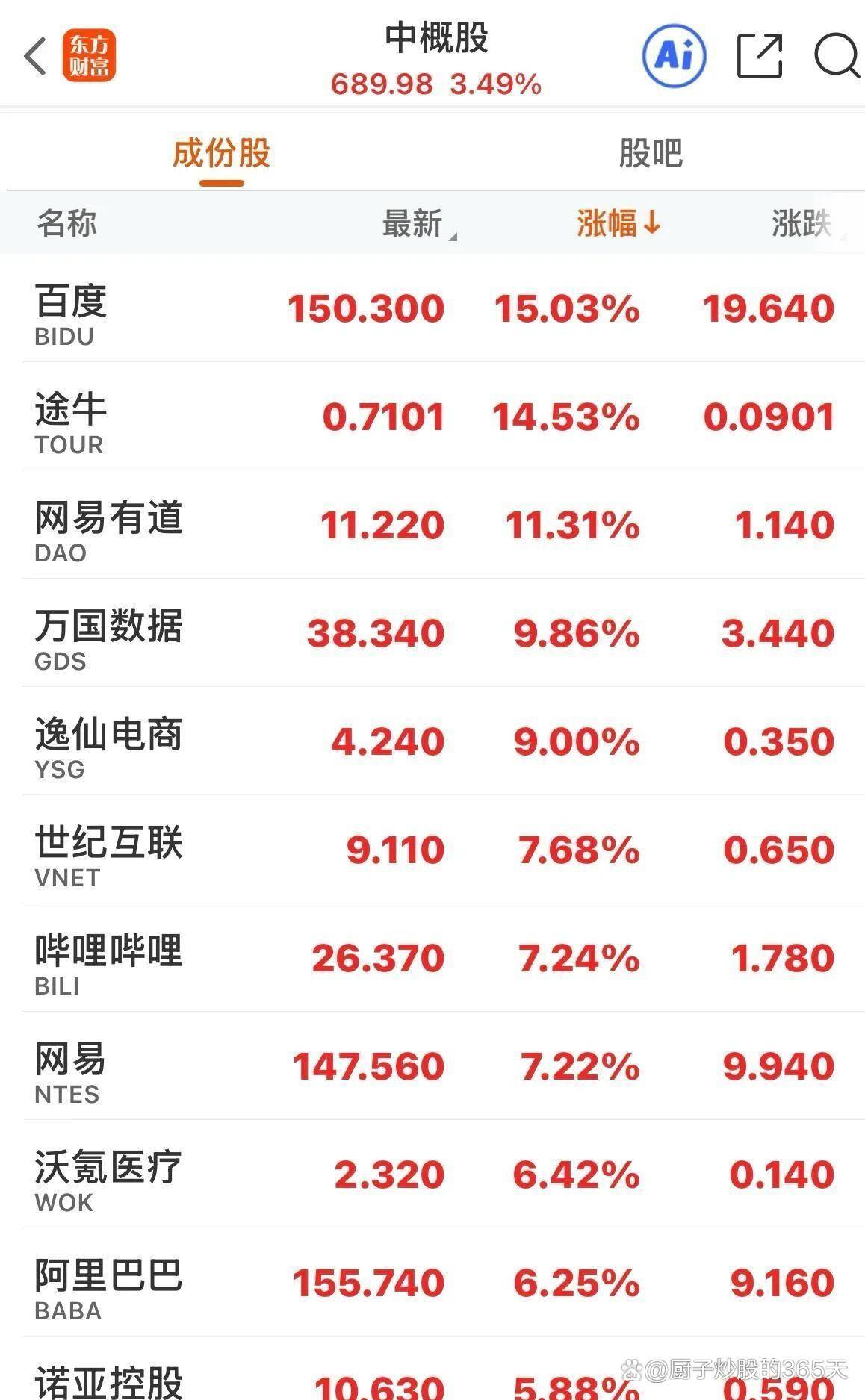
Group 1 - Baidu's stock price surged by 15.03% to $150.3, marking a three-year high, following the announcement of the spin-off of its AI chip business, Kunlun Chip, for a Hong Kong listing [1] - Analysts have redefined Baidu from a "search company" to a "full-stack AI enterprise," highlighting its extensive AI layout that includes chips, frameworks, large models, and applications [1] - The surge in Baidu's stock is part of a broader trend of global tech stocks rallying at the start of 2026, indicating a re-evaluation of Chinese tech values [1] Group 2 - On the same day as Baidu's stock surge, the U.S. stock market showed a mixed performance, with the Nasdaq index slightly down by 0.03%, while the semiconductor and commercial aerospace sectors experienced significant gains [3][4] - The semiconductor sector saw companies like Micron Technology and ASML rise by 10.74% and 8.78%, respectively, indicating a shift of capital from traditional tech stocks to hard tech sectors [3][4] - European markets also performed well, with indices like Germany's DAX and France's CAC rising by 0.20% and 0.56%, respectively, suggesting a rotation of global capital from the U.S. to non-U.S. markets [3][4] Group 3 - Baidu's AI chip, Kunlun, has replaced 90% of NVIDIA GPUs in training its Wenxin large model and secured nearly $1.5 billion in orders from China Mobile, leading to a valuation increase from 13 billion to 21 billion [11] - Baidu's AI business has shown significant growth, with new AI business revenue accounting for 37% of total revenue in the first three quarters of 2025, and daily calls for the Wenxin model exceeding 1 billion [11] - The company's autonomous driving platform has achieved profitability in 20 cities, further solidifying its position as more than just an advertising company [11]


2026投资主线浮现!中概股狂涨4%百度飙15%,黄金跳水藏玄机?
Sou Hu Cai Jing· 2026-01-04 04:00
Group 1 - The core point of the article highlights the contrasting market movements, with Chinese concept stocks surging by 4% and Baidu soaring by 15%, while gold prices experienced a significant drop of over 4.5% [1][2] - The surge in Chinese concept stocks is attributed to the successful implementation of US-China audit cooperation, which has alleviated delisting risks and encouraged foreign investment [2][3] - Baidu's 15% increase is driven by the announcement of its AI chip company Kunlun's application for independent listing, which is expected to unlock significant value due to its strong market position and order volume [2][3] Group 2 - The drop in gold prices is explained by three main factors: profit-taking after a 70% increase in 2025, a rebound in the US dollar, and increased trading costs due to higher margin requirements [3][4] - The article suggests that the investment theme for 2026 is clear, focusing on following policy directions and investing in hard technology sectors such as AI, high-end manufacturing, and consumer recovery [4][5] - The market logic indicates that sectors with policy support and performance certainty will thrive, emphasizing the importance of focusing on companies with solid technology and real orders rather than engaging in speculative trading [6]

李彦宏,分拆210亿芯片独角兽
创业邦· 2026-01-04 03:48
Core Viewpoint - Baidu's Kunlun Chip is set to go public, reflecting its growing importance in the AI chip market and aligning with the company's broader AI strategy [5][6][9]. Group 1: IPO and Market Position - Kunlun Chip has submitted a confidential application for listing on the Hong Kong Stock Exchange, with plans to potentially expedite its IPO timeline to early 2027 [5][6]. - The company has achieved a post-financing valuation of 21 billion yuan (approximately 3 billion USD) as of July 2025 [8]. - Following the IPO announcement, Baidu's stock surged by 15%, pushing its market capitalization above 50 billion USD [22]. Group 2: Strategic Importance of Kunlun Chip - The separation of Kunlun Chip is expected to enhance its image among clients and partners, facilitate direct access to capital markets, and improve management focus [19]. - The chip is positioned as a key player in the domestic AI landscape, especially as the demand for local chip solutions increases due to external supply chain disruptions [17][15]. - Kunlun Chip is projected to generate over 1 billion yuan (approximately 150 million USD) in revenue in 2024, with expectations to reach 5 billion yuan (approximately 750 million USD) in 2025 [18]. Group 3: Technological Advancements - Kunlun Chip has developed the P800 series, designed specifically for large model training, and is capable of supporting extensive AI workloads [40][38]. - The company aims to expand its cluster scale to one million cards by 2030, indicating a strong commitment to enhancing its technological capabilities [32]. - The P800 chip has been successfully utilized in various applications, including a significant project with China Mobile, showcasing its competitive edge in the market [41]. Group 4: Leadership and Management - The leadership of Kunlun Chip has been entrusted to Ouyang Jian, who has been pivotal in driving the company's growth and commercialization efforts since its independence [36][34]. - The company has undergone rapid iterations and product launches, with a focus on meeting market demands and enhancing its technological offerings [37].
百度持有的昆仑芯值多少?高盛:若类比寒武纪估值,相当于百度市值的45%
Hua Er Jie Jian Wen· 2026-01-04 03:40
Core Viewpoint - Goldman Sachs highlights that Baidu's chip division, Kunlun Chip, has officially submitted its listing application in Hong Kong, marking a significant step in unlocking asset value for Baidu [1][2]. Group 1: Listing and Ownership Structure - Kunlun Chip submitted its listing application to the Hong Kong Stock Exchange on January 1, 2026, through a global offering that includes both public and institutional placements [2]. - As of August 2025, Baidu holds a 59% controlling stake in Kunlun Chip, which is expected to remain a subsidiary post-listing, allowing Baidu to unlock market value while maintaining control over its core computing infrastructure [2]. Group 2: Financial Projections - Goldman Sachs projects that Kunlun Chip's revenue will reach approximately 6.5 billion RMB in 2026, with external sales expected to grow significantly, accounting for 14% of total cloud sales [7]. - The revenue structure is anticipated to shift towards more recurring and high-value subscription services, which could represent 43% of Baidu Cloud's total revenue by 2026 [7]. Group 3: Valuation Insights - If Kunlun Chip is valued similarly to Cambricon at a 40x price-to-sales ratio, Baidu's 59% stake could be worth up to $22 billion, representing 45% of Baidu's current market capitalization [1][12]. - A conservative valuation range for Kunlun Chip's 100% equity is estimated between $5 billion and $18 billion, translating to a value of $3 billion to $11 billion for Baidu's stake, which is 6% to 23% of its current market cap [12]. Group 4: Competitive Landscape - Comparisons with peers like Cambricon and Moore Threads indicate that these companies are trading at 40x to over 100x their projected 2026 sales, suggesting significant potential for Kunlun Chip's valuation [8]. - Goldman Sachs notes that Kunlun Chip's sales are expected to surpass those of Moore Threads and Wallen Technology by 2026, although it may lag behind Cambricon [8]. Group 5: Investment Implications and Catalysts - Goldman Sachs maintains a "Buy" rating on Baidu with a target price of $155, indicating confidence in Baidu's transition from traditional advertising to non-search business driven by AI [9]. - Key catalysts to watch include announcements regarding new orders or product upgrades for Kunlun Chip, updates on shareholder return policies, and progress on the listing in Hong Kong [13].

百度昆仑芯秘密赴港IPO,四年时间估值上涨61.5%
Sou Hu Cai Jing· 2026-01-04 03:28
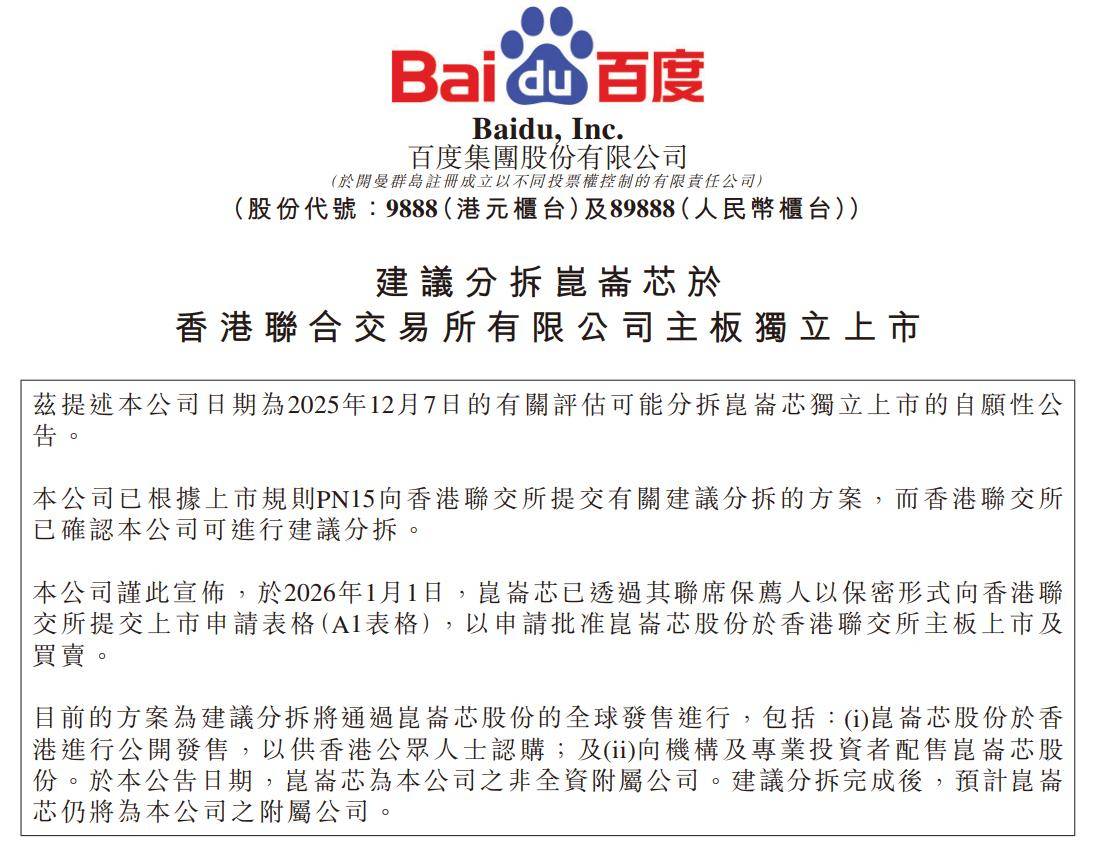
Core Viewpoint - Baidu Group announced the submission of a listing application for Kunlun Core to the Hong Kong Stock Exchange, aiming for a spin-off that will enhance operational and financial transparency, allowing investors to better assess Kunlun Core's performance and potential [2]. Group 1: Spin-off Details - Kunlun Core, a non-wholly owned subsidiary of Baidu, plans to conduct a global offering that includes a public offering in Hong Kong and a placement to institutional and professional investors [2]. - The spin-off is expected to maintain Kunlun Core as a subsidiary of Baidu post-listing, benefiting both companies [2]. Group 2: Business and Financial Implications - The spin-off will allow for a clearer reflection of Kunlun Core's value based on its strengths, attracting investors focused on AI computing chips and related hardware and software systems [2]. - Kunlun Core's business model is distinct from Baidu's more diversified operations, which is anticipated to enhance its market image and negotiation power with clients and suppliers [2]. - The company aims to independently access equity and debt capital markets in the future, improving financial resource allocation for Baidu [2]. Group 3: Financial Performance and Projections - Kunlun Core's valuation increased by 61.5% over four years, reaching approximately 29.7 billion USD after a recent funding round [3][4]. - The company reported revenues of 2 billion RMB with a net loss of 200 million RMB for 2024, with expectations to break even in 2025 with revenues exceeding 3.5 billion RMB [4]. - Morgan Stanley forecasts that Kunlun Core's revenue will surge to 8.3 billion RMB in 2026, representing a sixfold increase [4].
不只是分拆,更是宣战:昆仑芯IPO单飞,百度豪赌AI硬科技
Sou Hu Cai Jing· 2026-01-04 02:25
Core Viewpoint - Baidu has officially announced the plan for the independent listing of Kunlun Chip Technology on the Hong Kong Stock Exchange, marking a significant event in the domestic AI computing power sector [2] Group 1: Motivations Behind the Spin-off - The first strategic motivation is value reassessment, as Baidu has been perceived primarily as an "internet advertising" platform, which suppresses its valuation in the AI sector. By spinning off Kunlun Chip, Baidu aims to enjoy a higher valuation premium as a tech company [3] - The second motivation is independent development, allowing Kunlun Chip to become a standalone AI chip supplier, which will help expand its customer base beyond Baidu's ecosystem [3] - The third motivation is independent financing, as chip development is capital-intensive. An independent listing will enable Kunlun Chip to secure more funding for its research and development [3] - The fourth motivation is leveraging the Hong Kong capital market to enhance Kunlun Chip's brand recognition and potentially open up international markets [4] Group 2: Kunlun Chip's Strengths - Kunlun Chip is positioned as a critical component of Baidu's AI strategy and is one of the few domestic AI chips that can compete with international giants in specific scenarios. Its overall valuation reached approximately 21 billion yuan by 2025 [5] - The performance of Kunlun Chip, particularly the P800 series, is noteworthy, achieving a FP16 computing power of 345 TFLOPS, which is more than double that of Nvidia's H20 chip tailored for the Chinese market [6] - Kunlun Chip has successfully secured large orders, including a 10 billion-level AI computing device procurement from China Mobile, indicating its transition from experimental phases to large-scale production [6] Group 3: Challenges and Concerns - One major concern is the ecological barrier, as Kunlun Chip faces challenges in migrating customers from Nvidia's established software ecosystem, which complicates the transition for enterprises [7] - Another issue is customer dependency, as significant orders currently come from government procurement and Baidu, raising questions about acquiring more clients in a fully market-driven environment [7] - Supply chain vulnerabilities exist, particularly with high-end chips relying on TSMC for manufacturing. Potential restrictions on TSMC's services to domestic companies could hinder Kunlun Chip's production capabilities [7] - The financial aspect is also concerning, as Kunlun Chip is projected to have a revenue of nearly 2 billion yuan in 2024 but will incur a net loss of about 200 million yuan, highlighting the high costs associated with AI chip development [8] Group 4: Implications for Baidu and the Industry - The spin-off of Kunlun Chip is seen as a pivotal move for Baidu, marking the beginning of its transition away from an advertising-centric model. A successful IPO would solidify Baidu's position in the "computing power infrastructure" sector [9] - If Kunlun Chip achieves a high valuation upon listing, it could significantly boost confidence in the domestic AI chip industry and potentially trigger a new wave of IPOs in the hard tech sector [9] - Overall, this move is a demonstration of Baidu's capabilities in both application-level internet services and foundational hard tech development, despite the competitive and ecological challenges ahead [10]
新年美股首个交易日:科技题材开年大狂欢,中国资产大爆发
Xin Lang Cai Jing· 2026-01-04 01:29
Market Performance - On January 2, US stock markets showed mixed results, with the Dow Jones Industrial Average rising by 319.10 points, or 0.66%, closing at 48,382.39 points; the Nasdaq Composite fell by 6.36 points, or 0.03%, closing at 23,235.63 points; and the S&P 500 index increased by 12.97 points, or 0.19%, closing at 6,858.47 points, breaking a three-year trend of declines on the first trading day of the new year [1][2][5]. Technology Sector - The Nasdaq Composite index was unable to maintain its opening gains due to declines in several major tech stocks, including Tesla down 2.59%, Microsoft down 2.21%, Amazon down 1.88%, Meta down 1.41%, and Netflix down 2.97% [2][7]. Chinese Stocks - The Nasdaq China Golden Dragon Index surged by 4.38%, marking its largest single-day increase since May 12 of the previous year. Baidu led the gains among Chinese stocks, rising by 15.03% after announcing plans to spin off its AI chip company Kunlun and list it in Hong Kong, which investors believe will enhance the company's value and stimulate capital flow into Chinese AI and semiconductor stocks [3][7]. Other Chinese Stocks - Other notable performances among Chinese stocks included Tiger Brokers up 9.21%, Futu Holdings up 8.68%, Bilibili up 7.24%, NetEase up 7.22%, Alibaba up 6.25%, iQIYI up 5.73%, Tencent up 5.23%, Niu Technologies up 3.63%, Weibo up 3.13%, JD.com up 2.89%, and Pinduoduo up 2.08% [5][9].
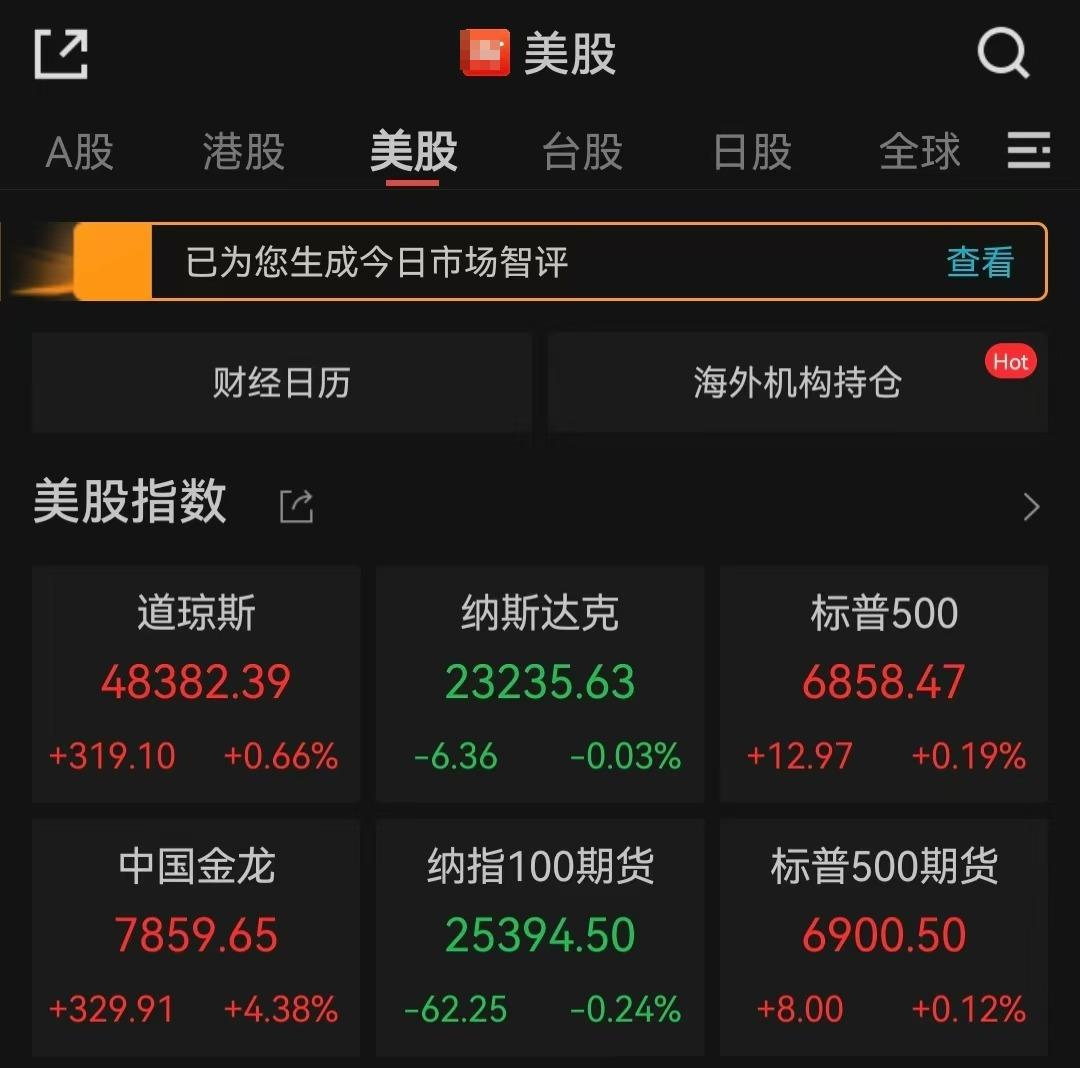
纳斯达克中国金龙指数收盘涨超4% 百度上涨15%
Xin Lang Cai Jing· 2026-01-04 01:29
Core Viewpoint - The Nasdaq Golden Dragon China Index experienced a significant increase of 4.38%, marking a strong start to the week with a cumulative rise of 2.23% [1] Group 1: Index Performance - The Nasdaq Golden Dragon China Index closed up by 4.38% [1] - The index recorded a cumulative increase of 2.23% for the week [1] Group 2: Individual Stock Performance - Baidu saw a notable increase of 15% [1] - Bilibili and NetEase both rose by over 7% [1] - Alibaba experienced a rise of over 6% [1] - JD.com increased by nearly 3% [1]


李彦宏,分拆210亿芯片独角兽
Xin Lang Cai Jing· 2026-01-04 01:24
Group 1 - The core announcement is that Kunlun Chip has applied for a mainboard listing on the Hong Kong Stock Exchange, with plans to reflect its value more comprehensively through this split [2][20] - The IPO timeline is expected to be accelerated, with a potential application submission in Q1 2026 and completion by early 2027 [2][20] - Kunlun Chip, which specializes in AI chips, has achieved a post-financing valuation of 21 billion yuan as of July 2025 [4][22] Group 2 - The split is anticipated to enhance Kunlun Chip's image among clients and partners, facilitate independent access to capital markets, and improve management focus [6][25] - The company is projected to generate over 1 billion yuan in revenue in 2024 and reach 5 billion yuan in 2025, with a potential valuation increase to 100 billion yuan [6][25] - The split is seen as a strategic move to mitigate sanction risks and attract more investment [6][24] Group 3 - Following the announcement, Baidu's stock surged by 15%, pushing its market capitalization above 50 billion USD [8][27] - Baidu has been a pioneer in AI investments, and the internal emphasis on chip development has increased significantly in recent years [8][27] - The company plans to launch new AI chip products, M100 and M300, in 2026 and 2027, respectively, with a commitment to annual product releases [10][29] Group 4 - The P800 chip, designed for large model training, has been a significant milestone, capable of supporting extensive training tasks for multiple enterprises [12][34] - The company aims to expand its cluster scale to one million cards by 2030, showcasing its technical capabilities [12][31] - Kunlun Chip has secured major contracts, including a significant order from China Mobile, indicating its growing market presence [12][34]
瞄准5万亿美元市场:跨界布局机器人,时代的新共识
3 6 Ke· 2026-01-04 00:26
Core Insights - The Chinese robotics industry is poised for significant growth by the end of 2025, with humanoid robots transitioning from experimental concepts to practical applications, achieving over 50% growth and indicating a trillion-yuan industry on the horizon [1] - The entry of major players from various sectors such as automotive, electronics, and the internet into the robotics field marks a shift from niche exploration to widespread competition, creating a unique trend of "cross-industry integration" [1] Group 1: Market Dynamics - In the first eight months of 2025, the primary market financing in the robotics sector reached 38.624 billion yuan, 1.8 times the total for 2024, highlighting the blue ocean effect attracting significant investment [2] - The global industrial robot sales are projected to reach 542,000 units in 2024, with China accounting for 295,000 units, representing 54% of the global market [2] - By 2025, the Chinese robotics market is expected to exceed 150 billion yuan, capturing 35% of the global market share, with predictions suggesting the market for embodied intelligence could reach 400 billion yuan by 2030 and over a trillion yuan by 2035 [2] Group 2: Industry Trends - At least 20 automotive companies have entered the humanoid robot market by the end of 2025, with notable developments including Chery's humanoid robot Mocha and BYD's production line for core robot components [3] - The automotive industry's supply chain overlaps significantly with robotics, with a 60% compatibility rate, driving car manufacturers to invest in robotics as they view vehicles as "mobile intelligent robots" [3] - Home appliance manufacturers are transitioning from traditional manufacturing to smart ecosystems, with companies like Midea establishing dedicated innovation centers for humanoid robots and developing comprehensive R&D systems [7] Group 3: Strategic Shifts - The automotive sector is seen as a key player in the transition to robotics, with companies like Geely planning to invest 5 billion yuan over three years to develop critical components and establish an ecosystem covering all robotics applications [6] - Internet giants are leveraging their technological and capital advantages to enter the robotics space, with ByteDance and Huawei making significant investments in developing advanced robotic models and systems [8] - The competition in the robotics sector is viewed as a strategic restructuring driven by technological advancements, with companies aiming to activate existing technological capabilities and build new ecosystems [9] Group 4: Challenges Ahead - Despite the enthusiasm for entering the robotics market, cross-industry players face challenges such as adapting core competencies to the robotics field, where technology paths are still being defined [10] - The high precision and stability required for industrial applications pose significant challenges for companies transitioning from other sectors, as they may struggle to meet the diverse demands of various operational environments [11] - Cost remains a critical issue, with companies like BYD and GAC aiming to reduce the production cost of humanoid robots to below 200,000 yuan, which requires overcoming substantial supply chain and process optimization challenges [11]



