Goldman Sachs(GS)

Search documents
亚洲经济-2026 年十大问题-Asia Economics Analyst_ Ten questions for 2026
2026-01-19 02:29
Summary of Key Points from the Conference Call Industry Overview - The report focuses on the Asia-Pacific economic outlook for 2026, with specific emphasis on China, Japan, India, Taiwan, and New Zealand. Core Insights and Arguments 1. **China's GDP Growth**: - Expected real GDP growth of 4.8% in 2026, surpassing consensus expectations of 4.5%-4.6% due to strong export growth and easing fiscal policy [6][5][4] 2. **Housing Market in China**: - The housing market is not expected to bottom out across all indicators; housing starts are down approximately 80% from peak levels in 2020, while construction activity has fallen about 60% [7][4] - Home prices have significantly declined, with expectations that they will remain lower by the end of 2026 [7][4] 3. **China's Trade Surplus**: - Anticipated to increase further, with a record trade surplus of nearly $1.2 trillion in 2025 expected to rise in 2026 due to competitive manufacturing and a focus on exports [13][14][4] 4. **US Tariff Relief**: - Modest tariff relief expected for Asia, particularly benefiting India, as negotiations continue to lower trade barriers [19][4] - Taiwan has signed an agreement to reduce US tariffs in exchange for significant investments in semiconductor and AI production [21][4] 5. **Japan's Fiscal Policy and Yields**: - No significant rise in bond yields expected post-election; fiscal policy may loosen but will be constrained by market pressures [25][26][4] - The yen is expected to strengthen slightly, moving away from the current weak levels [31][4] 6. **Growth Surprises in Asia-Pacific**: - Taiwan and New Zealand are projected to outperform consensus growth expectations, driven by tech exports and recovering economic conditions, respectively [33][4] 7. **Inflation Outlook**: - Inflation pressures are not expected to drive significant policy shifts among Asia-Pacific central banks, with CPI inflation returning to pre-COVID levels [41][4] - China and Thailand are expected to see continued easing in monetary policy due to low inflation [42][4] 8. **Central Bank Policy Rate Expectations**: - Anticipated tightening in Japan, Taiwan, and New Zealand, with the Bank of Japan expected to resume rate hikes [47][48][4] 9. **Asian Currencies Performance**: - Majority of Asian currencies expected to appreciate against the USD in 2026, with the CNY anticipated to strengthen due to strong fundamentals [52][4] Other Important Insights - The report highlights that most themes from the previous year were accurate, with notable surprises including the rise in government bond yields in China and the underperformance of the Indian Rupee [56][4] - The analysis includes a review of past predictions and their outcomes, reinforcing the credibility of the current forecasts [56][4]

高盛-2026年亚洲外汇与利率十大交易策略
Goldman Sachs· 2026-01-19 02:29
Investment Rating - The report maintains a positive outlook on emerging markets, particularly in Asia, indicating a favorable investment environment due to strong economic growth and declining inflation [4]. Core Insights - The report highlights two main themes in the Asian emerging markets: the gradual appreciation of the Renminbi and the end of the Asian interest rate easing cycle, driven by strong economic growth and export performance [5]. - The report suggests that the market is currently in a "Goldilocks" state, characterized by good economic growth and declining inflation, which is favorable for risk assets [4]. - The report emphasizes the importance of monitoring geopolitical risks, technology bubbles, and the independence of the Federal Reserve as potential risk factors [4]. Summary by Sections Economic Data and Trends - U.S. December CPI data was slightly below expectations, while China's December PPI inflation rate was slightly above expectations, with exports growing by 6.6% year-on-year [1][2]. - The People's Bank of China has lowered several structural loan tool rates by 25 basis points and increased their quotas, indicating a credit expansion [1][2]. Currency Strategies - The report recommends a bearish options strategy on USD/SGD, targeting a move towards the 6.80 range in the next 3-6 months, as policy signals indicate Renminbi appreciation [5]. - The report notes that the Renminbi's appreciation has limited spillover effects on low-yield currencies, as it is driven by a significant trade surplus rather than domestic demand [5]. Market Outlook - The report suggests that the current low-volatility environment is an opportune time for establishing risk hedges, particularly in the foreign exchange market [4]. - The report anticipates strong industrial value-added data from China, while retail sales and fixed asset investment may show weakness [8].
特朗普“强夺格陵兰”,欧洲开始考虑“反胁迫工具”,“资本战”一触即发?
Hua Er Jie Jian Wen· 2026-01-19 01:24
Core Viewpoint - The recent statement by President Trump linking tariffs to the purchase of Greenland has escalated tensions between the U.S. and its European allies, marking a significant shift from traditional trade negotiations to geopolitical coercion [1][2]. Group 1: Tariff Implications - Trump announced a 10% tariff on goods exported from Denmark, Norway, Sweden, France, Germany, the UK, the Netherlands, and Finland starting February 1, until an agreement on the "complete and total purchase of Greenland" is reached [1]. - HSBC noted that this represents a major escalation, as tariffs are now being used as a tool for territorial negotiations rather than just trade discussions [2]. Group 2: European Response - European leaders, including EU Commission President Ursula von der Leyen and French President Emmanuel Macron, have condemned the tariffs, warning of potential damage to transatlantic relations [6]. - There is a serious discussion within Europe about potential countermeasures, including the suspension of a previously negotiated EU-U.S. trade agreement and the implementation of reciprocal tariffs [6][7]. Group 3: Anti-Coercion Instrument (ACI) - The EU is considering activating the Anti-Coercion Instrument (ACI), designed to counter economic coercion from third countries, which could involve a range of non-tariff measures [7][8]. - The initiation of ACI signals a shift in strategy, moving beyond simple tariff retaliation to a broader consideration of capital and regulatory responses [8]. Group 4: Economic Impact - Goldman Sachs estimates that a 10% tariff could reduce the GDP of affected countries by approximately 0.1% to 0.2%, with Germany facing a larger impact [9]. - The potential for tariffs to rise to 25% could increase the GDP impact to 0.25% to 0.5% [9]. Group 5: Market Uncertainty - The primary concern for markets is not the immediate tariff changes but the resurgence of trade and geopolitical uncertainty, which could lead to increased risk premiums and volatility in asset pricing [12]. - Geopolitical risk premiums are already being factored into asset prices, with the euro declining against the dollar and increased volatility expected as deadlines approach [12].

每日债市速递 | 本周央行公开市场将有9515亿元逆回购到期
Sou Hu Cai Jing· 2026-01-19 00:00
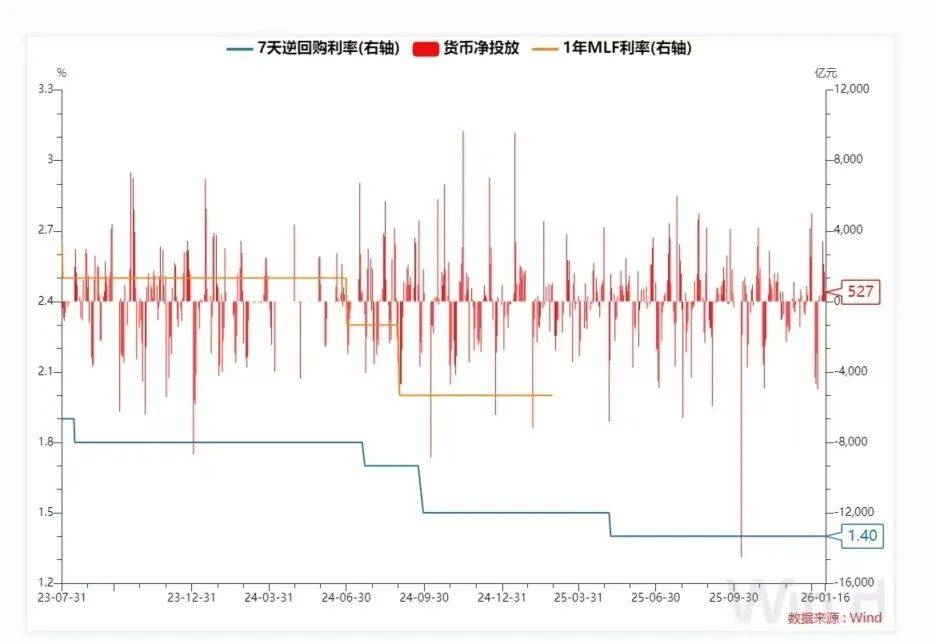
// 债市综述 // 1. 公开市场操作 央行公告称,1月16日以固定利率、数量招标方式开展了867亿元7天期逆回购操作,操作利率1.40%,投标量867亿元,中标量867亿 元。Wind数据显示,当日340亿元逆回购到期,据此计算,单日净投放527亿元。当周实现净投放8128亿元。 Wind数据显示,1月19日至23日当周,央行公开市场将有9515亿元逆回购到期。此外,23日还将有1500亿元国库现金定存到期。 (*数据来源:Wind-央行动态PBOC) 2. 资金面 银行间市场资金面逐渐恢复宽松,DR001加权平均利率降超4bp至1.32%附近。匿名点击(X-repo)系统上,隔夜报价也滑至1.30%, 供给在千亿元左右;非银机构质押信用债借入隔夜,最新报价集中在1.45%附近。 海外方面,最新美国隔夜融资担保利率为3.64%。 (IMM) (*数据来源:Wind-国际货币资金情绪指数、资金综合屏) 3. 同业存单 全国和主要股份制银行一年期同业存单最新成交在1.63%附近,较上日小幅下行。 (*数据来源:Wind-同业存单-发行结果) 4. 银行间主要利率债收益率普遍下行 (*数据来源:Wind-成交统 ...


“飙升的电费”成为美国中选焦点,AI数据中心站上“政治火山口”
Hua Er Jie Jian Wen· 2026-01-18 02:50
Core Viewpoint - Rising electricity costs have become a central issue in the U.S. political agenda, surpassing other types of inflation, particularly impacting utility bills ahead of the midterm elections [1][2]. Group 1: Electricity Cost Trends - U.S. electricity costs increased by 6.7% year-over-year in December, with a cumulative rise of approximately 38% since 2020, while overall consumer prices rose only 2.7% during the same period [2]. - In the Northeast and Mid-Atlantic regions, utility bills have inflated by 29% over the past three years, significantly higher than the Consumer Price Index (CPI) [4]. Group 2: Political Implications - The issue of rising electricity costs has become a key topic in gubernatorial campaigns across 36 states, potentially influencing the outcomes of utility commission elections in nine states [2][6]. - Politicians from both parties are leveraging voter concerns about rising electricity prices, with specific focus on the impact of data centers on utility costs [1][3]. Group 3: Data Centers as a Target - Data centers are being blamed for a significant portion of the rising electricity costs, raising questions about cost allocation between residential consumers and large commercial clients [4]. - The Trump administration has engaged with state governors to address concerns about data centers driving up electricity prices, urging large tech companies to bear the costs of their energy consumption [1][4]. Group 4: Investment Strategies - Goldman Sachs has advised investors to hedge against the political risks associated with artificial intelligence (AI) and its impact on electricity costs, as policymakers express growing concerns about data center energy consumption [2][7]. - The firm has identified three preferred trading strategies, including going long on non-tech companies that improve productivity through AI and hedging against volatility related to AI politicalization [8].
Surging credit markets prompt complacency warning
BusinessLine· 2026-01-17 16:10
Core Viewpoint - Global credit markets are experiencing their highest activity in two decades, with significant money managers warning against complacency regarding risks in the market [1][2]. Group 1: Market Conditions - Yield premiums on corporate debt have decreased to just over one percentage point, the lowest since June 2007, reflecting confidence in the economic outlook [1]. - The new issue concession for US companies is only 0.013 percentage points higher than existing bonds, significantly lower than the average of about 3 basis points from the previous year [4]. - Companies issued approximately $435 billion in bonds in the first half of January, a record for that period and over a third higher than last year's figures [9]. Group 2: Risk Factors - Money managers are facing a paradox where they want to participate in the market rally but must accept lower compensation for the risks associated with unpredictable US policy and geopolitical tensions [2][5]. - Barclays Plc's risk complacency signal in the US debt market reached 93%, the highest since December 2024, driven by bullish equities positioning and lower high-yield return volatility [3]. - There is a concern that the current tight credit spreads do not adequately account for geopolitical risks, as highlighted by investment professionals [7]. Group 3: Investment Strategies - Many money managers are continuing to invest in the rally, partly due to expectations of interest rate cuts by the Federal Reserve, which could support the global economy [5]. - Pacific Investment Management Co. is becoming more selective in fund deployment across credit markets due to expectations of deteriorating fundamentals [8]. - BlackRock Inc. is positioned to buy new deals while maintaining caution, emphasizing the need for returns despite the current market conditions [11].


财经深一度丨看好中国创新前景,外资对中国资产热情提升
Xin Hua Wang· 2026-01-17 13:36
Group 1 - International financial institutions are optimistic about the fundamentals of the Chinese economy and the performance of Chinese assets, expecting a systematic increase in the weight of Chinese assets in global investment portfolios [1][2] - UBS reports a significant increase in the participation of international long-term funds as cornerstone or core institutional investors in recent Hong Kong IPOs and refinancing projects, indicating a shift towards more proactive and long-term investment strategies in China [1] - The total annual amount of mergers and acquisitions involving foreign capital in China has reached 60 billion RMB, marking a 10-year high, as foreign capital becomes more active in the Chinese capital market [1] Group 2 - The consensus among overseas investors is that "Chinese assets are unavoidable," driven by the resilience of the Chinese economy and strong potential for technological innovation [2] - The structural changes in the fundamentals of Chinese enterprises are shifting their operational logic from "scale first" to focusing on profitability quality, technological barriers, long-term value, and innovation [2] - HSBC's 2026 outlook report indicates that with a focus on boosting domestic demand and ongoing structural reforms, China's economy is expected to maintain steady growth, with innovation becoming a core advantage attracting foreign investment [3]


中国市场杀疯了!资本大迁徙全都纷纷押注中国?外资为何要去中国
Sou Hu Cai Jing· 2026-01-17 05:13
Group 1 - The main theme of the capital market in 2026 is a strong focus on investing in China, with significant enthusiasm from foreign investment banks like Goldman Sachs and Morgan Stanley, predicting annual stock market growth of 15%-20% over the next two years [3] - Major international companies are expanding aggressively in China, with Müller planning to open 200-500 stores in five years and Lexus establishing its first overseas electric vehicle base in Shanghai [5] - Despite the excitement, some companies like IKEA are facing challenges, with closures in major locations indicating a potential misalignment with evolving consumer preferences [5][10] Group 2 - The decline of IKEA is attributed not to the failure of the Chinese market but to its inability to adapt to the fast-paced changes in consumer behavior, as traditional large stores are less appealing in the era of instant retail [7][8] - The luxury car market is not declining; rather, domestic brands are capturing market share with innovative electric vehicles, while traditional luxury brands like Porsche and BBA are struggling due to slow adaptation to market trends [12] - Northbound capital is increasingly investing in Chinese assets, with trading volumes expected to exceed 50 trillion yuan in 2025, reflecting a shift from individual stock picking to bulk buying of ETFs [12][14] Group 3 - The A-share market is seen as undervalued with a price-to-earnings ratio of 16 compared to 30 for the US market, making it an attractive investment opportunity, especially with the potential for currency appreciation [14] - The challenges faced by companies like IKEA and BBA are not indicative of a failing market but rather a failure to keep pace with consumer demands and technological advancements [10][14] - The influx of foreign investment and high-profile visits to China signal a strong belief in the country's market potential, suggesting that not investing in China could be a significant risk [14]


华尔街大行业绩创新高,股票交易业务收益增长
Huan Qiu Wang· 2026-01-17 00:50
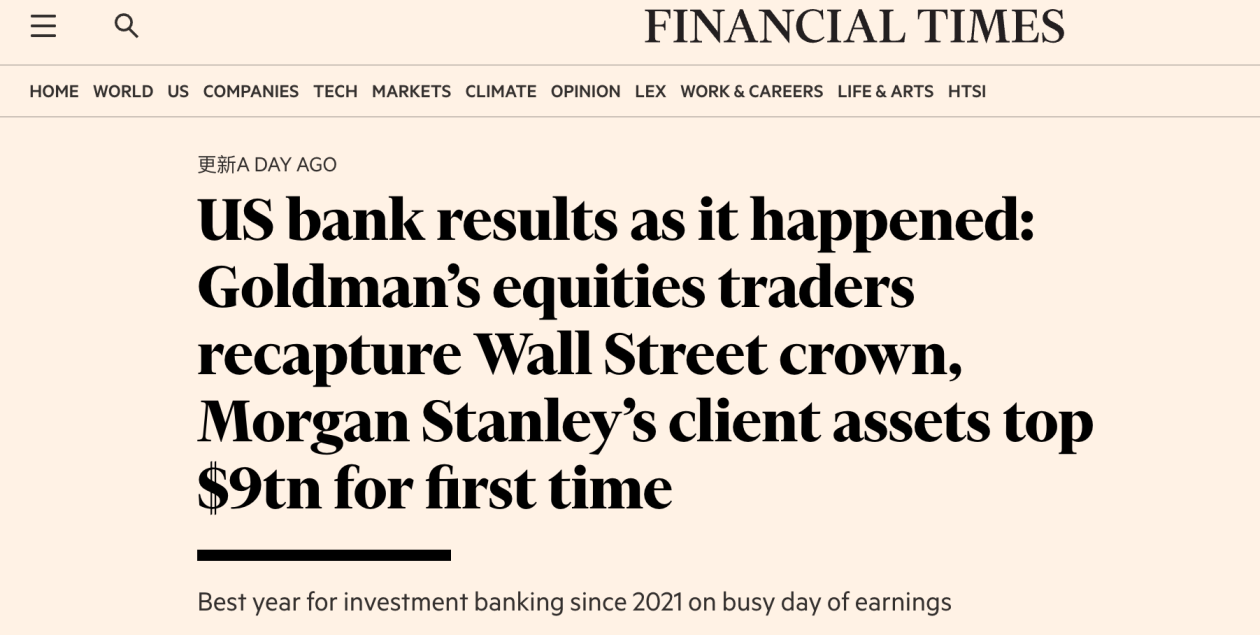
Group 1 - Goldman Sachs and Morgan Stanley reported profit growth in the fourth quarter, with Goldman Sachs' profits increasing by 12% and Morgan Stanley's by 18% [3] - Goldman Sachs' stock trading revenue reached $4.31 billion, significantly higher than Morgan Stanley's $3.7 billion, setting a new record for bank stock trading [3] - BlackRock reported a record inflow of funds, leading to its assets under management surpassing $14 trillion for the first time [3] Group 2 - Goldman Sachs' investment banking business saw a surge, with the volume of pending deals reaching its highest level in four years [3] - The termination of the partnership with Apple regarding credit cards contributed to Goldman Sachs' profit growth [3] - Morgan Stanley's profit growth was attributed to gains in both its investment banking and stock trading businesses [3]
美股多板块股票“直线拉升” 18%标普500成分股年内涨超10% AI与政策变化成主推力
智通财经网· 2026-01-16 23:47
Group 1: Stock Market Trends - Approximately 18% of S&P 500 stocks have seen a year-to-date increase of 10% or more, doubling the average of 9.4% from the past five years [1] - The technology, financial, and metals mining sectors have seen dozens of stocks rise over 50% in the past year, with the total market capitalization of this "surging stock" group exceeding $4 trillion [1] - Notable examples include Micron Technology, Western Digital, and SanDisk, which have benefited from strong storage demand driven by the AI wave, with related storage stocks rising over 200% in the past year [1] Group 2: Semiconductor and Data Center Demand - The demand for computing power has surged as companies integrate AI agents into software systems, leading to an expansion of data centers and a direct increase in semiconductor demand [2] - Connector manufacturer Amphenol has seen its revenue from data centers rise significantly, with its stock price doubling in the past year [2] - Corning, a materials giant, has experienced an 88% increase in stock price due to rising demand from data center expansions [2] Group 3: Commodity Market Impact - Copper prices have risen approximately 30% in the past year, driven by increased demand from data centers, benefiting mining companies like Southern Copper, whose stock has increased by about 91% [2] - Gold mining stocks have also rebounded strongly, with Newmont Mining and Barrick Mining both doubling in stock price, coinciding with a 66% increase in gold prices [2] Group 4: Financial Sector Performance - Major U.S. investment banks, including Citigroup and Goldman Sachs, have seen stock prices rise over 50% in the past year, driven by expectations of a Fed rate cut and increased credit demand [3] - Regulatory changes, such as relaxed capital and reserve requirements, have boosted bank valuations and facilitated more lending and mergers [3] - The acceleration of merger review processes by the FTC and DOJ has reduced transaction costs and increased certainty in deal completions [3]