LI AUTO(LI)

Search documents
美股异动 | 新能源车中概股普跌 理想汽车(LI.US)跌逾3%
智通财经网· 2025-12-01 14:53
智通财经APP获悉,周一,新能源车中概股普跌,理想汽车(LI.US)跌逾3%,小鹏汽车(XPEV.US)跌逾 2%。消息面上,11月,理想汽车交付新车3.3万辆。此前,理想汽车已将2025年销量目标从年初设定的 70万辆下调至64万辆。截至11月,理想汽车今年累计交付36.2万辆,年度目标恐难达成。小鹏汽车11月 交付新车36,728辆,同比增长19%,但环比下降12.58%。这也是小鹏近六个月来首次录得单月环比下 滑。 ...


渗透率剑指60%!11月新能源车企交付量集体冲高 多家品牌刷新月销纪录
Mei Ri Jing Ji Xin Wen· 2025-12-01 13:52
Core Insights - Multiple electric vehicle brands reported their November delivery figures, showcasing significant growth in the sector, particularly for Leap Motor, which achieved a record monthly sales figure [1][2]. Group 1: Company Performance - Leap Motor delivered 70,327 vehicles in November, marking a year-on-year increase of over 75% and achieving its annual sales target of 500,000 units 45 days ahead of schedule [1]. - Xiaomi Auto surpassed 40,000 deliveries for the third consecutive month, while XPeng Motors delivered 36,728 vehicles, reflecting a 19% year-on-year growth [2]. - NIO reported 36,275 deliveries, a 76.3% increase year-on-year, with expectations for accelerated production and delivery in December [3]. - Li Auto delivered 33,181 vehicles in November, with a cumulative total of approximately 1.496 million vehicles delivered to date [3]. - Zeekr and Lynk & Co combined delivered 63,902 vehicles, showing a 7.1% year-on-year increase [4]. - Lantu achieved a historic monthly sales record of 20,005 vehicles, while IM Motors delivered 13,577 vehicles, marking three consecutive months of over 10,000 deliveries [4]. Group 2: Market Trends - The overall passenger car retail market in November is expected to reach around 2.25 million units, with new energy vehicle sales projected at approximately 1.35 million units, indicating a penetration rate of about 60% [4]. - The domestic electric vehicle market is anticipated to experience a new consumption peak due to adjustments in vehicle purchase tax and the traditional year-end sales surge [4]. - A report from Zhongyuan Securities forecasts a moderate adjustment or stabilization in the total domestic passenger car market in 2026, driven by reduced purchase tax subsidies and elevated technical thresholds [5].


热门中概股美股盘前涨跌不一,蔚来跌超3%
Ge Long Hui A P P· 2025-12-01 13:05
Group 1 - The core viewpoint of the article highlights the mixed performance of popular Chinese concept stocks in the US pre-market trading, with some stocks experiencing gains while others faced declines [1] Group 2 - NetEase saw an increase of over 2% [1] - Alibaba, iQIYI, and Weibo each rose by more than 1% [1] - NIO experienced a decline of over 3%, while XPeng Motors fell by more than 2% [1] - Li Auto and Futu Holdings both dropped by over 1% [1]


热门中概股美股盘前涨跌不一
Jin Rong Jie· 2025-12-01 12:59
Group 1 - The performance of popular Chinese concept stocks in the US market shows mixed results, with NetEase rising over 2% [1] - Alibaba, iQIYI, and Weibo each saw an increase of over 1% [1] - NIO experienced a decline of over 3%, while XPeng Motors fell over 2% [1] - Li Auto and Futu Holdings also saw a decrease of over 1% [1]
11月新势力销量出现断层
第一财经· 2025-12-01 12:22
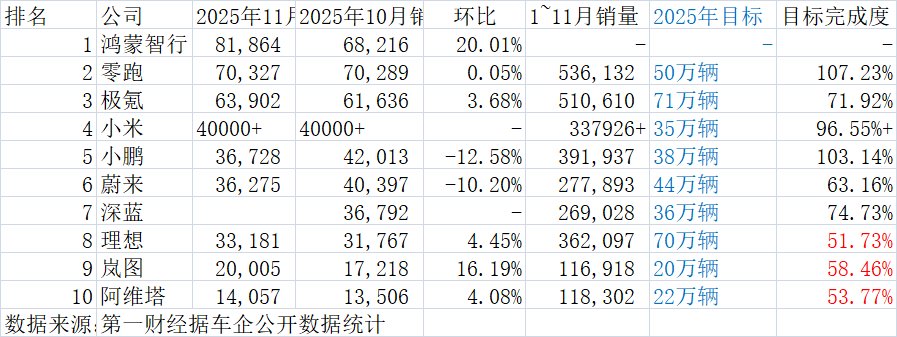
Core Viewpoint - The sales performance of new energy vehicle manufacturers in November shows a significant divergence in market dynamics, with some brands achieving record highs while others experience declines in sales [3][10]. Sales Performance Summary - Leap Motor and Hongmeng Zhixing achieved record sales of 70,327 and 81,864 vehicles respectively, maintaining their positions as leaders in the new energy vehicle sector [3][11]. - Zeekr's sales reached 63,902 units, marking a 3.68% month-on-month increase, although this growth masked a decline in Lynk & Co's sales, which fell by 13.8% to 35,059 units [5][11]. - Xiaomi reported over 40,000 vehicle deliveries, but specific figures were not disclosed, making it difficult to assess performance changes [6]. - NIO and Xpeng both fell below the 40,000 unit mark, with Li Auto also entering the 30,000 unit range [7][8]. - Li Auto delivered 33,181 vehicles, a slight increase of 4.45% month-on-month, but a year-on-year decline of 31.92% [8]. - Xpeng's deliveries were 36,728 units, down 12.58% month-on-month but up 18.88% year-on-year, while NIO delivered 36,275 units, reflecting a 10.02% month-on-month decline but a 76.3% year-on-year increase [9]. Market Trends and Challenges - The overall market for passenger vehicles in China saw a decline, with retail sales dropping 11% year-on-year in November [10]. - The new energy vehicle sector is facing challenges due to the reduction of replacement subsidies, which has led to a noticeable decrease in demand [10]. - The sales progress of leading new energy vehicle manufacturers like Li Auto, Lantu, and Avita is currently below 60% of their annual targets, raising questions about their ability to meet Q4 delivery guidance [10].

电动车11月成绩单:鸿蒙智行突破8万辆创新高,小米再破4万辆,理想i6和i8累计订单已突破10万辆
Hua Er Jie Jian Wen· 2025-12-01 12:21
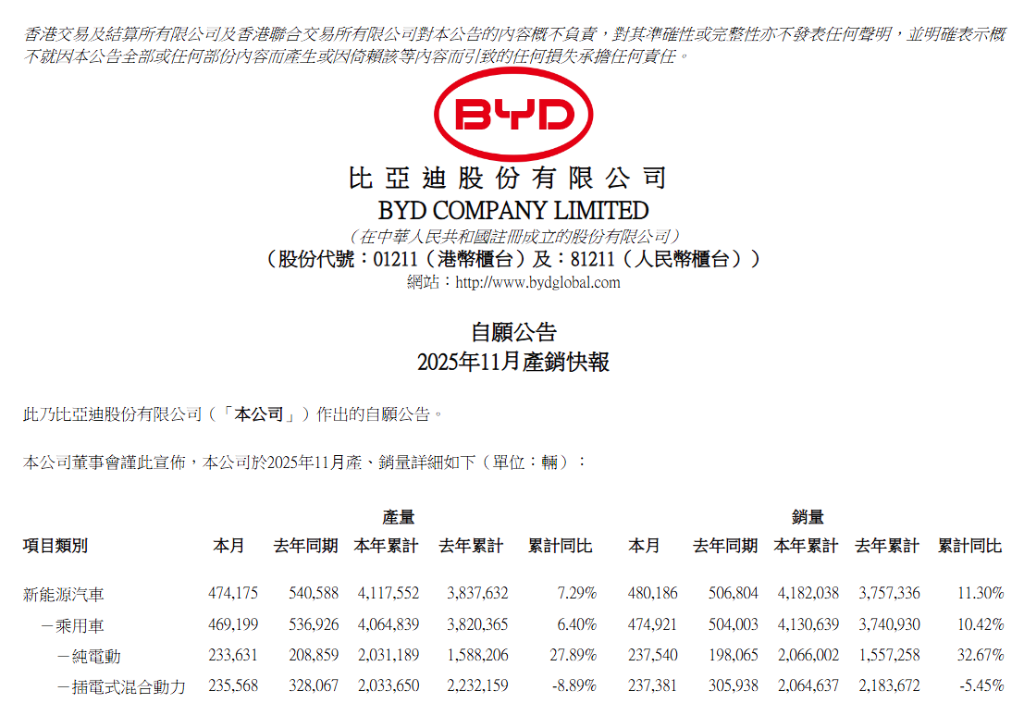
Core Insights - In November, BYD led the electric vehicle market with sales of 480,200 units, while other companies like Hongmeng Zhixing, Zeekr, and Leap Motor also reported significant sales figures, indicating a competitive landscape in the Chinese EV market [1][3][10]. Group 1: Sales Performance - BYD's November production reached 474,175 units, with a cumulative production of 4,117,552 units for the year, reflecting a year-on-year increase of 7.29% [3][5]. - Hongmeng Zhixing achieved a record monthly delivery of 81,864 units, maintaining its position as the industry leader [3][10]. - Zeekr delivered 63,902 units in November, marking a 7.1% year-on-year increase [8][10]. - Leap Motor's sales reached 70,327 units, showing a growth of over 75% compared to the previous year [10][12]. - NIO's multi-brand strategy resulted in 36,275 units delivered, a 76.3% increase year-on-year [16][21]. - Ideal Auto delivered 33,181 units, with total orders for the i6 and i8 models exceeding 100,000 [21][25]. Group 2: Market Trends - The electric vehicle market is experiencing a clear segmentation, with over half of the companies achieving monthly deliveries exceeding 10,000 units, and leading companies widening their sales advantages [1][2]. - Xiaomi's automotive division reported over 40,000 units delivered in November, continuing its strong growth trajectory [13][15]. - The introduction of new models and delivery policies is prevalent, with companies like Zhiji and Lantu launching new vehicles and optimizing delivery options [2][33][34].


11月新势力销量出现断层
Di Yi Cai Jing· 2025-12-01 12:13
Core Insights - The sales data for November reveals a significant market differentiation among new energy vehicle manufacturers, with some brands achieving record sales while others decline sharply [1][8] Group 1: Sales Performance - Leap Motor continues to lead the new energy vehicle segment with 70,327 units delivered, marking nine consecutive months at the top [1] - Hongmeng Zhixing achieved a record high of 81,864 units sold in November, showcasing strong growth [1] - Zeekr's sales reached 63,902 units, reflecting a month-on-month increase of 3.68% [2] - NIO and Xpeng both fell below the 40,000 unit mark, with NIO delivering 36,275 units and Xpeng 36,728 units, indicating a downward trend [5][7] Group 2: Brand Analysis - The growth of Zeekr (34.64%) masks the decline of Lynk & Co, which saw a 13.8% drop in sales from October to November [3] - Ideal Auto delivered 33,181 units, showing a slight month-on-month increase of 4.45% but a year-on-year decline of 31.92% [6] - The performance of Li Auto, Lantu, and Avita indicates that they are currently below 60% of their sales targets for the fourth quarter [8] Group 3: Market Trends - The overall market for passenger vehicles in China saw a decline, with retail sales dropping 11% year-on-year in November [8] - The reduction in government subsidies since October has led to a noticeable decrease in demand across the industry [8] - The sales targets for the top three new energy vehicle manufacturers (Li Auto, Lantu, and Avita) are under scrutiny as they strive to meet their fourth-quarter delivery goals [8]

新势力Q3财报:李斌、李想、何小鹏,终于活成了对方的模样
2 1 Shi Ji Jing Ji Bao Dao· 2025-12-01 11:55
Core Insights - The competitive landscape of new energy vehicle manufacturers in China is undergoing significant changes as Q3 2025 financial reports are released, with companies like XPeng showing remarkable revenue growth while others struggle with losses [1][3]. Group 1: Company Performance - XPeng Motors reported a revenue increase of 101.8% year-on-year, achieving 20.38 billion yuan in revenue, despite a net loss of 0.38 billion yuan, which is a 79% reduction compared to the previous year [2][4]. - NIO's revenue reached 21.79 billion yuan, with a year-on-year growth of 16.7%, but it remains the largest loss-maker among new energy vehicle companies, recording a net loss of 3.48 billion yuan, a 31.2% reduction year-on-year [2][8]. - Li Auto experienced a revenue decline of 36.2% year-on-year, totaling 27.4 billion yuan, and reported a net loss of 0.624 billion yuan, ending an 11-quarter streak of profitability [2][6]. - Leap Motor achieved a revenue of 19.45 billion yuan, marking a 97.3% increase year-on-year, and reported a net profit of 0.15 billion yuan, marking its second consecutive profitable quarter [2][11]. Group 2: Strategic Adjustments - XPeng is shifting its strategy by embracing range-extended electric vehicles (REEVs) and enhancing its overseas market presence, with a significant increase in deliveries abroad [5][6]. - NIO is focusing on cost reduction and efficiency, cutting R&D expenses by 28% year-on-year, and is refocusing on its core automotive business after diversifying into various sectors [8][9]. - Li Auto is pivoting towards AI technology, aiming to transform its vehicles into smart terminals, while still facing challenges in its electric vehicle transition [7][10]. - Leap Motor is entering the REEV market and targeting the high-end SUV segment, attempting to elevate its brand image beyond its previous reputation for cost-effectiveness [11][12]. Group 3: Market Dynamics - The Chinese new energy vehicle market is transitioning from growth to competition for existing market share, with companies needing to enhance their product, technology, and brand capabilities to survive [3][12]. - The competitive landscape is characterized by companies learning from each other and adapting their strategies, leading to a blurring of previous market labels [2][3]. - The overall profitability of these companies will be crucial in determining their positions in the market as they approach the end of 2025, with a focus on product definition, technology implementation, cost control, and brand perception [12][13].

——汽车行业周报:阿维塔递交港股IPO申请,蔚小理相继披露三季度财报-20251201
Guohai Securities· 2025-12-01 11:32
Investment Rating - The report maintains a "Recommended" rating for the automotive sector [2] Core Insights - The automotive sector outperformed the Shanghai Composite Index during the week of November 24 to November 28, 2025, with a sector index increase of 3.2% compared to the index's 1.4% rise [5][16] - The report highlights the submission of an IPO application by Avita Technology to the Hong Kong Stock Exchange, marking a significant step in its global strategy [12][30] - The report notes that the new energy vehicle sales reached 177.2 million units in October 2025, accounting for 51.6% of total new vehicle sales [34] Summary by Sections Recent Trends - The automotive sector index increased by 3.2% from November 24 to November 28, 2025, with passenger vehicles, commercial vehicles, parts, and services showing respective increases of 2.6%, 2.0%, 3.7%, and 3.9% [5][16] - The report indicates that major players like Li Auto, Xpeng, NIO, and Geely saw stock price increases of 4.8%, 6.9%, 1.3%, 12.2%, and 1.4% respectively during the same period [5][16] Company Performance - NIO reported a revenue of 21.79 billion yuan for Q3 2025, a year-on-year increase of 16.7%, while its net loss narrowed to 3.48 billion yuan [13][31] - Xpeng's Q3 revenue reached 20.38 billion yuan, showing a significant year-on-year growth of 101.8% [13][31] - Li Auto experienced a decline in deliveries by 39.0% year-on-year, with a revenue drop of 36.2% to 27.365 billion yuan, resulting in a net loss of 624 million yuan [13][31] Market Outlook - The report anticipates a potential decline in passenger vehicle year-on-year growth by the end of 2025 due to high base effects and the temporary withdrawal of certain subsidies [15] - It suggests that the high-end passenger vehicle market may perform better in 2026, particularly for domestic brands with offerings above 300,000 yuan [15] - Recommendations include companies like JAC Motors, Geely, Xpeng, Great Wall Motors, SAIC Motor, Li Auto, Seres, and BYD for passenger vehicles [15] Key Recommendations - For automotive parts, the report recommends companies benefiting from the penetration of high-level intelligence into lower-priced models, including Huayang Group, Desay SV, and Kobot [15][6] - In the commercial vehicle sector, it suggests companies like Weichai Power, Foton Motor, and China National Heavy Duty Truck Group as beneficiaries of the recovering demand for heavy trucks [15][6]
理想汽车没终身质保?高管回应:没有哪家公司能确保永远活着
Xi Niu Cai Jing· 2025-12-01 11:32
Core Insights - Li Auto is facing significant challenges with a notable decline in vehicle deliveries, with October figures showing a year-on-year drop of 38.25% and a month-on-month decrease of 6.43% [2] - The company has adjusted its warranty policy, now offering a 5-year or 100,000 km overall warranty and an 8-year or 160,000 km warranty for the three electric systems [2] - The decline in sales is attributed to the fading benefits of range-extended vehicles and setbacks in the pure electric vehicle segment [2][3] Sales Performance - In October, Li Auto delivered 31,767 vehicles, marking a 38.25% year-on-year decline and a 6.43% month-on-month decline, making it the only brand in the top tier to experience negative growth [2] - Cumulatively, the company delivered 328,900 vehicles in the first ten months of the year, reflecting a 16.36% year-on-year decline, with a completion rate of only 51.4% of its annual sales target [2] Product Challenges - The launch of the first pure electric MPV, Li MEGA, faced criticism due to its design and pricing, leading to a public relations crisis despite adjustments in configuration and price [2] - The first pure electric SUV, Li i8, also encountered issues, including a controversial incident during its launch event, resulting in a significant gap between actual sales (5,716 units in September) and the target of 8,000 to 10,000 units [3] - The second pure electric SUV, Li i6, received positive market feedback with over 70,000 orders, but production capacity constraints pose a challenge for timely delivery [3] Warranty Policy - Li Auto's product line manager stated that the company does not offer a lifetime warranty, emphasizing the impossibility of guaranteeing perpetual company existence [5]