LI AUTO(LI)

Search documents
理想汽车架构再调整,李想直管人事
Zhong Guo Qi Che Bao Wang· 2025-11-13 11:08
Core Viewpoint - Li Auto announced an organizational restructuring, merging the "Organization Department" and "Human Resources Department" into a new "Human Resources" department, which will be part of the Product and Strategy Group, led by Yang Haishan, reporting directly to CEO Li Xiang [1] Group 1: Organizational Changes - The restructuring includes the renaming of the Organization and Finance Group to CFO Functional Group [1] - This year, Li Auto has made multiple structural adjustments, including changes to the Sales and Service Group and the establishment of the Smart Vehicle Group [1] Group 2: Delivery Performance - In October, Li Auto delivered 31,767 new vehicles [1]

明年起购置税将减半征收,17家汽车品牌承诺兜底
Di Yi Cai Jing· 2025-11-13 08:07
Core Viewpoint - The end of the full exemption policy for new energy vehicle (NEV) purchase tax in 2025 has triggered a competitive order-seizing battle among car manufacturers, with many offering tax subsidy schemes to lock in consumers before the policy change [2][3]. Group 1: Policy Changes and Impacts - From January 1, 2026, the NEV purchase tax will be halved, with a maximum tax reduction of 15,000 yuan per vehicle [2]. - The current exemption policy allows for a maximum tax exemption of 30,000 yuan for NEVs purchased between January 1, 2024, and December 31, 2025 [2]. - The urgency among consumers to purchase vehicles has increased due to the impending policy changes, influencing their choice of models based on delivery timelines [3]. Group 2: Manufacturer Responses - 17 mainstream automotive brands have introduced purchase tax subsidy schemes to cover the tax difference for consumers whose vehicles are delivered after the policy change [2][3]. - The subsidy schemes include various forms such as tax difference vouchers, cash reductions on final payments, and direct cash subsidies, with a maximum subsidy of 15,000 yuan [3]. - The competition among manufacturers is expected to intensify as they aim to capture market share amid the changing tax policies [4]. Group 3: Market Trends and Performance - In October, NEV production and sales reached 1.772 million and 1.715 million units, respectively, both showing over 20% year-on-year growth, with a market penetration rate surpassing 50% [3]. - The cumulative production and sales of NEVs in the first ten months of the year exceeded 13 million units, marking a year-on-year increase of approximately 33% [3]. - The automotive market continues to show strong growth, with new models being launched and production rates maintained to meet demand [4]. Group 4: Future Outlook - The technical threshold for NEV purchase tax exemptions will increase starting in 2026, as plug-in hybrid vehicles with an electric range of less than 100 kilometers will no longer qualify for tax reductions [4]. - This change is expected to lead to a clearer market differentiation, with companies possessing core technological competitiveness likely to gain a larger market share [4].





明年起购置税将减半征收,17家汽车品牌承诺兜底
第一财经· 2025-11-13 07:49
Core Viewpoint - The article discusses the impending end of the full exemption from purchase tax for new energy vehicles (NEVs) in China, leading to a competitive order-seizing battle among car manufacturers as they introduce tax subsidy plans to attract consumers before the policy changes take effect [3][4]. Group 1: Policy Changes and Impacts - Starting January 1, 2026, the purchase tax for NEVs will be halved, with a maximum tax reduction of 15,000 yuan per vehicle [3]. - From January 1, 2024, to December 31, 2025, NEVs will continue to be exempt from purchase tax, with a maximum exemption of 30,000 yuan per vehicle [3][4]. - The adjustment in tax policy has intensified consumer urgency to purchase vehicles, influencing their choice of models based on delivery timelines [4]. Group 2: Manufacturer Responses - 17 major automotive brands, including Li Auto, NIO, and BYD, have introduced purchase tax subsidy plans to cover the tax difference for consumers whose vehicles are delivered after the policy change [3][4]. - The subsidy methods include tax difference vouchers, cash reductions on final payments, and direct cash subsidies, with a maximum subsidy of 15,000 yuan [4]. - The competition among manufacturers is expected to increase as they strive to maintain market share amid changing tax incentives [5]. Group 3: Market Trends and Performance - In October, NEV production and sales reached 1.772 million and 1.715 million units, respectively, with year-on-year growth exceeding 20% and a market penetration rate surpassing 50% [4][5]. - Cumulative NEV production and sales for the first ten months of the year exceeded 13 million units, reflecting a year-on-year growth of approximately 33% [4]. - The market is witnessing a shift as consumers, influenced by the availability of popular models, are increasingly opting for less popular models, contributing to sustained sales growth [4].


理想汽车,重大调整,CEO李想直管人事!业内:学习华为的一些流程不再适用当下的环境
Mei Ri Jing Ji Xin Wen· 2025-11-13 05:57
Core Viewpoint - Li Auto has made significant organizational and personnel adjustments to enhance efficiency and adapt to changing industry dynamics, with a focus on integrating human resources and streamlining decision-making processes [1][2][4]. Group 1: Organizational Changes - On November 11, Li Auto announced the integration of the "Organization Department" and "Human Resources" into a single "Human Resources" department, which will now report directly to CEO Li Xiang [1]. - The "Organization and Finance Group" has been renamed to the CFO Function Group, indicating a shift in focus towards financial management [1]. - Yang Haishan, a veteran employee since 2016, has been appointed as the head of the new Human Resources department, which is expected to simplify processes and expedite approvals [2]. Group 2: Strategic Direction - Li Xiang has emphasized the importance of organizational upgrades to achieve revenue targets, aiming for a breakthrough to a scale of 100 billion yuan and eventually 1 trillion yuan [4]. - The company has adopted a matrix organizational structure, inspired by industry giants like Alibaba and Huawei, to better align with its growth objectives [4]. - Continuous adjustments to the organizational structure have been made throughout the year, including significant changes in the sales and service groups and the establishment of new departments [5]. Group 3: Focus on AI and Efficiency - Li Auto's current vision is to become a global leader in artificial intelligence terminals, which necessitates ongoing iterations of its organizational structure [7]. - The restructuring of the intelligent driving team into 11 flat secondary departments aims to enhance information flow and decision-making efficiency [6]. - The company has shifted from a large-scale closed R&D model to a more collaborative approach, leveraging departmental expertise for improved operational efficiency [6].
李想将亲自管理人事,华为系高管淡出管理层
Guan Cha Zhe Wang· 2025-11-13 02:47
Core Insights - Li Auto has announced organizational adjustments aimed at optimizing processes and enhancing efficiency, particularly in relation to AI development [1][3] - The restructuring includes the integration of the "Organization Department" and "Human Resources" into a single "Human Resources" department, now reporting directly to CEO Li Xiang [2] - This marks the first time Li Xiang will directly manage the human resources department, indicating a shift in management dynamics within the company [2] Organizational Changes - CFO Li Tie's group has been renamed to CFO Functional Group, with the human resources department now under the direct oversight of CEO Li Xiang [2] - Former HR head Yuan Chunfeng is in the process of leaving the company, following the departure of Li Wenzhi just a day prior [2] - Li Auto has been gradually moving away from a Huawei-influenced management style, as evidenced by the abandonment of the Huawei PBC performance management system in favor of the original OKR method [3] Leadership Adjustments - The company has seen a series of leadership changes, including the exit of several Huawei-affiliated executives [3] - Li Xiang now directly manages five departments: Product Line, Product Department, Brand Department, Strategy Department, and Human Resources Department [3] - The restructuring is part of a broader strategy to enhance operational efficiency and adapt to AI-focused organizational needs [3]
增程“二次战争”:技术派车企开始接管战场?
Tai Mei Ti A P P· 2025-11-13 00:44
Core Insights - The article discusses the evolution of range-extended electric vehicles (REEVs) in the automotive industry, highlighting a shift from the initial focus on alleviating range anxiety to enhancing user experience through advanced technology integration [2][3][12] - The competition in the REEV market is now characterized by a deeper emphasis on technical capabilities, energy efficiency, and adaptability to various driving scenarios, rather than merely extending driving range [4][5][12] Summary by Sections First War vs. Second War - The first phase of the REEV market addressed the issue of range anxiety, providing consumers with a flexible solution that combined electric and fuel options, thus proving the viability of REEVs [3][12] - The second phase, marked by the entry of technology-driven companies, focuses on optimizing user experience and integrating advanced technologies into REEV systems [5][12] Technological Advancements - Companies like Xiaopeng and Leap Motor are now competing on the basis of their ability to balance integration, energy consumption, and spatial efficiency, moving beyond simple functionality [4][5] - The introduction of advanced materials and AI in control systems signifies a shift towards higher technical barriers in the REEV market, emphasizing the importance of R&D capabilities [5][12] Market Strategies - There is a notable divergence in technical strategies, with some companies opting for "large battery + small fuel tank" configurations aimed at urban users, while others prefer "large battery + large fuel tank" setups to cater to long-distance travel needs [6][7] - The strategic choice of configurations reflects a deeper understanding of user scenarios and market demands, particularly in international markets where charging infrastructure may be lacking [8][9] Global Expansion - Several Chinese brands view REEVs as a gateway to international markets, leveraging their unique features to address the challenges posed by inadequate charging facilities in many regions [9][12] - The article notes that while REEVs are perceived as a transitional technology in China, they offer a practical solution in diverse global markets, providing users with a "zero-anxiety" electric driving experience [9][12] Challenges Ahead - The article highlights potential challenges in the global expansion of REEVs, including consumer understanding, regulatory risks, and the need for localization in different markets [10][11] - Despite these challenges, the rise of REEVs represents a victory for practical solutions that meet the immediate needs of consumers, balancing the benefits of electric vehicles with the realities of current infrastructure [11][12]


上市车企10月销量:整车销量超231万辆北汽蓝谷、蔚来等销量增速加快
Xin Lang Cai Jing· 2025-11-13 00:05
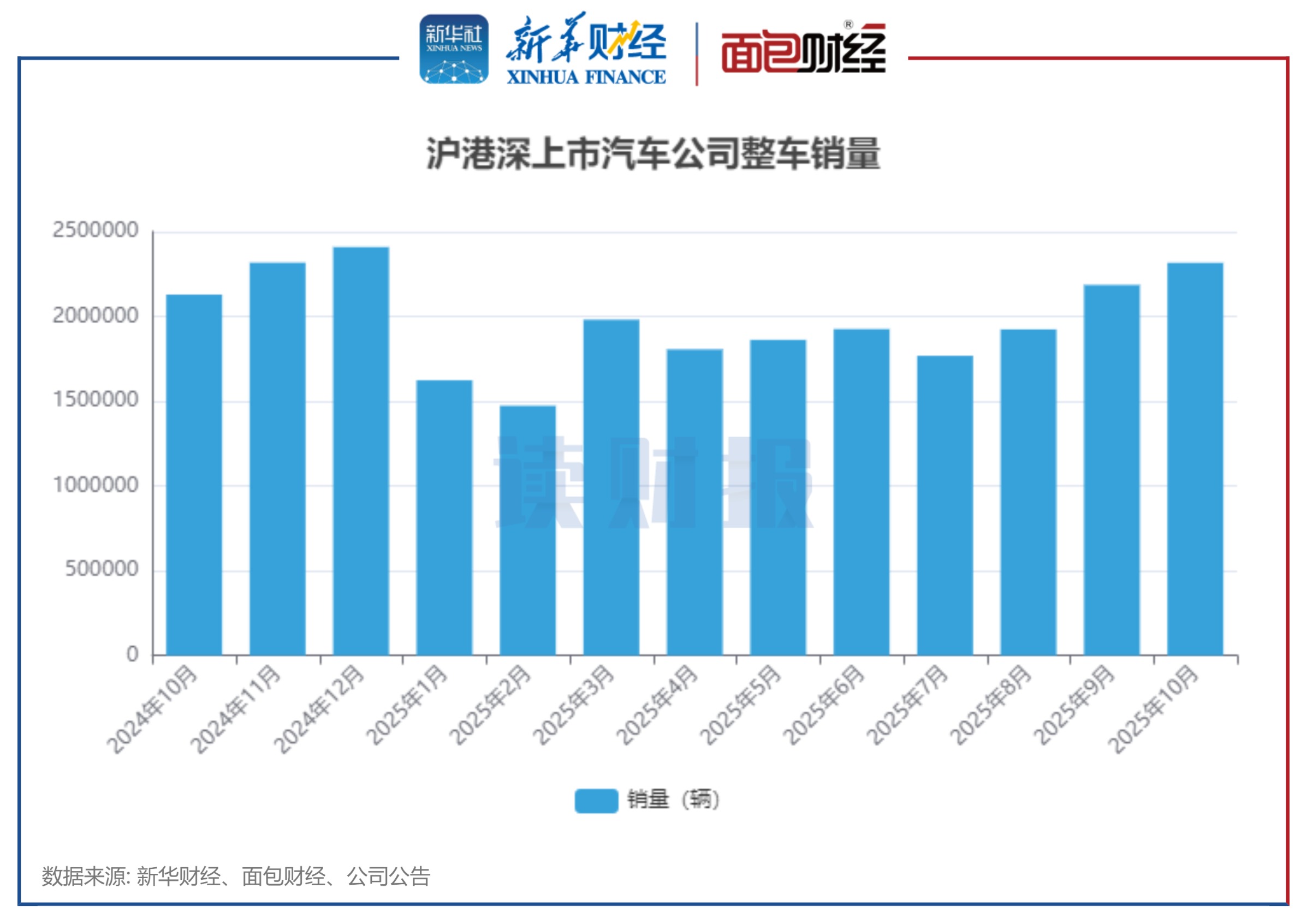
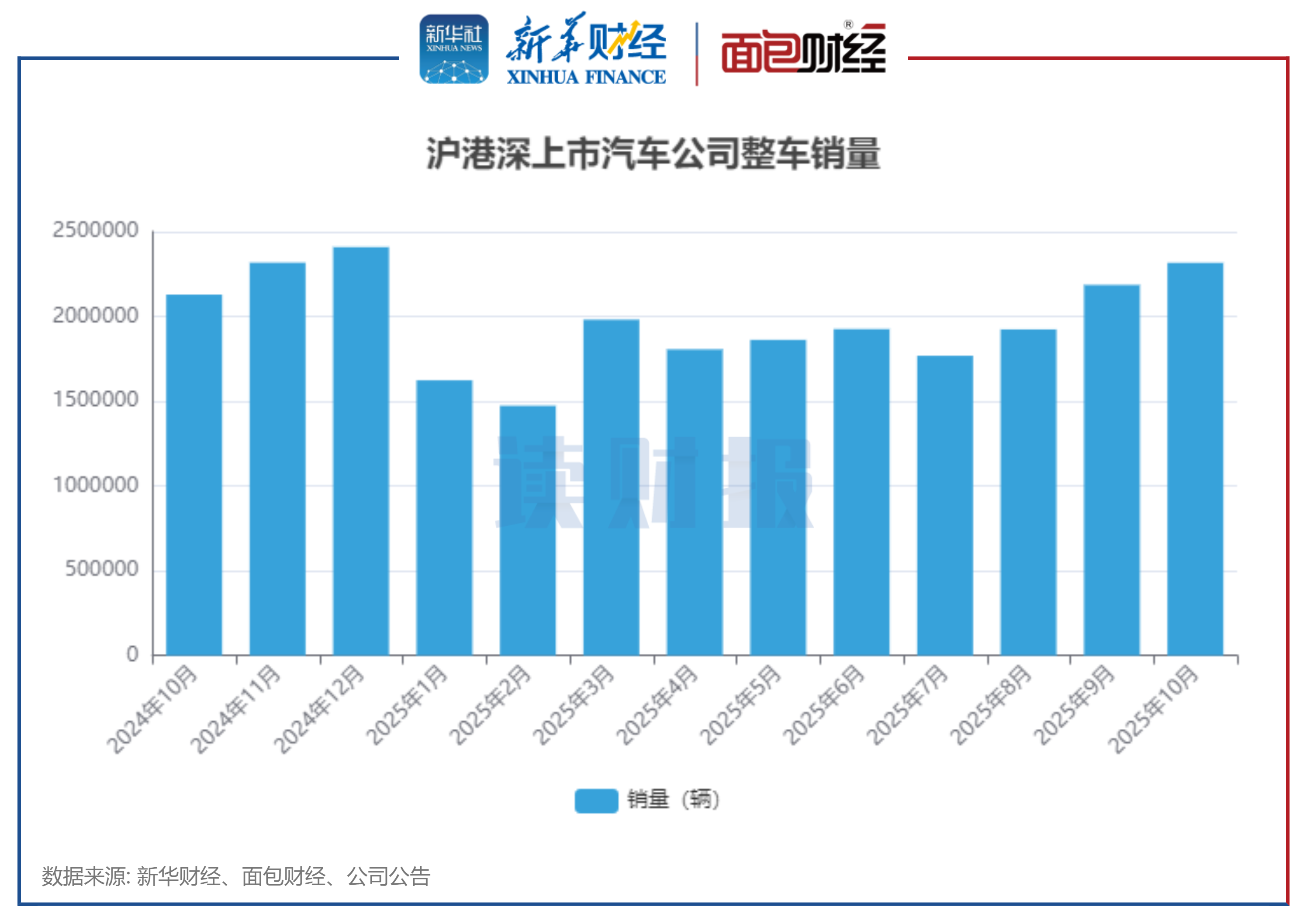
Core Insights - In October 2025, 20 major A and H-share listed automotive manufacturers reported a total vehicle sales of 2.3166 million units, representing a year-on-year increase of 8.82% and a month-on-month increase of 5.97% [1][2] - The total sales of new energy vehicles (NEVs) reached approximately 1.3078 million units, marking a year-on-year increase of 15.63% and a month-on-month increase of 9.68%, with a penetration rate of about 57.48% [1][3] Group 1: Overall Vehicle Sales - The top-selling company in October 2025 was SAIC Motor, with sales of 454,000 units, reflecting a year-on-year growth of 12.96% [2] - Other notable manufacturers included BYD, Geely, and Changan, which followed closely in sales figures [2] - Companies like Beiqi Blue Valley and Qianli Technology saw their sales growth exceed 100% year-on-year, while NIO and XPeng also experienced significant growth [2] Group 2: New Energy Vehicle Sales - The leading companies in NEV sales for October 2025 were BYD, SAIC Motor, and Geely, with sales of 441,700 units, 206,700 units, and 177,900 units respectively [3] - Beiqi Blue Valley's NEV sales growth exceeded 100% year-on-year, while NIO and XPeng also saw substantial increases in their sales growth rates compared to September [3] - BYD's total sales for the year up to October reached 3.7019 million units, showing a year-on-year increase of 13.88% [3]





降息,突发!美联储,大消息!美股突变,黄金大涨
Zheng Quan Shi Bao· 2025-11-12 23:55
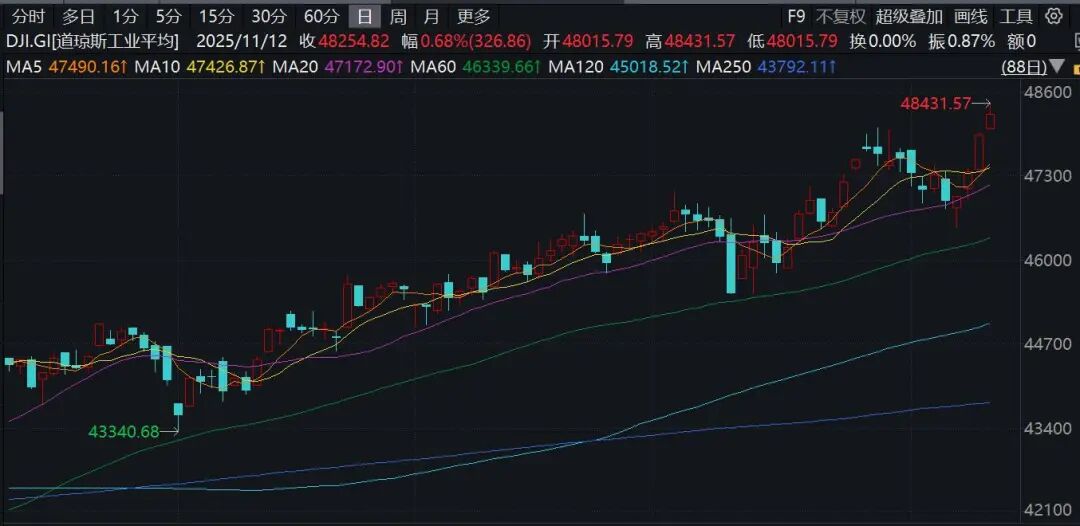
Market Overview - The three major U.S. stock indices showed mixed performance, with the Dow Jones Industrial Average rising by 0.68% to set a new closing high, while the Nasdaq Composite fell by 0.26%, and the S&P 500 increased by 0.06% [1] Individual Stocks - Bank stocks experienced a broad rally, with Goldman Sachs rising over 3%, and Citigroup and Morgan Stanley both increasing by over 2% [2] - Large technology stocks had mixed results, with AMD rising by 9%, while Oracle fell by over 3% and Tesla dropped by over 2% [2] - Chinese concept stocks saw a decline, with the Nasdaq Golden Dragon China Index falling by 1.46%. Stocks such as Xpeng Motors, NIO, iQIYI, and Baidu dropped over 2%, while Li Auto, Alibaba, and JD.com fell by over 1% [2] Gold and Silver Market - International gold prices surged, with spot gold surpassing $4200 per ounce for the first time since October 21, marking an intraday increase of over 2%. Spot silver also saw a significant rise, climbing over 4% at one point [2] Federal Reserve and Economic Policy - There are expectations on Wall Street that the record-long U.S. government shutdown may soon come to an end, as the House of Representatives is set to vote on a temporary funding bill previously passed by the Senate [3] - The Federal Reserve is undergoing personnel changes, with Atlanta Fed President Bostic unexpectedly announcing his retirement effective February next year. Discussions regarding the next Fed chair have surfaced, with Kevin Hassett indicating he would accept the position if invited by Trump [3] - Most regional Fed officials are not actively pushing for a rate cut in December, with Bostic supporting the idea of maintaining rates until inflation reaches 2%. Boston Fed President Collins also favors keeping rates unchanged to curb inflation [3] - According to CME's "FedWatch," the probability of a 25 basis point rate cut in December is 59.4%, while the probability of maintaining rates is 40.6%. The likelihood of cumulative rate cuts of 25 basis points by January is 51.5%, with a 23.5% chance of rates remaining unchanged and a 25% chance of a 50 basis point cut [4][5]


读财报上市车企10月销量:整车销量超231万辆 北汽蓝谷、蔚来等销量增速加快
Zhong Guo Jin Rong Xin Xi Wang· 2025-11-12 23:48
Core Insights - In October 2025, 20 A and H-share listed automotive manufacturers reported a total vehicle sales of 2.3166 million units, representing a year-on-year increase of 8.82% [1][4] - Among these, 16 companies disclosed their new energy vehicle (NEV) sales, totaling approximately 1.3078 million units, which is a year-on-year increase of 15.63% and a penetration rate of about 57.48% [1][8] Group 1: Overall Vehicle Sales - The total vehicle sales for October 2025 reached 2.3166 million units, marking a month-on-month growth of 5.97% [1][4] - SAIC Motor led the sales with 454,000 units, followed by BYD with 441,706 units and Geely with 307,133 units [5][6] - Notable growth was observed in companies like BAIC Blue Valley and NIO, with sales growth exceeding 100% year-on-year, while companies like Ideal Auto and NIO experienced a decline of over 30% [4][8] Group 2: New Energy Vehicle Sales - The total NEV sales for October 2025 were approximately 1.3078 million units, with a month-on-month increase of 9.68% [8][11] - Leading NEV manufacturers included BYD, SAIC Motor, and Geely, with sales of 441,706 units, 206,692 units, and 177,882 units respectively [11][15] - Companies such as BAIC Blue Valley and NIO saw their NEV sales growth exceed 50%, while Ideal Auto and BYD reported a year-on-year decline in sales [11][15]

【读财报】上市车企10月销量:整车销量超231万辆 北汽蓝谷、蔚来等销量增速加快
Xin Hua Cai Jing· 2025-11-12 22:59
Core Insights - In October 2025, 20 A and H-share listed automotive manufacturers collectively sold 2.3166 million vehicles, representing a year-on-year increase of 8.82% and a month-on-month increase of 5.97% [2][12]. Group 1: Overall Vehicle Sales - The top-selling company in October was SAIC Motor, with sales of 454,000 vehicles, showing a year-on-year growth of 12.96% [11][19]. - BYD followed closely with sales of 441,706 vehicles, but experienced a decline of 12.13% year-on-year [19]. - Other notable performers included Geely Automobile with 307,133 vehicles sold (up 35.49%) and Changan Automobile with 278,436 vehicles (up 11.00%) [8][19]. - Companies like BAIC Blue Valley and Qianli Technology saw significant growth, with year-on-year increases exceeding 100% [7][11]. Group 2: New Energy Vehicle Sales - A total of 16 companies reported new energy vehicle sales, with approximately 1.3078 million units sold in October, marking a year-on-year increase of 15.63% and a penetration rate of 57.48% [12][15]. - Leading new energy vehicle manufacturers included BYD, SAIC Motor, and Geely, with sales of 441,706, 206,692, and 177,882 units respectively [15][19]. - BAIC Blue Valley and NIO reported growth rates exceeding 100%, while Li Auto and BYD experienced declines in year-on-year sales [15][19].