
LI AUTO(LI)

Search documents
理想汽车首个海外零售中心开业
Bei Jing Shang Bao· 2025-10-14 04:32
北京商报讯(记者刘晓梦)10月14日,理想汽车宣布,理想汽车海外首家授权零售中心,乌兹别克斯坦首 都塔什干零售中心开业。据了解,理想汽车将面向当地市场销售三款增程电动产品理想L9、理想L7和 理想L6,区别于国内的直营销售,理想汽车海外销售目前采取授权经销商模式。 ...

汽车行业月报:9月新能源车渗透率升至57.8%,看好四季度销量冲刺提振车市表现-20251014
BOCOM International· 2025-10-14 02:28
Investment Rating - The automotive industry is rated as "Leading" with expectations for strong performance in the upcoming quarter [1]. Core Insights - In September, the penetration rate of new energy vehicles (NEVs) reached 57.8%, indicating a positive outlook for sales in the fourth quarter [1][3]. - The retail sales of passenger vehicles in September reached 2.241 million units, marking a year-on-year increase of 9.2% for the first nine months of 2025 [3]. - The report highlights that domestic brands outperformed the industry, capturing a retail market share of 66.9% in September [3]. Summary by Sections Industry Performance - The retail sales of new energy passenger vehicles in September were 1.296 million units, with a penetration rate of 57.8%, up 5.0 percentage points year-on-year [3]. - The export of passenger vehicles totaled 528,000 units in September, with a significant increase in NEV exports [3]. Company Valuation Overview - Companies such as CATL, BYD, and Xpeng Motors are rated as "Buy" with target prices indicating potential upside [2][11]. - The average price-to-earnings ratio for the covered companies is projected to be 30.9 for FY25E [2]. Investment Recommendations - The report suggests focusing on companies like Xpeng Motors and Geely for their upcoming product launches and internal resource integration [3]. - It is advised to remain cautious as the market may enter a consumption lull after the fourth quarter sales surge [3].




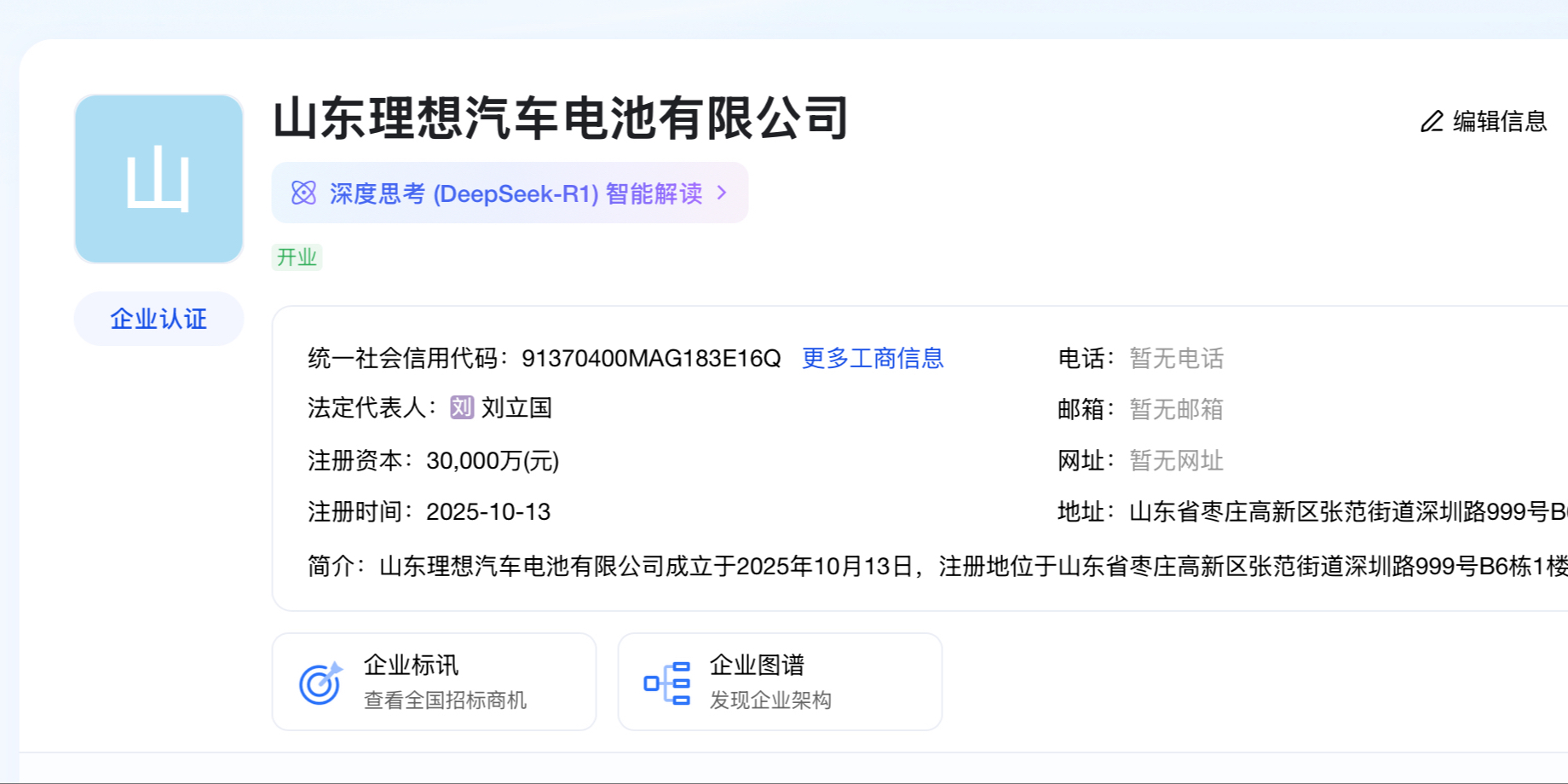
山东理想汽车电池有限公司成立,注册资本3亿元
Xin Lang Cai Jing· 2025-10-14 02:26
天眼查工商信息显示,10月13日,山东理想汽车电池有限公司成立,法定代表人为刘立国,注册资本3 亿人民币,经营范围包括电池制造、电池销售、新兴能源技术研发、电动汽车充电基础设施运营等。股 东信息显示,该公司由北京理想汽车有限公司、欣旺达动力科技股份有限公司共同持股。 ...

蔚来、小鹏、理想汽车智驾部门大调整
Zhong Guo Qi Che Bao Wang· 2025-10-14 01:39
国庆假期后,国内自动驾驶竞争进入新阶段。10月9日,小鹏汽车自动驾驶中心人事变动,刘先明 接替李力耘;同日,蔚来多名智驾相关负责人离职。此前,理想汽车已对自动驾驶部门组织架构进行重 新梳理。 ...
中国汽车-行业市场份额和利润分配的分散化可能持续至 2025 年第四季度-China Automobiles_ De-consolidation of industry market share and profit distribution likely to continue into 4Q25
2025-10-13 15:12
Summary of Conference Call Notes on the Automotive Industry Industry Overview - The automotive industry is experiencing a de-consolidation of market share and profit distribution, which is expected to continue into 4Q25 [1][2][18] - Domestic passenger vehicle (PV) demand is projected to slow down, with growth rates of +5% year-over-year (yoy) in 3Q25 and a decline of -9% yoy in 4Q25, compared to +11% yoy in 1H25 [1][2] Key Insights Market Dynamics - The capex expansion for auto original equipment manufacturers (OEMs) accelerated to +66% yoy in 2Q25, the highest growth rate since 3Q22, driven by a 13% growth in passenger vehicle production and a 14% increase in wholesale volume [2][9] - The Herfindahl-Hirschman Index (HHI) for domestic new energy vehicle (NEV) retail sales volume decreased to 1,218 in 8M25 from 1,479 in 8M24, indicating a more fragmented market [2] Financial Performance - The total OEM industry EBITDA declined by -1% yoy, with margins decreasing by -0.9 percentage points (pp) yoy. The top two profit-making OEMs saw a decline in EBITDA, while most others improved, suggesting a potential demand/supply imbalance [2][18] - Account payable days for the overall OEM industry shortened by 26 days quarter-over-quarter (qoq) and 5 days yoy, reflecting efforts to relieve suppliers' working capital pressure [2][16] Future Outlook - For 4Q25, expectations include: - Sequential growth in volume due to better seasonality and new model launches [4] - Potential widening of dealer discounts during the peak sales season [4] - Improvement in OEM margins sequentially, offsetting average selling price (ASP) pressure [4] - Gradual reduction in payable days and improved operating cash flow [4] Recent Trends - In 3Q25, market growth slowed due to a high base from the previous year and weaker-than-usual seasonality. NEV penetration increased to 56% from 50% in 1H25, while dealer discounts for NEVs widened [5][6] - The profit distribution among OEMs is becoming less concentrated, with industry leaders facing margin pressure while followers see margin improvements [6][18] Earnings Revisions - GAC's net profit estimates for 2H25/2026/2027 were lowered significantly due to continued market share loss, with a new target price of Rmb4.2, implying a downside of -45% [7] - SAIC's volume estimates were raised by up to 2% for 2H25-2027, but gross margins were lowered, maintaining a target price of Rmb8.8, implying a downside of -48% [7] - Huayu's EPS estimates were raised by 4%-6% due to better-than-expected customer diversification, with a target price increase to Rmb14.6, implying a downside of -29% [7] Additional Insights - The automotive industry is at a critical inflection point where many companies are nearing cash cost levels, indicating potential challenges in adding new capacity or maintaining profitability [19][20] - The overall industry is still above cash cost levels, but margin improvements are becoming increasingly difficult due to ongoing price competition and slowing volume growth [18][42] This summary encapsulates the key points from the conference call, highlighting the current state and future outlook of the automotive industry, along with specific financial performance metrics and earnings revisions for major players.




理想汽车出资3亿,联手欣旺达注册电池公司
Jing Ji Guan Cha Wang· 2025-10-13 11:28
Core Viewpoint - The establishment of Shandong Li Auto Battery Co., Ltd. marks a strategic move by Li Auto to enhance its battery manufacturing capabilities through a joint venture with battery manufacturer Xinwanda, aiming to produce self-developed power battery products [2] Group 1: Company Overview - Shandong Li Auto Battery Co., Ltd. has been established with a registered capital of 300 million yuan [2] - The legal representative of the company is Liu Liguo [2] - The business scope includes battery manufacturing, battery sales, emerging energy technology research and development, centralized fast charging stations, new material technology research and development, and software development [2] Group 2: Joint Venture Details - Li Auto and Xinwanda will invest in a 50:50 ratio to form the joint venture [2] - The joint venture is specifically aimed at producing Li Auto's self-developed power battery products [2]

理想AI-Brain让汽车工业更智能
理想TOP2· 2025-10-13 10:29
Core Viewpoint - The article discusses the development and implementation of AI-Brain, an intelligent hardware solution by the Li Auto Lianshan team, aimed at enhancing production line efficiency and decision-making through AI integration [2][6]. Group 1: AI-Brain Overview - AI-Brain is a compact and cost-effective intelligent hardware that enables AI algorithms to perform real-time inference directly on the production line, enhancing the intelligence of manufacturing processes [2]. - The solution ensures data privacy and security by operating independently in a closed network environment [2]. - The platform has demonstrated significant performance in various business sectors of Li Auto, achieving over 90% accuracy and recall rates in after-sales service and 99% accuracy in core manufacturing processes [3][4]. Group 2: Challenges and Solutions - The Li Auto Lianshan team identified common pain points between component suppliers and vehicle manufacturers, leading to the decision to share their intelligent solutions with a broader range of enterprises [6]. - The team aims to create a collaborative AI product that allows engineers, regardless of their coding skills, to effectively utilize AI tools for problem-solving [7]. Group 3: AI-Brain Capabilities - AI-Brain addresses several industry challenges, including low efficiency and high costs of manual inspections, difficulty in knowledge transfer from experienced engineers, and lengthy decision-making processes due to inadequate data [8]. - It supports over 10 industrial communication protocols for seamless integration with production equipment, ensuring real-time data collection and analysis [9]. - The hardware boasts a processing power of up to 275 TOPS, enabling real-time execution of complex AI models for quality issue prediction [11]. Group 4: Market Engagement and Future Prospects - Currently, nearly 500 AI-Brain units are operational in Li Auto and its suppliers' production lines, with significant commercial partnerships established with 49 suppliers, including 5 in negotiation stages [15]. - The Li Auto Lianshan team aims to collaborate with more quality enterprises in the automotive industry to further explore AI technology applications in industrial settings [15].

存在一定比例的用户对理想近期交付体验较低评价
理想TOP2· 2025-10-13 10:29
Core Viewpoint - The article highlights the low delivery experience of a specific automotive company, focusing on four main dimensions that contribute to customer dissatisfaction, including slow delivery, missed replacement subsidies, vague delivery timelines, and poor attitudes from delivery personnel [1][2][3][4]. Group 1: Delivery Experience Issues - Customers perceive the delivery process as slow, particularly for models i8 and i6, due to the company's inability to accurately gauge demand for new models, leading to insufficient production capacity [1]. - There is a concern regarding missed replacement subsidies, as the company did not anticipate the discontinuation of these subsidies in various regions during Q3 and Q4 of 2025, limiting their ability to adjust production plans accordingly [2]. - The delivery timelines provided by the company are considered too broad, causing inconvenience for customers who may have other commitments during the delivery period, and the inflexibility in rescheduling adds to the frustration [3]. Group 2: Customer Feedback and Attitudes - The overall attitude of delivery personnel is perceived negatively, especially during the high demand period for new models, which has led to increased customer complaints and dissatisfaction [4]. - A specific case illustrates a customer's poor experience, highlighting issues such as lack of proactive communication, last-minute changes to delivery schedules, and perceived disrespect from delivery staff [5][6][8].

时隔5个月,上汽重夺“销冠”
财联社· 2025-10-13 09:44
Core Viewpoint - The Chinese passenger car market experienced significant growth in September, with retail sales reaching 2.241 million units, a year-on-year increase of 6.3% and a month-on-month increase of 11.0%. Cumulatively, retail sales for the year reached 17.005 million units, marking a 9.2% year-on-year growth and setting a new historical peak [1]. Group 1: Market Performance - In September, 11 out of 14 listed car companies reported year-on-year sales growth, accounting for 78.6% of the sample. New energy vehicles (NEVs) were the primary driver of this growth, with total sales exceeding 1.32 million units among the 14 major companies [1]. - The penetration rate of NEVs in the overall passenger car retail market reached 57.8% in September, an increase of 5 percentage points compared to the same period last year. Among domestic brands, the penetration rate for NEVs reached 78.1% [1]. Group 2: Company-Specific Sales Data - SAIC Motor Corporation achieved sales of 439,777 units in September, a year-on-year increase of 40.39%, reclaiming the title of monthly sales champion among Chinese listed car companies after five months. Cumulative sales for the first nine months reached 3.193 million units, up 20.53% year-on-year [2]. - BYD's sales in September were 396,270 units, marking a year-on-year decline of 5.52%, ending an 18-month growth streak. The sales of pure electric models were 205,000 units, up 24.31%, while plug-in hybrid models saw a significant drop of 25.58% [3]. - Geely Automobile reported sales of 273,125 units in September, a year-on-year increase of 35.24%. NEV sales reached 165,201 units, up 81.27%, with a market penetration rate of 60.49% [3]. - Chery Automobile's sales reached 255,584 units in September, a year-on-year increase of 8.90%, with NEV sales at 83,498 units, up 17.24% [4]. - New force in the automotive sector, Leap Motor, achieved a record monthly delivery of 66,657 units in September, a year-on-year increase of 97.4% [4]. Group 3: Market Trends and Future Outlook - The automotive market in September saw the launch of over 70 new models, driven by government subsidies and local purchase incentives, which boosted consumer purchasing enthusiasm [5]. - The Secretary-General of the China Passenger Car Association, Cui Dongshu, indicated that the rapid release of new models, particularly from domestic brands, is enhancing competitiveness in the NEV market. The fourth quarter is expected to maintain stable growth due to policy guidance and a strong growth foundation [5].

汽车周报:紧抓科技主线,寻找低估成长新机会-20251013
Shenwan Hongyuan Securities· 2025-10-13 09:16
Investment Rating - The report maintains a positive outlook on the automotive industry, emphasizing the importance of technology and mid-to-high-end market segments as key investment themes [4]. Core Insights - The report highlights a surge in vehicle sales driven by limited subsidies in Q4, with a focus on companies capable of effectively releasing supply, such as Geely, BYD, Great Wall, Li Auto, and NIO [4]. - It suggests that in an uncertain consumer environment, attention should be directed towards "future industries" like robotics, AI, and low-altitude economy, recommending companies with strong growth potential and relatively low valuations [4]. - The report notes that the penetration rate of new energy vehicles reached 56.92%, with total retail sales of passenger cars at 650,000 units in the 39th week of 2025, reflecting a 27.95% increase month-over-month but a slight decline year-over-year [4][5]. Industry Updates - The report indicates that traditional energy vehicle sales were 280,000 units, up 32.70% month-over-month but down 15.07% year-over-year, while new energy vehicle sales were 370,000 units, up 24.58% month-over-month and up 13.15% year-over-year [4]. - Recent weeks have seen an increase in raw material price indices for both traditional and new energy vehicles, with traditional vehicle raw material prices rising by 0.8% week-over-week and decreasing by 1.3% month-over-month [4][52]. Market Situation - The automotive industry recorded a total transaction value of 266.97 billion yuan, with the automotive industry index closing at 8141.23 points, down 1.26% for the week, which is a greater decline compared to the Shanghai Composite Index [4][13]. - The report notes that 132 automotive stocks rose while 135 fell, with the largest gainers being Meili Technology, Jinlong Automobile, and Kabeiyi, while the largest decliners included Mingxin Xuteng, Meichen Technology, and Hengshuai Co., Ltd. [4][18]. Investment Recommendations - The report recommends focusing on domestic leading manufacturers such as NIO, Xiaomi, Xiaopeng, and Li Auto, as well as companies involved in intelligent trends like Huawei's HarmonyOS [4]. - It also suggests monitoring state-owned enterprise reforms, particularly with SAIC and Dongfeng, and highlights component manufacturers with strong growth prospects and overseas expansion capabilities [4]. Important Events - The report mentions the release of the 400th batch of new vehicle applications by the Ministry of Industry and Information Technology, which includes several anticipated models [5][31]. - It also discusses the joint announcement by three departments regarding the technical requirements for the exemption of vehicle purchase tax for new energy vehicles from 2026 to 2027 [8][10].

