
LI AUTO(LI)

Search documents
智能驾驶&座舱行业展望
2025-10-14 14:44
Industry and Company Analysis Summary Industry Overview - The smart driving and cockpit industry is experiencing significant collaboration among domestic OEMs, including BYD, Geely, Chery, FAW, Dongfeng, Changan, BAIC, SAIC, and GAC, with China Automotive Intelligent Technology (Tianjin) Co., Ltd. for research and user experience evaluation of intelligent connected vehicles [1][3] - The evaluation system for smart driving performance is based on N-CAP and CICAP standards, combined with consumer subjective evaluations, providing objective and scientific improvement suggestions for automakers [1] Key Companies and Their Performance - **Huawei**: Leading in L3 level autonomous driving with an aggressive strategy. Their ADS system has version differences, with high-end models like the Aito M8/M9 using ADS 4.0, while the M7 uses a downgraded version. Full features require additional payment, but the downgraded version is sufficient for low traffic cities and highways [1][8] - **Xpeng Motors**: Shows slightly lower stability compared to Huawei but performs well in certain scenarios [6] - **Li Auto**: Has a conservative but stable strategy, closely matching Huawei and Xpeng in overall performance [7] - **NIO and Xiaomi**: Positioned in the third tier, with NIO showing limited progress and Xiaomi needing algorithm optimization for better urban performance [7] Technological Developments - **Qualcomm 8,397 Chip**: Expected to be adopted by Li Auto and Xiaomi in 2026, with some traditional manufacturers potentially following suit due to issues with NVIDIA's Sora development [4][15] - **L2 Mandatory Standards**: Implementation is expected to increase compliance costs for automakers by 15%-20%, particularly affecting Xiaomi due to recent accident scenarios [4][17] User Experience Evaluation - The user experience evaluation for smart driving includes fixed-route tests in urban and highway environments, assessing various scenarios such as tunnels and complex intersections. The results are based on both professional evaluations and actual user feedback, ensuring a comprehensive analysis [5][10] Smart Cockpit Interaction - The evaluation of smart cockpit human-machine interaction focuses on usability, safety, creativity, and emotional engagement. New force car companies like NIO, Xpeng, and Li Auto excel in this area, while traditional manufacturers like BYD and Geely are catching up [12][13] - Huawei's HarmonyOS cockpit system is competitive but lacks customization features, leading to product homogenization [13] Future Trends - The future of smart cockpits will focus on five dimensions: visual, auditory, tactile, physiological monitoring, and optoelectronic applications. Key developments include DMS and OMS becoming mandatory standards, enhanced auditory quality, and more natural human-machine dialogue [19] - Touch interaction technology will rely on advancements in holographic technology, which could enable more complex gesture controls [20] Emerging Technologies Impacting Supply Chain - Technologies such as HUD and AR HUD, electronic rearview mirror systems, and smart seating are expected to significantly impact the automotive supply chain. These innovations will drive demand for related components and systems [22][25] Conclusion - The smart driving and cockpit industry is rapidly evolving, with significant advancements in technology and user experience evaluation. Key players like Huawei, Xpeng, and Li Auto are leading the charge, while regulatory changes are reshaping compliance costs and testing requirements. The future will see a focus on enhanced interaction and emerging technologies that will further transform the automotive landscape [1][4][19]


汽车行业重点公司三季报业绩前瞻
2025-10-14 14:44
Summary of Key Points from the Automotive Industry Conference Call Industry Overview - The automotive industry is experiencing a slowdown in overall growth, with key companies showing a sequential sales growth of 7.29%, surpassing the industry average of 5.6% [2][8] - The performance of new energy vehicle manufacturers is notably stronger compared to traditional automakers [8] Company Performance and Expectations BYD - BYD's Q3 profit is expected to be between 8 billion to 8.5 billion yuan, a significant increase from 6.6 billion yuan in Q2, despite a year-on-year sales decline of 1.82% [1][3][4] - The increase in profit is attributed to higher per-vehicle profit and reduced end-user promotions [4] Geely - Geely's Q3 sales are projected to grow by 7.89%, with an expected profit of approximately 4.3 billion yuan, reflecting a year-on-year increase of 75% and a sequential increase of about 20% [1][5] - The growth is driven by the "anti-involution" effect and contributions from high-value models such as the Xingyao 8, M9, and Lynk & Co 900 [5] Great Wall Motors - Great Wall Motors achieved Q3 sales of 353,600 units, a sequential increase of 13%, with exports being a key growth driver [1][6] - Expected revenue is around 60 billion yuan, with profits estimated between 4.2 billion to 4.5 billion yuan, benefiting from improved gross margins [6] Changan Automobile - Changan's Q3 sales reached 77,100 units, with a sequential growth of 9.4% [1][7] - The expected revenue is around 44 billion yuan, with profits estimated between 1.5 billion to 1.8 billion yuan, aided by reduced losses in the new energy sector [7] New Energy Vehicle Manufacturers - Leap Motor: Sales of 174,000 units, with a sequential growth of nearly 30%, expected revenue of around 18 billion yuan, and achieving breakeven or slight profit [1][9] - Li Auto: Sales of 93,000 units, with expected profits of 300 to 500 million yuan [1][9] - Xpeng Motors: Sales of 116,000 units, expected revenue of around 21 billion yuan, but still facing losses of 400 to 500 million yuan [1][9] Traditional Automakers - SAIC Motor: Q3 revenue around 165 billion yuan, a year-on-year increase of 39%, with expected profits of 3.5 to 4 billion yuan [10] - BAIC BluePark: Q3 revenue around 6 billion yuan, but slightly higher losses compared to Q2 [10] - GAC Group: Q3 revenue increased by 10% year-on-year, but still in a loss position [10] Component Manufacturers - The automotive electronics sector is expected to perform well in 2025, benefiting from lower procurement costs and reduced pricing pressure from automakers [11] - Companies like Desay SV, Huayang Group, and Jingwei Hirain are expected to exceed expectations in Q3, with Desay SV's profit projected at around 700 million yuan, a year-on-year increase of over 20% [11][12] - Other component manufacturers such as Wemaise and Newray Ford are also expected to show strong performance, with Wemaise's year-on-year growth estimated to exceed 100% [13] Key Takeaways - The automotive industry is gradually recovering, with various companies implementing proactive measures to address market competition and challenges [8] - Geely, Great Wall, and Leap Motor are highlighted as the most likely to exceed expectations in the automotive sector [15] - In the component sector, companies like Jingwei Hirain, Wemaise, and Fuyao Glass are expected to outperform market expectations [16]



美股异动 | 热门中概股普跌 阿里巴巴(BABA.US)跌超3%
智通财经网· 2025-10-14 14:29
Core Viewpoint - The Nasdaq China Golden Dragon Index experienced a significant decline of 2.69%, with major Chinese concept stocks also falling, attributed to escalating Sino-U.S. trade tensions [1] Market Performance - Major Chinese concept stocks such as 房多多 (DUO.US) fell over 5%, while 阿里巴巴 (BABA.US), 小鹏汽车 (XPEV.US), and 理想汽车 (LI.US) dropped more than 3%, and 好未来 (TAL.US) decreased over 2% [1] - The Hang Seng Index declined by 1.73%, and the Shanghai Composite Index fell by 0.62% [1] Analysis and Outlook - Analysts from 东方证券 noted that the impact of the current trade war is somewhat weaker than expected, but there remains potential for fluctuations in the future [1] - The outlook suggests that while the upward recovery may be delayed, the overall upward trend in the market is unlikely to change [1]


理想/欣旺达合资公司正式落地
起点锂电· 2025-10-14 10:24
Core Insights - The article discusses the collaboration between Li Auto and Aisin Wanda, focusing on the establishment of a joint venture for battery production and the development of an open-source vehicle operating system called Star Ring OS [2][3][10]. Group 1: Joint Venture and Collaborations - Li Auto and Aisin Wanda have formed a joint venture named Shandong Li Xiang Auto Battery Co., Ltd., with a registered capital of 300 million yuan, where both companies hold a 50% stake [3][4]. - The joint venture aims to focus on battery manufacturing, sales, and the development of new energy technologies, including electric vehicle charging infrastructure [4][3]. - Aisin Wanda's involvement in the Star Ring OS project will enhance the integration of supply chain and vehicle capabilities, promoting a more open and sustainable automotive software ecosystem [2][10]. Group 2: Market Position and Performance - Aisin Wanda ranks among the top 10 domestic power battery manufacturers, with a reported battery installation volume of 10.21 GWh in the first seven months of 2025, reflecting a year-on-year growth of 40.2% [5][11]. - The company's revenue for the first half of 2025 reached 26.985 billion yuan, a 12.82% increase year-on-year, with the power segment showing a 22.63% growth in revenue [11]. - The battery project with Li Auto is seen as a significant step in Aisin Wanda's strategy, following a similar partnership with Geely, which also focused on battery production in Shandong [4][5]. Group 3: Industry Trends and Future Outlook - The establishment of the joint venture is expected to adjust the current supply chain dynamics in the battery industry, particularly for Li Auto, which currently sources batteries from multiple suppliers, including CATL and Aisin Wanda [8][10]. - The overall battery installation volume in China for the first seven months of 2025 reached 343.52 GWh, with Aisin Wanda's contribution being significant [5][9]. - The collaboration is anticipated to enhance the competitive landscape of the electric vehicle market, as Li Auto aims to introduce self-developed battery products by 2026 [2][10].



i6发布, i8交付略低于此前Flag|理想25年9月记录
理想TOP2· 2025-10-14 09:46
Core Insights - The company aims to achieve significant delivery targets for its electric vehicles, with specific monthly goals set for different models, indicating a strong focus on growth in the high-end electric vehicle market [2][5][8] Delivery Performance - In September 2025, the company delivered a total of 33,951 vehicles, comprising 24,554 range-extended models and 9,397 pure electric models [1] - The delivery numbers for August 2025 were 23,196 range-extended and 5,333 pure electric models, showing a month-over-month increase in deliveries [1] Model-Specific Goals - The company has set ambitious monthly delivery targets for its models, with the ideal i8 aiming for a stable delivery of 6,000 units per month and the i6 targeting 9,000 to 10,000 units per month [2] - Overall, the pure electric models are expected to stabilize at 18,000 to 20,000 units per month [2] Product Development and Features - The company is actively enhancing its autonomous driving capabilities, with updates and new features being rolled out, including the OTA 8.0 update for AD MAX users [4][7] - The i6 model is set to be officially launched on September 26, 2025, with promotional activities already underway [5][6] Strategic Partnerships - A joint venture has been established with a battery company, aiming for regulatory approval in 2026, which indicates a strategic move to strengthen its supply chain [5] - The company is also focusing on in-house development of hardware and software to differentiate itself from competitors [5] Market Positioning and Brand Strategy - The company is positioning itself to compete effectively in the high-end electric vehicle segment, with a focus on design and user experience [5][6] - The appointment of a brand ambassador is part of a broader marketing strategy to enhance brand visibility and appeal [7] Legal and Regulatory Actions - The company has taken legal action against malicious online activities aimed at damaging its reputation, indicating a proactive approach to brand protection [12][14]

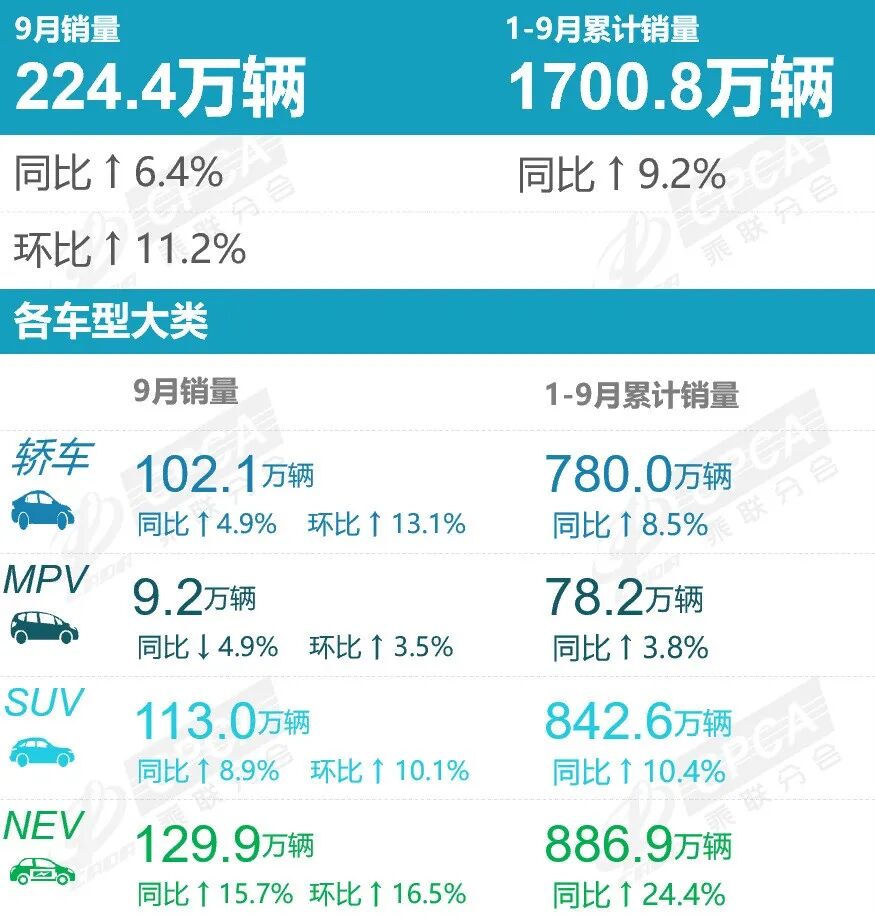
乘联分会:9月份国内狭义乘用车市场零售销量达224.4万辆 同比增长6.4%
智通财经网· 2025-10-14 09:12
Core Insights - In September 2025, the retail sales of narrow passenger vehicles in China reached 2.244 million units, marking a year-on-year increase of 6.4% and a month-on-month increase of 11.2% [1] - Cumulatively, from January to September 2025, the total sales reached 17.008 million units, reflecting a year-on-year growth of 9.2% [1] - The automotive market is experiencing strong growth ahead of year-end policy adjustments, with a shift towards stable pricing and reduced promotions [2] Wholesale Sales Rankings (September 2025) - BYD Auto led the wholesale sales with 393,060 units, a month-on-month increase of 5.8% but a year-on-year decrease of 5.9%, capturing a market share of 14.1% [3] - Geely Auto and Chery Auto followed with 273,125 and 269,070 units respectively, showing significant year-on-year growth of 35.2% and 13.5% [3] - The top ten manufacturers collectively reflect a diverse performance, with some experiencing declines while others show robust growth [3] Retail Sales Rankings (September 2025) - BYD Auto also topped the retail sales with 347,353 units, a month-on-month increase of 12.0% but a year-on-year decrease of 10.2%, holding a market share of 15.5% [5] - Geely Auto and Volkswagen ranked second and third with 232,460 and 138,655 units respectively, with Geely showing a year-on-year increase of 42.8% [5] - The retail landscape indicates a competitive environment with varying performance among the top players [5] Wholesale Sales Rankings (January to September 2025) - For the first nine months of 2025, BYD Auto led with 3.218 million units sold, a year-on-year increase of 17.6% and a market share of 15.4% [4] - Geely Auto and Chery Auto followed with significant growth rates of 45.7% and 14.3% respectively [4] - The overall market dynamics suggest a strong recovery and growth trajectory for several manufacturers [4] Retail Sales Rankings (January to September 2025) - In the cumulative sales from January to September 2025, BYD Auto again led with 2.542 million units, reflecting a modest year-on-year growth of 3.1% [6] - Geely Auto showed remarkable growth of 59.4%, reaching 1.875 million units [6] - The retail performance indicates a competitive market with varying growth rates among manufacturers [6] New Energy Vehicle (NEV) Wholesale Sales Rankings (September 2025) - BYD Auto dominated the NEV wholesale market with 393,060 units, holding a market share of 26.3% despite a year-on-year decline of 5.9% [7] - Geely Auto and Tesla China followed with significant increases in sales, particularly Geely with an 81.3% year-on-year growth [7] - The NEV segment is showing strong growth potential, with several manufacturers capitalizing on the trend [7] New Energy Vehicle (NEV) Retail Sales Rankings (September 2025) - In retail sales for NEVs, BYD Auto again led with 347,353 units, capturing a market share of 26.7% [9] - Geely Auto and Changan Auto followed with 150,570 and 84,237 units respectively, indicating strong year-on-year growth [9] - The NEV retail market is becoming increasingly competitive, with several players showing significant growth [9] New Energy Vehicle (NEV) Wholesale Sales Rankings (January to September 2025) - From January to September 2025, BYD Auto led the NEV wholesale market with 3.218 million units, reflecting a year-on-year growth of 17.6% [8] - Geely Auto showed impressive growth of 113.9%, reaching 1.167 million units [8] - The NEV market is expanding rapidly, with several manufacturers gaining market share [8] New Energy Vehicle (NEV) Retail Sales Rankings (January to September 2025) - In the NEV retail segment, BYD Auto led with 2.542 million units sold, a year-on-year growth of 3.1% [10] - Geely Auto and Changan Auto also showed strong performance with year-on-year growth rates of 107.2% and 40.2% respectively [10] - The NEV retail market is characterized by significant growth opportunities for various manufacturers [10]
市场监管总局发布最新一批无条件批准经营者集中案件列表
Di Yi Cai Jing· 2025-10-14 08:50
Core Viewpoint - The State Administration for Market Regulation has released a list of unconditionally approved concentration cases for the period from September 22 to September 30, 2025, highlighting several significant mergers and acquisitions in various sectors [1] Group 1: Mergers and Acquisitions - Chongqing Qianli Zhijia Technology Co., Ltd. and Zhejiang Jike Automobile Research and Development Co., Ltd. are establishing a joint venture [1] - Safran Short Cabin Company and Shanghai Aircraft Manufacturing Co., Ltd. are forming a new joint venture [1] - Beijing Ideal Automobile Co., Ltd. is partnering with Xinwangda Power Technology Co., Ltd. to create a new joint venture [1] - Mitsubishi Motors Corporation is acquiring equity in GAC Mitsubishi Automobile Sales Co., Ltd. [1] - eLong Limited is acquiring equity in Wanda Hotel Management (Hong Kong) Co., Ltd. [1]
【月度排名】2025年9月厂商销量排名快报
乘联分会· 2025-10-14 08:43
Core Viewpoint - The domestic narrow passenger car market in China shows strong growth in September 2025, with retail sales reaching 2.244 million units, a year-on-year increase of 6.4% and a month-on-month increase of 11.2% [2][3]. Sales Data Summary - In September 2025, the cumulative sales for the first nine months reached 17.008 million units, reflecting a year-on-year growth of 9.2% [2][3]. - The breakdown of September sales by vehicle type includes: - SUVs: 474,000 units, year-on-year increase of 4.9%, month-on-month increase of 13.1% [3]. - MPVs: 92,000 units, year-on-year decrease of 4.9%, month-on-month increase of 3.5% [3]. - Sedans: 1.13 million units, year-on-year increase of 8.9%, month-on-month increase of 10.1% [3]. - New Energy Vehicles (NEVs): 1.299 million units, year-on-year increase of 15.7%, month-on-month increase of 16.5% [3]. Manufacturer Performance - The top manufacturers by retail sales in September 2025 are: - BYD: 393,060 units, month-on-month increase of 5.8%, year-on-year decrease of 5.9%, market share of 14.1% [6]. - Geely: 273,125 units, month-on-month increase of 9.2%, year-on-year increase of 35.2%, market share of 9.8% [6]. - Chery: 269,070 units, month-on-month increase of 16.3%, year-on-year increase of 13.5%, market share of 9.6% [6]. - Cumulative sales from January to September 2025 show: - BYD: 3.218 million units, year-on-year increase of 17.6%, market share of 15.4% [7]. - Geely: 2.170 million units, year-on-year increase of 45.7%, market share of 10.4% [7]. New Energy Vehicle (NEV) Insights - In September 2025, the NEV wholesale sales rankings are led by: - BYD: 393,060 units, month-on-month increase of 5.8%, year-on-year decrease of 5.9%, market share of 26.3% [10]. - Geely: 165,201 units, month-on-month increase of 12.1%, year-on-year increase of 81.3%, market share of 11.1% [10]. - Cumulative NEV sales from January to September 2025 show: - BYD: 3.218 million units, year-on-year increase of 17.6%, market share of 30.8% [11].



理想汽车海外首家授权零售中心在乌兹别克斯坦开业
Mei Ri Jing Ji Xin Wen· 2025-10-14 05:40
Core Insights - Li Auto has officially opened its first authorized retail center overseas in Tashkent, Uzbekistan, focusing on the local market with three range-extended electric vehicle models: Li L9, Li L7, and Li L6 [1] Group 1 - The retail center in Tashkent marks a significant step in Li Auto's international expansion strategy [1] - Unlike its domestic sales model, Li Auto is adopting an authorized dealer model for overseas sales [1] - Additional retail centers are set to open in Kazakhstan's largest city, Almaty, and the capital, Astana, in November [1]
理想汽车首个海外零售中心正式开业
Zheng Quan Shi Bao Wang· 2025-10-14 04:37
Core Viewpoint - Li Auto has officially opened its first overseas authorized retail center in Tashkent, Uzbekistan, focusing on selling three range-extended electric vehicle models: Li L9, Li L7, and Li L6 [1] Group 1: Company Expansion - The retail center in Uzbekistan marks the company's first step into the overseas market, utilizing an authorized dealer model instead of direct sales as seen in domestic operations [1] - Additional retail centers are set to open in Kazakhstan's largest city, Almaty, and the capital, Astana, in November [1]