
Morgan Stanley(MS)

Search documents
X @Bloomberg
Bloomberg· 2025-08-29 20:07
Morgan Stanley asked the Fed to reduce its capital requirements, the regulator said as it announced upcoming capital requirements for most Wall Street banks that are in line with lenders’ expectations https://t.co/K3YqML1i0p ...

摩根士丹利对蓝思科技H股的多头持仓比例增至9.2%
Xin Lang Cai Jing· 2025-08-29 10:06
Group 1 - Morgan Stanley's long position in Lens Technology's H-shares increased from 8.75% to 9.2% as of August 26, 2025 [1]

凌晨重磅!美联储,降息大消息
Sou Hu Cai Jing· 2025-08-29 00:14
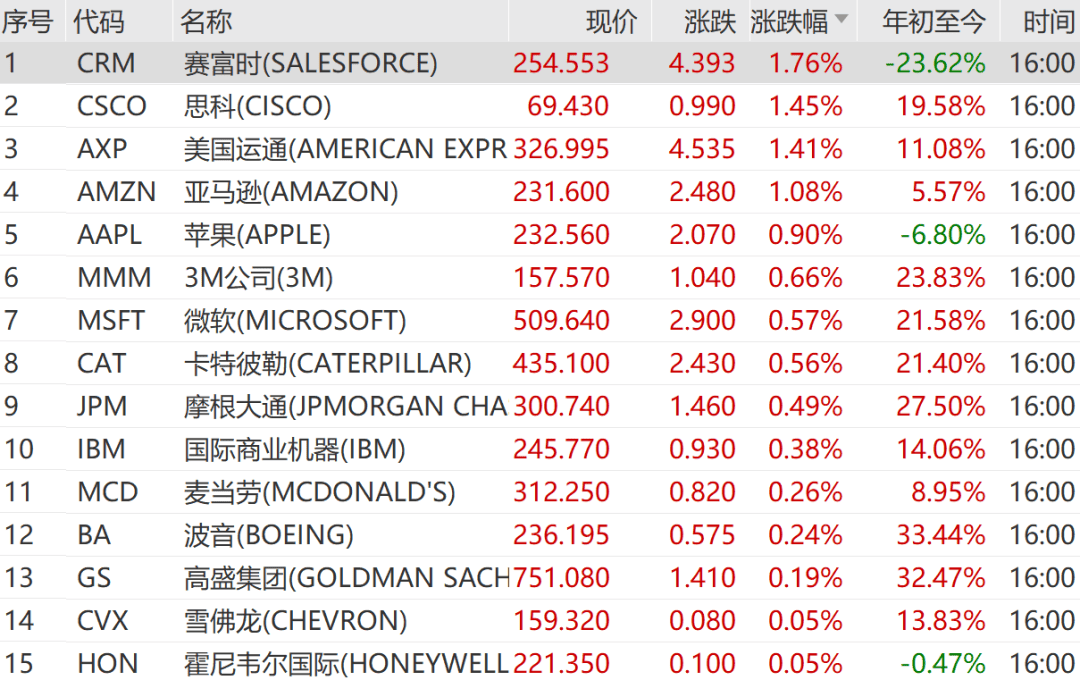
Core Viewpoint - Federal Reserve officials support a 25 basis point rate cut in September, indicating a shift towards a more accommodative monetary policy to prevent labor market deterioration and to guide inflation back to the 2% target [13]. Group 1: Market Performance - The Dow Jones Industrial Average and S&P 500 index both reached record closing highs, with the Dow up 0.16% at 45,636.9 points and the S&P 500 up 0.32% at 6,501.86 points [1]. - The Nasdaq also saw a slight increase of 0.53%, closing at 21,705.16 points [1]. - Major tech stocks mostly rose, with the US Tech Giants Index increasing by 0.47% [2]. Group 2: Individual Stock Movements - Google (Alphabet) rose over 2%, Amazon increased by more than 1%, Apple by nearly 1%, and Microsoft by 0.57%, while Nvidia fell by 0.82% and Tesla dropped over 1% [5][6]. - Among Chinese concept stocks, the Nasdaq Golden Dragon China Index rose by 0.14%, while the Wande Chinese Tech Leaders Index fell by 0.01% [7]. Group 3: Chinese Concept Stocks - Meituan fell by 4.78%, Alibaba by 2.18%, and JD.com by 1.40%, leading the decline in the Wande Chinese Tech Leaders Index [10]. - Notable gainers included NetEase, which rose by 2.35%, Baidu by 1.24%, and Xiaomi by 1.15% [10]. - Ctrip Group surged nearly 15%, while Newegg fell over 18% [10]. Group 4: Federal Reserve Insights - Federal Reserve Governor Waller emphasized the need for immediate action to lower rates, citing labor market and inflation data as supportive of this move [13]. - Morgan Stanley's Chief Investment Officer Lisa Shalett noted that while the market anticipates an over 80% chance of a rate cut in September, the actual likelihood may be closer to 50% due to strong economic indicators [15][16].


美联储降息窗口临近,美债、美元下半年将迎关键转折?
美股研究社· 2025-08-28 12:07
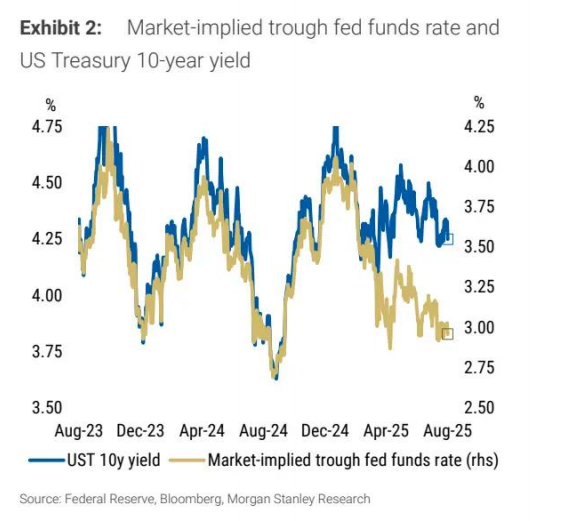
Core Viewpoint - Global asset prices are undergoing significant adjustments, with a notable decline in the 10-year US Treasury yield and the US dollar index. The Federal Reserve's policy shift is identified as the central logic for global asset pricing in the second half of the year [4][5]. Group 1: Macroeconomic Insights - The 10-year US Treasury yield has dropped over 50 basis points from its peak this year, while the US dollar index has fallen more than 10% from its high [4]. - Morgan Stanley's report indicates that the Federal Reserve's dovish signals at the Jackson Hole meeting suggest a potential decline in the federal funds rate, which could lead to new lows for both Treasury yields and the dollar index in the fall [4][5]. - The expected decline in the federal funds rate is supported by projections that it may fall to 2.625%, influenced by tighter immigration policies affecting labor market growth [5]. Group 2: Investment Strategies - Morgan Stanley recommends a long position in 5-year US Treasuries, which currently yield 3.75%, as they are expected to benefit from price increases during a yield decline cycle [15]. - The report suggests a steepening of the yield curve between 3-year and 30-year Treasuries, with the short end benefiting more from Fed rate cuts [15]. - For foreign exchange, Morgan Stanley advocates for shorting the US dollar while going long on the euro and yen, citing unfavorable interest rate differentials for the dollar [15][27]. Group 3: Economic Forecasts - The US Congressional Budget Office predicts a reduction in the federal deficit by $4 trillion from 2025 to 2035 due to tariff adjustments, which will lower the demand for government bonds and suppress long-term yields [10]. - The report highlights that if the federal funds rate dips below 2.69%, the 10-year Treasury yield could potentially fall below 4% [8]. Group 4: Regional Strategies - In the Eurozone, the focus is on yield curve flattening strategies and tactical opportunities in September, anticipating a rate cut by the European Central Bank [28]. - For the UK, the strategy involves going long on short-term rates as the Bank of England approaches the end of its rate hike cycle [30]. - In Japan, the recommendation is to buy 10-year Japanese government bonds while being cautious of yen volatility [31].

X @Investopedia
Investopedia· 2025-08-27 22:00
Morgan Stanley analysts said fast-casual restaurants are an industry bright spot amid second-quarter earnings reports that came in below estimates and weak data in the summer. https://t.co/WlNNKTiysN ...
GS vs. MS: Which Stock Should Value Investors Buy Now?
ZACKS· 2025-08-27 16:41
Core Viewpoint - Investors in the Financial - Investment Bank sector should consider Goldman Sachs (GS) and Morgan Stanley (MS), with GS appearing more attractive to value investors based on various metrics [1]. Valuation Metrics - GS has a forward P/E ratio of 16.41, while MS has a forward P/E of 16.90 [5]. - The PEG ratio for GS is 1.59, indicating a better expected earnings growth rate compared to MS's PEG ratio of 1.86 [5]. - GS's P/B ratio is 2.08, compared to MS's P/B of 2.4, suggesting GS is more favorably valued in terms of market value versus book value [6]. Earnings Outlook - GS is currently experiencing an improving earnings outlook, which enhances its attractiveness in the Zacks Rank model [7]. - GS holds a Zacks Rank of 2 (Buy), while MS has a Zacks Rank of 3 (Hold), indicating a stronger improvement in earnings outlook for GS [3]. Value Grades - Based on the valuation metrics, GS has earned a Value grade of B, whereas MS has received a Value grade of D, highlighting GS's superior value proposition [6].


摩根士丹利:AI革命将为标普500企业每年节省近万亿美元
财富FORTUNE· 2025-08-27 13:07
Core Insights - The article discusses the transformative impact of AI technology on American businesses, estimating potential annual cost savings of nearly $1 trillion due to automation and enhanced processes [2][3] - Morgan Stanley predicts that 90% of jobs will be affected by AI automation, with significant cost savings primarily from workforce reductions and automation of knowledge-intensive tasks [2][3] Cost Savings and Economic Impact - The estimated annual net benefit of deploying "agent AI" software and embodied AI robots for S&P 500 companies is $920 billion, which represents 28% of the projected pre-tax earnings for 2026 [3] - This cost saving could lead to a market value increase of approximately $13-16 trillion for S&P 500 companies, equating to nearly a quarter of their current total market capitalization [3] Industry-Specific Impacts - Industries such as essential consumer goods distribution, real estate management, and transportation are expected to experience the most significant impacts, with AI-driven productivity gains potentially exceeding 100% of the projected 2026 earnings [4] - In contrast, sectors like semiconductors and hardware, which already have high per capita output, are anticipated to have relatively lower potential for AI-driven value creation [5] Job Displacement and New Opportunities - While cost savings will largely come from workforce reductions, the report emphasizes that full automation differs from task-level enhancement, with agent AI focusing on task redistribution rather than outright job replacement [8] - The emergence of new job categories, such as Chief AI Officers and AI governance experts, is expected, mirroring historical trends from previous technological revolutions [8] Gradual Implementation Process - Despite the significant potential for cost savings, the full application of AI may take years or even decades, with companies likely prioritizing natural attrition and process optimization over immediate mass layoffs [11] - For investors, the message is clear: AI is no longer just a conceptual theme, but a substantial driver of potential profit growth for American businesses post-2025 [11]

美联储降息窗口临近,美债、美元下半年将迎关键转折?
Zhi Tong Cai Jing· 2025-08-27 12:38
Group 1 - The core viewpoint of the article is that the Federal Reserve's potential interest rate cuts are the main driving force for global asset pricing in the second half of the year, with expectations that U.S. Treasury yields and the dollar index may reach new lows [2][26] - The Federal Reserve's policy shift is highlighted as the central logic for global asset pricing, with indications that the federal funds rate may drop below 3%, and ultimately to 2.625% due to factors such as tightening immigration policies affecting labor market growth [2][4] - The relationship between U.S. Treasury yields and the federal funds rate is expected to dominate the bond market, with projections that if the federal funds rate falls below 2.69%, the 10-year Treasury yield could drop below 4% [4][6] Group 2 - Morgan Stanley recommends two core investment strategies: going long on U.S. Treasury durations and shorting the dollar, focusing on opportunities in both the bond and foreign exchange markets [10][11] - For U.S. Treasuries, the strategy includes going long on 5-year Treasury durations, which are expected to benefit from price increases during a yield decline cycle, and taking advantage of the steepening yield curve between 3-year and 30-year Treasuries [10][11] - In the foreign exchange market, the recommendation is to short the dollar while going long on the euro and yen, driven by the expectation that the Fed's rate cuts will exceed those of the European Central Bank [11][12] Group 3 - The report provides differentiated strategies for major economies, including focusing on yield curve flattening in the Eurozone and tactical strategies in the UK and Japan, reflecting the varying monetary policies and economic conditions [21][22][23] - In the Eurozone, the strategy involves entering into yield curve flattening trades and adjusting asset allocations based on updated yield targets for German bonds [21] - For the UK, the recommendation is to go long on short-term rates as the Bank of England approaches the end of its rate hike cycle, while in Japan, the strategy suggests buying 10-year Japanese bonds amid expectations of U.S. Treasury yield declines [22][23]
Is Morgan Stanley (MS) Outperforming Other Finance Stocks This Year?
ZACKS· 2025-08-26 14:40
Company Performance - Morgan Stanley (MS) has returned 17.4% year-to-date, outperforming the average return of 11.8% for Finance companies [4] - The Zacks Consensus Estimate for Morgan Stanley's full-year earnings has increased by 2.8% over the past three months, indicating improved analyst sentiment and earnings outlook [3] Industry Comparison - Morgan Stanley is part of the Financial - Investment Bank industry, which has an average year-to-date return of 23.1%, suggesting that MS is slightly underperforming its industry [5] - In contrast, Aviva (AVVIY) has significantly outperformed both the Finance sector and its own industry, returning 57.1% year-to-date [4][6] Sector Ranking - The Finance sector, which includes 869 individual stocks, currently holds a Zacks Sector Rank of 2, indicating strong performance relative to other sectors [2] - Morgan Stanley has a Zacks Rank of 2 (Buy), reflecting its favorable position within the Finance sector [3]


X @Ash Crypto
Ash Crypto· 2025-08-26 12:17
BREAKING:🇺🇸 MORGAN STANLEY SAYS THATFED WILL CUT RATES IN SEPTEMBER.BULLISH FOR MARKETS 🚀 ...