Morgan Stanley(MS)

Search documents
A股新增开户数放缓,全球资本配置将“继续对中国感兴趣”
Huan Qiu Wang· 2025-11-05 01:08
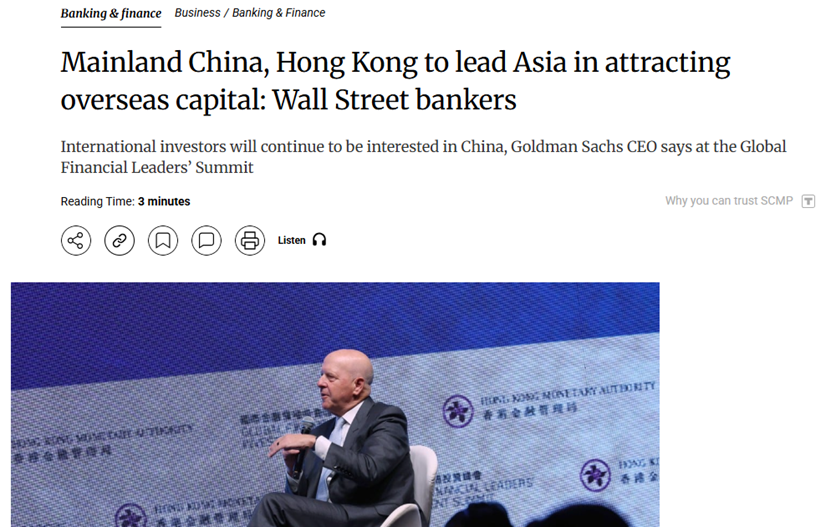
Group 1 - The core point of the articles indicates a significant decline in new A-share accounts in October, with a year-on-year decrease of 66% and a month-on-month decrease of 21% [1] - In the first ten months of 2025, a total of 22.46 million new A-share accounts have been opened, reflecting an 11% year-on-year growth [1] - UBS analysts suggest that due to expected lackluster earnings reports in the coming months, investors are selling off stocks that have seen substantial gains this year, which may narrow valuation gaps among companies and lead stock prices to revert to historical averages [1] Group 2 - Goldman Sachs has expressed that global capital allocators will continue to show interest in China, while Morgan Stanley remains optimistic about the stock markets in China, Japan, and India [4] - The CEOs of Goldman Sachs and Morgan Stanley specifically highlighted the attractiveness of the Hong Kong stock market, mentioning the impressive performance of tech stocks like DeepSeek [4]


英伟达、特斯拉大跌
Xin Lang Cai Jing· 2025-11-05 00:47
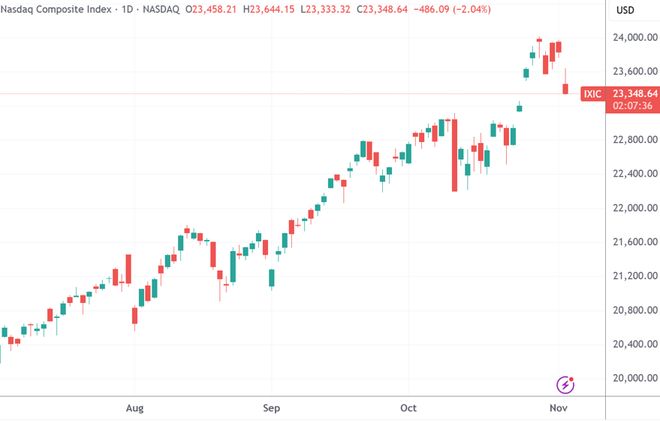
Market Overview - The S&P 500 index fell by 1.17% to 6771.55 points, the Nasdaq Composite dropped by 2.04% to 23348.64 points, and the Dow Jones Industrial Average decreased by 0.53% to 47085.24 points, indicating a market adjustment amid concerns over high valuations [1] Company Performance - Palantir, a leading AI application stock, saw its shares decline by 7.94% despite reporting earnings that exceeded expectations and raising its performance guidance. The stock has quadrupled in value over the past year, becoming a symbol of the "AI bubble" [2] - Nvidia's stock fell by 3.96%, while other major tech stocks like Apple and Microsoft experienced mixed results, with Apple rising by 0.37% and Microsoft dropping by 0.52% [7] Investor Sentiment - Investor confidence was further shaken by Michael Burry's disclosure of purchasing put options on Palantir and Nvidia, which raised concerns among retail investors [5] - The retail investor preference index compiled by Goldman Sachs dropped by 3.6%, approximately three times the decline of the S&P 500 index, reflecting a challenging day for day traders [5] Market Predictions - BTIG's chief market technician, Jonathan Krinsky, indicated that the S&P 500 has not tested the 50-day moving average since April, currently around 6654 points, and suggested potential declines to the 6400-6500 point range due to extreme market divergences [5] - Goldman Sachs and Morgan Stanley executives expressed concerns about a potential market pullback of 10% to 20% over the next 12 to 24 months, with Morgan Stanley's CEO suggesting that a 10%-15% correction would be welcome if not driven by macroeconomic factors [5] Broader Market Trends - Similar to the U.S. stock market, commodities, including oil and gold, experienced declines, with Bitcoin dropping nearly 6% and Ethereum falling over 10% in the cryptocurrency market [6] - The Nasdaq China Golden Dragon Index fell by 2.05%, with notable declines in Chinese stocks such as Alibaba down 2.02% and JD.com down 2.93% [8]


“黑天鹅”突袭,华尔街投行警告!科技龙头、加密货币闪崩,金银铜齐跌
Qi Huo Ri Bao· 2025-11-04 23:45
Market Overview - US stock markets experienced a decline, with major indices such as the Nasdaq down 2.04%, S&P 500 down 1.17%, and Dow Jones down 0.53% [2] - Large tech stocks faced significant losses, including Intel down over 6%, Tesla down over 5%, and Nvidia down over 3% [2] - The cryptocurrency market saw Bitcoin drop below $100,000, with a minimum price of $99,600, reflecting a 6.5% decline [2] Economic Indicators - Wall Street executives expressed concerns about a potential major correction in the US stock market, with estimates of a 10% to 20% decline [1] - The US government is facing an extended shutdown, with the current situation expected to surpass the previous record of 35 days [1] Commodity Market - Gold prices fell sharply, with spot gold down 1.67% to $3,934.06 per ounce, and COMEX gold down 1.71% to $3,945.30 per ounce [2] - Silver and copper also experienced declines, with silver down 1.72% to $47.11 per ounce [2] - International oil prices saw slight decreases, with WTI crude oil down 0.8% to $60.56 per barrel [2] Agricultural Sector - The US soybean export volume is projected to decrease significantly, with a forecasted export of approximately 4.96 million tons for 2025, a substantial drop from the previous year [4] - Exports to China have notably declined, with only 593,000 tons exported in the first eight months of 2025, down nearly 80% from 2.68 million tons in the same period of 2024 [4] Precious Metals Market - Analysts suggest that gold and silver prices are currently in a consolidation phase after a significant drop from historical highs, driven by profit-taking and reduced expectations for interest rate cuts by the Federal Reserve [5][6] - The recent tax policy changes regarding gold transactions are expected to impact market dynamics, potentially leading to increased selling pressure from companies holding large amounts of physical gold [7][8] - The new tax regulations aim to guide gold trading towards more regulated markets, enhancing transparency and efficiency [8]





美国债市:国债在股市和原油下跌之际温和走高
Xin Lang Cai Jing· 2025-11-04 21:16
Core Viewpoint - US Treasury bonds experienced a mild increase on Tuesday, with yields fluctuating within a narrow range as the stock market faced declines, indicating a cautious sentiment among investors regarding high valuations [1] Group 1: Market Performance - US Treasury yields fell by 2-3 basis points across various maturities, with the 10-year Treasury yield closing at 4.085%, down 2.5 basis points, approaching the day's low [1] - The S&P 500 index declined by approximately 1.2%, while the Nasdaq 100 index fell by about 2% during the trading session [1] Group 2: Investor Sentiment - Wall Street executives warned investors to prepare for a potential pullback in the stock market from high valuation levels, contributing to the negative sentiment [1] - There was a notable demand for upward hedging in SOFR options, reflecting an increasing expectation for a loosening of Federal Reserve policies [1] Group 3: SOFR Options Activity - A significant trade in SOFR options involved a dovish hedge, betting on two rate cuts before the March 18 policy meeting next year, which is more dovish than the current market's implied expectation of a total cut of 35 basis points over the next three meetings [1] Group 4: Treasury Futures Trading - Trading volume in Treasury futures remained subdued, reaching only 75% of the 20-day average by 3 PM Eastern Time [1] Group 5: Yield Data - As of 3 PM Eastern Time, the following Treasury yields were reported: - 2-year yield at 3.5799% - 5-year yield at 3.6993% - 10-year yield at 4.0871% - 30-year yield at 4.6676% - The spread between the 5-year and 30-year yields was 96.65 basis points, while the spread between the 2-year and 10-year yields was 50.51 basis points [1]
Goldman Sachs and Morgan Stanley's CEOs both see a stock market correction on the horizon
Yahoo Finance· 2025-11-04 20:24
Market Outlook - Global stocks may face a correction in the next 12 to 24 months, with a potential drawdown of 10 to 20% as indicated by Goldman Sachs CEO David Solomon [1][4] - Morgan Stanley CEO Ted Pick noted that while stocks appear expensive, the systematic risk has likely narrowed, and drawdowns of 10 to 15% could be a healthy development rather than a negative one [3][4] Valuation Insights - Valuations in the market are described as "challenging," with earnings remaining strong, according to Capital Group CEO Mike Gitlin, who stated that the market is "somewhere between fair and full" [4] - Analysts have raised concerns about overvaluation as equity markets continue to reach new highs, suggesting a cautious approach to investment [3]
Wall Street Bigwigs Are Talking About a Big Pullback in Stocks. Should You Be Worried?
Investopedia· 2025-11-04 19:45
Core Insights - Goldman Sachs CEO David Solomon and Morgan Stanley's Ted Pick predict a potential stock market correction of 10% to 20% within the next 12 to 24 months, indicating concerns over high valuations and a possible AI bubble [3][8] - Despite these warnings, both executives maintain an optimistic outlook for the stock market, suggesting that investors should stay invested and reassess their portfolio allocations [6][11] Market Concerns - Wall Street is increasingly worried that the AI-driven stock market rally may be creating a bubble, with a brief correction potentially helping to reset valuations and investor expectations [4][9] - The tech-heavy Nasdaq Composite index experienced a nearly 2% drop following the comments from Solomon and Pick, with high-valuation AI stocks, such as Palantir, facing significant declines despite strong earnings [5][9] Valuation Perspectives - Current valuation models indicate that risk asset prices are above fundamental values, raising the likelihood of corrections during adverse market conditions [10] - Some analysts argue that the tech companies leading AI investments are more financially secure and better valued compared to those during the Dotcom era, suggesting a more stable environment [10][11] Economic Environment - The Federal Reserve is expected to lower interest rates over the next year, which could stimulate the economy and mitigate the risk of a credit crunch that might burst an asset bubble [11] - Solomon notes that while tech valuations are high, the broader market has areas with more reasonable multiples, especially in light of earnings growth [11]

外资10月以来密集调研A股 覆盖309家公司 重视“含科”量
Zheng Quan Shi Bao· 2025-11-04 17:48
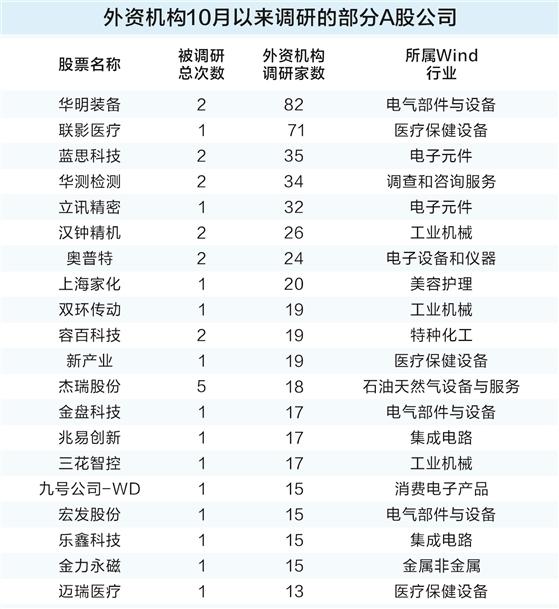
Group 1: Foreign Investment Focus - Since October, foreign institutions have conducted research on 309 A-share listed companies, primarily focusing on high-growth industries such as artificial intelligence, industrial automation, new energy, semiconductors, and consumer electronics [1][3] - Notably, 35 companies received attention from more than 10 foreign institutions, indicating a strong interest in companies like Huaming Equipment, United Imaging Healthcare, Lens Technology, and others [3] - Major foreign institutions involved in the research include Goldman Sachs, UBS, and Morgan Stanley, with Goldman Sachs alone researching over 50 A-share companies since October [5][6] Group 2: Company-Specific Insights - Huaming Equipment was the most researched company, with 82 foreign institutions focusing on its Q3 performance and future export orders [3][4] - United Imaging Healthcare attracted 71 foreign institutions, which were particularly interested in its performance in overseas markets and project deliveries [4] - Other companies like Lixun Precision, Han's Laser, and Jereh Group also received significant attention, reflecting a trend towards sectors like industrial machinery and medical equipment [1][3] Group 3: Economic Outlook and Policy Implications - Foreign institutions are optimistic about China's "14th Five-Year Plan," with Goldman Sachs raising its forecasts for China's export growth and GDP growth [2][6] - The focus on building a robust domestic market and enhancing advanced manufacturing capabilities is expected to positively impact A-shares, particularly in sectors related to self-sufficiency and emerging industries [6][7] - Goldman Sachs predicts that China's export volume will grow by 5% to 6% annually over the next few years, contributing to overall economic expansion [7]


Dow falls 450 points as Goldman Sachs, Morgan Stanley CEOs warn of market correction after AI boom
New York Post· 2025-11-04 15:16
Market Overview - US stocks experienced a decline, with the Dow Jones Industrial Average dropping 450 points (1%), and the S&P 500 and Nasdaq falling 1.2% and 1.7%, respectively [1][3] - Concerns about a market correction were raised by the CEOs of Goldman Sachs and Morgan Stanley, who indicated that a 10 to 20% drawdown in equity markets is likely within the next 12 to 24 months [1][3] CEO Insights - Goldman Sachs CEO David Solomon noted that market pullbacks are typical in long-term bull markets, comparing the current situation of AI stocks to the dot-com bubble of the 1990s [3][4] - Solomon emphasized that a 10 to 15% drawdown is common even during positive market cycles and does not alter fundamental capital allocation beliefs [4] - Morgan Stanley CEO Ted Pick echoed this sentiment, suggesting that investors should view periodic pullbacks as healthy for the market [4][9] AI Stocks Performance - Shares of Palantir fell 9.7% despite a positive earnings report, as analysts questioned the sustainability of its valuation, which has surged approximately 175% this year [5][7] - Other AI stocks, including Oracle, AMD, Nvidia, and Amazon, also saw declines of 2.4%, 3.6%, 2.5%, and 1%, respectively [7][12] Economic Context - Investor anxiety is compounded by concerns over potential economic repercussions from the ongoing government shutdown, which has reached a record duration of 35 days [9] - Federal Reserve Chair Jerome Powell, along with other financial leaders, has warned about inflated stock valuations [10] Regional Focus - Both Goldman Sachs and Morgan Stanley maintain a bullish outlook on Asia, citing a recent trade deal between the US and China as a positive factor [11] - Morgan Stanley highlighted growth potential in China's AI, electric vehicle, and biotech sectors, viewing them as part of a broader narrative for global Asia [11]

CB Insights:《2025年技术趋势报告》,一个正被AI从根本上重塑的全球产业图景
欧米伽未来研究所2025· 2025-11-04 13:47
Core Insights - The report by CB Insights highlights that by 2025, AI will be a central strategic issue for boards, shifting from being an IT experiment to a core business focus [3] - AI is driving a structural transformation across various sectors, including corporate strategy, energy, geopolitics, finance, and healthcare, marking it as a "meta-trend" [2] M&A Trends - Since 2020, the share of AI in total tech M&A has doubled, reaching 7.2% by 2024 [3] - The leading acquirers have shifted from traditional tech giants to AI infrastructure and data management companies like Nvidia and Accenture [3] Competitive Landscape - The competition between "open" and "closed" model developers is intensifying, with closed models like OpenAI leading in funding [4] - OpenAI has raised $19.1 billion, significantly outpacing open model companies [4] Cost Dynamics - The cost of AI inference is decreasing rapidly, with OpenAI's GPT-4o model costing nearly ten times less than GPT-4 [5] - A mixed market is expected, with powerful closed models dominating complex workflows while smaller open models are used for specific tasks [5] Energy and Infrastructure - AI's demand for computing power is driving a revolution in energy and industrial sectors, with total spending on AI infrastructure projected to exceed $1 trillion [6] - Data center electricity consumption is expected to double from 460 TWh in 2022 to over 1000 TWh by 2026 [7] Space Economy - The cost of space launches has dramatically decreased, fostering a new space economy, particularly in satellite constellations [8] - SpaceX's Starlink has launched 1,935 objects in 2023, representing 73% of global launches [8] Financial and Healthcare Applications - AI is automating administrative tasks in finance, with the goal of freeing up human advisors [9] - In healthcare, AI is shifting disease management from passive treatment to proactive prediction, with significant investments in early detection technologies [10] Geopolitical Dynamics - The U.S. is leading in AI funding, receiving 71 cents of every dollar in global AI equity financing, while China is the only other major contender [12] - The report emphasizes the dual strategy of Chinese tech giants investing in both internal model development and supporting local AI startups [13] Emerging Trends - The report identifies a growing trend of "sovereign AI," where countries recognize the need to develop their own AI capabilities [13] - Countries like Belgium, Brazil, Italy, and Australia are emerging as specialized AI centers, potentially offering new collaboration opportunities for multinational companies [14]





高盛、大摩CEO齐发预警:美股估值太高了,可能出现至少10%回调!
美股IPO· 2025-11-04 12:42
Core Viewpoint - Despite strong corporate earnings, current valuation levels are concerning, particularly for technology stocks, with expectations of a potential market correction of 10% to 20% in the next 12 to 24 months, viewed as a healthy adjustment rather than a crisis [1][3][7] Valuation Concerns - Goldman Sachs and Morgan Stanley executives express worries about high valuation levels in the U.S. stock market, indicating that most investors perceive valuations to be between reasonable and full, with few considering stocks to be cheap [3][6] - Solomon from Goldman Sachs notes that technology stock valuations are particularly full, although this does not apply to the entire market [5][6] Market Correction as a Healthy Adjustment - Wall Street executives unanimously agree that market corrections should be seen as normal and healthy developments rather than signals of a crisis, with Solomon emphasizing that 10% to 15% corrections often occur even in positive market cycles [7][9] - Pick from Morgan Stanley encourages investors to welcome the possibility of cyclical corrections, stating that such adjustments are not driven by macroeconomic cliff effects [9] Positive Outlook for Asian Markets - Both Goldman Sachs and Morgan Stanley maintain an optimistic outlook for Asian markets, particularly China, Japan, and India, citing unique growth narratives in these regions [4][10] - Goldman Sachs expects continued interest in China from global capital allocators due to recent positive developments, while Morgan Stanley highlights investment opportunities in China's AI, electric vehicles, and biotechnology sectors, as well as Japan's corporate governance reforms and India's infrastructure development [11][12]