
Microsoft(MSFT)

Search documents
欧洲监管机构重拳整治大型科技企业
Xin Lang Cai Jing· 2026-02-06 13:27
Group 1: Alphabet (Google) - The European Commission has launched an antitrust investigation into Alphabet's Google regarding its use of online content from publishers and YouTube in the AI business [1][11] - Google was fined €2.95 billion (approximately $3.46 billion) by the European Commission on September 5 for anti-competitive behavior in its advertising technology business [1][11] - In September 2024, Google appealed against a €1.49 billion antitrust fine related to hindering competition in online search advertising and won the case [1][11] - Google lost an appeal against a €2.42 billion fine for unfairly benefiting from its own comparison shopping service [1][11] - The UK antitrust regulator preliminarily found Google abusing its dominant position in digital advertising in September 2024 [1][11] - France's competition authority fined Google €25 million for alleged violations of EU intellectual property regulations in March 2024 [1][11] Group 2: Amazon - The German Federal Cartel Office has prohibited Amazon from setting price caps for online retailers on its German e-commerce platform and has reclaimed millions of euros from the company for anti-competitive behavior [2][12] - In November 2024, the EU General Court upheld the classification of Amazon as a platform strictly regulated under EU online content regulations [2][12] Group 3: Apple - Italy's competition authority fined Apple and its subsidiaries €98.6 million in December 2024 for allegedly abusing its dominant position in the mobile app market [4][13] - In October 2025, civil rights organizations filed complaints against Apple regarding its App Store and device-related terms with EU antitrust regulators [4][13] - The UK Competition and Markets Authority recognized Apple and Google as having "strategic market positions" and gained the authority to require specific remedies from both companies [4][13] - Apple was fined €500 million under the Digital Markets Act in April 2025, while Meta was fined €200 million [4][14] - Apple lost an appeal against a German regulatory assessment that would impose stricter controls on the company [4][14] - Apple lost an appeal against an EU directive requiring it to repay €13 billion in taxes to Ireland [4][14] - Apple agreed to open its contactless mobile payment system to competitors to resolve an EU antitrust investigation [4][14] - Brussels fined Apple €1.84 billion in March 2024 for suppressing competition in the music streaming sector [5][15] Group 4: Meta - The European Commission initiated an antitrust investigation into Meta's WhatsApp AI features in December 2024 [7][16] - Meta was fined €797.72 million in November 2024 for abusing its market position to support Facebook Marketplace [7][16] - The company was accused of violating the Digital Markets Act with its new "pay or agree" advertising model in July 2024 [7][16] Group 5: Microsoft - The European Commission accused Microsoft of illegally bundling its Teams chat video application with its Office software in June 2024 [8][17] Group 6: TikTok - The EU tech regulator accused TikTok of violating online content regulations due to addictive features and may require product design changes [9][18] - Preliminary investigation results in October 2025 indicated that TikTok and Meta violated obligations under the Digital Services Act by not providing sufficient public data access to researchers [9][18] - TikTok was accused in May 2025 of failing to comply with the Digital Services Act regarding the publication of an advertising library and facilitating user identification of fraudulent ads, but made concessions to enhance transparency to avoid fines [9][18] Group 7: X (formerly Twitter) - French police raided the offices of X, owned by Elon Musk, as part of an expanding investigation [10][19] - The European Commission announced an investigation into X's Grok chatbot for potentially spreading illegal content in January 2026 [10][20] - In December 2025, X was fined €120 million for violating online content regulations, marking the first penalty since the implementation of the Digital Services Act [10][20]




甲骨文称“相信OpenAI融资履约能力”,为何股票还在跌?
财富FORTUNE· 2026-02-06 13:06
2025年9月23日,OpenAI公司CEO山姆·奥特曼在德州阿比林市的"星际之门"AI数据中心接受媒体采访。图片来源: Kyle Grillot—Bloomberg/Getty Images 最近,甲骨文公司宣布将融资500亿美元用于AI基础设施建设。消息一出,甲骨文当日开盘走高。但是 在甲骨文提醒了投资者该基础设施的服务对象后,甲骨文股价在收盘时最终收跌。 上周日晚,甲骨文公司宣布,该公司计划2026年通过债权和股权融资500亿美元用于数据中心建设,其 目的在于为公司的云业务客户提升数据中心容量。周一开盘后,市场的反映还是比较积极的,甲骨文股 价在早盘交易中上涨约 2%。投资者显然将这一消息视为AI基础设施需求旺盛的证据。另外,甲骨文虽 然目前已有千亿美元的债务,但市场似乎也对它的化债方案展现了一定的信心。 就在甲骨文股价在168美元的价位小幅波动之际,甲骨文的社交媒体团队发布了一条声明。 黄仁勋还重申,英伟达"肯定会参与" OpenAI的新一轮融资,这或将成为英伟达"规模最大的一笔投 资",但金额绝不会达到1000亿美元。上周,由于投资者对微软的AI投资感到不安,微软的股票价 值蒸发了3600亿美元。尽 ...



分析师:美股在经历艰难的几天后有望小幅回升
Ge Long Hui A P P· 2026-02-06 12:32
格隆汇2月6日|Investinglive分析师Justin Low表示,截至目前,美股股指期货的走势喜忧参半。昨天华 尔街科技股遭受重挫,这一状况在亚马逊公布财报后仍持续。美国大型科技公司仍在试图证明其为AI 基础设施增加的支出是合理的,但投资者正逐渐转向"拿出实际成果看看"的心态。值得注意的是,今日 美股股指期货在亚盘下跌后有所反弹,且微软股价盘前一度上涨1.6%,Palantir股价盘前涨幅一度超过 5%,这两只股票在昨日交易中以及本周大部分时间内均遭遇重挫。但最新反弹仅带来些许缓解,因标 普500指数昨日微跌,试图测试100日移动均线。上次到达这一关键位置是在去年11月,当时逢低买入者 占据上风。但若以纳斯达克指数为参照,本周科技股可能再次下跌,从而再次确认跌破100日移动均线 ——若是如此,这必将波及标普500指数,甚至可能影响华尔街更广泛的风险情绪。 ...
堪比“ChatGPT”时刻!SemiAnalysis深度解读:Claude Code将是AI “智能体”的转折点
Hua Er Jie Jian Wen· 2026-02-06 12:19
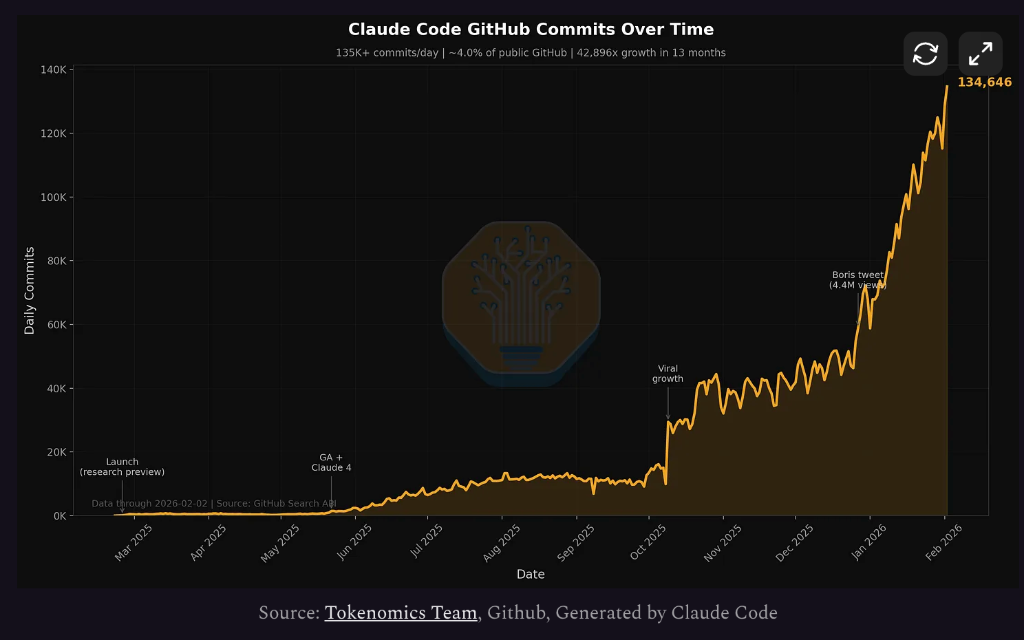
Anthropic旗下AI编程工具Claude Code已占GitHub公共代码提交量的4%,并预计到2026年底该比例将超20%。研究机构SemiAnalysis最新分析指 出,Claude Code是AI"智能体"的转折点。 该报告强调,Claude Code不仅改变了编程形态,更预示着AI智能体将重塑全球约15万亿美元的信息工作市场。目前,Anthropic依托该技术实现 营收快速增长,其季度年度经常性收入(ARR)增量已超越OpenAI,反映出AI智能体赛道的竞争格局正发生结构性变化。 对科技巨头而言,战略平衡变得更为复杂。微软既通过Azure为OpenAI、Anthropic等提供算力支持,又需防御AI代理工具对其Office 365等核心 产品的冲击。据悉,CEO Satya Nadella已亲自参与AI产品战略调整,可见该领域对公司未来发展影响深远。 随着Claude Code等AI代理工具持续渗透,从开发流程到企业运营的智能化重构进程正全面加速。 Claude Code与智能体未来 智能体将成为人类与人工智能交互的主要方式。Claude Code的出现,不仅展示了人类如何引导AI,更揭示了智能 ...
Big Tech sees over $1 trillion wiped from stocks as fears of AI bubble ignite sell-off
CNBC· 2026-02-06 12:16
Core Viewpoint - Big Tech companies have experienced a significant decline in market capitalization, losing over $1 trillion due to concerns over AI spending and capital expenditures [1]. Group 1: Market Performance - Microsoft, Nvidia, Oracle, Meta, Amazon, and Alphabet all saw their shares decline in the week leading up to Thursday's market close, driven by fears surrounding AI spending [1]. - Amazon's shares fell by 7% in premarket trading on Friday, while Alphabet decreased by 0.7%, and Meta remained largely unchanged; Oracle, Nvidia, and Microsoft saw slight increases in the low single-digit percentages [2]. Group 2: Capital Expenditure Plans - Big Tech companies announced plans to invest $660 billion into AI this year, a figure that exceeds the GDP of several countries, including the United Arab Emirates, Singapore, and Israel [2]. Group 3: Industry Sentiment and Volatility - Companies developing hardware for AI are expected to face ongoing volatility as market sentiment shifts, with concerns about capital expenditures related to large language model (LLM) build-outs and the potential for over-expansion of capacity [3]. - Investment director Paul Markham highlighted that questions regarding the extent of capital expenditures and the eventual return on investment will persist in the industry [3].

Google and Microsoft offer lucrative deals to promote AI, but even $500,000 won't sway some creators
CNBC· 2026-02-06 12:00
Megan Lieu is an influencer who makes content about tech and gives career advice on social media.Tech companies like Microsoft and Google are going after new users for their AI services the way any marketer tries to make their products look cool: through social media influencers.Other artificial intelligence players, including OpenAI, Anthropic and Meta, are also hiring social media creators to post sponsored content on apps like Facebook, Instagram, YouTube and even LinkedIn. The payout for these promotion ...

软件股末日论”点燃大变革! 恐慌抛售之后,市场将捧起AI时代的“软件基石
Zhi Tong Cai Jing· 2026-02-06 11:49
Core Viewpoint - The recent narrative of "Software-mageddon" has led to a significant sell-off in the software sector, particularly affecting SaaS stocks, following the launch of new AI tools by Anthropic, which are perceived as threats to traditional software business models [1][4][5]. Group 1: Market Reaction - The S&P 500 Software & Services Index has experienced a decline of approximately 30% since its recent peak at the end of October, marking the most severe sell-off since 2022 [1][6]. - Major software companies, including Thomson Reuters and Salesforce, have seen their stock prices drop significantly, with some experiencing declines of up to 10% in a single day [5][6]. - The sell-off has been exacerbated by disappointing earnings guidance from major companies, including Microsoft, and heightened expectations for AI infrastructure spending [5][6]. Group 2: Institutional Response - Some institutional investors are beginning to enter the market to buy undervalued software stocks, believing that the market has overreacted to the AI threat [2][12]. - Analysts express a divided view on the long-term impact of AI on software companies, with some believing that AI will reshape profit trajectories rather than eliminate the need for existing software [9][14]. Group 3: Expert Opinions - Rick Sherlund, a prominent analyst, argues that the software industry undergoes significant transformations every 10 to 15 years, and companies with strong fundamentals, like SAP, will likely benefit from AI rather than be threatened by it [3][16]. - Nvidia's CEO Jensen Huang emphasizes that the notion of AI completely replacing software is illogical, suggesting that AI will enhance existing software rather than replace it [7][8]. - The current market panic is described as "micro-hysteria," with experts suggesting that the fears surrounding AI's impact on software are exaggerated [8][12]. Group 4: Future Outlook - The software sector is expected to experience a technical rebound as investors reassess the long-term value of companies that integrate AI into their operations [2][11]. - High-quality software companies that embrace AI are likely to emerge stronger from the current turmoil, as the market begins to differentiate between those with robust business models and those that are more vulnerable [11][15].
“沾上OpenAI就没吸引力了!”华尔街开始“清算”OpenAI概念股,谷歌大涨36%成赢家
美股研究社· 2026-02-06 10:55
Core Viewpoint - The sentiment on Wall Street regarding OpenAI has dramatically reversed, with previously favored stocks now facing sell-offs, while Alphabet has emerged as a major winner in the AI sector, with its stock price rising approximately 36% since October of last year [5][7]. Group 1: Market Sentiment Shift - Investors are increasingly skeptical about OpenAI's financial sustainability, despite its signing of several billion-dollar contracts, leading to concerns about its ability to fulfill commitments [8]. - The market narrative has shifted from favoring OpenAI to preferring Alphabet, as highlighted by analysts who note that the reliance on OpenAI for revenue has become a liability for companies like Microsoft and Oracle [9][10]. Group 2: Alphabet's Performance - Alphabet's AI investments have generated significant returns across the company, with CEO Sundar Pichai reporting over 750 million monthly active users for Google Gemini, an increase from 650 million in the previous quarter [12]. - Google Cloud revenue surged by 48% in the December quarter, exceeding Wall Street expectations, which has bolstered investor confidence [12]. Group 3: Broader Market Dynamics - A Deutsche Bank report indicates that the AI investment frenzy has entered a "cleansing" phase, with the S&P 500's performance largely supported by Alphabet, while many other tech stocks have experienced significant declines [7][14]. - The report emphasizes a decisive shift in market sentiment from a belief that all tech stocks would succeed to a more brutal reality of clear winners and losers, with Alphabet being the standout performer [14][15].
Big Tech's $600 billion spending plans exacerbate investors' AI headache
Yahoo Finance· 2026-02-06 10:49
By Lucy Raitano, Dhara Ranasinghe and Chibuike Oguh NEW YORK/LONDON, Feb 6 (Reuters) - A planned $600 billion artificial intelligence spending splurge by big tech firms in 2026 is adding to investor unease as they assess the implications for profitability as well as a potential existential threat to software firms. Shares of Amazon, which had announced a $200 billion capital expenditure outlay, slid 7% on Friday, while Alphabet lost 3% after the company said on Wednesday that capital spending could d ...
行业研究|行业周报|通信设备Ⅲ:通信行业周观点:北美云商Capex信心强劲,康宁光互连长单驱动扩产-20260206
Changjiang Securities· 2026-02-06 10:45
Investment Rating - The industry investment rating is "Positive" and maintained [8] Core Insights - The communication sector saw a 5.26% increase in the fourth week of 2026, ranking third among major industries in the Yangtze River region; since the beginning of 2026, the sector has risen by 5.42%, ranking sixteenth [2][3] - Microsoft continues to experience high growth in its cloud business, with Azure revenue increasing by 39% year-over-year, and a significant increase in data center capacity [4] - Meta's advertising business has benefited from AI enhancements, leading to a 24% year-over-year increase in advertising revenue, with a capital expenditure guidance of $115 to $135 billion for 2026 [4] - Corning's optical communication business is growing rapidly, with a 35% year-over-year increase in revenue, driven by a long-term agreement with Meta worth up to $6 billion [5][6] Summary by Sections Microsoft - In FY26Q2, Microsoft cloud revenue reached $51.5 billion, up 26% year-over-year; Azure and other cloud services grew by 39% [4] - Microsoft expects Azure revenue growth of 37%-38% in FY26Q3 [4] Meta - Meta's Family of Apps advertising revenue was $58.1 billion in Q4 2025, up 24% year-over-year, with AI driving both volume and pricing increases [4] - Meta's capital expenditure for Q4 2025 was $22.1 billion, a 49% increase year-over-year [4] Corning - Corning reported Q4 2025 revenue of $4.22 billion, a 20% increase year-over-year, with optical communication revenue growing by 24% [5] - Corning's long-term agreement with Meta is expected to support its expansion in the U.S. [5][6] Investment Recommendations - Recommended companies include China Mobile, China Telecom, and China Unicom for operators; for optical modules, companies like Zhongji Xuchuang and Tianfu Communication are highlighted [6]
