
NIKE(NKE)

Search documents
Global Head Coach of Nike Running Shares Expert Tips with YourUpdateTV
GlobeNewswire News Room· 2025-08-07 16:20
Core Insights - Nike is promoting running among Americans, with over 50 million individuals participating regularly, and is encouraging them to engage in running events [1] - Chris Bennett, Nike Running Global Head Coach, is providing motivation and tips for runners through a nationwide media tour [2] Product Offerings - Nike offers a range of running footwear designed for various needs, focusing on cushioning, including models like Pegasus, Structure, and Vomero [3] Community Engagement - Running serves as a social activity, fostering community through run clubs and race events, which helps maintain motivation among participants [4] Coach Profile - Chris Bennett, known as "Coach B," has extensive experience in competitive running and coaching, helping runners of all levels build confidence and connection to the sport [5]



望远镜系列12之2025Q1财报总结:营收表现分化,终端需求待修复
Changjiang Securities· 2025-08-06 23:30
Investment Rating - The report maintains a "Positive" investment rating for the textile, apparel, and luxury goods industry [11]. Core Insights - Revenue performance in Q1 2025 shows divergence among brands, with On (+40%) and Adidas (+13%) performing well, while Nike (-7%) and Under Armour (-11%) face revenue declines due to weak demand and inventory adjustments [6][20]. - The cautious revenue guidance from key companies indicates a continuation of this divergent performance in upcoming quarters, with some brands canceling their full-year guidance [7][25]. - The industry is entering a replenishment phase, but weak end-consumer demand necessitates close monitoring of recovery trends [9][34]. Revenue Performance - In Q1 2025, On and Adidas exhibited strong revenue growth, while Nike and UA struggled with declines [6][18]. - The overall revenue growth rates varied significantly across regions, with North America and Greater China showing relative weakness [20][22]. Inventory Dynamics - The apparel industry has returned to a healthy inventory level but is now entering a replenishment phase, with some brands beginning to accumulate stock [8][9]. - Retailers' inventory-to-sales ratios are normal, but certain brands are still in a destocking phase, particularly Nike and VF [8][9]. Future Outlook - The report emphasizes the need to monitor the pace of consumer demand recovery, especially as the industry faces challenges from weak demand and inflationary pressures [9][34]. - Nike's gradual operational improvement may alleviate some negative pressures on the industry, suggesting potential for a rebound in the manufacturing sector [9][34].


以儿童为中心,耐克在打造属于下一代的运动世界
Xin Jing Bao· 2025-08-06 06:14
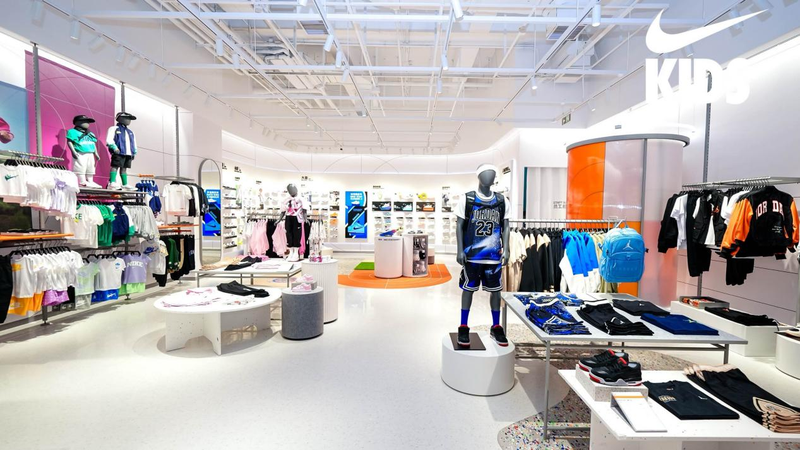
具体来看,此次耐克合生汇新店的升级中,品牌在门店设计规划上突出了"以运动为核心"理念,并设置了中国首 块专为儿童及家长设计的创新鞋墙,通过对运动场景和消费诉求的细分呈现,该设计帮助孩子和家长轻松找到满 足不同运动需求的产品,充分彰显耐克的运动DNA。 其次针对校园跑步等与中国儿童紧密相关的场景,门店打造具象化的体验空间,既实现了品类细分,又增强了孩 子的感知与互动。另外,新门店从孩子需求出发设计空间,鞋墙前的地板、动线规划、试衣间设置等细节,均遵 循"为孩子服务"的原则,让门店不仅是购物场所,更成为孩子理解运动、体验品牌、激发热爱的起点。 在耐克"回归运动"的核心战略驱动下,其儿童业务的转型战略落地同样"运动"属性满满。 7月31日,耐克在北京合生汇落地升级的Nike Kids好动体验店正式开幕。作为耐克儿童业务转型战略的重要落地 场景,此次门店升级并非简单的空间改造,而是耐克儿童"运动场景驱动零售体验"战略的重要落地,旨在通过沉 浸式运动场景、亲子互动体验及本土化产品创新,进一步巩固其在儿童运动市场的领先地位。 耐克大中华区儿童品类副总裁兼总经理胡志丰(Eddie Hu)在接受新京报贝壳财经采访时表示,实体 ...
美国消费者追踪2Q25-通胀上升,实际收入下降,关税在下半年考验消费者-US Consumer Tracker (2Q25)_ Inflation up, real income down, tariffs test consumers in H2
2025-08-05 03:19
Summary of US Consumer Tracker (2Q25) Industry Overview - **Industry**: US Consumer Sector - **Key Focus**: Impact of inflation, consumer sentiment, and tariffs on spending behavior Core Insights 1. **Inflation and Consumer Income**: - Inflation has increased, with a notable rise to 2.7% in June 2025, while real disposable income has declined sequentially in May 2025 [3][15] - Tariff-driven inflation is expected to further impact consumer prices in the second half of 2025 [2] 2. **Consumer Sentiment**: - Consumer sentiment showed slight recovery in June but remains significantly lower year-to-date in 2025, particularly among high-income consumers concerned about inflation and employment [3][17] - The trade-down effect is evident as consumers shift to lower-priced options due to economic pressures [3][17] 3. **Retail Sales Trends**: - Retail sales growth has normalized after an earlier pull forward, indicating stable shopping behaviors despite economic challenges [3][21] - Categories such as home goods and toys have turned inflationary in Q2 2025, contributing to a weak consumer backdrop [3][87] 4. **Sector Performance**: - **Broadlines & Hardlines Retail**: Companies like Dollar General (DG), Dollar Tree (DLTR), and Walmart (WMT) are expected to benefit from trade-down trends, with WMT well-positioned due to its enhanced shopping experience [4] - **Specialty Retail**: Anticipated price increases of high single digits to low double digits for apparel and footwear, and over 20% for hard goods due to tariffs, may impact Q3 spending [5] - **Restaurants**: A macro deceleration in May affected spending, with potential declines in 2026 due to SNAP benefit reductions [6] - **Alcohol Sector**: Consumption is pressured by affordability concerns, particularly among low-income consumers [7] 5. **Investment Ratings**: - **Retailing**: Outperform ratings for WMT, COST, DG, and LOW; Market-Perform for HD and DLTR; Underperform for TGT [11] - **Food Sector**: Outperform ratings for MKC, MDLZ, SMPL, and CPB; Market-Perform for several others [11] - **Apparel & Specialty Retail**: Outperform ratings for brands like NKE, TJX, and LULU; Market-Perform for CPRI and ROST [11] Additional Insights 1. **Consumer Behavior**: - The gap between low-income and high-income consumer sentiment has narrowed, indicating a shift in spending patterns [13][17] - Cooking from scratch is increasing as consumers seek value amid rising prices [7] 2. **Economic Indicators**: - The unemployment rate remains low, but consumer credit growth has decelerated in a high-rate environment [13][51] - The 10-Year Treasury yield remains elevated, reflecting higher inflation expectations [46][48] 3. **Inflation Dynamics**: - Cumulative inflation since January 2019 is at 28%, with food and energy leading the increases [94][96] - General merchandise categories have recently turned inflationary, influenced by tariff-driven price increases [83] This summary encapsulates the key findings and implications from the US Consumer Tracker for Q2 2025, highlighting the challenges and opportunities within the consumer sector amidst ongoing economic pressures.



高盛:美企承担了约五分之三的关税成本
Zhong Guo Qi Che Bao Wang· 2025-08-05 01:27
Group 1 - The core viewpoint of the article highlights that numerous American companies, including automaker General Motors and sportswear brand Nike, are experiencing significant profit declines due to Trump's import tariffs [1] - Goldman Sachs estimates that American companies are bearing approximately 60% of the tariff costs [1]


日媒:关税冲击美国服装进口,多家知名品牌酝酿在美涨价
Huan Qiu Shi Bao· 2025-08-04 22:44
Group 1: Impact of Tariffs on Apparel Industry - The recent announcement of tariffs ranging from 19% to 25% on apparel imports from major Asian countries like Vietnam, Cambodia, Bangladesh, and India is expected to significantly affect companies reliant on these production bases [1][2] - Major brands such as Uniqlo's parent company Fast Retailing and Adidas are considering raising prices in the U.S. market due to increased costs from tariffs [1][2] - In 2023, the total U.S. apparel import value reached $79.3 billion, with Vietnam accounting for 18%, Bangladesh for 9%, and India for 6% [1] Group 2: Company-Specific Responses - Fast Retailing has 74 stores in the U.S. and is adjusting prices flexibly due to tariff impacts, with higher tariffs expected on autumn and winter products [2] - Nike anticipates an additional $1 billion in costs due to U.S. tariffs, while GAP estimates an increase of $250 million to $300 million [2] - Puma has shifted from a profit forecast to a loss due to tariffs, expecting an additional cost of €80 million [2] Group 3: Regional Implications for India and Bangladesh - India's textile sector is heavily reliant on the U.S. market, which constitutes 25% of its total textile exports, prompting discussions on the impact of a 25% tariff [3] - Bangladesh's economy is significantly dependent on textile exports, with over 90% of its exports in this sector, and companies are exploring alternative markets like the EU, Australia, and Japan in response to U.S. tariffs [3] - The Bangladesh Policy Dialogue Center reports that over 100 garment companies are entirely dependent on the U.S. market, indicating a potential crisis due to tariff increases [3]

An options trade that bets on Deckers gaining market share on Nike
CNBC· 2025-08-04 13:59
Core Viewpoint - Deckers' stock performance has been weak, remaining only about 5% above its 52-week lows, indicating a bearish market sentiment unless a rebound occurs [1] - The consumer discretionary sector is experiencing general weakness, impacting Deckers and its competitors [1] Company Analysis: Deckers - Deckers is positioned for potential growth due to its strong HOKA brand and solid financial health, which may allow it to outperform competitors like Nike [4][5] - Despite a nearly 50% decline in stock price year-to-date, Deckers maintains a strong balance sheet, enabling aggressive share repurchases and operational flexibility [6] - Deckers' valuation metrics are attractive, with a trailing P/E of 17.2 and a forward P/E of 17.6, significantly lower than Nike [6] - The enterprise value-to-sales ratio of Deckers is just over 2.5, close to Nike's, despite better growth prospects, indicating relative undervaluation [7] - Seasonal demand for UGGs may provide a tailwind for Deckers, with potential for a 20-30% rally by December 2025 if consumer spending stabilizes [7] Company Analysis: Nike - Nike is facing significant challenges, including a 12% revenue decline in Q4 2025, attributed to inventory issues and weakening demand in key markets [8] - The company's stock has dropped nearly 60% from its 2021 highs, reflecting lost market share to competitors like HOKA and Lululemon [9] - Nike's innovation stagnation and flawed direct-to-consumer strategy have negatively impacted brand desirability among younger consumers [9] - The company is estimating over $1 billion in additional costs from tariffs, further straining its EBITDA margins, which are currently around 14% [10] Trade Strategy - A pairs trade strategy is proposed, taking a long position in Deckers and a short position in Nike to capitalize on diverging fundamentals within the athletic footwear sector [3][12] - This strategy aims to neutralize broader market risks while leveraging Deckers' superior growth rates and lower P/E multiple compared to Nike [13] - Even if Deckers' net income margins were halved, it would still trade at a similar multiple to Nike, highlighting its better growth potential [13]

耐克回到起跑线
3 6 Ke· 2025-08-03 23:41
Core Insights - Nike's brand connection with China has weakened over the past two decades, leading to a significant decline in revenue and brand narrative clarity [4][5][6] - The latest financial report indicates a 21% year-over-year revenue drop in the Greater China region, with e-commerce down 31% and wholesale channels down 24% [4][17] - The company's shift towards a Direct to Consumer (DTC) model has created initial efficiencies but has also led to a disconnect with local market dynamics [16][29] Group 1 - Nike's advertising strategy in the early 2000s effectively resonated with a nation eager for recognition and success, exemplified by Liu Xiang's Olympic victory [1][2] - The brand's previous dominance in the market was characterized by consistent double-digit growth, with little competition, leading to complacency [8][12] - The rise of the sneaker resale market in 2019 marked a shift in consumer behavior, focusing more on investment potential rather than product experience [9][10] Group 2 - Under CEO John Donahoe, Nike adopted a DTC approach, which initially seemed effective but ultimately led to a loss of brand identity and connection with consumers [15][21] - The restructuring of the organization to prioritize efficiency over brand essence has diluted Nike's core narrative centered around sports [23][28] - The company's response to market challenges has been slow and ineffective, revealing deeper issues within its global structure and decision-making processes [30][32] Group 3 - The introduction of the "Win Now" strategy aims to restore Nike's brand spirit by focusing on local market needs and empowering regional leadership [36][38] - The shift back to professional and technical products reflects a recognition of changing consumer preferences towards lifestyle and comfort [45][46] - Nike's recent organizational changes indicate a move towards greater local adaptability, essential for regaining market relevance in China [40][46]
美股市场速览:市场突发回撤,大盘价值刚性较优
Guoxin Securities· 2025-08-03 07:04
Investment Rating - The report maintains a "Weaker than Market" rating for the U.S. stock market [1] Core Insights - The U.S. stock market experienced a sudden pullback influenced by non-farm employment data, with the S&P 500 declining by 2.4% and the Nasdaq by 2.2% [3] - Among sectors, large-cap value stocks outperformed large-cap growth and small-cap stocks, indicating a preference for stability in turbulent market conditions [3] - The report highlights that three sectors saw gains while 21 sectors faced declines, with utilities, food and staples retailing, and media and entertainment being the only sectors to rise [3] Summary by Sections Price Trends - The S&P 500 fell by 2.4% and the Nasdaq by 2.2% this week, with large-cap value stocks declining by 1.8% compared to a 3.1% drop in large-cap growth stocks [3] - Utilities (+1.6%), food and staples retailing (+0.9%), and media and entertainment (+0.2%) were the only sectors to increase, while transportation (-5.9%), materials (-5.1%), and retail (-4.8%) faced the largest declines [3] Fund Flows - The estimated fund flow for S&P 500 constituents was -$16.95 billion this week, a significant increase from the previous week's -$2.2 billion [4] - Media and entertainment (+$1.59 billion), utilities (+$0.27 billion), and food and staples retailing (+$0.042 billion) saw inflows, while healthcare equipment and services (-$3.47 billion) and financials (-$4.15 billion) experienced the largest outflows [4] Earnings Forecast - The report indicates a 0.6% upward adjustment in the 12-month EPS forecast for S&P 500 constituents, with 18 sectors seeing an increase and 5 sectors experiencing downgrades [5] - Retail (+3.3%), media and entertainment (+2.0%), and technology hardware (+1.5%) led the upward revisions, while healthcare equipment and services faced a significant downgrade of -3.6% [5]



