NTES(NTES)

Search documents
逆水寒两度发文疑似开团燕云十六声,网易互娱AI团队连夜找回账号下场发布声明
3 6 Ke· 2025-08-15 02:55
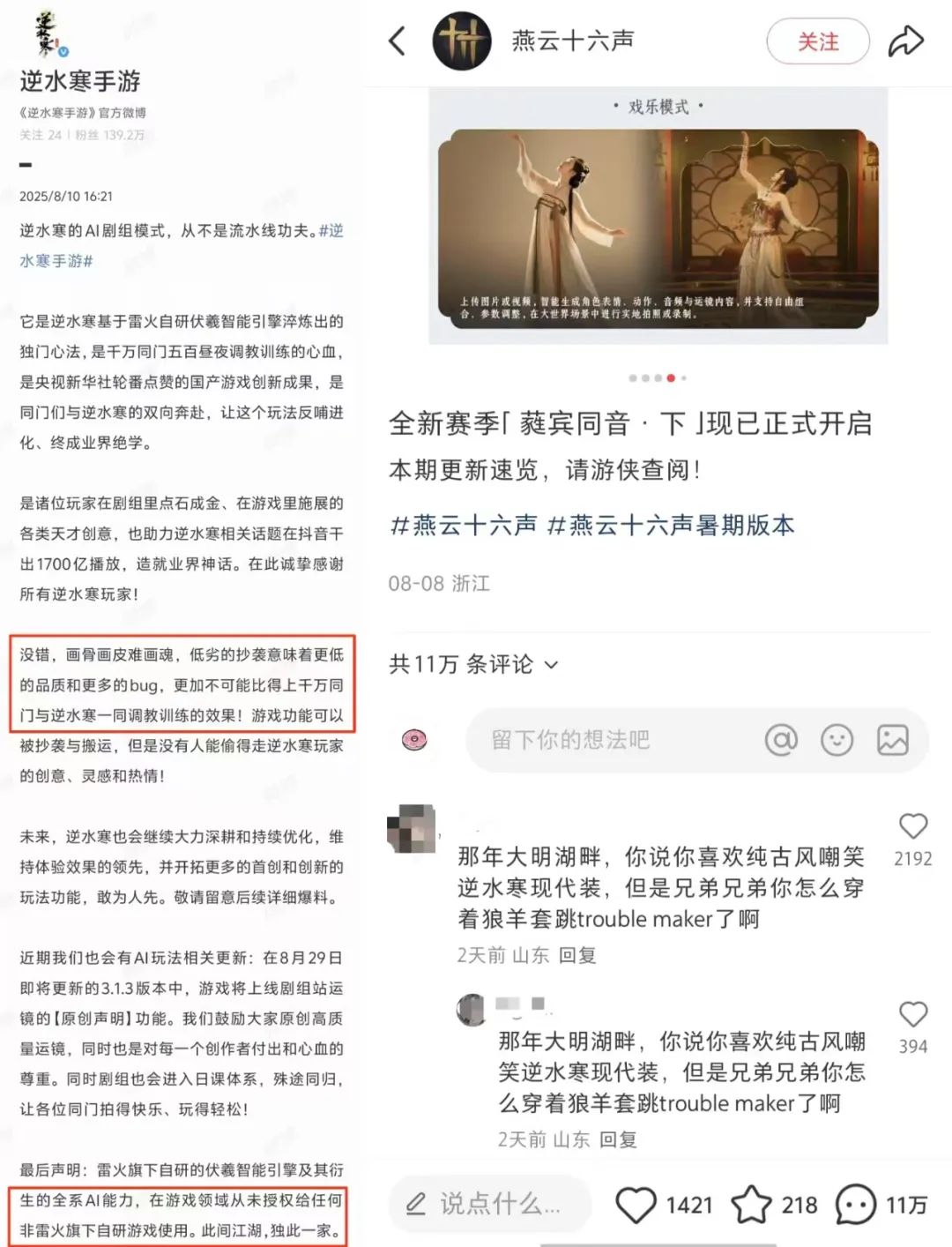
Core Viewpoint - The ongoing conflict between two games under NetEase, "逆水寒手游" (Nirvana in Fire Mobile) and "燕云十六声" (Yanyun Sixteen Sounds), highlights internal competition within the company, with accusations of plagiarism and marketing strategies that may be seen as a new form of promotion [1][9][21]. Group 1: Game Development and Technology - "逆水寒手游" claims its AI-driven gameplay is developed using its proprietary Fuxi intelligent engine and has not been licensed to any non-NetEase games [1]. - "燕云十六声" acknowledges that its "戏乐模式" (Xile Mode) utilizes algorithms from NetEase's AI Lab, which has been in development since 2018 [3][7]. - The competition between the two games is characterized as a "世子之争" (prince competition), with each game belonging to different business units within NetEase, leading to a lack of shared technology and resources [9][12]. Group 2: Market Performance - "逆水寒手游" achieved over 2 billion yuan in revenue within its first month and has registered over 50 million players [14]. - "燕云十六声" generated an estimated revenue of 700-1 billion yuan in its first month and saw over 3 million downloads within four days of its PC launch [15][16]. - Both games are currently performing closely in the market, with rankings in mobile game revenue fluctuating between the two [16]. Group 3: Marketing and Competition - The public dispute over alleged plagiarism has led to significant player engagement, with "燕云十六声" receiving 110,000 comments on social media platforms [1]. - The competitive nature of the two games is expected to drive improvements in technology, service, and player experience, benefiting the gaming industry as a whole [21].


腾讯王者归来、京东喜忧参半、网易不及预期,业绩分化的港股科技怎么布局?
Jin Rong Jie· 2025-08-15 02:47
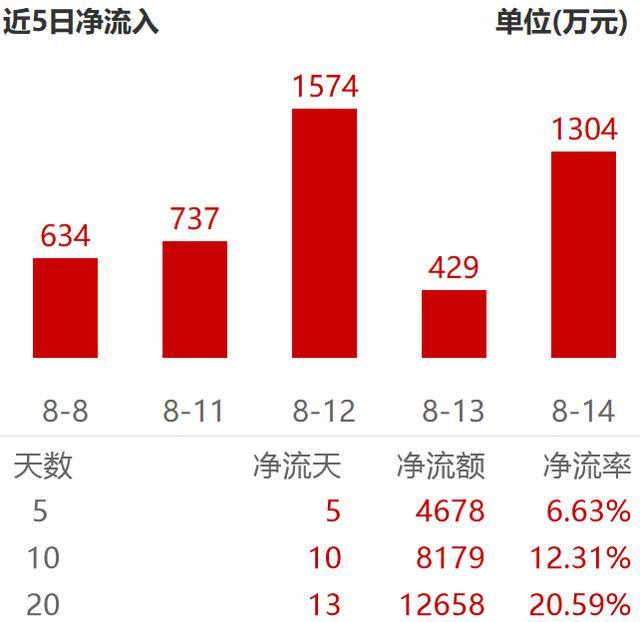
导火索?当然是科技巨头们的年中成绩单陆续揭晓了。财报季向来是试金石,这次更是看点十足。 今天早盘,腾讯再度红开,盘中一度涨0.93%。时隔四年多,腾讯股价重回600港元关口附近,目前年 内涨幅超过40%——这头大象真跳起舞来了。 资金这边似乎也是达成了某种"默契",纷纷加大投入。其中最具代表的就是南向,过去7天大手笔扫货 港股科技股超110亿港元,以小米、阿里领衔。 ETF方面,作为重要观察窗口的港股科技50ETF(159750)连续12天资金净流入,年内吸金超6亿,规 模频频刷新纪录。这个ETF还是两融标的,背后是实打实的资金共识。 3.京东:增长迅猛,代价不小 京东这次营收飙升22%+确实猛,尤其是外卖为代表的新业务,直接干出200%的增幅,够生猛!但硬币 另一面是新业务的"战略性亏损"远超预期:144.5亿 vs 预期110亿,直接把集团整体拖入了亏损。 其他的话,零售赚钱,物流尚可,但新业务这个"吞金兽"的胃口和消化能力,市场可能还得再掂量掂 量。 1.腾讯:王者归来,AI立功 鹅厂这份中报确实能打,营收、利润双创新高,特别是广告和游戏两大引擎动力十足。毛利率冲上 57%,赚钱效率肉眼可见地提升。 但 ...
网易有道:二季度净收入14.2亿元 同比增长7.2%
Zhong Zheng Wang· 2025-08-15 02:33
Financial Performance - Net revenue for the second quarter reached 1.42 billion yuan, a year-on-year increase of 7.2% [1] - Operating profit for the second quarter was 28.8 million yuan, marking the first time the company achieved profitability in this quarter [1] - For the first half of the year, operating profit totaled 130 million yuan, a historical high, with total net revenue amounting to 2.7 billion yuan [1] AI Integration and Services - The learning services segment, a key area for AI technology application, generated net revenue of 660 million yuan in the second quarter, up 2.2% year-on-year [1] - Digital content services contributed 450 million yuan to net revenue [1] - User retention rate improved to over 75%, reaching a historical peak, driven by features like AI essay correction and AI college application guidance [1] Online Marketing Services - The online marketing services segment achieved a record revenue of 630 million yuan, a year-on-year increase of 23.8% [1] - The growth was primarily attributed to the full-chain AI integration, with the launch of the AI advertising optimization tool "Youdao Xiaozhi" [1] Technological Advancements - The company open-sourced the "Ziyue 3" mathematical model, the first of its kind in China focused on math education, significantly reducing costs [2] - The accuracy rate for K12 math problem-solving using the AI full-subject learning assistant Youdao Xiaop increased to over 95% [2] Strategic Outlook - The CEO emphasized the strong financial performance due to the effective execution of the "AI-native" strategy and plans to deepen this strategy further [2] - Future initiatives will focus on optimizing the Ziyue large model through scenario-driven iterations and accelerating technological innovation in learning and advertising [2]

网易有道2025年第二季度营收14.2亿元 上半年经营利润1.3亿元
Jin Rong Jie· 2025-08-15 02:30
Core Insights - NetEase Youdao reported a net revenue of 1.42 billion yuan for Q2 2025, marking a year-on-year growth of 7.2% [1] - The company achieved an operating profit of 28.8 million yuan, marking its first profitable Q2 [1] - For the first half of the year, operating profit reached a historical high of 130 million yuan, with total net revenue of 2.7 billion yuan [1] Financial Performance - Q2 net income was 1.42 billion yuan, up 7.2% year-on-year [1] - Operating profit for Q2 was 28.8 million yuan, with a total operating profit of 130 million yuan for the first half of the year [1] - Operating cash flow outflow narrowed significantly by 49.9% year-on-year [1] Business Segments - Learning services generated net revenue of 660 million yuan in Q2, a 2.2% increase year-on-year [1] - Digital content services contributed 450 million yuan to net revenue [1] - Youdao's AI-driven services, including AI essay correction and college application guidance, improved user retention rates to over 75% [1] Growth Drivers - AI subscription services saw sales of nearly 80 million yuan in Q2, reflecting a robust year-on-year growth of approximately 30% [1] - Online marketing services achieved a record revenue of 630 million yuan, up 23.8% year-on-year [1] - Collaboration with NetEase Games and other game advertisers led to a more than 50% increase in game advertising revenue [1] Product Performance - Youdao's dictionary pen maintained its position as the best-selling product on e-commerce platforms for six consecutive years [1]
网易_财报回顾_第二季度表现稳健,长青游戏将推动下半年持续增长;买入-NetEase Inc. (NTES)_ Earnings Review_ solid 2Q, evergreen titles to drive sustained growth into 2H; Buy
2025-08-15 02:26
Summary of NetEase Inc. (NTES) Earnings Review Company Overview - **Company**: NetEase Inc. (NTES) - **Market Cap**: $85.6 billion - **Enterprise Value**: $66.4 billion - **Industry**: China Games, Entertainment & Healthcare Tech Key Financial Highlights - **2Q Performance**: - Game revenue increased by 15% year-over-year (yoy) - Deferred revenue rose by 28% yoy - Operating profit (OP) grew by 24% yoy - **Market Reaction**: Despite solid results, share price reaction was muted with a -2% decline in ADR post-results [1][2][22] - **Future Projections**: Expected to maintain at least mid-teens yoy game revenue growth for 3Q25 and steady margins for the rest of 2025E [1][2] Core Insights - **Defensive Business Model**: The results highlighted the strength and evergreen nature of NetEase's legacy titles, which continue to perform well despite a lack of major new game launches in 2Q [1][3][17] - **S&M Spending**: Sales and marketing (S&M) spending normalized to 13-14% of sales, with management indicating improved ROI from elevated promotional spending during July-August [18][24] - **Game Pipeline**: Focus on a limited number of high-quality games for global markets, with notable upcoming titles including "Destiny Rising" (launching August 28) and updates for "Ananta" [2][19][32] Financial Forecasts - **Revenue Forecasts**: - 2025E: Rmb 114.91 billion (up 0.4% from previous estimates) - 2026E: Rmb 124.07 billion (up 0.8%) - 2027E: Rmb 132.55 billion [20][21] - **Net Profit Projections**: Revised up by 1.2% to 2.0% for 2025E-27E due to improved gross margins [20][21] Important Metrics - **P/E Ratio**: Currently trading at 15X forward P/E, which is a discount compared to peers and historical averages [2] - **EPS Growth**: Expected EPS growth of 4.1% in 2025E, with further growth projected in subsequent years [12] Additional Insights - **Deferred Revenue**: Strong deferred revenue growth indicates future revenue potential, with a 28% yoy increase in 2Q25 [22] - **Market Position**: NetEase has built a solid user base and community for its titles, which is expected to sustain its evergreen nature in the coming quarters [17] - **Cash Flow**: Positive cash flow from operations projected to increase, with free cash flow expected to reach Rmb 42.18 billion in 2025E [15] Conclusion NetEase Inc. demonstrated solid financial performance in 2Q, driven by its legacy titles and effective marketing strategies. The company is well-positioned for continued growth with a strong pipeline of upcoming games and a focus on maintaining efficient spending. The market's attention is likely to shift towards its potential blockbuster titles as they approach launch dates.
中金:维持网易-S(09999)跑赢行业评级 目标价263港元
Zhi Tong Cai Jing· 2025-08-15 01:53
Core Viewpoint - The report from CICC maintains its earnings forecast for NetEase (09999, NTES.US), with a target price of HKD 263/USD 169, indicating an upside potential of 27%/25% for the stock in Hong Kong and the US respectively [1] Group 1: Financial Performance - In Q2 2025, NetEase's revenue increased by 9% year-on-year to RMB 27.9 billion, aligning closely with CICC's expectation of RMB 27.6 billion [1] - Non-GAAP net profit rose by 22% year-on-year to RMB 9.5 billion, also in line with CICC's forecast of RMB 9.4 billion [1] - The company declared a dividend of USD 0.57 per ADS, with a payout ratio of 30% [1] Group 2: Game Development and Global Strategy - Online gaming revenue grew by 15% year-on-year in Q2 2025, driven by titles such as "Identity V," "Yanyun," and "Marvel Duel," along with some licensed games like Blizzard products [2] - The flagship product "Fantasy Westward Journey" mobile game achieved a new quarterly revenue high in Q2 2025 [2] - New releases like "Yanyun" and "Seven Days World" performed well, and several products were launched overseas, achieving notable rankings in regional download charts [2] Group 3: Profitability and Cost Management - Gross margin for Q2 2025 was 65%, showing slight improvements from 64% in Q1 2025 and 63% in Q2 2024, primarily due to increased margins in gaming and VAS businesses [3] - The sales expense ratio in Q2 2025 recovered to 13%, up from 9% in Q1 2025, driven by marketing investments for key new versions of products [3] - Deferred revenue in Q2 2025 decreased by 4% quarter-on-quarter but showed a strong year-on-year growth of 25%, laying a solid foundation for future performance [3] Group 4: Upcoming Releases and Market Outlook - The highly anticipated mobile game "Destiny: Stars" is set to launch in overseas markets on August 28, 2025, with domestic testing starting on August 15 [4] - Flagship products like "逆水寒" and "Identity V" continue to rank highly on the iOS bestseller list, indicating strong product vitality [4] - The company has a robust pipeline of diverse upcoming products, including "Forgotten Sea" and "Return to Tang," which are expected to enhance its market position [4]
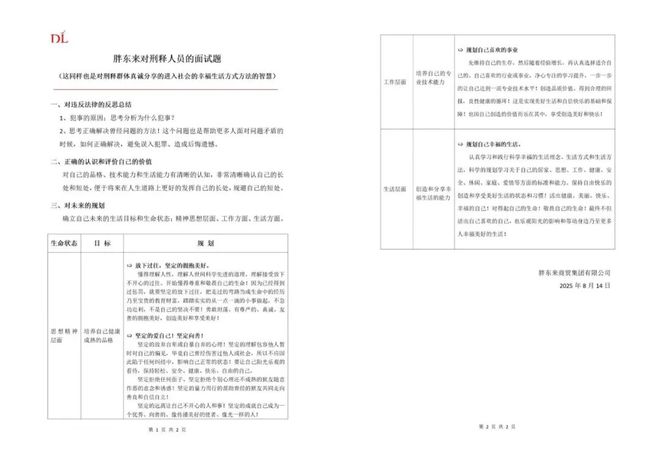
胖东来公布对刑释人员的面试题;寒武纪紧急辟谣;大疆辟谣销售部门大调整;尚界渠道招商火爆:豪车4S店转投;中国新增K字签证丨邦早报
创业邦· 2025-08-15 00:08
Group 1 - The core viewpoint of the article is that recent rumors regarding the company, including large orders and revenue forecasts, are false and misleading [3][4] - The company's stock price experienced a cumulative increase of 30% over three consecutive trading days (August 12, 13, and 14, 2025), which is classified as abnormal trading behavior [4][5] - The company confirmed that there are no undisclosed significant matters affecting its operations, and it is currently operating normally [4][6] Group 2 - Alibaba's Taotian Group has been restructured and renamed as the China E-commerce Group - Taotian Group, aligning it with Ele.me and Fliggy [7] - Alibaba has initiated a large-scale recruitment drive for nearly 1,000 AI talents, focusing on advanced technologies such as large language models and AI hardware [7] - The company is actively expanding its workforce to enhance its capabilities in cutting-edge technology areas [7] Group 3 - Geely Automobile reported a record revenue of 150.3 billion RMB for the first half of 2025, marking a 27% year-on-year increase [21][22] - The core net profit attributable to shareholders reached 6.66 billion RMB, reflecting a 102% increase compared to the previous year [21][24] - The company has raised its annual sales target to 3 million vehicles based on strong sales performance in the first half of the year [21][24] Group 4 - NetEase reported a Q2 revenue of 27.9 billion RMB, with a net profit of 9.5 billion RMB, indicating a stable growth trajectory [24][25] - The company has maintained a strong focus on high-quality and diversified product offerings, driving long-term performance [24][25] Group 5 - The global smart glasses market saw a 110% year-on-year increase in shipments in the first half of 2025, with Meta holding over 70% market share [34] - The AI smart glasses segment experienced a significant growth rate of over 250% compared to the previous year [34]



8点1氪丨胖东来公布对刑释人员的面试题;微信新功能聊天可引用部分文字;雷军入选全球最具影响力商界领袖
3 6 Ke· 2025-08-15 00:01
Group 1: Company Announcements - Wolong Electric Drive has submitted an application for issuing overseas listed shares (H-shares) and listing on the Hong Kong Stock Exchange on August 13, 2025, with the application materials published on the same day [1] - Shunhao Co., Ltd. plans to issue overseas shares (H-shares) and list on the Hong Kong Stock Exchange to respond to national policies aimed at accelerating the development of new productivity and promoting business transformation [2] - Chipsea Technology announced its intention to issue shares overseas and list on the Hong Kong Stock Exchange, considering the interests of existing shareholders and market conditions [3] Group 2: Financial Reports - Kang Shifu reported a revenue of 40.092 billion yuan for the first half of 2025, a decrease of 2.7% year-on-year, with a net profit of 2.688 billion yuan, an increase of 20.3% [23] - Weibo's Q2 revenue reached 4.448 billion USD (approximately 32 billion yuan), with an adjusted operating profit of 1.618 billion USD (approximately 11.58 billion yuan), exceeding Wall Street expectations [24] - Lenovo Group reported a revenue of 136.2 billion yuan for the first quarter of the 2025/26 fiscal year, a year-on-year increase of 22% [25] Group 3: Market Trends - The global smart glasses market saw a 110% year-on-year increase in shipments in the first half of 2025, with Meta holding over 70% market share [22] - JD Group reported a revenue of 356.7 billion yuan for Q2, a year-on-year increase of 22.4%, with a net profit of 16.2 billion yuan [27] - Vipshop achieved a net revenue of 25.8 billion yuan in Q2, with a GMV of 51.4 billion yuan, reflecting a 1.7% year-on-year growth [28] Group 4: Investment and Financing - "Dagu Technology" completed a new round of financing worth tens of millions of yuan, with the funds intended for production line construction, technology research and development, and global market expansion [29]




盘前必读丨海南发文支持生物医药产业;寒武纪辟谣不实信息
Di Yi Cai Jing· 2025-08-14 23:41
Market Overview - The Shanghai Composite Index has surpassed 3700 points, with total market trading volume exceeding 2 trillion yuan, indicating a strong market characteristic and further solidifying the foundation for a slow bull market [1][10] - The market shows clear signs of sector rotation and upward movement, suggesting that holding stocks is advisable in the short to medium term [1][10] Economic Data - The National Bureau of Statistics released the national economic operation data for July [2] - The U.S. Producer Price Index (PPI) rose by 3.3% year-on-year in July, with a month-on-month increase of 0.9% [6] U.S. Stock Market Performance - The U.S. stock market showed mixed results, with the S&P 500 index slightly up by 0.03%, while the Dow Jones Industrial Average fell by 0.02% [3] - Intel shares surged by 7.4% following reports of potential government investment, while other tech stocks like Amazon and Netflix rose over 2% [3] Chinese Stock Market Performance - The Nasdaq Golden Dragon China Index fell by 2.13%, with major Chinese stocks like Li Auto and Alibaba experiencing declines of over 4% [4] Company Announcements - JD Group reported a second-quarter revenue of 356.7 billion yuan, a year-on-year increase of 22.4%, but net profit decreased to 6.2 billion yuan from 12.6 billion yuan in the same period last year [7] - China Shipbuilding Industry Company announced plans to terminate the listing of China Shipbuilding Heavy Industry Company following a merger [9] - Aimeike's subsidiary REGEN is involved in a significant arbitration case, with claims amounting to approximately 1.6 billion yuan [10]



【早报】央行:开展5000亿元买断式逆回购操作;香港证监会及香港金管局就稳定币相关市场波动发表联合声明
财联社· 2025-08-14 23:10
Company News - China Heavy Industry announced on August 14 that it has submitted an application for voluntary termination of its A-share listing [7] - China Telecom reported a net profit of 23.02 billion yuan for the first half of the year and plans to distribute an interim dividend of 16.58 billion yuan [8] - Tianpu Co. announced that its actual controller is planning a change in company control, and its stock will be suspended from trading starting tomorrow [9] Industry News - The number of investors participating in margin trading reached 523,400 on August 13, marking a new high for the year, with an increase of 46,100 from the previous trading day, a 9.67% month-on-month growth [4] - The China Chemical and Physical Power Industry Association released a draft proposal on August 14 to maintain fair competition and promote healthy development in the energy storage industry, with 152 energy storage companies participating in the initiative [6] - Jiangsu Province announced on August 14 that it will waive towing and lifting fees for vehicle rescue services on highways starting in September, making it the first province to fully exempt these fees [6] - The Guizhou Provincial Government issued a three-year action plan for the high-quality development of the low-altitude economy, aiming to establish a basic low-altitude management mechanism by 2027 [6] Global Market - The U.S. stock market saw most indices rise, with the S&P 500 index reaching a new record closing high for three consecutive trading days, up 0.03% [10] - International crude oil futures prices increased by approximately 2%, with WTI crude oil futures for September rising by 2.09% [11] - COMEX gold futures fell by 0.77%, settling at $3,382 per ounce, while silver futures dropped by 1.46% to $38.04 per ounce [11]