Nvidia(NVDA)

Search documents
This Is the Best AI Stock to Buy in February 2026, According to Wall Street
The Motley Fool· 2026-02-14 06:02
Core Viewpoint - Nvidia is identified as a top stock to buy, with significant growth potential highlighted by Wall Street analysts [2][4]. Company Performance - Nvidia's current stock price is approximately $185 per share, which is about 10% below its all-time high [4]. - The average price target from Wall Street analysts for Nvidia is $253.62, indicating a potential upside of 37% over the next year [4]. - The stock has experienced a recent decline of 2.21%, with a current price of $182.81 [5]. Market Position and Growth Projections - Nvidia is projected to report around $213 billion in revenue for fiscal 2026, with a forecasted revenue growth of 53% to $326 billion in fiscal 2027 [6]. - If Nvidia maintains a profit margin of 53%, this would result in approximately $173 billion in profits [6]. - Analysts have set a bullish price target of $352 per share, suggesting a potential upside of nearly 100% from current levels [6]. Industry Context - Several AI hyperscalers have announced substantial capital expenditure plans for AI data centers, which will benefit Nvidia [6]. - The market capitalization of Nvidia could reach $6.9 trillion at a price-to-earnings ratio of 40, indicating a potential upside of 53% [8].


12 Youngest Hedge Fund Billionaires and Their Top Stock Picks
Insider Monkey· 2026-02-14 04:48
Core Insights - The wealth of billionaires worldwide increased by 16% in the last year, reaching $18.3 trillion, marking an 81% increase since 2020, highlighting a growing divide between the ultra-rich and the rest of the population [2][3] - The youngest hedge fund billionaires are actively influencing stock market dynamics, with their investment choices reflecting strategies in a volatile financial landscape [4][5] Billionaire Wealth and Market Influence - The report attributes the increase in billionaire wealth to U.S. policies, tax cuts, and reduced scrutiny of monopolies, which have allowed the wealthy to consolidate political influence [3] - Billionaires are 4,000 times more likely than average citizens to hold political office, indicating a significant concentration of power [3] Stock Picks and Market Trends - The youngest hedge fund billionaires' stock selections provide insights into navigating current market conditions, with a focus on unique holdings to avoid duplication [7][10] - The report includes a list of the 12 youngest hedge fund billionaires and their top stock picks, ranked by age, showcasing a diverse selection of investments [10] Individual Stock Highlights - **NVIDIA Corporation (NASDAQ:NVDA)**: Clifford Asness holds a 2.62% stake worth $4.09 billion, with analysts projecting a revenue of $67.5 billion for the fiscal fourth quarter, exceeding guidance [12][13][14] - **Meta Platforms, Inc. (NASDAQ:META)**: Philippe Laffont's top pick, accounting for 7.27% of his portfolio, is developing a new application called "Instants" to enhance user engagement [18][20] - **Visa Inc. (NYSE:V)**: Ken Griffin's fifth-largest holding, with a 0.16% portfolio share worth $1.04 billion, recently launched Visa & Main to support small business growth through a $100 million working capital facility [23][25][26]



中概股全线走低、美股全线大跌,有色金属、半导体芯片、苹果重挫
Sou Hu Cai Jing· 2026-02-14 04:30
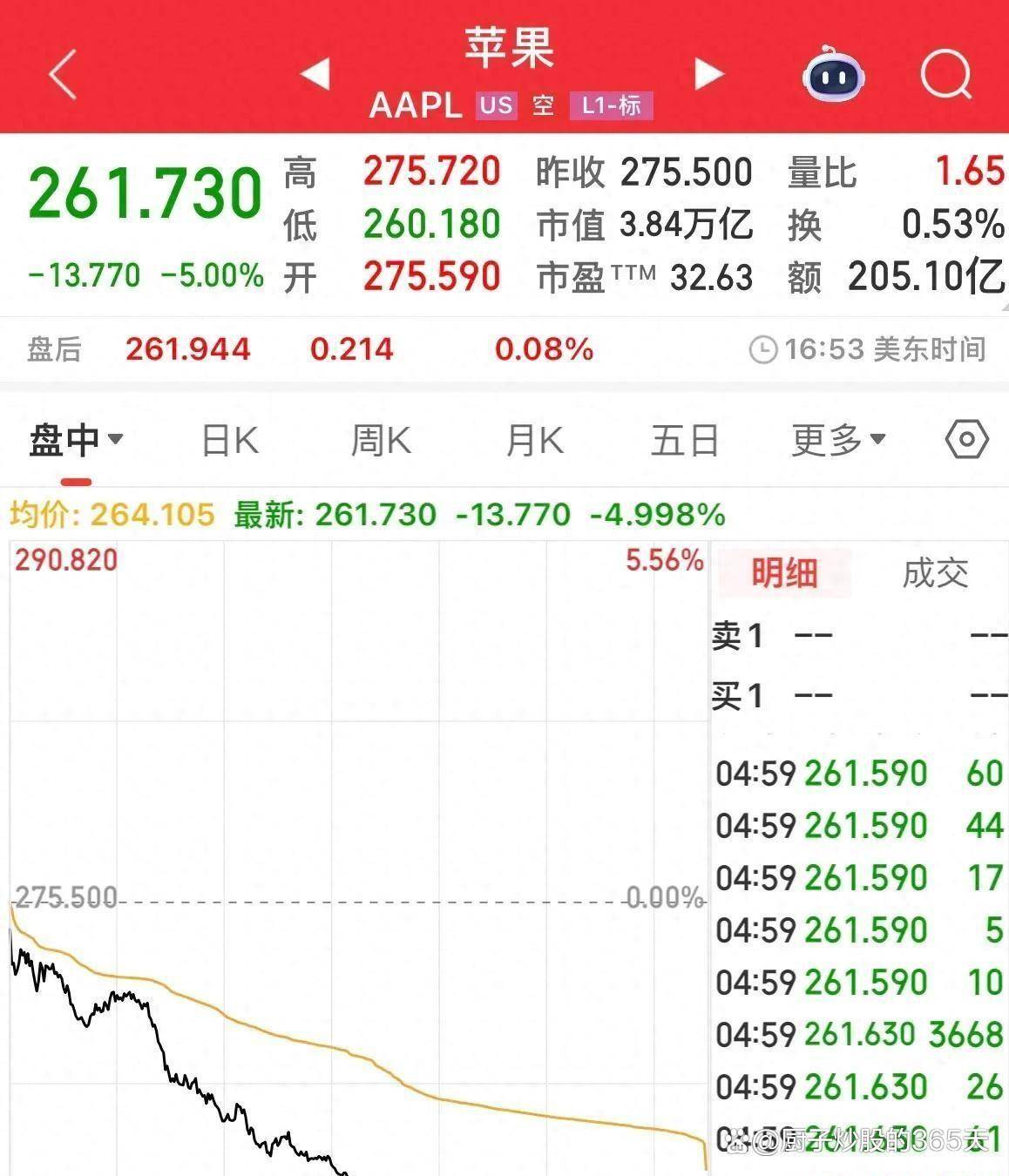
Market Overview - The US stock market experienced a significant decline, with the Dow Jones Industrial Average dropping 669.42 points (1.34%) to close at 49,451.98 points, the Nasdaq Composite falling 469.32 points (2.03%) to 22,597.15 points, and the S&P 500 decreasing by 108.71 points (1.57%) to 6,832.76 points [1][2][3] Market Sentiment - Over 4,100 stocks declined, indicating widespread market panic as investors rushed to sell assets, particularly in the tech and growth sectors. The VIX index surged, reflecting heightened risk aversion [2][3] Sector Performance - The sell-off affected nearly all sectors, with notable declines in precious metals and semiconductor stocks. The precious metals sector saw significant drops, with gold futures down 3.08% and silver futures plummeting 10.62% [4][5][6][8] - The Philadelphia Semiconductor Index fell by 2.5%, with individual stocks like AEHR Test Systems down 17.58% and Intel down over 3% [8][10] Major Companies - Apple Inc. experienced a substantial drop of 5.00%, resulting in a market cap loss of over $120 billion, attributed partly to regulatory concerns [12] - Other major tech companies also faced declines, with Tesla down 1.62%, Amazon down 2.20%, and Meta Platforms down nearly 3% [12] Financial Sector - Bank stocks fell across the board, with JPMorgan Chase down over 2%, Goldman Sachs down over 4%, and Citigroup down over 5%, driven by concerns over AI disrupting traditional wealth management [13][14] Economic Indicators - Recent economic data, including a drop in initial jobless claims and lower-than-expected existing home sales, contributed to market anxiety about potential economic overheating and prolonged high interest rates [24][25][26] Global Market Impact - The sell-off in the US markets had a ripple effect on global markets, with European indices also closing lower after initially opening higher, indicating a widespread sentiment of fear [18][19][20] AI Concerns - The market's decline was exacerbated by fears regarding the disruptive impact of AI technologies on various industries, leading to significant stock price drops in sectors perceived to be at risk [21][22][30] Storage Chip Sector - In contrast to the overall market trend, storage chip stocks saw gains, with companies like SanDisk and Seagate Technology rising significantly, reflecting a belief that AI's growth will increase demand for data storage [29]


晚间暴雷!黄金、白银、原油、美股全线崩盘,42只中概集体下跌
Sou Hu Cai Jing· 2026-02-14 04:22
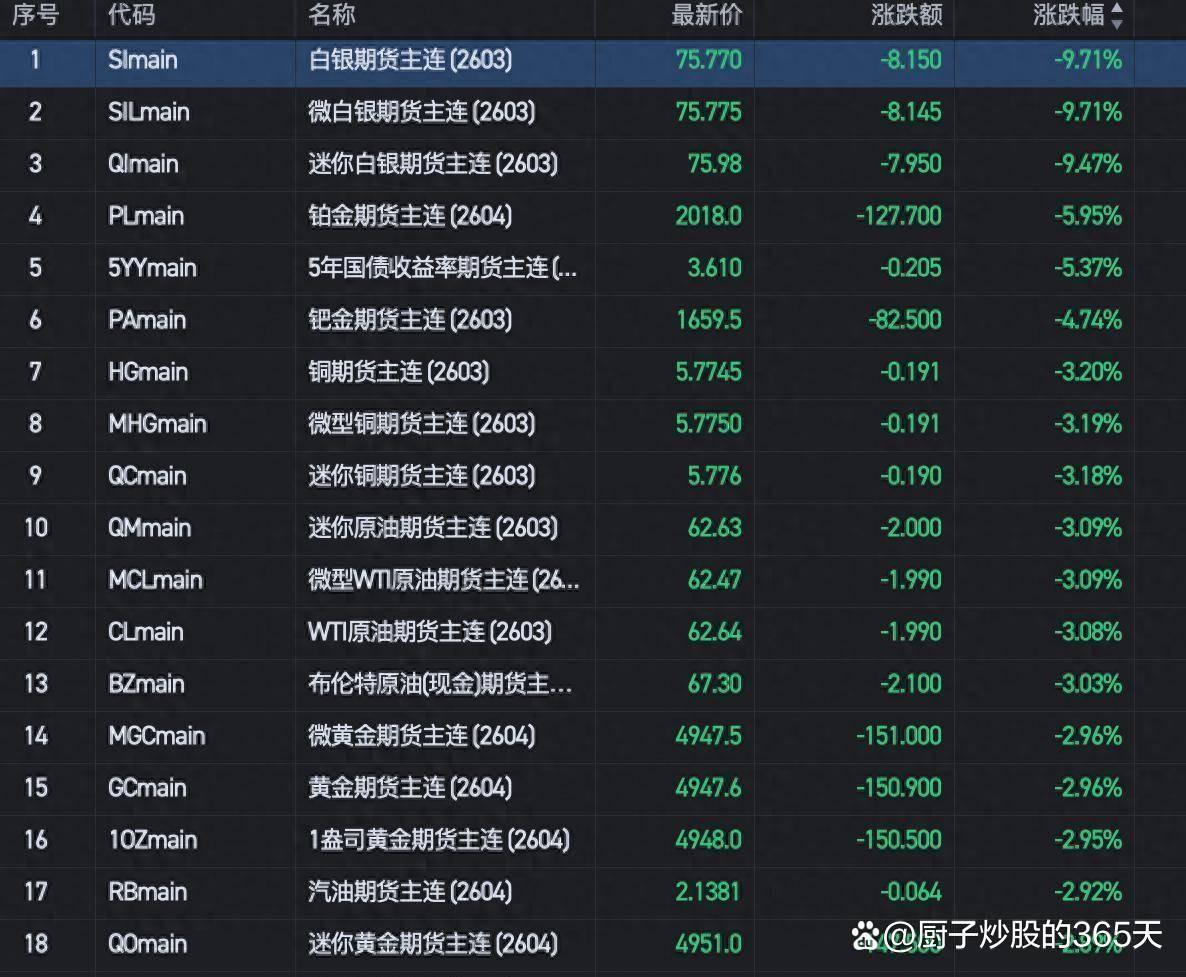
Market Overview - On February 13, 2026, a significant asset sell-off occurred in global financial markets, particularly impacting U.S. stock indices. The Dow Jones Industrial Average fell by 669.42 points (1.34%) to close at 49,451.98, while the Nasdaq Composite Index dropped 469.32 points (2.03%) to 22,597.15. The S&P 500 Index also declined by 108.71 points (1.57%) to 6,832.76 [1]. Commodity Market Impact - The sell-off extended to the commodity markets, with gold and silver experiencing substantial declines. COMEX gold futures fell by 3.08% to $4,941.4 per ounce, while COMEX silver futures plummeted by 10.62% to $75.01 per ounce [2][3]. Technology Sector Reaction - Major technology companies were severely affected, with Apple’s stock price dropping by 5%, resulting in a market value loss of over $120 billion (approximately 800 billion RMB). Other tech giants like Microsoft, Amazon, Tesla, Meta, and Nvidia also saw significant declines [3][4]. Chinese Concept Stocks - The Nasdaq Golden Dragon China Index, which includes many Chinese concept stocks, fell by 3% on the same day, indicating a collective sell-off in this sector. Over 40 Chinese concept stocks experienced substantial declines, with Tencent Music down 10.57% and Alibaba down 3.40% [3][4][6]. Employment Data Influence - The catalyst for this market turmoil was a strong U.S. employment report released on February 11, showing a non-farm payroll increase of 130,000 in January, significantly above the expected 70,000. This led to a shift in market expectations regarding Federal Reserve interest rate cuts, with the probability of a March rate cut dropping from 19.6% to 6% [5][6]. Capital Expenditure Concerns - Major tech companies announced aggressive capital expenditure plans for 2026, with Alphabet projecting $175 billion to $185 billion and Amazon estimating $200 billion, both nearly doubling their 2025 expenditures. This raised investor concerns about the return on such investments, especially as many companies reported record profits but saw stock price declines [10][11]. Market Sentiment and Volatility - The market's fear and volatility increased sharply, with the VIX index rising significantly. The sell-off was exacerbated by algorithm-driven trading, which triggered stop-loss orders and led to extreme price movements [15][16][17]. Global Market Impact - The financial turmoil that began in Wall Street quickly spread to global markets, with Asian and European stock markets opening lower in response to the U.S. declines [18].



桥水四季度持仓曝光,英伟达大幅增持54%重回第三大重仓,黄金板块同步加码
Jin Rong Jie· 2026-02-14 04:16
Group 1 - The core viewpoint of the news is that Bridgewater, the world's largest hedge fund, made significant adjustments to its positions in AI-related stocks and gold during the fourth quarter of 2022, as reported in its 13F filing with the SEC [1][2]. - Bridgewater's total holdings at the end of the fourth quarter amounted to approximately $27.4 billion, reflecting a 7.5% increase from the previous quarter's $25.5 billion [1]. - The fund added 191 new positions, increased holdings in 450 stocks, reduced positions in 395 stocks, and completely exited 165 positions during the quarter [1]. Group 2 - In the AI sector, Bridgewater notably increased its stake in NVIDIA by 1.35 million shares, raising its total from 2.51 million shares to 3.87 million shares, a 54% increase, making it the third-largest holding [1]. - Amazon also saw a significant increase in holdings, with shares rising from 1.12 million to 1.95 million, a growth of approximately 73% [1]. - In the gold sector, Bridgewater increased its position in Newmont Corporation, a leading gold producer, which was among the top five purchases for the quarter [1]. Group 3 - The top ten holdings included SPDR S&P 500 ETF and iShares S&P 500 ETF in the first two positions, with NVIDIA in third, followed by Lam Research, ServiceNow, Google, Microsoft, Amazon, Adobe, and GE Vernova [2]. - Notably, several stocks in the top ten holdings, including Lam Research, ServiceNow, Google, and Microsoft, experienced varying degrees of reduction in positions [2]. - The largest reductions in positions for the quarter were seen in Uber, Fiserv, Google, META, and Microsoft [2].
英伟达跌,AMD涨,罪魁祸首可能是Arista Networks?
美股IPO· 2026-02-14 04:12
分析指出,虽然英伟达和AMD股价波动幅度不算巨大,但Ullal的评论意义重大。 自三年多前OpenAI推出ChatGPT、人工智能行业起飞以来,英伟达 一直主导着AI GPU市场。 目前,英伟达在AI芯片市场的份额约为90%,潜在挑战者包括AMD,以及谷歌。谷歌的TPU也正在获得越来越多的采用。英伟达目前是美国市值最高 的公司,市值超过4.5万亿美元。AMD市值约为3350亿美元。 在周四晚间的财报电话会上,当被分析师问及公司与AMD的合作情况时,Arista首席执行官Ullal表示:"一年前,基本上99%都是英伟达,对吧?而今 天,当我们查看部署情况时,大约有20%,甚至略高一些,约20%至25%的项目中,AMD正成为首选加速器。"英伟达股价周五盘中下跌近3%,而AMD 上涨接近1%。 周五,英伟达与AMD的股价走势出现分化,此前Arista Networks首席执行官在财报电话会议上表示,公司正看到部分部署转向AMD。 英伟达股价周五盘中下跌近3%,而AMD上涨接近1%。 在周四晚间的财报电话会上,当被分析师问及公司与AMD的合作情况时,Arista首席执行官Ullal表示:"一年前,基本上99%都是英伟 ...


索罗斯Q4调仓路线图:猛砍Snowflake,狂买微软、英伟达,新建仓黄金股
美股IPO· 2026-02-14 04:12
Core Viewpoint - Soros Fund Management made significant adjustments to its investment portfolio in the fourth quarter, focusing on increasing exposure to tech giants while engaging in "buy high, sell low" strategies for energy and cryptocurrency stocks [1]. Group 1: Technology Sector Investments - The fund substantially increased its holdings in core technology stocks, including adding 161,000 shares of Microsoft (MSFT.US), 118,000 shares of Nvidia (NVDA.US), and approximately 66,000 shares of Apple [3]. - In the software and mobility sectors, the fund also increased its positions by acquiring approximately 216,000 shares of Atlassian (TEAM.US), 55,000 shares of Salesforce (CRM.US), and 119,000 shares of Uber (UBER.US) [3]. Group 2: Defensive and Growth Investments - In the defensive sector and consumer space, the fund increased its holdings in utility company Exelon (EXC.US) by approximately 488,000 shares and in gaming giant Electronic Arts (EA.US) by about 318,000 shares [3]. Group 3: Reduction in High Volatility and Financial Stocks - The fund reduced its positions in high-volatility and financial stocks, significantly cutting approximately 168,000 shares of Snowflake (SNOW.US) [4]. - It also reduced its holdings in Circle Internet Group (CRCL.US) by about 151,000 shares and in Interactive Brokers (IBKR.US) by approximately 813,000 shares, indicating a cautious stance towards the financial brokerage sector [5][6]. Group 4: New Positions and Exits - The fund opened new positions by purchasing gold-related assets such as New Gold (NGD.US) and established positions in DigitalBridge (DBRG.US), Blue Owl Capital (OWL.US), Exact Sciences (EXAS.US), and Xcel Energy (XEL.US) [7]. - It completely exited positions in KeyCorp (KEY.US), CareTrust REIT (CTRE.US), Cipher Mining (CIFR.US), and KKR & Co. (KKR.US), indicating a shift away from traditional banking and certain cryptocurrency mining stocks towards more stable or defensive sectors [7]. Group 5: Overall Strategy - The overall strategy of Soros Fund Management in the fourth quarter reflects a clear approach: embracing AI and core tech assets like Microsoft and Nvidia while avoiding high-volatility cloud and data companies like Snowflake, and hedging against macroeconomic uncertainties by investing in gold stocks. This "pick and choose" adjustment strategy highlights the pursuit of certainty and safety margins amid global economic uncertainties [7].






桥水Q4大举增持英伟达和黄金股
Xin Lang Cai Jing· 2026-02-14 03:17
Core Insights - Bridgewater, the world's largest hedge fund, disclosed its latest U.S. stock holdings report (13F) on Friday, revealing significant investments in AI-related stocks such as Nvidia, Amazon, and Micron Technology, as well as an increase in holdings of Newmont Corporation, a leading gold producer, benefiting from rising gold prices [1] Group 1 - In the fourth quarter ending December 31, the total market value of Bridgewater's holdings reached $27.4 billion, up from $25.5 billion in the previous quarter [1] - During the third quarter, Bridgewater added 191 new positions, increased holdings in 450 positions, while reducing stakes in 395 positions and completely exiting 165 positions [1] - The top ten holdings of Bridgewater accounted for 36.33% of the total market value [1]
英伟达困局:内存瓶颈或将重塑全球AI产业链竞争格局
Xin Lang Cai Jing· 2026-02-14 02:59
Core Insights - The key bottleneck in AI development has shifted from computing power to memory, as highlighted by Intel's CEO Chen Lifeng [3][6][7] - The training and inference of large models require the exchange of tens of terabytes of data per second between GPUs and memory, likened to a high-performance car constrained by a narrow fuel line [3][6] - Only three companies globally can mass-produce the high-bandwidth memory (HBM) necessary for advanced AI, with their production capacity booked until 2028, leading to a significant imbalance between computing power and memory expansion [3][6] Short-term Implications - The current situation results in low utilization of computing power and increased costs for model training and inference [3][6] Mid-term Challenges - The semiconductor manufacturing capacity and the limits of the semiconductor industry will be tested [3][6] Long-term Considerations - There will be challenges related to power, heat dissipation, materials, and infrastructure support capabilities [3][6] - The competition in AI has evolved beyond algorithms to a national-level endurance contest encompassing computing power, memory manufacturing, energy, and infrastructure [3][6] Future Outlook - The future potential of AI will not be determined by sporadic model breakthroughs but by the robust industrial foundation that supports the stable operation of complex systems [3][6][7] - The ultimate form of AI is envisioned as a stable, operating intelligent industrial machine rather than merely a singular smart model [3][6][7]
腾讯研究院AI每周关键词Top50
腾讯研究院· 2026-02-14 02:33
Group 1: Core Insights - The article highlights the top 50 keywords in AI for the week, providing a comprehensive overview of the latest developments in the AI industry [2] - Key models mentioned include Claude Opus 4.6 by Anthropic and GPT-5.3-Codex by OpenAI, indicating advancements in AI model capabilities [3] - Various applications of AI are showcased, such as Seedance 2.0 by ByteDance and WorkBuddy by Tencent, reflecting the growing integration of AI in different sectors [3][4] Group 2: Models - Claude Opus 4.6 and Opus 4.6极速模式 are significant models from Anthropic, showcasing their focus on enhancing AI performance [3] - OpenAI's GPT-5.3-Codex represents a notable evolution in generative AI technology [3] - Other models like 2Bit量化端侧模型 by Tencent and Ming-flash-omni 2.0 by Ant Group highlight the competitive landscape in AI model development [3] Group 3: Applications - The article lists various innovative applications, including DreamZero by NVIDIA and AI女友Clawra by OpenClaw, indicating diverse use cases for AI technology [3][4] - The introduction of tools like CodeBrain-1 by Feeling AI and 深度研究智能体 by Meituan reflects the trend towards specialized AI applications in research and development [4] - The presence of applications like FireRed-Image-Edit by Xiaohongshu and 自定义智能体 by Rokid shows the focus on user-friendly AI solutions [4] Group 4: Technology and Trends - The article discusses technological advancements such as AI绘制脑图 by the University of California and the concept of a robot fighting league, indicating the innovative directions in AI research [4] - Insights from figures like Elon Musk on the concept of a robot perpetual motion machine suggest ongoing debates and explorations in AI capabilities [4] - The mention of AI基建支出 by major US tech companies highlights the increasing investment in AI infrastructure [4]