
Nvidia(NVDA)

Search documents
8连跌!“资本开支最高”的亚马逊跌入熊市,投资者对Mag 7“用脚投票”
Hua Er Jie Jian Wen· 2026-02-13 00:07
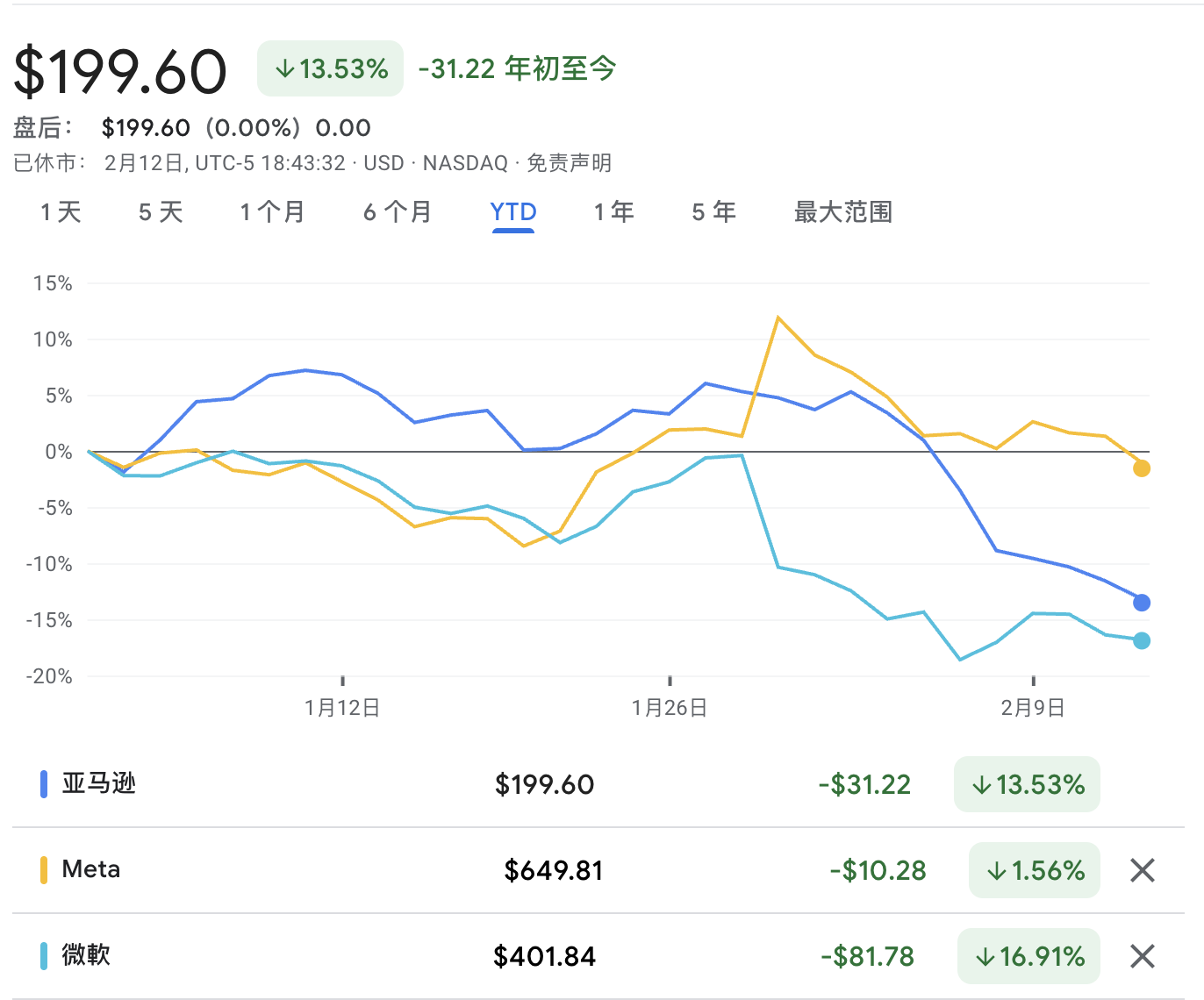
Group 1 - Amazon's stock has entered a technical bear market after falling for eight consecutive trading days, marking it as the second company in the Mag7 to do so, with a closing price of $199.60, down 21.4% from recent highs [1] - Amazon is projected to have the highest capital expenditure among major cloud service providers, with plans to spend $200 billion by 2026, contributing to concerns over AI spending and investor confidence [1] - Meta is at risk of becoming the next Mag7 member to enter a bear market, with its stock only 2.3% away from the bear market threshold, despite exceeding revenue and earnings expectations in Q4 [1] Group 2 - Investors are rotating within the Mag7, highlighting a growing divergence among its members, with a shift away from Microsoft, Nvidia, and Oracle towards Alphabet and Broadcom [3] - Alphabet's vertically integrated technology stack has helped mitigate concerns over excessive spending, resulting in a smaller decline of 9.2% from recent highs [3] - Increased AI spending by Amazon, Microsoft, and Meta has raised doubts about their ability to generate sufficient returns, with Amazon potentially facing negative free cash flow this year [4] Group 3 - The next significant catalyst for AI investments is expected to be Nvidia's earnings report on February 25, which will indicate whether the AI boom is cooling or if Nvidia has successfully captured substantial investments from its largest clients [4]







苹果大跌5%
财联社· 2026-02-12 23:41
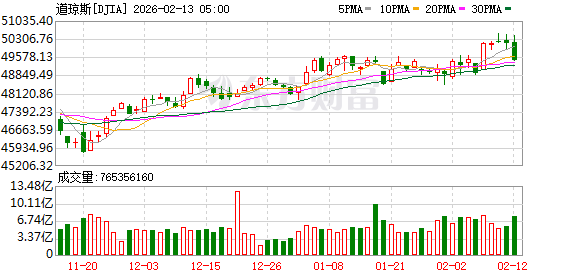
Core Viewpoint - Concerns over the disruptive potential of artificial intelligence (AI) have led to a decline in major stock indices, with the Nasdaq falling by 2% and the S&P 500 and Dow Jones also experiencing significant drops [1][4]. Group 1: Market Performance - The Dow Jones index closed down 1.34% at 49,451.98 points, the S&P 500 index fell 1.57% to 6,832.76 points, and the Nasdaq index dropped 2.03% to 22,597.15 points [4]. - Major technology stocks saw declines, with Apple down 5%, erasing its gains for the year, and Nvidia down 1.64% [9]. Group 2: Sector Impact - The introduction of AI tools has negatively impacted various sectors, including software companies, publishers, and financial services, raising concerns about potential business model replication and profit margin erosion [5]. - Financial stocks, such as Morgan Stanley, faced pressure due to fears that AI could disrupt wealth management services [5]. - Trucking and logistics companies, like C.H. Robinson, saw a 14% drop in stock price as AI is expected to optimize freight operations, potentially reducing revenue sources [5]. Group 3: Real Estate and Defensive Sectors - The real estate sector is also affected, with concerns that higher unemployment rates will reduce demand for office space, leading to declines in stocks like CBRE and SL Green Realty [6]. - Investors are shifting towards more defensive sectors, with Walmart and Coca-Cola seeing stock price increases of 3.8% and 0.5%, respectively [7]. - In the S&P 500, the consumer staples and utilities sectors outperformed, both rising over 1%, with the consumer staples sector reaching a historical closing high [8].



道指重挫逾600点!AI抛售潮重燃 思科暴泻12% 商业地产遭遇“黑色星期四”
Di Yi Cai Jing· 2026-02-12 23:27
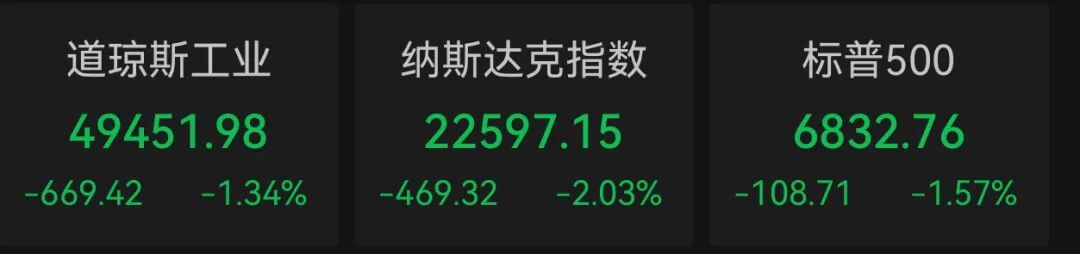
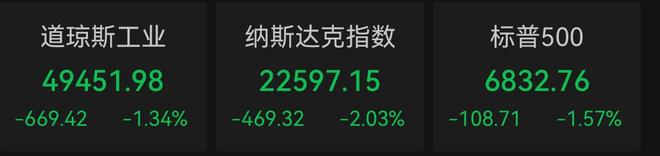
Market Overview - US stock market experienced a significant decline, driven by concerns over the accelerated penetration of artificial intelligence impacting the software industry and office space demand, leading to pressure on commercial real estate and tech sectors [2] - The Dow Jones Industrial Average fell by 669.42 points, a decrease of 1.34%, closing at 49,451.98 points; the S&P 500 dropped by 108.71 points, down 1.57%, closing at 6,832.76 points; the Nasdaq Composite decreased by 469.32 points, a decline of 2.03%, closing at 22,597.15 points [2] Popular Stocks Performance - Major tech companies faced significant losses, with Apple plunging 5%, marking its largest single-day drop since April 2025, following claims by the US Federal Trade Commission regarding Apple's suppression of conservative content [3] - Other notable declines included Meta Platforms down 2.82%, Amazon down 2.20%, Tesla down 2.62%, Nvidia down 1.64%, Microsoft down 0.63%, and Google C shares down 0.63% [3][4] Commercial Real Estate and Financial Services - The current sell-off in the US stock market is primarily focused on commercial real estate and related financial services, with fears that increased use of AI tools may structurally weaken demand for office space, impacting leasing and valuation [5] - Major commercial real estate service companies saw significant stock price drops, with CBRE Group down 8.8%, JLL down 7.6%, and Colliers International down 11.5% [5] - Analysts noted that the discussion around AI reducing office demand has been ongoing, but the recent sell-off in brokerage stocks has led investors to reassess commercial real estate risks more directly [5] Transportation and Logistics Sector - The trucking and logistics sector also faced notable pressure, with the Dow Jones Transportation Average dropping over 4%, marking its worst day since the US announced tariff increases in April of last year [6] - Among the 20 component stocks of the Dow Jones Transportation Average, 17 experienced declines, with Landstar System and C.H. Robinson seeing drops of 15.6% and 14.5%, respectively [6] - Concerns were heightened following Algorhythm Holdings' disclosure that its SemiCab division increased customer freight volumes by 300% to 400% without a corresponding increase in workforce, raising fears about AI's potential to reduce labor demand in logistics [6] Labor Market Data - Recent labor market data showed that initial jobless claims fell by 5,000 to 227,000, indicating overall stability in the job market [7] Bond Market Reaction - US Treasury yields fell, with the 10-year Treasury yield decreasing by 8.1 basis points to 4.102%, marking the largest single-day drop in October; the 2-year yield fell by 4.8 basis points to 3.464% [8] Commodity Market Performance - International oil prices saw a significant decline, with light crude oil futures for March delivery dropping by $1.79 to $62.84 per barrel, a decrease of 2.77%; Brent crude futures for April fell by $1.88 to $67.52 per barrel, down 2.71% [10] - Precious metals also faced pressure, with spot gold down 3.26% to $4,918.36 per ounce and silver down 10.89% to $75.0942 per ounce [10]


英伟达(NVDA.US)16年长租协议助推数据中心债券发行,AI基础设施借贷热潮转向“垃圾债”市场
Zhi Tong Cai Jing· 2026-02-12 23:27
英伟达(NVDA.US)预计将租赁一座利用38亿美元垃圾债券发行资金建设的数据中心。此举进一步加剧 了围绕人工智能基础设施的借贷热潮。 英伟达在运营自有数据中心的同时,也通过从亚马逊的AWS和微软的Azure等云服务提供商处租赁空间 来获取额外容量。英伟达利用AI来设计芯片和计算机,该公司表示,这一过程正变得日益复杂,且需 要更强大的算力。此外,英伟达还开发AI模型和软件产品,其中许多是开源的。 近几个月来,数据中心开发商一直在利用高收益债券市场(垃圾债市场)为新设施的建设筹措资金。此 前,两家加密货币矿商——Cipher Mining Inc.和TeraWulf Inc.——在谷歌的支持下进行了此类融资; Applied Digital Corp.也为相关设施筹集了资金,而这些设施将依赖债券评级为垃圾级的CoreWeave Inc. 作为主要租户。 Tract Capital是一家专注于数字基础设施的另类资产管理公司,管理资产规模约为60亿美元。该公司近 期推出了名为"Fleet"的战略,旨在为超大规模企业建设新数据中心。Fleet I是其首支基金,也是本次债 券发行借款方SV RNO Property O ...
道指重挫逾600点!AI抛售潮重燃,商业地产遭遇“黑色星期四”
Di Yi Cai Jing· 2026-02-12 23:24
Market Overview - US stock market experienced a significant decline, driven by concerns over the accelerated penetration of artificial intelligence impacting the software industry and office space demand [1] - The Dow Jones Industrial Average fell by 669.42 points, a decrease of 1.34%, closing at 49,451.98 points; the S&P 500 dropped by 108.71 points, down 1.57%, closing at 6,832.76 points; the Nasdaq Composite decreased by 469.32 points, a decline of 2.03%, closing at 22,597.15 points [1] Technology Sector Performance - Major tech stocks faced pressure, with Apple experiencing a sharp decline of 5%, marking its largest single-day drop since April 2025, following claims by the US Federal Trade Commission regarding Apple's suppression of conservative content [3] - Other tech giants also saw declines: Meta Platforms down 2.82%, Amazon down 2.20%, Tesla down 2.62%, Nvidia down 1.64%, Microsoft down 0.63%, and Alphabet's Class C shares down 0.63% [3][4] Commercial Real Estate Impact - The sell-off in the US stock market focused on commercial real estate and related financial services, with fears that increased use of AI tools could structurally weaken demand for office space, impacting leasing and valuation systems [5] - Major commercial real estate service companies saw significant stock price drops, with CBRE Group down 8.8%, JLL down 7.6%, and Cushman & Wakefield down 11.5% [6] - Analysts noted that the discussion around AI reducing office demand has been ongoing, and the recent sell-off in brokerage stocks has led investors to reassess commercial real estate risks more directly [6] Transportation and Logistics Sector - The transportation and logistics sector also faced significant pressure, with the Dow Jones Transportation Average dropping over 4%, marking its worst day since the US announced tariff increases in April of last year [6] - Among the 20 components of the Dow Jones Transportation Average, 17 stocks declined, with Landstar System and C.H. Robinson experiencing the largest drops of 15.6% and 14.5%, respectively [7] - Concerns were heightened following Algorhythm Holdings' disclosure that its SemiCab division increased customer freight volumes by 300% to 400% without a corresponding increase in workforce, raising fears about AI's impact on labor demand in the logistics industry [7] Global Market Reactions - The impact of the US market decline extended to European markets, with Swiss logistics group Kuehne + Nagel's stock falling by 13% and Danish logistics firm DSV A/S dropping over 10% [8] Economic Data and Interest Rates - Recent labor market data showed a smaller-than-expected decline in initial jobless claims, leading to fluctuating market expectations regarding the Federal Reserve's interest rate path for the year [8] - The yield on 10-year US Treasury bonds fell by 8.1 basis points to 4.102%, marking the largest single-day drop since October, while the yield on 2-year bonds decreased by 4.8 basis points to 3.464% [8] Commodity Market Performance - International oil prices saw a notable decline, with light crude oil futures for March dropping by $1.79 to $62.84 per barrel, a decrease of 2.77%, and Brent crude oil futures for April falling by $1.88 to $67.52 per barrel, down 2.71% [9] - Precious metals also faced pressure, with spot gold down 3.26% to $4,918.36 per ounce and silver down 10.89% to $75.0942 per ounce [9]
道指重挫逾600点!AI抛售潮重燃,思科暴泻12%,商业地产遭遇“黑色星期四”
第一财经· 2026-02-12 23:22
Core Viewpoint - The article discusses the significant decline in the U.S. stock market, driven by concerns over the impact of artificial intelligence on the software industry and office space demand, leading to a reassessment of the Federal Reserve's interest rate path [3]. Market Performance - Major U.S. indices fell sharply, with the Dow Jones Industrial Average down 669.42 points (1.34%) to 49,451.98, the S&P 500 down 108.71 points (1.57%) to 6,832.76, and the Nasdaq Composite down 469.32 points (2.03%) to 22,597.15 [3]. - Tech giants faced significant pressure, with Apple dropping 5% (largest single-day decline since April 2025), Meta down 2.82%, Amazon down 2.20%, and Tesla down 2.62% [6][7]. Commercial Real Estate Concerns - The sell-off focused on commercial real estate and related financial services, with fears that increased AI usage could structurally weaken demand for office space, impacting leasing and valuation [10]. - Major commercial real estate service companies saw significant stock declines, with CBRE down 8.8%, JLL down 7.6%, and Colliers down 11.5% [10]. - Analysts noted that the discussion around AI reducing office demand has been ongoing, but recent sell-offs in brokerage sectors have intensified fears regarding commercial real estate risks [10]. Transportation and Logistics Sector - The transportation and logistics sector also faced declines, with the Dow Jones Transportation Average dropping over 4%, marking its worst day since April of the previous year [11]. - Key logistics companies like Landstar System and C.H. Robinson saw declines of 15.6% and 14.5%, respectively, due to concerns over AI potentially reducing labor demand in the logistics industry [12]. Economic Data and Federal Reserve Outlook - Recent labor market data showed a smaller-than-expected drop in initial jobless claims, leading to fluctuating market expectations regarding the Federal Reserve's interest rate decisions [12]. - The market is currently pricing in a cumulative rate cut of 59 basis points by the end of the year, up from 54 basis points earlier in the day [12]. Commodity Market Trends - International oil prices fell significantly, with WTI crude down $1.79 to $62.84 per barrel (2.77% decline) and Brent crude down $1.88 to $67.52 per barrel (2.71% decline) [15]. - Precious metals also faced pressure, with spot gold down 3.26% to $4,918.36 per ounce and silver down 10.89% to $75.0942 per ounce [15].


道指重挫逾600点!AI焦虑抛售潮重燃,思科暴泻12%,商业地产遭遇“黑色星期四”
Di Yi Cai Jing Zi Xun· 2026-02-12 23:03
Market Overview - The U.S. stock market experienced a significant decline, with concerns about the impact of artificial intelligence on the software industry and office space demand leading to a sell-off in commercial real estate and tech sectors [1] - The Dow Jones Industrial Average fell by 669.42 points, a decrease of 1.34%, closing at 49,451.98 points; the S&P 500 dropped by 108.71 points, down 1.57%, closing at 6,832.76 points; and the Nasdaq Composite decreased by 469.32 points, a drop of 2.03%, closing at 22,597.15 points [1] Technology Sector Performance - Major tech stocks faced pressure, with Apple experiencing a 5% drop, marking its largest single-day decline since April 2025, following claims by the U.S. Federal Trade Commission regarding content suppression [2][3] - Other tech giants also saw declines: Meta Platforms down 2.82%, Amazon down 2.20%, Tesla down 2.62%, Nvidia down 1.64%, Microsoft down 0.63%, and Alphabet (Google) down 0.63% [2][3] Commercial Real Estate Impact - The commercial real estate sector faced a sharp sell-off, with major service companies like CBRE Group down 8.8%, JLL down 7.6%, and Cushman & Wakefield down 11.5% [4] - Analysts noted that the discussion around AI reducing office demand has been ongoing, and the recent sell-off in brokerage stocks has led investors to reassess risks in commercial real estate [4] Transportation and Logistics Sector - The transportation and logistics sector also suffered, with the Dow Jones Transportation Average dropping over 4%, marking its worst day since the U.S. announced tariff increases in April of last year [5] - 17 out of 20 stocks in the Dow Jones Transportation Average declined, with Landstar System and C.H. Robinson falling by 15.6% and 14.5%, respectively, due to concerns over AI reducing labor demand in logistics [6] Economic Data and Interest Rates - Recent labor market data showed a smaller-than-expected decline in initial jobless claims, leading to fluctuating expectations regarding the Federal Reserve's interest rate cuts for the year [6] - The yield on 10-year U.S. Treasury bonds fell by 8.1 basis points to 4.102%, marking the largest single-day drop since October [7] Commodity Market Performance - International oil prices saw a notable decline, with light crude oil futures dropping by $1.79 to $62.84 per barrel, a decrease of 2.77% [8] - Precious metals also faced pressure, with spot gold down 3.26% to $4,918.36 per ounce and silver down 10.89% to $75.0942 per ounce [8]
外资巨头,减持美股科技股
Shang Hai Zheng Quan Bao· 2026-02-12 22:56
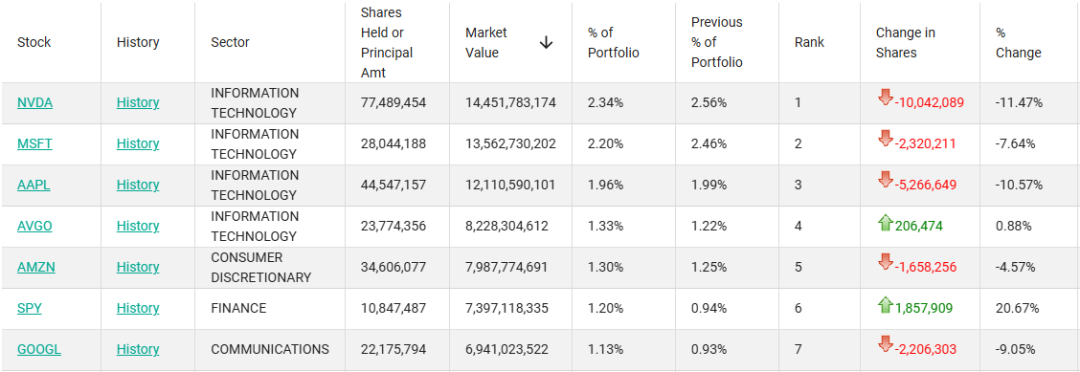
近日,瑞银集团和高盛相继向美国证券交易委员会(SEC)递交了截至2025年12月31日的第四季度持仓报告(13F),报告显示,两家机构均对多只美股 科技巨头进行了大手笔减仓。 具体来看,去年四季度,瑞银集团减持了1004.2万股英伟达,减持幅度达11.47%;减持微软232万股,减持幅度为7.64%;减持苹果526.7万股,减持幅度 为10.57%;减持亚马逊165.8万股,减持幅度为4.57%;减持谷歌220万股,减持幅度为9.05%。此外,瑞银集团对美光科技、甲骨文、AMD、西部数据等 科技股也进行了不同程度减持。 | Stock | History | Sector | Shares Held or | Market | % of | Previous % of | Rank | Change in | ଟିଚ | | --- | --- | --- | --- | --- | --- | --- | --- | --- | --- | | | | | Principal | > Value | Portfolio | Portfolio | | Shares | Change | | | | | Am ...

英伟达将租赁由38亿美元垃圾债券融资建设的数据中心
Xin Lang Cai Jing· 2026-02-12 22:40
格隆汇2月13日|英伟达预计将租赁一座利用38亿美元垃圾债券融资建造的数据中心。此举进一步推升 了围绕人工智能基础设施的借贷热潮。据知情人士透露,由资产管理公司Tract Capital支持的实体将发 行债务,为内华达州斯托里县一座200兆瓦的数据中心及变电站的部分建设费用提供资金。由于需求旺 盛,该债券发行规模在周四下午增加了1.5亿美元。知情人士补充称,目前的定价讨论预计收益率在6% 左右。 ...
Amazon, Microsoft, and Alphabet Stocks Plummet on AI Investments. These 3 Stocks Are Set to Win.
Yahoo Finance· 2026-02-12 22:25
Core Viewpoint - The market reacted negatively to the stock prices of major hyperscalers like Alphabet, Microsoft, and Amazon due to concerns over excessive spending on artificial intelligence (AI), despite their strong earnings reports [1] Group 1: Company Spending Plans - Alphabet plans to increase its AI spending to $180 billion in 2026, up from $91 billion in 2025 [7] - Microsoft spent $37.5 billion in the fiscal second quarter, an increase from $34.9 billion in the first quarter, and aims to boost total AI capacity by over 80% in the next two years [7] - Amazon's AI spending is projected to reach $200 billion in 2026, up from $125 billion last year [7] Group 2: Beneficiaries of AI Spending - Taiwan Semiconductor Manufacturing (TSMC) is positioned to benefit significantly from the AI spending surge, as it manufactures specialized chips for major tech companies involved in AI [3][4] - TSMC's capital expenditures (Capex) are expected to rise from $41 billion in 2025 to approximately $54 billion this year, indicating a strong growth outlook [4] - Nvidia, as a leading provider of graphics processing units (GPUs), is set to maintain substantial growth due to increased demand for powerful chips and integrated solutions from hyperscalers [6]
