
TRIP.COM(TCOM)

Search documents
大和:微升携程集团-S(09961)目标价至750港元 次季盈利胜市场预期
Zhi Tong Cai Jing· 2025-08-29 08:25
Core Viewpoint - Daiwa has raised the target price for Trip.com Group Ltd (09961) to HKD 750, following a second-quarter profit that exceeded market expectations by 8% due to higher-than-expected revenue from accommodation and other services [1] Group 1: Financial Performance - The second-quarter profit surpassed market expectations by 8% [1] - Revenue from accommodation and other services was higher than anticipated [1] Group 2: Future Outlook - For the third quarter, Daiwa expects revenue and operating profit margins to meet current market expectations, with potential for upward movement in operating profit margins due to lower-than-expected marketing expenses [1] - The company is expected to complete its investment in international business this year, with operating profit margins likely to rebound next year [1] Group 3: Share Buyback and Valuation - Trip.com Group announced a new share buyback plan worth USD 5 billion [1] - Daiwa has increased the target price from HKD 745 to HKD 750, corresponding to a projected price-to-earnings ratio of 25 times, while reiterating a "buy" rating [1]

大行评级|花旗:上调携程目标价至85美元 上调2025至27年盈测
Ge Long Hui· 2025-08-29 07:38
Core Viewpoint - Citigroup's research report indicates that Trip.com exceeded expectations in its second-quarter performance, with resilient domestic revenue growth anticipated for the second half of the year [1] Group 1: Financial Performance - Citigroup expects Trip.com's domestic revenue growth to remain robust, with a significant number of room nights still being booked [1] - The strong momentum of Trip.com is likely to continue into the third quarter [1] Group 2: Earnings Forecast and Target Price - The earnings estimates for Trip.com for the years 2025 to 2027 have been raised by 2%, 2%, and 3% respectively [1] - The target price for Trip.com has been increased from $78 to $85, maintaining a "Buy" rating [1]
携程集团-S(09961):利润略超预期,新增回购提振市场信心
CMS· 2025-08-29 05:05
Investment Rating - The report maintains a "Strong Buy" rating for the company [3][7]. Core Views - The company's Q2 2025 financial results slightly exceeded expectations, with revenue of 14.83 billion yuan, representing a year-on-year growth of 16.2%, and a NON-GAAP net profit of 5.01 billion yuan, up 0.5% [1][7]. - Domestic travel demand has steadily released since Q2 2025, and the inbound and international business continues to show high growth, supported by optimized marketing expenses and effective personnel cost control [1][7]. - The new large share buyback authorization has effectively boosted market confidence, and the outbound and international business is expected to be a core growth driver in the long term [1][7]. Financial Performance Summary - For the fiscal year 2023, the company is projected to achieve a main revenue of 44.51 billion yuan, with a year-on-year growth of 122% [2][9]. - The net profit attributable to shareholders is expected to reach 9.92 billion yuan, reflecting a significant year-on-year increase of 632% [2][9]. - The adjusted EPS for 2025 is estimated at 27.35 yuan, with a PE ratio of 18.5 [2][10]. Business Segment Performance - Revenue from accommodation bookings, transportation tickets, vacation travel, business travel management, and other services for Q2 2025 was 6.23 billion, 5.40 billion, 1.08 billion, 690 million, and 1.47 billion yuan respectively, with year-on-year changes of +21.2%, +10.8%, +5.3%, +9.3%, and +31.0% [7]. - The overall gross margin for the period was 81.0%, a slight decrease of 0.9 percentage points, primarily due to the increasing proportion of lower-margin international business [7]. Market Outlook - The report indicates that the outbound and international business is expected to continue driving growth, with international OTA platform bookings increasing by over 60% year-on-year and inbound tourism bookings more than doubling [1][7]. - The company has approved a new share buyback plan with a total repurchase scale not exceeding 5 billion USD, which, along with dividends, is expected to provide continuous investment returns to shareholders [1][7].
携程集团-S午前涨超5%,股价刷新年内新高!公司二季度业绩超预期,净利润48.46亿,同比增加26.43%
Ge Long Hui· 2025-08-29 04:50
Core Insights - Ctrip Group's stock price increased over 5%, reaching a new high of 584.5 HKD, with a current price of 580.5 HKD and a trading volume of 1.241 billion HKD [2] Financial Performance - For Q2 2025, Ctrip reported a net revenue of 14.843 billion RMB, a year-on-year increase of 16.22% [2] - The net profit attributable to Ctrip Group was 4.846 billion RMB, reflecting a year-on-year growth of 26.43% [2] Business Growth - The company's international business segments showed strong growth, with total bookings on the international OTA platform increasing by over 60% year-on-year [2] - Inbound tourism bookings more than doubled, with a year-on-year growth exceeding 100% [2] - Outbound hotel and flight bookings surpassed 120% of the levels seen in the same period in 2019, prior to the pandemic [2] Market Position and Valuation - According to CMB International, the Q2 performance exceeded expectations, with hotel business growth surpassing forecasts and market share continuing to increase [2] - The target price for Ctrip has been raised from 591 HKD/76 USD to 653 HKD/84 USD, based on a 20x P/E ratio for 2026, while maintaining a "buy" rating [2] - The firm anticipates a 15% year-on-year revenue growth for Q3, with hotel revenue expected to grow by 18%, driven by increased overnight stays and expanding market share in mainland China [2]

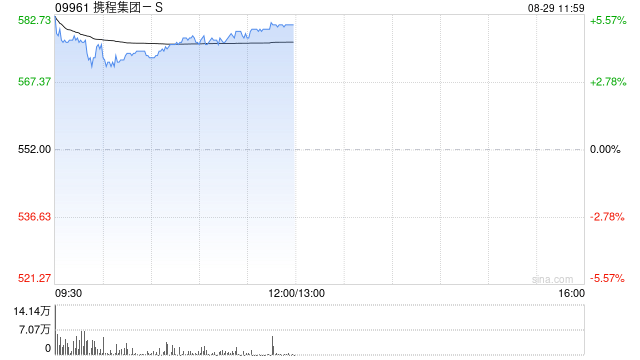
携程集团-S再涨超5% 股价刷新年内新高 公司二季度业绩超预期
Zhi Tong Cai Jing· 2025-08-29 04:04
Core Viewpoint - Ctrip Group's stock price has increased over 5%, reaching a new high of 584.5 HKD, following the release of its Q2 2025 earnings report, which showed strong growth across various business segments [1] Financial Performance - Ctrip Group reported a net revenue of 14.843 billion RMB for Q2 2025, representing a year-on-year increase of 16.22% [1] - The net profit attributable to Ctrip Group Limited was 4.846 billion RMB, reflecting a year-on-year growth of 26.43% [1] Business Segments Growth - The international OTA platform's total bookings increased by over 60% year-on-year [1] - Inbound tourism bookings saw a remarkable growth of over 100% year-on-year [1] - Outbound hotel and flight bookings have surpassed 120% of the levels seen in the same period before the pandemic in 2019 [1] Market Position and Valuation - According to CMB International, the Q2 performance exceeded expectations, with hotel business growth surpassing forecasts and market share continuing to rise [1] - The target price for Ctrip has been raised from 591 HKD/76 USD to 653 HKD/84 USD, based on a 20x P/E ratio for 2026, while maintaining a "buy" rating [1] - The firm anticipates a 15% year-on-year revenue growth and an 18% increase in hotel revenue for Q3, driven primarily by an increase in room nights [1]
港股异动 | 携程集团-S(09961)再涨超5% 股价刷新年内新高 公司二季度业绩超预期
智通财经网· 2025-08-29 03:55
Group 1 - Ctrip Group's stock price increased over 5%, reaching a new high of 584.5 HKD, with a current price of 580.5 HKD and a trading volume of 1.227 billion HKD [1] - For Q2 2025, Ctrip reported a net revenue of 14.843 billion RMB, a year-on-year increase of 16.22%, and a net profit attributable to Ctrip of 4.846 billion RMB, up 26.43% year-on-year [1] - The company's international business segments showed strong growth, with total bookings on the international OTA platform increasing over 60% year-on-year, inbound tourism bookings more than doubling, and outbound hotel and flight bookings exceeding 120% of pre-pandemic levels [1] Group 2 - According to CMB International, Ctrip's Q2 performance exceeded expectations, with hotel business growth surpassing forecasts and market share continuing to rise [1] - The target price for Ctrip was raised from 591 HKD/76 USD to 653 HKD/84 USD based on a 20x P/E ratio for 2026, while maintaining a buy rating [1] - The firm anticipates a 15% year-on-year revenue growth and an 18% increase in hotel revenue for Q3, driven by increased room nights and expanding market share in mainland China [1]
中金:维持携程集团-S跑赢行业评级 上调目标价至588.5港元
Zhi Tong Cai Jing· 2025-08-29 03:52
Group 1 - The core viewpoint of the report is that Ctrip Group's revenue expectations for 2025 and 2026 are maintained, with an 8% increase in the 2025 non-GAAP net profit forecast to 17.7 billion yuan, and the 2026 non-GAAP net profit forecast remaining at 18.9 billion yuan [1] - The company reported a 16% year-on-year increase in revenue for Q2 2025, reaching 14.9 billion yuan, which exceeded market expectations by 1%, primarily due to better-than-expected accommodation revenue [2] - The company achieved a non-GAAP net profit of 5 billion yuan in Q2 2025, surpassing market expectations by 15%, attributed to controlled marketing expenses and higher-than-expected government subsidies [2] Group 2 - Domestic hotel booking revenue for Q2 2025 was 6.2 billion yuan, a 21% year-on-year increase, exceeding market expectations by 3%, driven by higher hotel booking volumes [3] - The company expects a low double-digit year-on-year growth in domestic hotel night volumes for Q3 2025, despite a generally weak performance in the industry during the summer [3] - The company’s outbound travel bookings for Q2 2025 recovered to over 120% of 2019 levels, continuing to outperform the industry’s flight recovery rate of 84% [4] Group 3 - The international OTA booking volume increased by over 60% in Q2, with Trip.com’s revenue share rising to 14%, and inbound travel bookings more than doubling [5] - Despite increased hotel price subsidies from international competitors in Thailand and South Korea, Trip.com maintained over 70% growth in hotel revenue, indicating effective execution of its differentiated strategy [5] - The company is expected to maintain over 50% year-on-year growth in Q3 2025, supported by continued investment in the Asia-Pacific region and expansion in the Middle East [5]
中金:维持携程集团-S(09961)跑赢行业评级 上调目标价至588.5港元
智通财经网· 2025-08-29 03:49
Core Viewpoint - Company maintains revenue expectations for 2025 and 2026, with an 8% increase in 2025 non-GAAP net profit forecast to 17.7 billion yuan, and a maintained forecast of 18.9 billion yuan for 2026 [1] Group 1: Financial Performance - In Q2 2025, company reported a 16% increase in revenue to 14.9 billion yuan, exceeding market expectations by 1%, driven by better-than-expected accommodation revenue [2] - Non-GAAP net profit for Q2 2025 was 5 billion yuan, with a net profit margin of 34%, surpassing market expectations by 15% due to controlled marketing expenses and higher-than-expected government subsidies [2] - The company completed its previously announced $400 million shareholder return plan ahead of schedule and approved a new buyback plan of up to $5 billion in August 2025 [2] Group 2: Domestic Hotel Performance - In Q2 2025, domestic hotel accommodation revenue reached 6.2 billion yuan, a 21% year-on-year increase, exceeding market expectations by 3% due to higher hotel booking volumes [3] - Despite a lackluster industry performance during the summer, the company outperformed the market in night stays, with expectations of low double-digit year-on-year growth in domestic hotel night stays for Q3 2025 [3] Group 3: International Travel Performance - In Q2 2025, company’s outbound flight and hotel bookings recovered to over 120% of 2019 levels, continuing to outperform the industry’s recovery rate of 84% [4] - The company anticipates a slight slowdown in year-on-year growth for outbound revenue due to high base effects from last year's summer travel [4] Group 4: Competitive Landscape - In Q2, international OTA booking volume increased by over 60%, with Trip.com’s revenue share rising to 14% [5] - Despite increased hotel price subsidies from international competitors in Thailand and South Korea, the overall market remains fragmented, and Trip.com’s differentiated strategy has effectively maintained over 70% growth in hotel revenue [5] - The company is also expanding in the Middle East, with expectations of maintaining over 50% year-on-year growth for Trip.com in Q3 2025 [5]
招银国际每日投资策略-20250829
Zhao Yin Guo Ji· 2025-08-29 03:35
Group 1: Semiconductor Industry - AI infrastructure investment continues to rise, with Nvidia's outlook indicating strong demand [2] - Nvidia reported Q2 FY2026 revenue of $46.7 billion, a year-on-year increase of 56% and a quarter-on-quarter increase of 6%, exceeding Bloomberg consensus estimates [2] - The company's Q2 net profit reached $25.8 billion, reflecting a year-on-year growth of 52% and a quarter-on-quarter growth of 30% [2] Group 2: Ctrip (携程) - Ctrip's Q2 FY2025 revenue was RMB 14.9 billion, a year-on-year increase of 16%, surpassing both internal and market expectations [9] - The non-GAAP operating profit was RMB 4.7 billion, exceeding expectations by 7% and 9% due to better-than-expected operational leverage [9] - The company is expected to maintain resilient growth in travel demand, supported by strong supply chain capabilities and customer service [9] Group 3: SenseTime (商汤科技) - SenseTime reported H1 FY2025 revenue of RMB 2.36 billion, a year-on-year increase of 36%, exceeding expectations by 6% [10] - The adjusted net loss narrowed by 50% to RMB 1.16 billion, driven by operational leverage and organizational adjustments [10] - The company anticipates a 25% year-on-year revenue growth in H2 FY2025, supported by strong demand for AI computing and applications [10] Group 4: Anta Sports (安踏) - Anta's retail sales trends showed a mixed performance, with the main brand experiencing weaker growth while other brands like Descente and Kolon continued to perform strongly [24][25] - The company adjusted its retail growth targets for FY2025, lowering Anta's from high single digits to mid single digits, while maintaining FILA's at mid single digits [25] - Despite challenges, Anta's operational profit margin is expected to remain between 20%-25% due to strict control over operating expenses [25]


携程集团-S(09961):2季度业绩超预期,内地营销投放效率提升趋势将持续
BOCOM International· 2025-08-29 02:49
Investment Rating - The report maintains a "Buy" rating for the company, with an updated target price of HKD 653, representing a potential upside of 18.3% from the current price of HKD 552 [2][11]. Core Insights - The company's Q2 performance exceeded expectations, driven by better-than-expected growth in hotel business and an increase in market share. The trend of improving marketing efficiency in mainland China is expected to continue. Despite increased competition in overseas markets, the impact on overall profitability is manageable. The valuation has been rolled forward to 2026, with a target price adjustment based on a 20x P/E ratio for 2026 [2][6]. Financial Performance Summary - For Q2 2025, total revenue reached RMB 14.864 billion, a year-on-year increase of 16%, slightly above market expectations. The hotel segment grew by 21%, transportation by 11%, and vacation services by 5% [6][7]. - The adjusted net profit for Q2 was RMB 4.846 billion, showing a year-on-year increase of 13% [8][14]. - The company expects Q3 revenue to grow by 15%, driven by an 18% increase in hotel bookings, with continued expansion in market share in mainland China [6][8]. Earnings Forecast Changes - Revenue forecasts for 2025E, 2026E, and 2027E are RMB 61.611 billion, RMB 69.659 billion, and RMB 78.590 billion, respectively, with growth rates of 15.4%, 13.1%, and 12.8% [5][14]. - Adjusted operating profit for 2025E is projected at RMB 17.981 billion, with a margin of 29.2% [5][14]. - The adjusted net profit for 2025E is expected to be RMB 17.974 billion, with a net profit margin of 29.2% [5][14]. Market Position and Competitive Landscape - The company is well-positioned in the competitive landscape of the mainland China market, benefiting from effective marketing strategies and a strong recovery in travel demand [2][6]. - The recovery in outbound travel bookings has surpassed pre-pandemic levels, indicating robust growth potential [6][7].