
TRIP.COM(TCOM)

Search documents
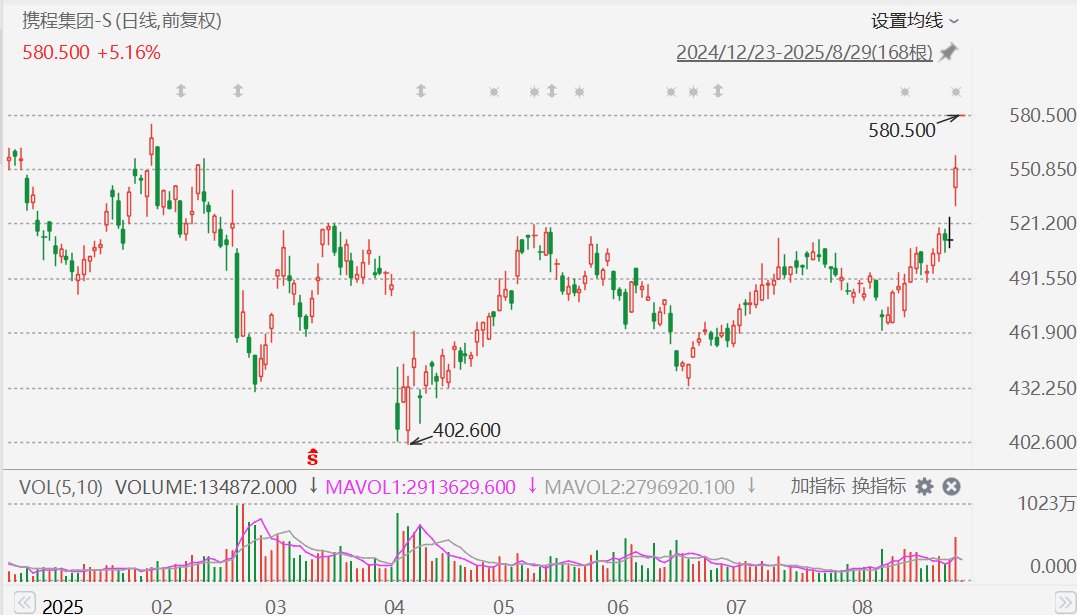
港股异动丨携程集团高开超5%,绩后2连升,创年内新高
Ge Long Hui· 2025-08-29 02:15
Core Viewpoint - Ctrip Group's stock price has reached a new high following strong earnings results, reflecting positive market sentiment and robust financial performance [1] Financial Performance - For the second quarter of 2025, the company reported a net profit attributable to shareholders of 9.123 billion yuan, an increase of 12.01% year-on-year, with basic earnings per share of 13.82 yuan [1] - Total revenue for the same quarter was 28.714 billion yuan, representing a year-on-year growth of 16.21% [1] - For the quarter ending June 30, the net profit attributable to shareholders was 4.846 billion yuan, up 26.43% year-on-year, with basic earnings per share of 7.34 yuan [1] - Revenue for this quarter was 14.864 billion yuan, showing a year-on-year increase of 16.23%, exceeding expectations [1] - Adjusted EBITDA for the quarter was 4.9 billion yuan, compared to 4.4 billion yuan in the same period last year, with an adjusted EBITDA margin of 33%, down 2 percentage points year-on-year [1] Stock Buyback Plan - The board of directors approved a new share repurchase plan, authorizing the company to buy back up to 5 billion USD (approximately 39 billion HKD) of its issued ordinary shares and/or American Depositary Shares (ADS) [1]

交银国际每日晨报-20250829
BOCOM International· 2025-08-29 01:55
Group 1: Nvidia - Blackwell Ultra deployment is progressing smoothly, but uncertainties remain regarding exports to China. FY2Q26 revenue reached $46.7 billion with a Non-GAAP gross margin of 72.7%, exceeding previous guidance [1] - Management has guided a median revenue of $54 billion for FY3Q26, with a median gross margin of 73.5%. If export conditions allow, an additional $2-5 billion in revenue could be generated [1] - The launch of Spectrum XGS and the progress of the Rubin series are in line with expectations, although the performance improvement of Rubin over Blackwell remains unclear [2] Group 2: Ctrip Group - Ctrip's Q2 performance exceeded expectations, with hotel business growth surpassing forecasts and market share continuing to rise. The company is well-positioned in the current competitive environment [3] - The target price has been adjusted to HKD 653 based on a 20x 2026 P/E ratio, maintaining a buy rating [3] Group 3: Meituan - Meituan's Q2 revenue grew by 12% year-on-year, but adjusted net profit fell by 89% due to irrational competition in the industry [6] - The company expects intensified competition in the third quarter, leading to a projected loss exceeding 15 billion yuan [6][7] Group 4: China National Heavy Duty Truck Group - The company reported a 4.2% year-on-year increase in revenue for the first half of 2025, with net profit rising by 4.0%, aligning with market expectations [8] - The target price is set at HKD 26.45, reflecting a 9.9x P/E ratio for 2025, with a focus on structural recovery in heavy truck sales [8] Group 5: China Innovationpay - The company experienced a 31.7% year-on-year revenue increase in the first half of 2025, with a significant 109.7% growth in energy storage battery revenue [9] - The target price is maintained at HKD 24.77, anticipating a concentrated release of delivery capacity in 2026 [10] Group 6: Innovent Biologics - The company reported a 37% year-on-year increase in product revenue for the first half of 2025, with net profit reaching 830 million yuan [11] - The target price has been raised to HKD 105, reflecting a positive outlook on the company's pipeline and commercialization efforts [12] Group 7: China Life Insurance - The company saw a 6.9% year-on-year increase in net profit for the first half of 2025, although growth has slowed compared to Q1 [18] - The target price has been adjusted to HKD 30, based on a 1.4x P/B ratio for 2025 [19] Group 8: China Pacific Insurance - The company achieved a 32.3% year-on-year increase in net profit for the first half of 2025, with strong performance in both underwriting and investment [20] - The target price has been raised to HKD 24, reflecting improved profitability and competitive advantages [21] Group 9: Yasheng Group - The company reported an 8.3% year-on-year decline in total revenue for the first half of 2025, primarily due to proactive business scale adjustments [22] - The target price is maintained at HKD 3.20, with expectations for recovery as margins stabilize [23] Group 10: XinAo Energy - The company experienced a slight 1% year-on-year decline in core profit for the first half of 2025, meeting market expectations [24] - The target price has been adjusted to HKD 73.66, reflecting a cautious outlook on retail gas demand [24]

港股开盘 | 恒指高开0.39% 携程集团(09961)涨超5%
智通财经网· 2025-08-29 01:40
Group 1 - The Hang Seng Index opened up by 0.39%, while the Hang Seng Tech Index rose by 0.8% [1] - Ctrip Group increased by over 5%, Li Auto by nearly 3%, Kuaishou by over 2%, and JD Group and Baidu Group by over 1% [1] Group 2 - According to Zhongtai International, despite the significant recovery in Hong Kong stock valuations, the Hang Seng Index's forecast PE has returned to nearly the 80th percentile of the past seven years [1] - External monetary policy uncertainty has decreased, and internal policies such as "anti-involution" and industrial support are being strengthened, providing upward support for the market [1] Group 3 - Guotai Junan Securities noted that a rate cut in September seems likely, and given that Hong Kong stocks have significantly retraced their excess relative to A-shares this year, the A-H market will return to a unified starting line [1] - Changes in corporate earnings will drive the performance differences between the two markets [1] Group 4 - Huatai Securities released a strategy report indicating that foreign capital still has room to increase allocation to the Chinese market [1] - Factors include the likelihood of easier overseas liquidity due to monetary policy and financial regulation, as well as an improvement in domestic fundamentals and potential appreciation of the RMB [1] - However, it is noted that the importance of foreign capital in the Hong Kong stock market has decreased, with southbound capital accounting for over 40% of trading in interconnectivity stocks, making the sustainability of future inflows a key focus [1]
Q2归母净利增长26.43% 携程(TCOM.US)大涨超12%
Zhi Tong Cai Jing· 2025-08-28 22:59
Core Insights - Ctrip (TCOM.US) experienced a significant increase of over 12%, closing at $73.22 [1] - The company reported a net revenue of RMB 14.843 billion for Q2, representing a year-on-year increase of 16.22% [1] - Ctrip's net profit attributable to the company was RMB 4.846 billion, reflecting a year-on-year growth of 26.43% [1] Business Performance - The international business segments of Ctrip continued to show strong growth in Q2 [1] - Total bookings on the international OTA platform increased by over 60% year-on-year [1] - Bookings for inbound tourism surged by over 100% year-on-year [1] - Bookings for outbound hotels and flights have surpassed 120% of the levels seen in the same period before the pandemic in 2019 [1]
隔夜美股 | 标普500指数站上6500点 英伟达(NVDA.US)跌0.79%
智通财经网· 2025-08-28 22:20
Market Performance - The three major U.S. indices closed higher, with the S&P 500 index surpassing 6500 points, setting a new closing record [1] - The Dow Jones increased by 71.67 points (0.16%) to 45636.9 points, while the Nasdaq rose by 115.02 points (0.53%) to 21705.16 points [1] - In European markets, the DAX30 index fell by 14.66 points (0.06%), while the CAC40 index rose by 18.67 points (0.24%) [1] Commodity Prices - Light crude oil futures for October delivery rose by $0.45 to $64.60 per barrel (0.70% increase) [2] - Gold prices increased by 0.57%, reaching $3416.55 per ounce, while COMEX gold futures rose by 0.83% to $3477.20 per ounce [3] - LME copper prices rose by $62 to $9818 per ton, while LME nickel increased by $132 to $15263 per ton [3] Macro News - The IMF's Gita Gopinath warned about the fragile state of the global bond market, highlighting rising debt levels [4] - The U.S. government has begun publishing GDP data on public blockchains, indicating a recognition of blockchain technology [4] Corporate News - Boeing is seeking EU approval for a $4.7 billion buyback of Spirit AeroSystems, with a decision expected by September 30 [6] - Trump threatened to impose significant tariffs on countries that implement digital taxes, following discussions with Meta Platforms' CEO Mark Zuckerberg [6]



美股异动 | Q2归母净利增长26.43% 携程(TCOM.US)大涨超12%
智通财经网· 2025-08-28 15:48
Core Viewpoint - Ctrip (TCOM.US) experienced a significant increase of over 12%, reaching $73.22, driven by strong financial performance in Q2 [1] Financial Performance - The company's net revenue for Q2 was RMB 14.843 billion, representing a year-on-year increase of 16.22% [1] - Ctrip's net profit attributable to the company was RMB 4.846 billion, showing a year-on-year growth of 26.43% [1] Business Growth - The international business segments continued to show robust growth, with total bookings on the international OTA platform increasing by over 60% year-on-year [1] - Inbound travel bookings saw a remarkable growth of over 100% year-on-year [1] - Bookings for outbound hotels and flights have surpassed 120% of the levels seen in the same period before the pandemic in 2019 [1]
携程集团20250828
2025-08-28 15:15
Trip.com Group Q2 2025 Earnings Call Summary Company Overview - **Company**: Trip.com Group - **Date**: Q2 2025 Earnings Call Key Financial Metrics - **Net Revenue**: 14.8 billion RMB, up 16% year-over-year and 7% quarter-over-quarter [2][16] - **Adjusted EBITDA**: 4.9 billion RMB, an increase of 10% year-over-year [3][16] - **Cash Reserves**: 94.1 billion RMB (approximately 13.1 billion USD) [2][16] - **Stock Buyback Plan**: New plan approved for up to 5 billion USD [4][16] Industry Insights - **Inbound Tourism Growth**: Inbound tourism bookings increased by over 100% year-over-year, driven by strong demand from South Korea and Southeast Asia [2][3] - **Market Potential**: Inbound tourism currently accounts for less than 0.5% of China's GDP, significantly lower than the 1-2% typical in developed markets [4][25] - **International Bookings**: International bookings grew by over 60% year-over-year, with significant contributions from the Asia-Pacific region [2][8] Strategic Initiatives - **Technological Innovations**: Upgraded itinerary planner providing personalized experiences; AI system supports 26 languages for customer service [2][6] - **Support for SMEs**: Trip.com is providing digital tools and marketing support to local hotels, restaurants, and travel agencies [7] - **Sustainability Efforts**: Encouraged over 100 million travelers to choose eco-friendly travel options, with a doubling of low-carbon hotel participation to 3,000 [15] Market Trends - **Domestic Tourism Resilience**: Domestic tourism shows strong growth, with flight volumes recovering to 80-90% of pre-pandemic levels [18] - **Pricing Trends**: Domestic hotel and flight prices are under pressure, but overall demand remains robust [19] - **Consumer Sentiment**: Increased interest in experiential products like concerts and festivals, particularly among younger travelers [20] Target Demographics - **Silver Generation**: The "Old Friends Club" targeting retirees aged 50-55 saw user numbers and GMV grow over 100% [13][23] - **Youth Engagement**: Travel and entertainment products are attracting younger travelers, with revenue growth exceeding 100% [14][24] Competitive Landscape - **Service Quality Focus**: Emphasis on providing high-quality service rather than solely competing on price [22] - **Direct Airline Sales**: Introduction of direct airline sales functionality expected to enhance customer satisfaction and sales opportunities [21] Future Outlook - **Global Expansion**: Continued focus on global market expansion and enhancing service quality to meet evolving customer demands [17][22] - **Marketing Strategy**: Investment in high-performance marketing strategies to drive long-term growth, particularly in the APEC region [27] Conclusion Trip.com Group is positioned for significant growth in the inbound tourism market, leveraging technology and strategic partnerships while focusing on sustainability and customer experience to enhance its competitive edge in the travel industry.
美股三大指数小幅高开,英伟达绩后涨超1%
Ge Long Hui· 2025-08-28 13:38
Market Overview - The U.S. stock market opened with slight gains, with the Nasdaq up 0.18%, S&P 500 up 0.1%, and Dow Jones up 0.09% [1] Company Highlights - Nvidia saw a rise of over 1%, reporting a Q2 revenue growth of 56% year-over-year, exceeding expectations, and approved an additional $60 billion for stock buybacks [1] - Cloud software company Snowflake increased by 10.5%, with Q2 revenue growth of 32% year-over-year, also raising its full-year revenue forecast [1] - Trip.com Group (携程) rose by 8.2%, reporting a Q2 net profit attributable to shareholders that grew over 26% year-over-year, and announced a stock buyback of up to $5 billion [1] - CrowdStrike experienced a decline of over 2%, reporting a Q2 net loss of $77.7 million, reversing from profit, and provided slightly lower revenue guidance for the upcoming quarter [1]


纳指三大指数小幅高开,英伟达绩后涨超1%
Ge Long Hui A P P· 2025-08-28 13:37
Group 1 - The U.S. stock market opened with slight gains, with the Nasdaq up 0.18%, S&P 500 up 0.1%, and Dow Jones up 0.09% [1] - Nvidia's Q2 revenue increased by 56% year-over-year, exceeding expectations, and the company approved an additional $60 billion for stock buybacks [1] - Snowflake's Q2 revenue grew by 32% year-over-year, surpassing expectations, and the company raised its full-year revenue forecast [1] - Trip.com saw an 8.2% increase in stock price, with Q2 net profit attributable to shareholders rising over 26%, and announced a stock buyback of up to $5 billion [1] - CrowdStrike experienced a decline of over 2%, reporting a net loss of $77.7 million in Q2, transitioning from profit to loss, with revenue guidance slightly below market expectations [1]
TRIP.COM(TCOM) - 2025 Q2 - Quarterly Report
2025-08-28 10:08
RECONCILIATION BETWEEN U.S. GAAP AND IFRS ACCOUNTING STANDARDS The unaudited consolidated statements of income for the six month ended June 30, 2025 and the unaudited consolidated balance sheet as of June 30, 2025 (collectively, the "Unaudited Interim Financial Statements") of Trip.com Group Limited (the "Company"), its subsidiaries, the variable interest entities, and the subsidiaries of the variable interest entities (collectively, the "Group") are prepared in accordance with the accounting principles gen ...