Toyota(TM)

Search documents
丰田该对特朗普说谢谢
3 6 Ke· 2025-07-25 11:12
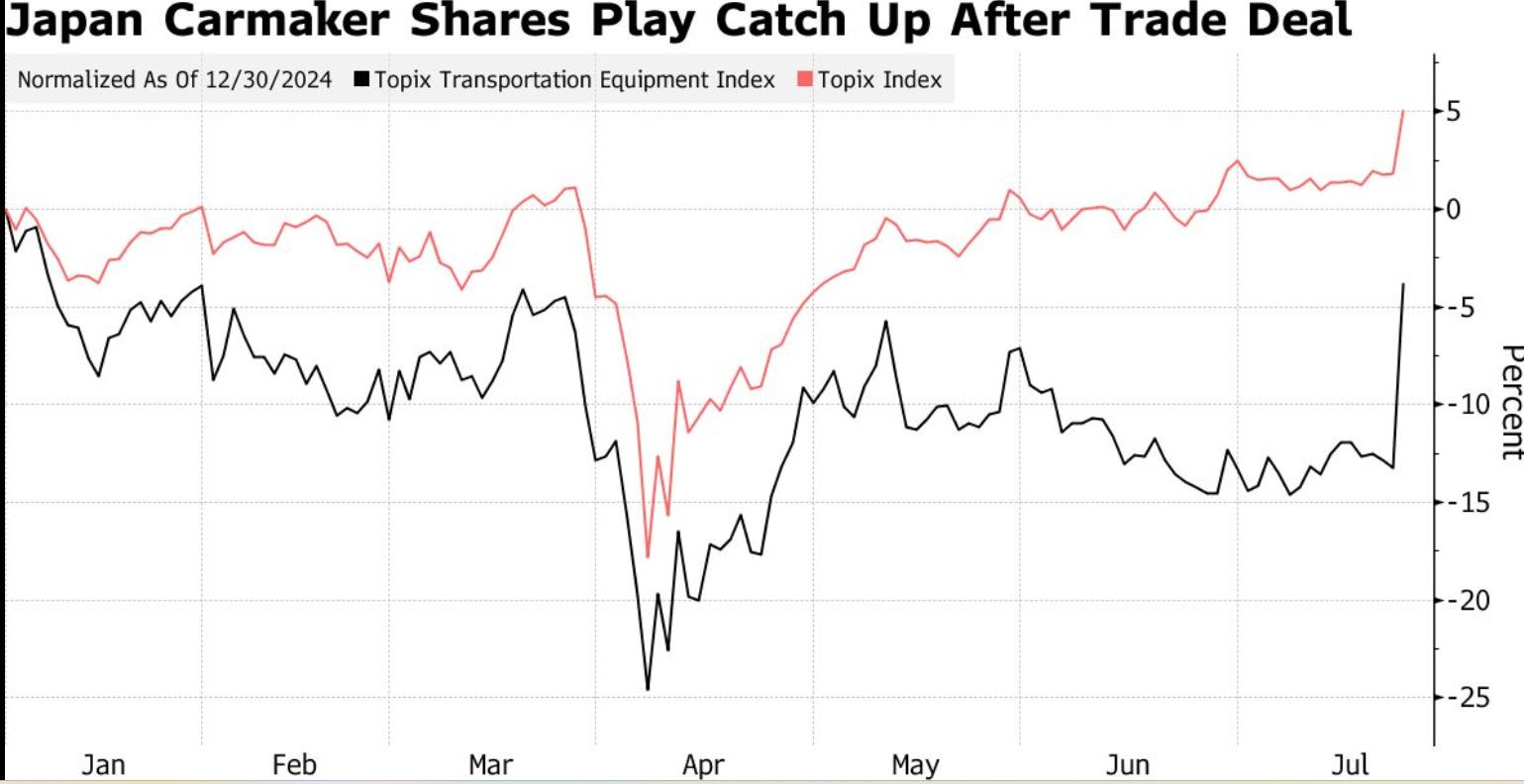
Core Viewpoint - The Japanese automotive industry is experiencing a significant turnaround following the announcement of a reduction in U.S. tariffs on imported cars from 25% to 15%, leading to a surge in stock prices for major Japanese automakers [1][2]. Group 1: Tariff Changes and Market Impact - The reduction in tariffs has resulted in substantial stock price increases for Japanese automakers, with Toyota's stock rising nearly 12% and Mazda's soaring over 17% [1]. - The automotive sector is crucial for Japan's economy, accounting for 28.3% of Japan's total exports to the U.S. in 2024, highlighting its importance as a "national pillar" amidst competition from electronics and home appliances [1]. - Prior to the tariff reduction, Japanese car exports to the U.S. had seen a dramatic decline, with June exports plummeting by 26.7% year-over-year [1]. Group 2: Political and Economic Context - The Japanese government, under Prime Minister Kishida, is facing political challenges, having failed to secure a majority in the upper house of parliament for the first time since its establishment in 1955 [2]. - The negotiations leading to the tariff reduction were complex, with Japan agreeing to invest $550 billion in the U.S. and open its markets to American agricultural products in exchange for the tariff cut [2]. Group 3: Industry Strategies and Challenges - Toyota has been focusing on hybrid vehicles, achieving global sales of 1.187 million units for its RAV4 model, surpassing Tesla's Model Y [3]. - The company is also expanding its production capacity in the U.S., with plans to increase local production and component sourcing to mitigate tariff impacts [7]. - Despite the tariff reduction, Toyota anticipates a significant drop in North American operating profit margins, projecting a decline from 12% in 2024 to 0.6% [5]. Group 4: Long-term Industry Trends - The Japanese automotive industry has been slow to adapt to the shift towards electric vehicles, with a historical focus on hydrogen fuel technology, which has not kept pace with global trends [12]. - Japanese automakers have lost significant market share in China, dropping from 23.1% in 2020 to an estimated 13.7% in 2024, while Chinese brands have gained a dominant position [13]. - The competitive landscape is shifting, with Japanese automakers facing increased pressure from both domestic and international competitors, particularly in the electric vehicle segment [16].

日美达成关税协议,日本车企高兴得起来吗?
日经中文网· 2025-07-25 05:41
Core Viewpoint - The U.S. is reducing the automobile import tariff on Japan from 27.5% to 15%, which will alleviate the financial burden on Japanese automakers, but the high tariff level is expected to become a new norm, limiting future growth prospects [1][3][7]. Group 1: Tariff Changes and Financial Impact - The estimated reduction in tariff burden for seven major Japanese automakers is approximately 1.6 trillion yen, down from a previous burden of 3.47 trillion yen [3][4]. - The impact on operating profit for these companies is expected to decrease from a 47% drop to a 25% drop for the fiscal year 2024 [3]. - Specific companies like Toyota, Honda, and Nissan will see their tariff impacts reduced significantly, with Toyota's burden decreasing from 1.6 trillion yen to 872 billion yen [3][4]. Group 2: Supply Chain Adjustments - Japanese automakers are restructuring their supply chains to mitigate tariff impacts, with Honda moving production of its Civic hybrid model to the U.S. [4]. - Mitsubishi Motors, lacking a factory in the U.S., will rely on Nissan for OEM production [4]. Group 3: Local Market Reactions - U.S. manufacturers, including General Motors, express dissatisfaction with the tariff reduction, arguing it undermines American industry and labor [6]. - Despite the tariff reduction, Japanese automakers may still face challenges in maintaining competitiveness without price increases, as inflation continues to affect consumer behavior [7]. Group 4: Long-term Outlook - The high tariff rate of 15% is expected to persist, leading to a need for Japanese automakers to enhance local production and operational efficiency [7][8]. - The competitive landscape in the U.S. market is becoming increasingly challenging for Japanese automakers, especially with the rise of domestic manufacturers in China [8].



丰田本土300万产量商业模式面临考验
日经中文网· 2025-07-25 05:41
Core Viewpoint - Toyota's strength is attributed to its continuous cost reduction efforts and the collaborative work of thousands of employees in the vicinity of Toyota City, emphasizing the importance of maintaining domestic production of 3 million vehicles in Japan to sustain related employment and the environment [1][4]. Group 1: Economic Impact and Export Dynamics - Toyota's president, Akio Toyoda, highlighted the importance of exports in generating foreign currency to support energy imports, with Japan importing approximately 25 trillion yen in energy annually, while automotive and parts exports amount to about 20 trillion yen [2]. - In the fiscal year ending March 2025, Toyota produced 3.23 million vehicles domestically, with nearly two-thirds exported to overseas markets, particularly the U.S. [2]. - Japan's market accounts for 66% of Toyota's operating profit, surpassing the North American market despite lower sales volume [2]. Group 2: Taxation and Employment Considerations - Export companies like Toyota benefit from a significant "consumption tax refund," estimated at around 700 billion yen annually, which constitutes about 15% of Toyota's operating profit for the fiscal year 2024 [3]. - The U.S. tariff policies pose a challenge to Toyota's traditional principles, as a reduction in exports could disrupt Japan's domestic ecosystem, with the automotive industry's production inducement effect being as high as 2.74 [3]. Group 3: Regional Relationships and Production Strategy - Toyota's commitment to maintaining domestic production of 3 million vehicles is rooted in its long-standing relationships with local communities and the collaborative efforts of nearby workers [4]. - The population of Toyota City has tripled since the establishment of the first "Crown" model in 1959, contrasting with the decline of Detroit, which faced economic challenges due to a lack of export focus [5]. Group 4: Future Challenges and Brand Value - Future challenges for Toyota include potential obstacles to its 3 million vehicle target, such as Japan's declining population and the shift towards local production and consumption in various countries [6]. - Despite these challenges, Japanese cars maintain high brand value, with Toyota's average new car price in the U.S. estimated at around $40,000, indicating strong market positioning [6].

破防咯,美日达成贸易协议,日本接受15%税率,开放汽车大米市场
Sou Hu Cai Jing· 2025-07-25 05:23
Group 1 - The signing of the $550 billion US-Japan trade agreement is seen as a significant event that could have a domino effect on the global economy, with potential implications for international trade dynamics [1][3] - The agreement includes a reduction of tariffs on Japanese goods from a threatened 25% to 15%, but this still poses challenges for Japanese industries, particularly the automotive sector [4][5] - Japanese farmers are expected to face severe competition from US agricultural products, particularly rice, which could capture 10% of the Japanese market due to price advantages [5][9] Group 2 - The agreement has been compared to the 1985 Plaza Accord, indicating a potential crisis of industrial hollowing out in Japan as a result of capital outflow and market opening [7] - The deal's implications extend beyond the US and Japan, as it may embolden the US to impose further tariffs on other developed economies, affecting global trade relations [9][11] - The Japanese government faces significant political pressure and public discontent as a result of the agreement, with farmers planning protests against the perceived negative impacts on their livelihoods [11]

乘用车专题:复盘丰田高端化,对比亚迪有何启示
Tianfeng Securities· 2025-07-25 04:13
Industry Rating - The industry investment rating is maintained at "Outperform" [1] Core Insights - The report analyzes Toyota's high-end transformation and draws parallels to BYD's potential strategies for success in the high-end market [2][3][4] Summary by Sections Toyota's High-End Transformation - Toyota successfully established the Lexus brand in North America by leveraging low trade barriers and addressing the demand for economical luxury cars during the oil crisis [2] - The company invested $1 billion in R&D for the LS 400, producing 450 prototypes and conducting extensive testing to ensure performance and reliability [2][5] - Marketing strategies included the iconic "highball glass" advertisement, which effectively positioned Lexus as a high-quality luxury brand [2][21] - Lexus quickly became the best-selling imported luxury car in North America, surpassing competitors like BMW and Mercedes-Benz within two years of launch [2][24] BYD's High-End Strategy - BYD aims to replicate Toyota's successful high-end strategy by launching the Tengshi Z9 GT in Western Europe, avoiding saturated SUV markets [3][4] - The company plans to establish over 1,000 service outlets across multiple countries within two years, focusing on smart driving features to address local consumer needs [3] - In the domestic market, BYD is introducing models like the Fangchengbao Titanium 7 and Yangwang U8L, which align with consumer preferences for aesthetics and space [3][55] Market Performance Expectations - If BYD can successfully implement a strategy similar to Toyota's, it could capture a significant share of the European luxury market and improve its domestic market position against established brands [4] - The report highlights the importance of technological innovation and differentiated marketing in achieving high-end brand recognition [4][34]

X @Bloomberg
Bloomberg· 2025-07-24 09:04
US-Japan Trade Relations - Toyota hopes for improved ties between the US and Japan [1] - Toyota calls for further tariff reductions between the US and Japan [1] Company Perspective - Toyota's statement comes a day after President Trump announced a trade pact with Japan [1]
异动盘点0724| 造纸板块、券商股,博彩走强;美股核电大涨,文远知行涨超5%,德州仪器跌超13%
贝塔投资智库· 2025-07-24 04:24
Group 1: Market Trends - The paper sector continues its upward trend, with Nine Dragons Paper (02689.HK) leading the gains, rising over 9% after announcing a price increase of 30 CNY/ton for corrugated paper and recycled cardboard starting August 1, reflecting an optimized supply-demand structure in the industry [1] - The brokerage sector saw collective strength, with major Chinese brokerages like Dongfang Securities (03958.HK) and Zhongyuan Securities (01375.HK) rising over 6% and 5% respectively, indicating significant capital inflow into the sector [1] - Urban Beauty (02298.HK) surged 13% as its online GMV for 2024 is projected to reach 1.57 billion CNY, marking a 100% year-on-year increase, showcasing the effectiveness of its new retail transformation [1] Group 2: Company Performance - China Duty Free Group (01880.HK) soared 17% after Macquarie's report indicated a narrowing year-on-year revenue decline from 19.5% in Q4 2024 to 11% in Q1 2025, with a stable gross margin of 33% [1] - The gaming sector experienced a broad increase, with companies like 澳博控股 (00880.HK) and 银河娱乐 (00027.HK) rising over 3%, supported by UBS data showing Macau's average daily gaming revenue in July at 683 million MOP, a 14% year-on-year increase [2] - 雍禾医疗 (02279.HK) saw a 13% increase after forming a strategic partnership with Meituan Health to build a medical-grade hair health service system [2] Group 3: Real Estate and Financing - The Hong Kong real estate sector collectively strengthened, with Country Garden (02007.HK) leading with nearly a 10% rise, driven by improved financing conditions as indicated by the People's Bank of China's report showing a recovery in real estate loan growth [3] - Meilan Airport (0357.HK) rose 10% as CITIC Securities highlighted the significance of Hainan's trade opening, which is expected to benefit the local tourism industry [3] Group 4: Gold Sector Decline - The gold sector faced pressure, with companies like 潼关黄金 (00340.HK) and 大唐黄金 (08331.HK) dropping over 4%, attributed to a decline in spot gold prices below 3,380 USD/oz, driven by reduced safe-haven appeal due to easing trade tensions [4] Group 5: US Market Highlights - Futu Holdings (FUTU.US) rose 2.82% after announcing a long-term strategic partnership with Huaxia Fund to promote the integration of traditional finance and blockchain technology [5] - Japanese automotive stocks surged, with Toyota (TM.US) and Honda (HMC.US) rising over 13% following news of a trade agreement reducing tariffs on Japanese cars [6] - Nuclear power stocks in the US saw significant gains, with Oklo Inc (OKLO.US) rising 9.21%, reflecting a growing interest in nuclear energy [5]


汽车狂飙,军工与地产退潮! 美日贸易协议改写日本股市输赢榜
智通财经网· 2025-07-24 02:31
Group 1: Trade Agreement Impact - The unexpected US-Japan trade agreement has transformed Japan's stock market dynamics, turning previous losers into winners, particularly benefiting large automotive manufacturers [1][2] - The agreement reduces US tariffs on Japanese cars from 25% to 15%, leading to a significant rebound in the automotive sector, with the Nikkei automotive index soaring by 11% [4] - Japan's government has committed to investing $550 billion in the US, which is expected to benefit machinery manufacturers as automotive companies may expand their investments in the US [5] Group 2: Winners - Automotive manufacturers are the biggest winners from the trade agreement, with major companies like Toyota seeing stock price increases of 14% [4] - Machinery manufacturers, such as Fanuc and Yaskawa, experienced stock price increases of 12% and 11% respectively, due to anticipated benefits from increased investment in the US [5] - Large commercial banks are expected to benefit from rising interest rates and bond yields, with a high probability of the Bank of Japan raising rates by the end of the year [6] Group 3: Losers - Defense-related stocks, previously seen as safe havens, are experiencing significant sell-offs due to rumors surrounding Prime Minister Shigeru Ishiba's potential resignation [7] - Domestic-oriented defensive stocks, such as Ryohin Keikaku and Food & Life, may face substantial selling pressure following the trade agreement [8][9] - Real estate companies are likely to be under pressure due to higher debt levels and potential increases in bond yields, which could negatively impact their fundamentals [10]

Why Toyota Stock Zoomed Nearly 14% Higher on Wednesday
The Motley Fool· 2025-07-23 21:39
Group 1 - The recent trade agreement between Japan and the U.S. significantly reduces tariffs on auto imports from Japan, lowering them from 27.5% to 15% [2][4] - The deal also includes a reduction in tariffs on other Japanese goods from 25% to 15% [2] - Toyota Motor emerged as a major beneficiary of the tariff reduction, with its stock rising nearly 14% in response to the news, outperforming the S&P 500 index's 0.8% increase [1] Group 2 - The auto sector is vital for Japan, accounting for over a quarter of the country's exports to the U.S., with Toyota being a prominent player in this market [5] - Toyota operates 11 manufacturing plants in the U.S., which helps mitigate the impact of tariffs, but it still relies on imports to meet American demand [6] - The trade agreement also includes a commitment from Japan to invest $550 billion in the U.S., which may further benefit the automotive industry [4]

Dow Jones Industrial Average Nears New Highs: Stock Market Today
Kiplinger· 2025-07-23 20:06
Market Overview - The main U.S. equity indexes experienced modest gains, with the Dow Jones Industrial Average increasing by 1.1% to 45,010, the S&P 500 rising by 0.8% to 6,358, and the Nasdaq Composite up by 0.6% to 21,020 [7][8] - The upcoming Federal Reserve meeting is set for July 29-30, during which the latest policy statement will be released [6] Housing Market - The National Association of Realtors reported a decline in housing sales as home prices reached record highs in June, indicating affordability challenges [5] - President Trump criticized Fed Chair Jerome Powell for the slow housing market, attributing it to the refusal to lower interest rates [2] Treasury Yields - The yield on the 10-year U.S. Treasury note increased to 4.388% from 4.336%, while the 2-year note rose to 3.886% from 3.831% [6][7] - The 30-year yield approached the significant 5% level, rising to 4.944% from 4.903% [7] Company Highlights - GE Vernova (GEV) stock surged by 14.6% after reporting second-quarter earnings that exceeded expectations and raising its full-year guidance [10] - Analyst Julien Dumoulin-Smith raised the 12-month target price for GEV from $427 to $565, despite previous concerns about valuation [10] - Among analysts tracked by S&P Global Market Intelligence, 24 rate GEV a Buy, 8 a Hold, and 1 a Sell, with an average 12-month target price of $511.75 [11] Automotive Sector - Japanese automakers Honda Motor (HMC) and Toyota Motor (TM) saw significant gains of 13.1% and 13.7%, respectively, following a tariff deal announced by President Trump [12] - Domestic automakers also benefited, with GM stating it would not raise prices to offset tariff impacts [13] Nuclear Energy Investment - Oklo (OKLO) stock rose by 9.3% after announcing a partnership with Vertiv Holdings (VRT) to develop power and cooling systems for AI data centers [14] - Oklo is focused on developing advanced fission power plants to provide clean energy at scale [15]