Tesla(TSLA)

Search documents
2 AI Stocks to Buy Before They Soar to $20 Trillion, According to Wall Street Experts
The Motley Fool· 2026-01-24 08:40
Core Insights - Nvidia and Tesla are positioned to deliver significant returns for shareholders due to their involvement in the AI revolution [1][2] - Experts predict that the combined market value of Nvidia and Tesla could reach at least $20 trillion in the future [2] Nvidia - Nvidia's GPUs are the industry standard for AI infrastructure, accounting for approximately 85% of AI accelerator sales in 2025, with expectations of maintaining this dominance [4][5] - The company employs a "full-stack" approach to accelerated computing, integrating hardware and software to provide the lowest total cost of ownership for customers [4][5] - Nvidia's data center GPU sales are projected to grow at an annual rate of 36% through 2033, with adjusted earnings expected to increase at 38% annually over the next three years [6][7] - Analyst Beth Kindig predicts Nvidia could reach a market value of $20 trillion by 2030, implying a potential upside of about 340% from its current market value of $4.5 trillion [8] Tesla - Tesla's current market value is $1.5 trillion, with CEO Elon Musk suggesting it could reach $25 trillion, indicating a potential upside of approximately 1,560% [8][10] - Despite losing its status as the global leader in electric vehicle sales, Tesla's investment thesis now focuses on physical AI, including autonomous vehicles and humanoid robots [10][12] - Tesla's full self-driving (FSD) software is set to expand into new markets, with plans for monetization through subscriptions and autonomous ride-sharing services [11] - The robotaxi market is expected to grow at 99% annually through 2033, while humanoid robot sales are projected to increase at 54% annually through 2035 [13] - Musk claims Tesla's expertise in physical AI is unmatched, but the stock's valuation remains challenging due to struggles in the core electric car business and execution risks in new AI ventures [14][15]


新华读报|马斯克称“擎天柱”机器人明年开售
Xin Hua She· 2026-01-24 07:38
0:00 新华社音视频部制作 交付100万台"擎天柱"机器人,是马斯克获得特斯拉股东去年11月批准的十年万亿美元薪酬计划所须满 足的条件之一。 编导:郭琳 《参考消息》1月24日综合法新社、路透社报道《马斯克称"擎天柱"机器人明年开售》。 埃隆·马斯克22日在达沃斯承诺,特斯拉将在2027年底前开始将其人形机器人"擎天柱"投入商业应用。 这是这位世界首富首次参加达沃斯论坛。 ...

100亿台!马斯克惊人“剧透”
Ge Long Hui· 2026-01-24 07:21
Core Insights - The market dynamics are heavily influenced by figures like Trump and Musk, with Musk's announcement about the commercial launch of the Optimus robot by the end of 2027 being a significant focal point [1][3] - Musk predicts that the number of humanoid robots will exceed the human population, potentially reaching 10 billion by 2040, a claim that raises skepticism due to its ambitious nature [1][17] Group 1: Technological Development and Challenges - The commercial path for Optimus is aggressive, with a target price of $20,000 and a timeline that includes completing complex industrial tasks by the end of 2026 [3] - Current capabilities of the Optimus V3 include enhanced freedom of movement and improved AI architecture, but it still faces significant challenges in achieving full functionality for household tasks [4][6] - Key technical issues include dynamic error control not meeting civilian standards, insufficient tactile sensing precision, and limited battery life, which hinder its practical application in home environments [6][10] Group 2: Cost and Production Challenges - The current cost of an Optimus unit is approximately $55,000, and despite efforts to reduce costs through design optimizations, achieving the target price of $20,000 by 2027 seems unlikely [10][13] - Production scalability is constrained by the cost structure, with estimates suggesting that only 500,000 units could be produced by the end of 2027, leading to a necessary price adjustment to maintain profit margins [12][13] Group 3: Market Demand and Future Projections - The projected demand for humanoid robots is significantly lower than Musk's forecast, with estimates suggesting a maximum of 4 billion units needed across various sectors by 2040 [25][29] - The potential for self-replicating robots could lead to exponential growth in production, but this is contingent on achieving high precision in operations and full automation in manufacturing [19][22] Group 4: Economic and Social Implications - The widespread adoption of humanoid robots is expected to reshape industries, potentially surpassing the automotive and semiconductor sectors in market size [31] - The introduction of low-cost robots could lead to deflationary pressures in the economy, raising concerns about the implications for human labor and income distribution [34]

特斯拉官宣保险补贴方案
新华网财经· 2026-01-24 06:37
Group 1 - Tesla announced a new subsidy plan on January 24, which includes an 8000 yuan insurance subsidy for Model 3 rear-wheel drive, long-range rear-wheel drive, and long-range all-wheel drive models [1] - The introduction of this subsidy is expected to enhance the competitiveness of Tesla's Model 3 in the market [1] Group 2 - The article highlights the ongoing developments in the electric vehicle industry, particularly focusing on Tesla's strategies to boost sales through financial incentives [1] - The impact of such subsidies on consumer purchasing behavior and overall market dynamics is also implied, suggesting a potential increase in demand for Tesla vehicles [1]

马斯克:明年年底实现Optimus规模化销售
Robot猎场备忘录· 2026-01-24 05:17
Core Viewpoint - Elon Musk is actively promoting the Optimus V3 humanoid robot, which is expected to start public sales by the end of 2026 and achieve mass market availability by the end of 2027, with projections of billions of humanoid robots fulfilling caregiving tasks [2][3]. Market Sentiment and Stock Performance - The market sentiment around T-chain stocks has been positive but lacks substantial catalysts, with a notable increase in stock prices following Musk's tweets about Optimus V3 [4]. - Key stocks in the T-chain have shown significant gains, particularly those involved in North American communications, with some reaching daily price limits [4][8]. Production Capacity Guidance - A Tier supplier indicated production capacity for Optimus V3, forecasting a weekly output of 2 units in January, 10 units in February, 2000 units by June, and 10,000 units by early next year [7]. - This production guidance aligns with recent communications from core suppliers, confirming the supply chain's readiness for mass production [7]. T-Chain Developments - Several T-chain companies are progressing towards production agreements and have entered the RFQ (Request for Quotation) phase, indicating a focus on securing contracts and finalizing production details [8]. - The T-chain is experiencing a "narrowing circle" effect, where capital is increasingly concentrated on a smaller number of core companies as they approach critical production milestones [8]. Upcoming Events - The Tesla Q4 earnings call is anticipated to provide further insights into the Optimus V3 and its impact on T-chain stocks, with expectations of a significant market reaction [4][10].


特斯拉Robotaxi启动全无人运营,但被网友吐槽是“障眼法”
3 6 Ke· 2026-01-24 04:14
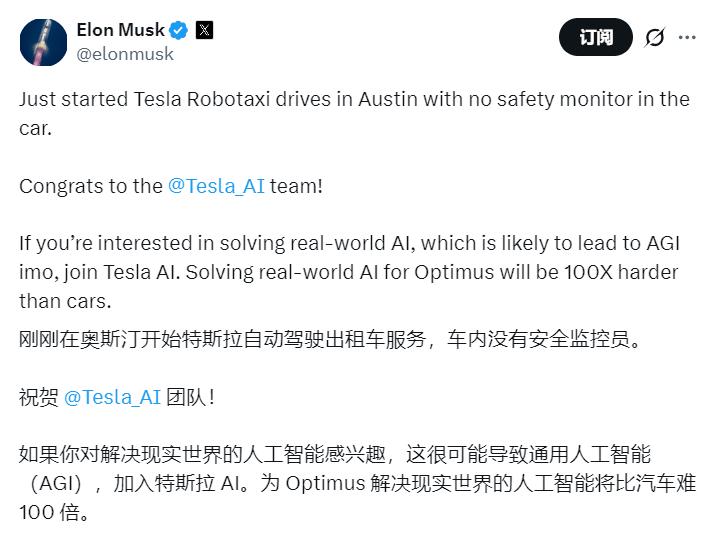
杰西卡 发自 副驾寺智能车参考 | 公众号 AI4Auto Robotaxi上路不到一年就去安全员,还得是"马斯克"速度。 马哥本人宣布了这一里程碑时刻——特斯拉Robotaxi,开始启动全无人服务。 外界一片欢呼雀跃,特斯拉的股价登时上涨了4%,更有网友已经火速体验上了。 不过,也有人从乘车视频里发现了端倪: 这车真是完全无人的吗?怎么看起来像是"障眼法"啊? 特斯拉Robotaxi宣布去安全员 马斯克在社交媒体平台X上发帖,宣布了新进展: 特斯拉Robotaxi,刚刚在奥斯汀启动全无人服务,车内没有安全监控员。祝贺特斯拉AI团队! 刚好赶上最近急着下场抢人、组建「AI人才狙击队」,马斯克还顺带打了一波招聘广告,邀请对"解决现实世界AI问题"感兴趣的工程师前来加入。 关注自动驾驶的朋友都知道,对于一家做Robotaxi的公司而言,去掉安全员的公开运营,无疑是一个重要的里程碑时刻。 而特斯拉的特别之处在于,其每一阶段的部署都非常迅速: 去年6月,特斯拉才首次在美国奥斯汀推出Robotaxi服务,起初只面向少数乘客开放;逐步面向公众运营、扩大运营范围到加州湾后,去年12月才开始进 行去安全员测试……到现在开放全 ...
速递 | 木头姐2026最新报告炸裂解读:马斯克押注的13个赛道全拆解
未可知人工智能研究院· 2026-01-24 04:08
Group 1: AI Infrastructure - The global data center investment is projected to grow from $500 billion in 2025 to $1.4 trillion by 2030, marking a 29% annual growth rate [4][5] - NVIDIA's dominance in the GPU market, currently at 85% market share and 75% gross margin, is expected to decline as competitors like AMD and custom ASIC chip manufacturers gain market share [8][14] - The AI infrastructure ecosystem includes not only NVIDIA but also ASIC manufacturers, AMD, TSMC, and cloud service providers like AWS and Microsoft Azure, which are experiencing growth rates surpassing traditional cloud computing [14] Group 2: Consumer Revolution - AI Agents are transforming the $8 trillion online shopping market, reducing the time to complete a purchase from 60 minutes in the 1980s to just 90 seconds today [15][21] - By 2030, AI Agents are expected to facilitate online consumption exceeding $8 trillion, a twelvefold increase from the current 2% market share [21] - Brands must adapt to AI recommendations by optimizing product data for AI systems and shifting marketing strategies away from traditional advertising [21] Group 3: Robotics Breakthrough - Home robots could contribute $6.2 trillion to the U.S. GDP, equating to a 20% increase, if they penetrate 80% of American households [26][27] - The cost of a household robot is projected to be around $20,000, making it feasible for widespread adoption [27] - Companies like Tesla and Boston Dynamics are leading the charge in redefining labor through robotics [27] Group 4: Autonomous Driving - The Robotaxi market is projected to exceed $10 trillion by the early 2030s, with profit margins significantly higher than traditional vehicles [29][31] - Autonomous driving is expected to convert non-market activities into GDP-generating activities, enhancing economic growth [31] - Key players in this space include Tesla, Waymo, and Baidu, with opportunities in the supply chain for components like lidar and AI chips [32] Group 5: Underestimated Sectors - The AI-driven biopharmaceutical revolution is expected to reduce drug development costs by 100 times, with new therapies moving from labs to commercialization by 2025 [36][40] - Energy bottlenecks pose a challenge for AI growth, but solutions like distributed energy sources and advancements in storage technology are emerging [40] - Companies in the energy sector should consider transitioning to the intersection of data centers and energy solutions [40]
刚刚!突发重磅利好!
天天基金网· 2026-01-24 02:45
Core Viewpoint - The commercial aerospace sector is experiencing significant positive catalysts, including advancements in reusable rocket technology by SpaceX and supportive policies for the commercial aerospace industry in China, particularly in Jiuquan [2][8]. Group 1: SpaceX Developments - Elon Musk announced at the Davos World Economic Forum that SpaceX aims to achieve complete reusability of rockets through its "Starship" technology this year, potentially reducing the cost of space access by 99%, bringing it below $100 per pound [2][4]. - SpaceX has demonstrated the capability to capture rocket boosters on the launch pad but has yet to attempt the reuse of the Starship spacecraft [5]. - Musk also discussed plans to launch solar-powered AI satellites in the coming years, highlighting that solar panels in space could be five times more efficient than those on Earth due to the absence of atmospheric interference [5][6]. Group 2: Jiuquan's Commercial Aerospace Plan - The Jiuquan Municipal Government has released the "Jiuquan Commercial Aerospace Industry Development Plan (2026-2035)," which outlines the strategic positioning of Jiuquan as a national commercial aerospace launch base and research facility [8][9]. - The plan emphasizes the construction of a "China Jiuquan Commercial Aerospace Port" and identifies key principles such as park support, cluster development, and system innovation [8][9]. - It aims to establish a multi-faceted industrial structure, including seven key sectors: launch and testing, rocket manufacturing, satellite manufacturing, aerospace data applications, and more, with specific actions to ensure effective implementation [9][10]. Group 3: Market Potential and Investment Opportunities - According to China Galaxy Securities, the commercial aerospace industry is entering a golden era driven by both demand and supply, with significant market potential projected for the satellite industry [10]. - By 2030, the ground equipment manufacturing and satellite services sectors are expected to contribute approximately 1.3 trillion yuan in related output value, indicating a broad market space across the entire industry chain [9][10]. - Investment focus areas include satellite launches and manufacturing, particularly in the upstream supply chain and materials that support satellite mass production [10].
脑机接口大消息!马斯克,突发!
Sou Hu Cai Jing· 2026-01-24 02:43
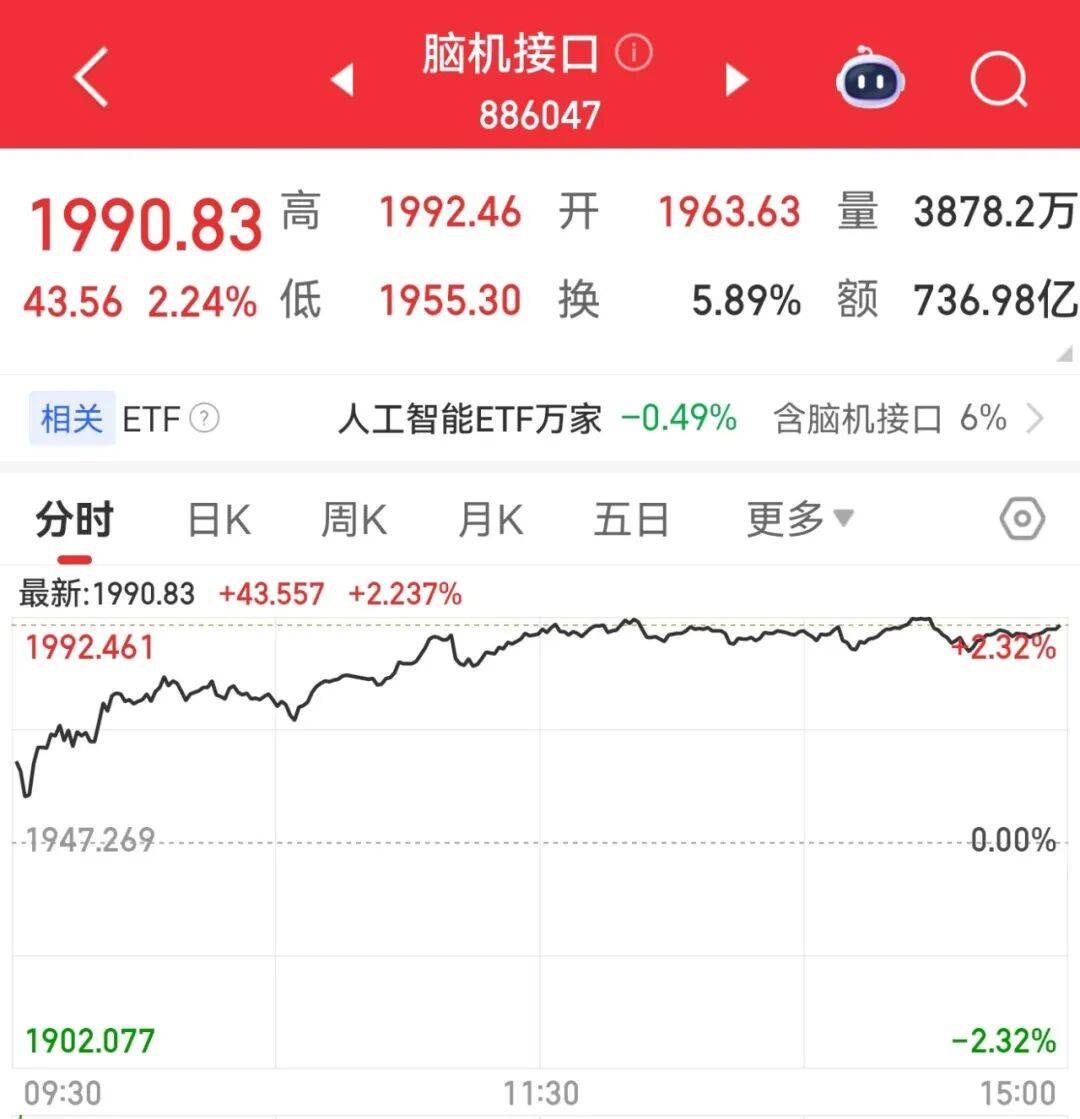
Group 1: Brain-Computer Interface Industry - The A-share brain-computer interface sector experienced a significant increase, closing up over 2% on January 23 [1] - Neuralink, founded by Elon Musk, plans to achieve large-scale production of brain-computer interface devices by 2026, with a highly automated surgical process [3] - Strong Brain Technology, one of the "Six Little Dragons" in Hangzhou, has submitted a confidential IPO application and recently completed approximately 2 billion yuan in financing, marking the second-largest financing event in the brain-computer interface field globally, after Neuralink [4] Group 2: Market Potential and Applications - The brain-computer interface technology has vast application prospects in various fields, including healthcare, consumer electronics, and military aerospace [5] - The technology is expected to transition from experimental stages to pilot applications, with significant industry value anticipated during the "14th Five-Year Plan" period [4] - The integration of brain-computer interfaces into high-end manufacturing and strategic industries is seen as a foundational technology supporting new industrialization [5] Group 3: Neuroplasticity and Cognitive Health - Joyce Shaffer, a respected expert in neuroplasticity and brain health, emphasizes that neuroplasticity is a lifelong ability, allowing for cognitive rejuvenation regardless of age [9][10] - The book "How to Unlock the Reverse-Aging Brain" provides a systematic approach to reducing brain degeneration across the lifespan, highlighting the importance of active intervention in neural networks [11] - The LANDS model introduced in the book integrates five scientifically validated areas—Love, Aerobics, Neurobics, Diet, and Sleep—into a comprehensive lifestyle system for brain health [11]