
UBS(UBS)

Search documents
瑞银再次上调黄金目标价:政治或经济动荡中将涨至5400美元
Jin Shi Shu Ju· 2025-12-30 05:19
Group 1 - UBS has raised its gold price target for the first three quarters of 2026 to $5,000 per ounce, with a potential increase to $5,400 if political or economic turmoil related to the U.S. midterm elections escalates [1] - The bank expects gold prices to decline to $4,800 per ounce by the end of 2026, up from a previous forecast of $4,300 [1] - UBS attributes the steady growth in gold demand in 2026 to low real yields, global economic concerns, and uncertainties surrounding U.S. domestic policies [1] Group 2 - UBS has frequently adjusted its gold price expectations within a short period, indicating that recent price corrections are temporary and driven by geopolitical or market risks [2] - The bank highlighted strong and accelerating buying trends from central banks and individual investors, with a reported net purchase of 634 tons of gold by central banks in the first three quarters of 2025 [2] - Global gold ETFs have seen significant increases in holdings, with an addition of 222 tons in the third quarter, supporting UBS's outlook on demand [2] Group 3 - Demand for gold bars and coins has exceeded 300 tons for the fourth consecutive quarter, indicating enhanced investor interest [3] - Despite a 19% year-over-year decline in global gold jewelry demand, markets like China and India are showing seasonal recovery signs [3] - UBS recommends investors to allocate a moderate single-digit percentage of their portfolios to gold, viewing it as an effective hedge and diversification tool [3] Group 4 - UBS reiterated that factors such as interest rate cuts, declining bond yields, fiscal challenges, and political instability in the U.S. will continue to drive gold demand in the coming months [4] - The bank's chief investment office noted that gold prices have recovered some losses from late October, with demand growth expected to support further price increases [4]


瑞银再次上调黄金目标价:政治或经济动荡中将涨至5400美元!
Jin Shi Shu Ju· 2025-12-30 05:11
Core Viewpoint - UBS has raised its gold price target for the first three quarters of 2026 to $5,000 per ounce, with a potential increase to $5,400 if political or economic turmoil related to the U.S. midterm elections escalates [1][2]. Group 1: Price Predictions - UBS expects gold prices to decline to $4,800 per ounce by the end of 2026, an increase of $500 from the previous forecast of $4,300 [1]. - The bank has frequently adjusted its gold price expectations, indicating a temporary market correction rather than a fundamental decline in demand [3]. Group 2: Demand Drivers - Factors supporting gold demand include low real yields, global economic concerns, and uncertainties surrounding U.S. domestic policies, particularly related to midterm elections and increasing fiscal pressures [1]. - Central banks and individual investors have shown strong and accelerating buying trends, with global central bank net purchases reaching 634 tons in the first three quarters of 2025, significantly above pre-2022 averages [3]. Group 3: Investment Trends - Demand for gold bars and coins has exceeded 300 tons for the fourth consecutive quarter, indicating strengthened investor interest [4]. - Despite a 19% year-on-year decline in global gold jewelry demand, markets like China and India are showing seasonal recovery signs [4]. - UBS recommends investors maintain a moderate single-digit percentage allocation to gold in their portfolios, viewing it as an effective hedge and diversification tool [4]. Group 4: Future Outlook - UBS anticipates that interest rate cuts, declining bond yields, fiscal challenges, and political instability in the U.S. will continue to boost gold demand in the coming months [5].
2026年大宗商品逻辑生变!瑞银:“情绪博弈”消退,主导权将回归基本面
智通财经网· 2025-12-30 04:25
Group 1: Precious Metals - The precious metals market has become the focal point of the commodities sector, driven by expectations of a Federal Reserve interest rate cut in 2026 and geopolitical risk, with gold prices reaching an all-time high [2] - Silver's performance has been particularly remarkable, with a monthly increase marking the highest since 1979 and a weekly rise of 16.08% [2] - UBS warns that the current price surge is largely driven by sentiment and technical momentum rather than solid industry fundamentals, indicating potential risks of price corrections as market sentiment normalizes [2] Group 2: Energy and Industrial Metals - The energy market shows mixed performance, with crude oil prices fluctuating around $58 per barrel, supported by U.S. actions against Venezuela and the Russia-Ukraine conflict, but limited by ample global supply [3] - UBS notes that the U.S. government prefers to manage inflation through low oil prices, establishing an "invisible floor" for oil prices around $50 [3] - Industrial metals maintain high prices due to optimistic market sentiment regarding Chinese economic support policies and strong demand for metals like copper and aluminum in green energy infrastructure [3] Group 3: Agriculture and Livestock - The agricultural market faces challenges from South American weather and geopolitical risks, with corn and soybean prices initially boosted by Chinese demand but later pressured by farmer sell-offs [4] - A significant warning is that soybean export volumes have decreased by nearly one-third year-on-year, which may impact planting decisions for 2026 [4] - In contrast, corn exports have surged by 30% year-on-year, becoming a highlight in the grain market, while the livestock sector remains robust for cattle but faces downward pressure in the pork market due to increased supply [4] Group 4: Market Outlook for 2026 - As the new year approaches, market liquidity is expected to remain low, amplifying the impact of any sudden news on prices [5] - The current commodities market is at a critical juncture, with precious metals experiencing strong momentum but facing valuation challenges, while energy and agricultural markets seek new pricing logic amid policy interventions and climate variability [5] - For 2026, a return to fundamentals may replace the current sentiment-driven trading, becoming the main theme in the market [5]
金价暴跌200美元、银价跌超10%!全球大行爆仓传闻疯传,瑞银紧急否认
Sou Hu Cai Jing· 2025-12-30 04:14
有网友转发了一篇博客文章,里面明确提到,一家在白银期货市场重仓空头头寸的系统重要性银行,因为没能按时缴上追加保证金,在美国东部时间周日 凌晨,已经被强制平仓,还被正式接管了。 紧接着瑞银就赶紧出来紧急澄清,明确否认这件事,说爆仓的不是自己。 12月29号深夜,眼看就快到半夜12点,国际贵金属市场突然迎来大跳水,直接把一众做多的投资者给集体套牢,损失惨重。 伦敦现货黄金更是跌得离谱,一口气狂跌205美元,价格直接跌到4320美元上下,跌幅高达4.52%;白银跌得比黄金还狠,单日跌幅直接超10%,堪称闪 崩;不光这俩,铂金、钯金也没能扛住,盘中跌幅一度冲到15%左右,整个贵金属市场一片惨淡。 | CONTRACT THE 100 ST 100 W | | A the promote of the property of the | 11125 | | --- | --- | --- | --- | | | 国际贵全展 | | | | 名称 | 现价 | 涨跌 | 温跌幅 | | 伦敦全现 | 4327.400 | -205.010 | -4.52% | | 伦敦银现 | 71.139 | -8.190 | =10 ...
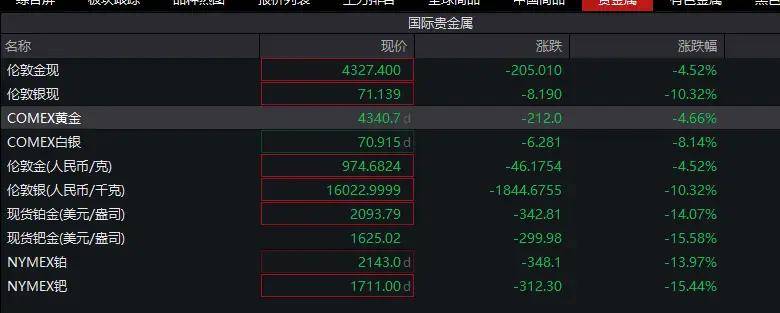
贵金属多头遭集体坑杀:金价暴跌200美元,银价跌幅超10%
Mei Ri Jing Ji Xin Wen· 2025-12-29 22:52
| | 国际贵金属 | | | | --- | --- | --- | --- | | 名称 | 现价 | 涨跌 | 涨跌幅 | | 伦敦全现 | 4327.400 | -205.010 | -4.52% | | 伦敦铜现 | 71.139 | -8.190 | -10.32% | | COMEX黄金 | 4340.7 d | -212.0 | -4.66% | | COMEX自银 | 70.915 d | -6.281 | -8.14% | | 伦敦金(人民币/克) | 974.6824 | -46.1754 | -4.52% | | 伦敦银(人民币/千克) | 16022.9999 | -1844.6755 | -10.32% | | 现货铂金(美元/盎司) | 2093.79 | -342.81 | -14.07% | | 现货把金(美元/盎司) | 1625.02 | -299.98 | -15.58% | | NYMEX铂 | 2143.0 d | -348.1 | -13.97% | | NYMEX | 1711.00 d | -312.30 | -15.44% | 行情剧烈波动之际,社交平台上流 ...
外资做多中国股市新动向曝光
21世纪经济报道· 2025-12-29 14:15
Core Viewpoint - Major foreign institutions are optimistic about the Chinese stock market for 2026, shifting their focus from "valuation repair" in 2025 to "profit growth" in 2026, driven by accelerating corporate earnings, macro policy support, and RMB appreciation [1][3][6]. Group 1: Market Outlook - Goldman Sachs predicts a 38% increase in the Chinese stock market by the end of 2027, with corporate earnings expected to grow by 14% in 2026 and 12% in 2027 [4]. - UBS sets the target for the Hang Seng Tech Index at 7100 points and the MSCI China Index at 100 points by the end of 2026, indicating significant upside potential [4]. - HSBC forecasts the Shanghai Composite Index to reach 4500 points, the CSI 300 Index to 5400 points, and the Shenzhen Component Index to 16000 points by the end of 2026, driven primarily by corporate earnings growth rather than valuation increases [4]. Group 2: Investment Opportunities - Foreign institutions highlight structured investment opportunities, particularly in technology innovation, with a focus on artificial intelligence, semiconductors, and high-end manufacturing [8]. - Traditional industries are also attracting foreign investment, with expectations of valuation recovery and improved profitability in state-owned enterprises [8]. - The influx of foreign capital is primarily directed towards high-quality assets, including technology leaders and high-dividend stocks, emphasizing value investment [8][10]. Group 3: Foreign Capital Inflow - Since the beginning of 2025, global investments in Chinese assets have seen a net inflow of $83.1 billion, with the technology sector receiving the most significant inflow of $9.5 billion [10]. - Active foreign capital is expected to return to the Chinese market, with institutions like Citigroup maintaining an "overweight" rating on China while reducing exposure to other Asian emerging markets [10][12]. - The anticipated return of active funds is supported by improving corporate fundamentals, a weaker dollar, and the attractiveness of RMB assets [11][12].


外资持续看好中国资产:盈利接棒估值,科技仍是主线
2 1 Shi Ji Jing Ji Bao Dao· 2025-12-29 14:08
Core Viewpoint - Foreign institutions are optimistic about the Chinese stock market for 2026, shifting their focus from "valuation repair" in 2025 to "profit growth" in 2026, driven by accelerating corporate earnings, macro policy support, and RMB appreciation [1][2][5]. Investment Trends - As of December 20, 2025, global investment in Chinese assets through ETFs has seen a net inflow of $83.1 billion, with the technology sector receiving the most inflow at $9.5 billion [1][9]. - Active foreign capital is expected to return to the Chinese stock market, with some institutions already increasing their positions in preparation for 2026 [10][12]. Earnings Forecasts - Goldman Sachs predicts a 38% increase in the Chinese stock market by the end of 2027, with corporate earnings expected to grow by 14% in 2026 and 12% in 2027 [3]. - UBS forecasts an increase in the Hang Seng Tech Index target to 7,100 points and the MSCI China Index target to 100 points by the end of 2026, indicating significant upside potential [3]. Valuation Insights - Morgan Stanley and Goldman Sachs believe there is still about a 10% potential for valuation repair in the Chinese stock market, which will support market growth [4][5]. - JPMorgan has upgraded its rating on the Chinese market to "overweight," citing reasonable valuations and light positions among international investors [4]. Sector-Specific Opportunities - The technology sector is highlighted as a core focus for profit growth, with opportunities in artificial intelligence, semiconductors, and high-end manufacturing [6]. - Traditional industries are also attracting foreign investment, with improvements in state-owned enterprise profitability and dividend increases acting as a dual engine for market growth [7][8]. Market Dynamics - The report indicates that the Chinese stock market will enter a new phase dominated by fundamentals, with a focus on structural investment opportunities [2][5]. - The anticipated return of active foreign capital is expected to be driven by improving corporate fundamentals, a weaker dollar, and the attractiveness of RMB assets [12].

瑞银否认因白银保证金上调导致违约
Mei Ri Jing Ji Xin Wen· 2025-12-29 10:13
(文章来源:每日经济新闻) 每经12月29日上海电(记者李玉雯)近日,有传言称有大型银行持有大量白银期货空头,因空头亏损加 之COMEX(纽约商品交易所)上调保证金比率,该行面临保证金违约风险,传言还指向瑞银集团 (UBS)。记者今日就此向瑞银集团求证,对方予以否认,称"不是瑞银"。 ...
瑞银报告:居民收入全面放缓
Xin Lang Cai Jing· 2025-12-29 03:50
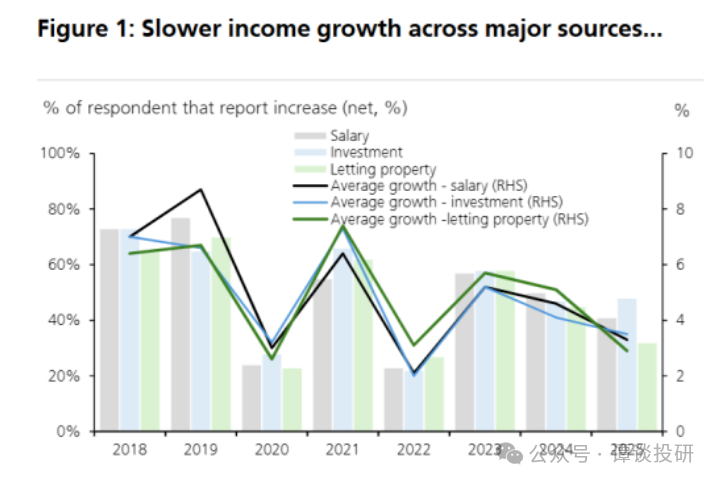
Group 1 - The core finding of UBS's survey of 3,000 Chinese consumers indicates a continued decline in consumer sentiment, primarily driven by falling incomes and asset values leading to a negative wealth effect [1][19] Group 2 - Household income is decreasing, with significant slowdowns in both wage and rental income growth, while investment income has seen a slight increase due to a bullish A-share market [2][20] - Consumers exhibit a pessimistic outlook on their income over the next 12 months, particularly regarding wages and rental income, which diminishes their expectations for future financial improvement [5][23] - The relationship between income decline and consumption is not linear; a decrease in income can lead to a disproportionately larger drop in consumption due to the multiplier effect [5][24] Group 3 - There is an increased willingness to save and a decreased willingness to consume, with savings and investment proportions rising while consumption proportions are falling [6][25] - Consumption trends show a clear divide, with high willingness to spend in essential sectors like education and healthcare, while discretionary spending in clothing and entertainment is declining [9][28] Group 4 - Government subsidies have had a limited impact on stimulating consumption, with monthly increases in spending being minimal, often just a few hundred yuan [12][31] - The effectiveness of subsidies is diminishing due to previous purchases made by willing consumers and tightening fiscal conditions leading to reduced subsidy amounts [12][31] Group 5 - Approximately half of those who sold their homes this year did so at a loss, as average national housing prices have reverted to levels seen in 2015-2016, affecting many recent buyers [15][34] - The expectation of future profits from real estate sales is higher among those who have not yet sold, indicating a tendency to overestimate the value of held assets [15][34] Group 6 - The decline in the real estate market has not redirected funds to other sectors as previously theorized; instead, it has negatively impacted various industries, leading to significant capital evaporation [18][37] - UBS predicts that without substantial stimulus policies, overall consumption growth in China will continue to slow, potentially stabilizing at a modest single-digit growth rate by 2026 [18][37] - For sustainable recovery in consumption, key factors include stabilizing employment, improving the social security system, and maintaining stable housing prices [18][37]
全球经济预测数据库_本周预测变动-Global Economic Forecast Database _UBS forecasts - changes this week
UBS· 2025-12-29 01:04
ab 24 December 2025 Global Research Global Economic Forecast Database UBS forecasts - changes this week Latest global economic forecasts All UBS economic forecasts (>50 indicators for roughly 40 countries/regions) are accessible in Excel through our "Global Forecast Database" which can be found here. For ease of reference, we also circulate the Database tables, on a weekly basis, sorted by Indicator and Region (pg 7-73). A summary can be found on pg 4. Pg 5 shows forecast changes compared to a week ago and ...