
UBS(UBS)

Search documents
全球石油基本面 - 欧佩克 + 将进一步推动-Global Oil Fundamentals_ OPEC+ to push further
2025-09-11 12:11
Summary of Key Points from the Conference Call Industry Overview - **Industry**: Global Oil Market - **Key Players**: OPEC+ members, specifically Saudi Arabia and UAE Core Insights and Arguments 1. **Production Increase**: OPEC+ partners will raise oil production by 137 thousand barrels per day (kb/d) in October, following the unwinding of previous cuts of 2.2 million barrels per day (Mb/d) by the end of September [2][4] 2. **Expected Shortfall**: The actual production increase from the second tranche of cuts is expected to be around 40% of the announced 1.65 Mb/d, compared to a 60% realization for the previous cuts [3] 3. **Major Contributors**: The bulk of the production increase is anticipated to come from Saudi Arabia (500 kb/d) and the UAE (144 kb/d) [3] 4. **Market Surplus**: A significant surplus in the oil market is projected, with estimates of 1.2 Mb/d in 4Q25 and 2.4 Mb/d in 1Q26, potentially rising to ~2.7 Mb/d if production increases continue at the current pace [4] 5. **Price Outlook**: The decision to increase production could lead to Brent crude prices falling below $60 per barrel, with a projected price of $62 per barrel in 4Q25/1Q26 [4] Additional Important Information 1. **Contingent Adjustments**: Any further adjustments to production levels will depend on evolving market conditions, indicating a cautious approach by OPEC+ [2] 2. **Historical Volatility**: Oil prices are noted for their unpredictability due to various political, geological, and economic factors, which could affect supply and demand [15] 3. **Analyst Team**: The report is prepared by a team of analysts from UBS, indicating a collaborative effort in the research [5] This summary encapsulates the essential points discussed in the conference call regarding the oil market dynamics, production strategies of OPEC+, and the anticipated impact on oil prices.

瑞银最新报告:2025 年长期投资该押注哪些方向?这 5 大主题被重点看好
美股研究社· 2025-09-11 07:56
Core Insights - UBS's latest report identifies five key long-term investment themes as the most attractive entry points, emphasizing the importance of understanding both "what to invest in" and "why to invest now" [5][6]. Group 1: Key Long-term Investment Themes - The five long-term investment themes identified are: 1. Digital Consumers 2. Diversity and Equality 3. Enabling Technologies 4. Fintech 5. Identifying the Next Frontier [6][8]. - "Identifying the Next Frontier" is a new entry into the top five, while "Fintech" has improved from fifth place [6]. Group 2: Investment Logic and Rationale - **Digital Consumers**: The younger generation, particularly Gen Z, is reshaping consumption patterns, focusing on shared experiences rather than ownership. AI plays a crucial role in this transformation, making it a top investment theme due to strong quality metrics and robust balance sheets [8]. - **Diversity and Equality**: Regulatory pressures and economic incentives are driving companies to enhance diversity, which is expected to contribute to GDP growth over the next decade. This theme is characterized by reasonable valuations and strong quality scores [10]. - **Enabling Technologies**: The integration of AI and other technologies is projected to create a market worth $2.6 trillion by 2030, with significant growth driven by sectors like AI, AR/VR, and 5G [11]. - **Fintech**: The sector is expected to grow from $310 billion in 2024 to $580 billion by 2030, driven by urbanization, demand from younger demographics, and supportive policies [12]. - **Identifying the Next Frontier**: Emerging markets are anticipated to be the main drivers of global GDP growth, with favorable demographics and productivity advantages [13]. Group 3: Short-term Cautions - **Genetic Therapies and Healthtech**: These themes are currently ranked low due to a lack of positive short-term catalysts and face significant capital constraints. Investors are advised to avoid these areas for the time being [15]. - **Smart Mobility**: This theme has shown improvement in valuation and momentum, making it a potential area for renewed interest [16]. Group 4: Long-term Investment Trends - Three irreversible trends are highlighted: 1. Population growth, with projections indicating an increase from 8.1 billion in 2024 to over 10 billion by 2100, primarily in low- and middle-income countries [19]. 2. Urbanization, with the urban population expected to rise from 55% in 2018 to 68% by 2050 [19]. 3. Aging population, with a significant increase in the proportion of individuals aged 65 and older, particularly in developed countries [19]. Group 5: Recommendations for Investors - Diversification across multiple themes is recommended to mitigate risks [26]. - A long-term investment approach is encouraged, focusing on core drivers like AI and emerging market growth [26]. - Investors should remain vigilant about risks and consider consulting professionals if unfamiliar with specific themes [26].


持续引入境外客户!瑞银期货董事长张家荣最新发声
券商中国· 2025-09-11 07:45
Core Viewpoint - The article highlights the accelerated opening of China's futures market, with significant measures taken by regulators to expand the participation of qualified foreign institutional investors (QFII) in various futures and options products, reaching a total of 104 available products, marking an unprecedented level of openness [1][9]. Group 1: Market Opening and Opportunities - Since 2025, the Chinese futures market has seen three major opening measures, signaling a commitment to sustained expansion and stability despite global uncertainties [1][8]. - UBS Futures, as one of the first foreign-controlled futures companies in China, is actively engaging foreign investors and adapting to the market's opening [2][3]. - The number of futures and options products available for foreign investors has increased to 104, covering nearly 90% of market liquidity, which has sparked significant interest among international investors [9][11]. Group 2: Business Innovations and Strategies - UBS Futures has implemented advanced risk management frameworks and trading solutions, providing customized services to clients [6]. - The company has been proactive in introducing QFII and RQFII to domestic commodity futures trading, becoming the first to support QFII participation in this market [6][9]. - UBS Futures aims to leverage its global resources to enhance the understanding of the Chinese market among international clients, emphasizing the importance of collaboration and openness in the future [7][10]. Group 3: Future Outlook - The growth of foreign clients in the futures market has surged by 63% compared to the same period in 2022, indicating a robust internationalization process [11]. - The company is committed to continuously following the opening process of the Chinese futures market and bringing more international investors to promote high-quality international development [11].

机构前瞻欧洲央行利率决议:按兵不动成为共识,年内会否再次降息变数仍存
Jin Shi Shu Ju· 2025-09-11 07:19
Core Viewpoint - The European Central Bank (ECB) is expected to maintain interest rates unchanged, with various banks providing insights on potential future actions and economic conditions affecting this decision [1][2][3][4][5][6][7][8][9][10][11]. Group 1: Interest Rate Expectations - Several banks, including Scotiabank and HSBC, anticipate that the ECB will keep interest rates steady, with a cautious approach towards any future rate cuts [1][2]. - Bank of America suggests that ECB President Lagarde will mention the US-EU trade agreement while emphasizing flexibility without committing to future actions [3]. - Societe Generale predicts that the next rate cut may occur in the first quarter of next year, influenced by weakening inflation and increasing negative impacts from tariffs [4]. - UBS believes that the rate cut cycle may have ended due to large-scale fiscal stimulus measures being introduced in the EU, which are expected to support the economy starting next year [6]. - Danske Bank concludes that the easing cycle is likely over, with rates expected to remain unchanged until the end of next year due to unexpected growth and fiscal measures [7]. Group 2: Economic Conditions and ECB's Position - Monex Group indicates that if Lagarde officially announces victory over inflation and signals the end of the current easing cycle, the euro may appreciate [8]. - French Foreign Trade Bank notes that a final rate cut of 25 basis points in December is possible, contingent on a more severe slowdown in the labor market than anticipated [9]. - Berenberg Bank highlights that the market is focused on how the ECB will respond to political turmoil in France, although Lagarde is likely to remain silent on this matter [10]. - ING suggests that the current rationale for the ECB's inaction is strong, but the market may be underestimating the possibility of another rate cut this year [11].

关税迷雾压顶 瑞银CEO对降息持谨慎立场:通胀传导尚不明 美联储政策路径难判
Zhi Tong Cai Jing· 2025-09-11 07:16
Group 1: Economic Outlook and Federal Reserve Policy - UBS CEO Sergio Ermotti expressed uncertainty regarding the impact of global tariff policies initiated by President Trump on the U.S. economy and inflation, complicating predictions for Federal Reserve policy [1][3] - Market expectations are leaning towards the Federal Reserve initiating a new round of rate cuts in September, with traders betting on three consecutive cuts by the end of the year to address a slowing economy and a weak labor market [1][2] - Barclays economists have adjusted their forecasts, now predicting three rate cuts of 25 basis points each this year, aligning with Goldman Sachs' expectations, indicating a shift in focus from combating inflation to addressing potential economic slowdown [1][2] Group 2: Employment Data and Market Reactions - The U.S. non-farm payrolls increased by only 22,000 in August, significantly below the median economist estimate of 75,000, with the unemployment rate rising to 4.3%, the highest since 2021 [2] - The downward revision of previous months' employment data has led some traders to anticipate a larger rate cut of 50 basis points, with expectations for more easing measures from the Federal Reserve by the end of 2025 [2] Group 3: UBS's Position and Regulatory Challenges - UBS is engaged in discussions with the Swiss government regarding trade agreements, particularly in light of high tariffs imposed by the U.S. on Swiss exports, which pose a significant threat to Swiss businesses [4][6] - The bank's relationship with the Swiss government has been strained due to UBS's opposition to new capital regulation proposals, which are seen as excessively punitive and could limit the bank's growth [6] - Ermotti emphasized that UBS has no plans to reduce its operations and aims to maintain its global presence while integrating clients from Credit Suisse, with the integration expected to be completed by next year [6]
?关税迷雾压顶 瑞银CEO对降息持谨慎立场:通胀传导尚不明 美联储政策路径难判
Zhi Tong Cai Jing· 2025-09-11 07:16
(原标题:?关税迷雾压顶 瑞银CEO对降息持谨慎立场:通胀传导尚不明 美联储政策路径难判) 智通财经APP获悉,来自欧洲金融巨头瑞银集团(UBS Group AG)的首席执行官塞尔吉奥·埃尔莫蒂周四 接受采访时表示,美国总统特朗普发起的面向全球关税政策对美国经济前景以及通胀路径的影响仍不清 晰,这使得预测美联储政策前景更加困难。埃尔莫蒂还表示,关税的真正问题将体现在庞大的美国消费 者身上,目前尚不清楚美国关税是否带来持续性的长期通胀。 这位征战金融市场多年的老兵对于美国通胀与美联储降息路径的展望,与市场普遍预期相比可谓谨慎得 多,当前交易员们集体押注美联储9月开启新一轮降息,并且认为关税对于美国通胀的影响将是短暂 的,因此押注在年底之前美联储将连续三次降息来提振大幅放缓的美国经济以及陷入萎靡的劳动力市 场。 "在美国市场,我们仍然认为经济增长会持续存在,但是增速可能大幅放缓。不过,关于通胀的问题及 其如何体现在央行货币政策上仍未有定论,"埃尔莫蒂周四在香港接受媒体采访时说道。 尽管美联储将在9月16-17日会议上降息的预期已被市场100%定价,但对于美联储9月降息25基点还是更 激进的50基点,以及在此之后的 ...
关税迷雾压顶 瑞银CEO对降息持谨慎立场:通胀传导尚不明 美联储政策路径难判
智通财经网· 2025-09-11 07:14
Group 1 - UBS CEO Sergio Ermotti expressed uncertainty regarding the impact of global tariff policies initiated by President Trump on the U.S. economy and inflation, complicating predictions for Federal Reserve policy [1][3] - Market expectations are leaning towards the Federal Reserve initiating a new round of rate cuts in September, with traders betting on three consecutive cuts by the end of the year to stimulate a slowing economy and a weak labor market [1][2] - Barclays economists have adjusted their forecasts, now predicting three rate cuts of 25 basis points each this year, aligning with Goldman Sachs' expectations, indicating a shift in focus from combating inflation to addressing potential economic slowdown [1][2] Group 2 - The U.S. non-farm payrolls increased by only 22,000 in August, significantly below the median economist estimate of 75,000, with the unemployment rate rising to 4.3%, the highest since 2021 [2] - The downward revision of non-farm payrolls for June and July by a total of 21,000, including a negative growth in June, has led some traders to anticipate a larger rate cut of 50 basis points [2] - The current economic conditions suggest that the Federal Reserve's monetary policy may be "slightly behind" the actual economic situation, potentially leading to more aggressive dovish signals than expected in September [2] Group 3 - Ermotti highlighted the need to understand whether tariffs will have a lasting negative impact on inflation, indicating that the true effects will be felt by consumers [3] - The global economy is becoming increasingly divided, driven by emerging technologies and artificial intelligence, contrasting with more traditional sectors [3] - The complex geopolitical environment adds to the uncertainty surrounding economic growth, as noted by Ermotti [4] Group 4 - UBS is engaged in discussions with the Swiss government regarding trade agreements, particularly in light of high tariffs imposed by the U.S. on Swiss exports [4] - The relationship between UBS and the Swiss government has been strained due to UBS's opposition to new capital regulation proposals, which are seen as overly punitive [6] - Following the collapse of Credit Suisse, the Swiss government is considering new capital rules that could significantly increase UBS's capital requirements, raising concerns about the bank's growth and operational strategy [6]
UBS's Ermotti on Tariff Impact on Consumers, Policy
Bloomberg Television· 2025-09-11 04:40
What are you looking forward to, this this entire event about disruptive technologies. How is the bank looking to get involved here. No, it was great to be back in Hong Kong with all the executive board and the board of directors for a full week of sessions.And now we are also hosting our 11th event here on disruptive technology and gathering 1000 clients and really the pivotal moment for the sector. I think that we always saw a lot of innovations, particularly coming out of Asia, but now the acceleration i ...
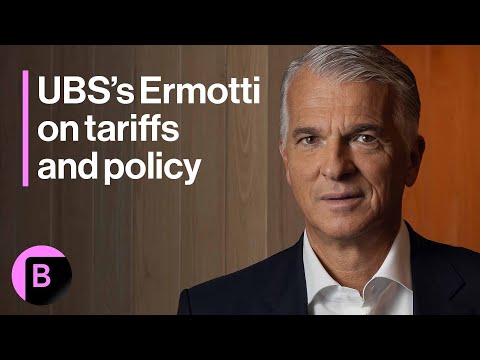
瑞银CEO:特朗普关税对美国经济和通胀的影响不明朗,更难预测美联储动向
Sou Hu Cai Jing· 2025-09-11 03:19
Core Insights - The impact of global tariffs on the US economy and inflation remains unclear, complicating predictions regarding Federal Reserve policy [1][3] - UBS CEO Sergio Ermotti believes the US economy will continue to grow, but the implications of inflation on Fed policy are uncertain [3] - There is a significant divide in the global economy, driven by technology and AI on one side and more traditional sectors on the other [3] Economic Outlook - Ermotti emphasizes the need to understand whether tariffs will lead to inflation in the US, indicating that this is still unclear [3] - The upcoming Federal Reserve meeting on September 16-17 is anticipated to involve discussions on interest rate cuts, with changing investor expectations regarding the extent of policy adjustments [3] Geopolitical Context - The current economic momentum is described as positive, but there is no definitive conclusion due to the complexity of economic factors and the intricate geopolitical environment [3] - The IPO market in Hong Kong is highlighted as an example of the economic divide, showcasing a thriving sector amid broader economic trends [3]
UBS CEO Says Tariff Impact on Inflation, Fed Still Unclear
Yahoo Finance· 2025-09-11 01:12
Group 1 - The impact of global tariffs on the US economy and inflation is unclear, complicating predictions for Federal Reserve policy [1][2][3] - There is an expectation for a reduction in interest rates by the Fed at its upcoming meeting, but investors are uncertain about future policy adjustments [2] - The divergence in the global economy is characterized by a split between technology-driven sectors and traditional sectors, affecting markets like Hong Kong's IPO landscape [4] Group 2 - The Swiss economy ministry is seeking input from UBS to improve the US trade deal, as the Trump administration has imposed a 39% tariff on Swiss exports, the highest for any developed nation [4] - UBS's potential role in navigating tariffs could enhance its relationship with Swiss authorities amid tensions over proposed capital rules [5] - Proposed capital plans in Switzerland could add up to $26 billion to UBS's existing capital demands, following the collapse of Credit Suisse [6]