XPENG(XPEV)

Search documents
多家企业驰援香港大埔火灾救援,捐款捐物总额超6亿港元
Xin Lang Cai Jing· 2025-11-28 02:02
Group 1: Incident Overview - A major fire occurred in Hong Kong's Tai Po district, resulting in 94 fatalities, including one firefighter, and 76 injuries, with 11 being firefighters [1] - The Hong Kong government established a relief fund with an initial allocation of 300 million HKD to assist affected residents [1] Group 2: Corporate Donations - Alibaba Group announced a donation of 20 million HKD for immediate relief efforts and additional support for affected families [2] - Tencent Charity Foundation pledged a total of 30 million HKD, including an initial 10 million HKD and an additional 20 million HKD to the relief fund [2] - ByteDance (Hong Kong) and Baidu each committed 10 million HKD for emergency relief and community recovery efforts [2] Group 3: Additional Corporate Contributions - Various companies, including NetEase, Xiaomi, and Kuaishou, each donated 10 million HKD to support emergency relief and community recovery [3] - Anta Group and Bosideng Group each contributed 30 million HKD, while Li Ning Group and Xtep Group donated 20 million HKD each for disaster relief [4][5][6] - Other companies like 361°, Chow Tai Fook, and Nongfu Spring also made significant contributions, totaling millions in cash and supplies [7][8] Group 4: Broader Industry Response - Multiple sectors, including automotive, real estate, and finance, participated in the relief efforts, with companies like Chery Automobile and BYD each donating 10 million HKD [9][10] - Financial institutions and logistics companies, such as Didi and SF Express, also pledged substantial amounts for emergency aid and recovery efforts [15]


小鹏汽车:管理层调研-2026 年车型管线充足,量产可见性提升,新兴业务可期;给予 “买入” 评级
2025-12-01 00:49
Summary of XPeng Inc. (XPEV) Conference Call Company Overview - **Company**: XPeng Inc. (XPEV) - **Industry**: Electric Vehicles (EV) and Intelligent Driving Key Insights 1. **Strong Order Expectations**: XPeng anticipates strong orders to counter industry challenges in 2026, driven by the X9 EREV and new model launches in 1Q26 and 2Q26 and beyond [1][5][7] 2. **Volume Production Initiatives**: The company is set to begin volume production of new models, which is crucial for real-world applications and technology advancement [2][5] 3. **Revenue Growth Projections**: XPeng projects a 27% year-over-year revenue growth in 2026, fueled by new model launches including the X9 EREV and several other models [2][5] 4. **Operating Profit Break-even**: The company expects to achieve non-GAAP operating profit break-even by 4Q25E [2] 5. **Robotaxi Development**: XPeng aims to obtain a license for Robotaxi trial operations in 2H26, starting with an in-house fleet in Guangzhou [7] 6. **Humanoid Robots Production**: The company targets production of several hundred humanoid robots next year, leveraging synergies between vehicle and robotics technology [7] 7. **Overseas Expansion Plans**: XPeng plans to establish 300 stores in 60 countries by the end of 2025, with localized production in Indonesia and Austria [7] 8. **Collaboration with Volkswagen**: The partnership with Volkswagen has generated over RMB 1 billion in service revenue, with expectations for continued revenue growth in 2026 [7] Additional Important Points 1. **Competitive Advantages**: XPeng's strengths include large data sets from its NEV fleet, in-house design and production capabilities, and technology synergies across different business lines [2] 2. **Model Launch Timeline**: The company plans to launch four new models in 2Q26, including a large 6-seat SUV and two Mona SUVs [5][7] 3. **Technological Advancements**: XPeng is transitioning to AI model-driven autonomous driving, moving away from rule-based models, and has no reliance on HD maps [7] 4. **Financial Metrics**: XPeng's market cap is approximately $20.1 billion, with projected revenues of RMB 40.87 billion in 2025 and RMB 107.54 billion in 2026 [9] Risks and Considerations - **Price Target Risks**: Risks include lower-than-expected sales volume, increased price competition, and weaker market demand [8]
汽车早报|多家车企捐款驰援香港 本田10月全球汽车产量同比下降10.9%
Xin Lang Cai Jing· 2025-11-28 00:42
Group 1: Automotive Industry Overview - The automotive industry in China reported a profit of 38.95 billion yuan from January to October 2025, reflecting a year-on-year increase of 4.4% [1] - During the same period, the production of vehicles reached 27.33 million units, marking an 11% increase year-on-year [1] - The industry's revenue for the first ten months of 2025 was 88.778 billion yuan, up 7.9% compared to the previous year, while costs increased by 8.7% to 78.243 billion yuan [1] Group 2: Company Developments - Avita Technology submitted a listing application to the Hong Kong Stock Exchange, reporting a revenue of 12.208 billion yuan for the first half of 2025, which is a 98.5% increase year-on-year [2] - WM Motor established a new company with a registered capital of 200 million yuan, focusing on the sales of new energy vehicles and related products [3] Group 3: Corporate Donations for Disaster Relief - BYD donated 10 million HKD to support disaster relief efforts in Hong Kong following a major fire [3] - Chery Automobile also contributed 10 million HKD for emergency rescue and post-disaster recovery in Hong Kong [4] - GAC Group donated 6 million HKD for medical assistance and temporary housing for fire victims [5] - XPeng Motors announced a donation of 5 million HKD to aid families affected by the fire [6] - Seres Group contributed 5 million HKD for medical aid and living arrangements for those impacted by the disaster [7] Group 4: Global Automotive Sales Performance - Nissan reported a global sales decline of 4.8% in October 2025, with production down by 3.9% to 276,323 units [8] - Honda's global production in October 2025 decreased by 10.9%, totaling 302,671 units [9]



小鹏汽车-W(9868.HK):Q3总毛利继续提升 AI业务及全球化战略提速
Ge Long Hui· 2025-11-27 20:04
Core Insights - Xiaopeng Motors reported Q3 2025 revenue of 20.38 billion, a year-on-year increase of 101.8%, with a gross margin of 20.1%, up 4.8 percentage points, and a net loss of 380 million [1][2] - The company launched its second-generation VLA model on November 5, which introduces a "physical world model" for smart driving applications across multiple scenarios [1] - Xiaopeng aims to achieve mass production of advanced humanoid robots by the end of 2026, with significant progress in its global strategy, including local production in Europe [2] Financial Performance - Q3 vehicle revenue reached 18.05 billion, a year-on-year increase of 105%, with a gross margin of 13.1% [1] - The service and other profit margin was 74.6%, showing growth both year-on-year and quarter-on-quarter, primarily due to revenue from technology research and development services [1] - For Q4, the company projects delivery volumes of 125,000 to 132,000 units, a year-on-year increase of 37% to 44%, and total revenue of 21.5 to 23 billion, a year-on-year increase of 34% to 43% [2] Strategic Developments - The second-generation VLA model will be co-created with pioneer users by the end of December 2025 and will be fully pushed to the Xiaopeng Ultra model in Q1 2026 [1] - The new IRON humanoid robot was unveiled, featuring three Turing AI chips and solid-state batteries, targeting commercial applications such as guiding and shopping [1] - Xiaopeng's overseas deliveries exceeded 29,000 units from January to September 2025, a year-on-year increase of 125%, with local production projects initiated in Indonesia and Austria, and a research center established in Munich, Germany [2] Future Outlook - Revenue forecasts for 2025, 2026, and 2027 are projected at 79 billion, 133.6 billion, and 159.8 billion respectively, with year-on-year growth rates of 93%, 69%, and 20% [2] - The current stock price corresponds to price-to-sales ratios of 1.81, 1.07, and 0.89 for 2025, 2026, and 2027 [2]
瞄准盈利目标 新势力车企多路线突围
Zheng Quan Ri Bao· 2025-11-27 15:59
Core Insights - The performance of four listed new energy vehicle companies in China, namely Leap Motor, Xpeng Motors, NIO, and Li Auto, shows significant divergence in their third-quarter results for 2025, highlighting the competitive landscape in the market [1] Sales Performance - Leap Motor achieved sales of 173,900 units, a year-on-year increase of 101.8%, leading the market - Xpeng Motors sold 116,000 units, up 149.3% year-on-year - Li Auto's sales reached 93,200 units, a decline of 39.0% year-on-year - NIO sold 87,100 units, marking a year-on-year growth of 40.8% [2] Revenue Data - Li Auto led in revenue with 27.4 billion yuan, although this represented a year-on-year decline of 36.2% - NIO reported revenue of 21.79 billion yuan, up 16.7% year-on-year - Xpeng Motors generated revenue of 20.38 billion yuan, a 101.8% increase year-on-year - Leap Motor's revenue was 19.45 billion yuan, reflecting a 97.3% year-on-year growth [2] Profitability - The profitability landscape showed "one profit and three losses" among the four companies - Leap Motor achieved a net profit of 150 million yuan, marking consecutive quarterly profitability - Xpeng Motors reported a net loss of 380 million yuan, significantly reduced from 1.81 billion yuan in the same period last year - Li Auto recorded a net loss of 620 million yuan, down from a profit of 2.8 billion yuan last year - NIO's net loss was 3.48 billion yuan, a decrease of 31.2% from 5.06 billion yuan year-on-year [2] Gross Margin Analysis - Xpeng Motors led with a gross margin of 20.1%, an increase of 4.8 percentage points year-on-year - Li Auto's gross margin was 16.3%, which adjusted for the recall costs of the Li MEGA model, would be 20.4% - Leap Motor reported a gross margin of 14.5%, up 6.4 percentage points year-on-year - NIO's gross margin stood at 13.9%, an increase of 3.2 percentage points year-on-year [3] Technological Innovation - The four companies are actively pursuing technological innovations, particularly in the field of physical AI - Xpeng Motors plans to launch three Robotaxi models by 2026 and aims for mass production of humanoid robots by the end of the year - Li Auto has invested heavily in AI, with a monthly usage rate of its VLA driver model reaching 91% and an expected annual R&D expenditure of 12 billion yuan, with over 6 billion yuan allocated to AI [4] - Leap Motor emphasizes self-research and development, achieving significant advancements in core components and technologies [4] Competitive Strategies - NIO continues to enhance its battery swap technology to create a differentiated competitive advantage and is accelerating its overseas market expansion [5] - Industry experts indicate that the third-quarter financial data reflects a new phase of differentiated development among Chinese new energy vehicle companies, with technology innovation, cost control, and globalization being critical success factors [5]


支援香港大埔救灾,阿里、滴滴、腾讯、字节、小米、京东等大厂捐款捐物



YOUNG财经 漾财经· 2025-11-27 14:26
Group 1 - Major tech companies including Alibaba, JD.com, Didi, Tencent, ByteDance, and Xiaomi have made significant donations to support disaster relief efforts in Hong Kong following a severe fire incident in Tai Po [2][3][4][5]. - The Ma Yun Public Welfare Foundation donated 30 million HKD to assist affected families and individuals, while Alibaba Group initiated a donation of 20 million HKD for rescue and recovery efforts [2]. - Didi contributed 10 million HKD for emergency rescue and humanitarian aid, and is actively coordinating with local authorities to ensure public safety during the crisis [2][5]. Group 2 - Tencent Charity Foundation announced an initial donation of 10 million HKD for urgent relief, transitional housing, and emotional support for affected residents [2][5]. - Lenovo Hong Kong also donated 10 million HKD to support emergency rescue, medical assistance, and subsequent recovery efforts for the affected community [4]. - Xiaomi Foundation pledged 10 million HKD for immediate disaster relief, alongside contributions from BYD and NetEase, each donating 10 million HKD, and Anta Group and 361° Group contributing a total of 30 million HKD and 15 million HKD respectively [5]. Group 3 - JD.com quickly mobilized resources, delivering essential supplies such as bottled water and instant noodles to the disaster site, with logistics support from its extensive supply chain network [5]. - Alibaba's logistics arm, Cainiao, is actively dispatching emergency supplies like food and bedding to the affected areas [6].


多家车企驰援香港
Guo Ji Jin Rong Bao· 2025-11-27 13:24
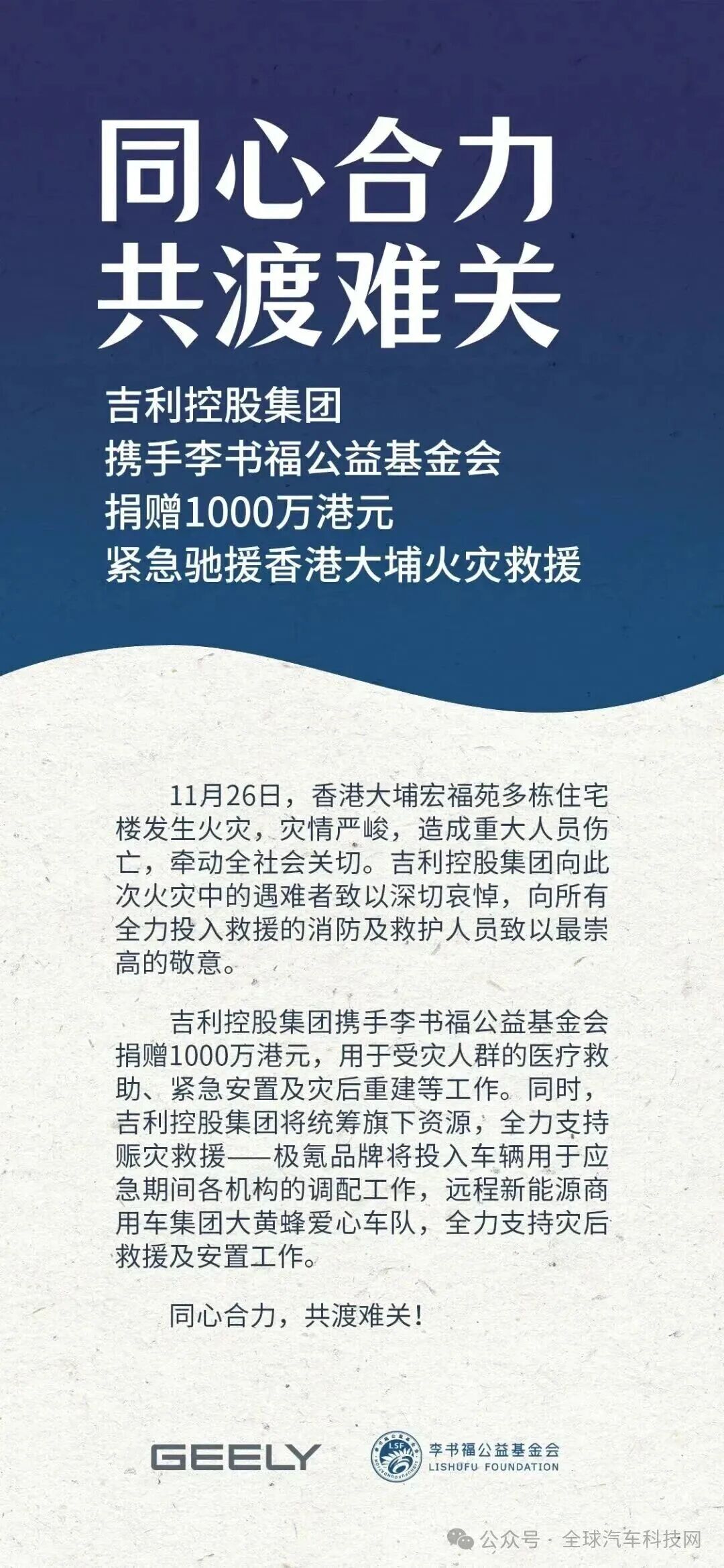
Group 1 - The fire incident in Tai Po, Hong Kong, occurred on November 26, resulting in multiple casualties and prompting a significant response from various sectors [1] - The Hong Kong government has established eight shelter centers and mobilized nearly 200 community care team members to provide necessary support to affected citizens [2] Group 2 - Geely Holding Group, in collaboration with the Li Shufu Public Welfare Foundation, donated 10 million HKD for medical assistance, emergency accommodation, and post-disaster reconstruction [2] - BYD donated 10 million HKD through BYD (Hong Kong) for medical aid, emergency accommodation, and post-disaster rebuilding efforts [4] - Xpeng Motors contributed 5 million HKD to support affected families and pledged to monitor the situation closely [8] - GAC Group donated 6 million HKD for emergency medical assistance, temporary accommodation, and rebuilding efforts, while also preparing support vehicles for disaster response [11] - Chery Automobile Co., Ltd. donated 10 million HKD through the China Red Cross Foundation to assist in rescue and recovery efforts in Tai Po [14]

支援香港大埔救灾,阿里、京东、滴滴、腾讯、联想等大厂捐款捐物
2 1 Shi Ji Jing Ji Bao Dao· 2025-11-27 12:14
Core Points - Major internet companies including Alibaba, JD.com, Didi, Tencent, ByteDance, and Lenovo have made significant donations to support fire relief efforts in Hong Kong following a severe fire incident in Tai Po [1][2][3] Group 1: Donations and Contributions - Alibaba Group has initiated a donation of 20 million HKD for fire relief, including 30 million HKD from the Jack Ma Foundation for affected families [1] - Didi has pledged 10 million HKD for emergency rescue and humanitarian aid, with plans for ongoing support [1] - Tencent Charity Foundation has committed 10 million HKD for urgent relief efforts, including transitional housing and emotional support for affected residents [1] - ByteDance and Lenovo each donated 10 million HKD to assist with emergency rescue and community recovery efforts [1] - Xiaomi Foundation has also contributed 10 million HKD for the fire relief [2] - BYD and NetEase each donated 10 million HKD, while Anta Group and 361° Group collectively contributed 30 million HKD and 15 million HKD respectively [2] Group 2: Logistics and Support - JD.com has mobilized its logistics network to deliver essential supplies such as water and food to the disaster area, with the first batch dispatched on the night of the fire [2] - JD Logistics has activated emergency plans to ensure timely delivery of bedding, hygiene products, and other necessities from its warehouses [2] - Didi's public welfare rescue team is collaborating with local rescue teams to participate in post-disaster support efforts [2] - Alibaba's logistics arm, Cainiao, is coordinating the delivery of food and emergency supplies to the affected areas [3]

支援香港大埔救灾,阿里、京东、滴滴、腾讯、联想等大厂捐款捐物
21世纪经济报道· 2025-11-27 12:07
Group 1 - Major internet companies including Alibaba, JD.com, Didi, Tencent, ByteDance, and Lenovo have made significant donations to support fire relief efforts in Hong Kong following a major fire incident in Tai Po [1][2] - Alibaba Group has initiated a donation of 20 million HKD for disaster relief, while the Ant Group contributed 10 million HKD [1] - Didi and Tencent each donated 10 million HKD for emergency rescue and humanitarian assistance [1] - ByteDance and Lenovo also contributed 10 million HKD each to support urgent relief and community recovery efforts [1] - Xiaomi Foundation announced a donation of 10 million HKD for immediate fire relief [1] Group 2 - Other companies such as BYD and NetEase donated 10 million HKD each, while Anta Group and 361° Group collectively donated 30 million HKD and 15 million HKD respectively [2] - JD.com played a crucial role in logistics, delivering essential supplies like bottled water and instant noodles to the disaster site, with a rapid response team established for ongoing support [2] - Didi's public welfare rescue team is collaborating with local rescue teams to assist in post-disaster recovery efforts [2] - Alibaba's logistics arm, Cainiao, is mobilizing emergency supplies to the affected area [2]

新势力成绩单出炉:小米首盈、零跑续赚、理想转亏
Xin Lang Cai Jing· 2025-11-27 11:58
Core Insights - The domestic new energy vehicle market is experiencing intensified competition and rapid technological iteration, leading to significant performance differentiation among leading new forces in the automotive sector [2] Company Performance Summary NIO - NIO reported a total delivery of 87,100 vehicles in Q3, a year-on-year increase of 40.8%, with revenue reaching 21.79 billion yuan, up 16.7% year-on-year [4] - The company narrowed its net loss to 3.48 billion yuan, a reduction of 31.2% compared to the previous year, and aims for profitability in Q4 with a delivery guidance of 120,000 to 125,000 vehicles [4] Xpeng - Xpeng achieved a record delivery of 116,000 vehicles in Q3, a year-on-year increase of 149.3%, with revenue surpassing 20 billion yuan for the first time, reaching 20.38 billion yuan, up 101.8% year-on-year [5] - The net loss was reduced to 380 million yuan, down 78.9% from the previous year, and the company aims for overall breakeven in Q4 [5] Li Auto - Li Auto reported a total delivery of 93,211 vehicles in Q3, a year-on-year decline of 39%, with revenue of 27.4 billion yuan, down 36.2% year-on-year, marking its first loss in nearly three years with a net loss of 624.4 million yuan [6] - The company anticipates a Q4 delivery of 100,000 to 110,000 vehicles, with revenue expected to be between 26.5 billion and 29.2 billion yuan [6] Leap Motor - Leap Motor achieved revenue of 19.45 billion yuan in Q3, nearly doubling year-on-year, and reported a net profit of 150 million yuan, marking consecutive quarters of profitability [8] - The company delivered 173,852 vehicles, leading the new forces in sales, and plans to accelerate its global expansion [8] Xiaomi - Xiaomi's automotive division achieved its first quarterly profit with an operating income of 700 million yuan, contributing to a total revenue of 290 billion yuan, up 199% year-on-year [9] - The company delivered 108,796 vehicles in Q3 and aims to exceed 400,000 vehicle deliveries for the full year [9]