广汽

Search documents
博世集团与银河通用成立合资公司推进具身智能在工业端落地
news flash· 2025-06-18 23:15
Group 1 - Bosch Group's subsidiary, Bosch Capital, and China Galaxy General announced the establishment of a joint venture named "Chengmai Boyin Hechuang Technology Co., Ltd." to focus on complex assembly and intelligent quality inspection in manufacturing [1] - The joint venture aims to develop agile robots and promote the large-scale implementation of embodied artificial intelligence in the industrial sector [1] - As a result of this collaboration, Boyin Hechuang signed a strategic cooperation memorandum with United Automotive Electronics to establish the "RoboFab" joint laboratory for embodied intelligent robots, exploring their applications in automotive manufacturing [1] Group 2 - Recent developments include the addition of CICC Guango and Ant Group as shareholders in Lingxin Qiaoshou Company, and the establishment of a new enterprise by Zhiyuan Robotics in collaboration with Hillhouse Capital [1] - The humanoid robot sector has become a hot topic in the industry, with investments and initiatives from automotive industry players such as XPeng, Chery, GAC, SAIC, and BYD [1]
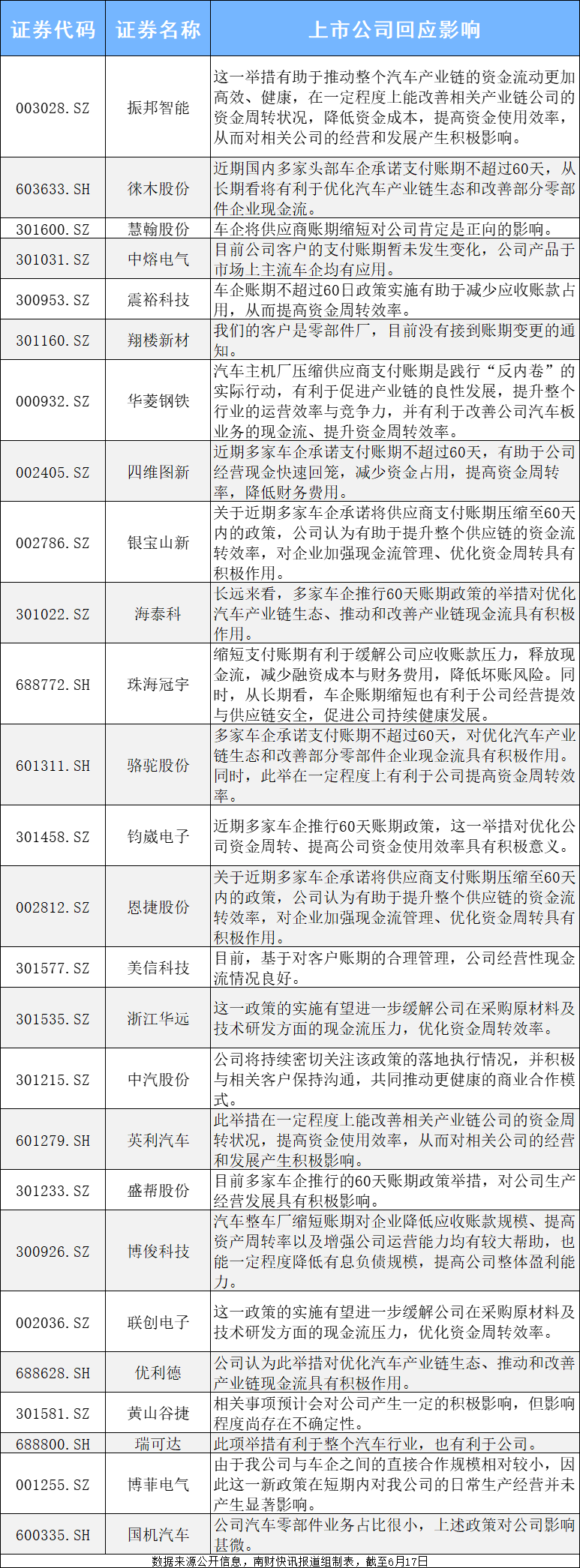
车企承诺支付账期不超60天!多家上市公司回应影响
2 1 Shi Ji Jing Ji Bao Dao· 2025-06-17 13:46
Core Viewpoint - Major automotive companies in China have committed to a payment term of no more than 60 days for suppliers, which is expected to enhance the cash flow of small and medium-sized enterprises in the supply chain and promote a healthier industry ecosystem [1][2]. Group 1: Industry Impact - The commitment to a 60-day payment term is seen as crucial for building a collaborative and win-win development ecosystem between vehicle manufacturers and parts suppliers, which is essential for sustainable industry growth [1]. - The automotive industry has historically faced long payment terms, with an average accounts payable turnover of 182 days, significantly exceeding the international standard of 90 days, leading to cash flow challenges for suppliers [2][7]. - Shortening payment terms is anticipated to alleviate financial pressure on suppliers, allowing them to invest more in research and development, thus driving industry innovation and upgrading the supply chain [2][3]. Group 2: Company Responses - Companies such as Huahan Co. and Yuli Technology have expressed that the reduction in payment terms will positively impact their cash flow and operational efficiency [3][4]. - Several listed companies have reported that the new policy will enhance the efficiency of capital flow within the supply chain, reduce financial costs, and improve overall business operations [4][5]. - Some companies, however, indicated that their exposure to the automotive parts business is minimal, and thus the impact of the new policy may be limited [4][6]. Group 3: Challenges Ahead - Analysts have pointed out that breaking the inertia of long-standing payment practices will be challenging, as some companies previously maintained payment terms exceeding 170 days [7]. - The complexity of payment models and the lack of a robust credit system in the industry may hinder the effective implementation of the new payment terms [7]. - There may be discrepancies in understanding the new payment terms between suppliers and automotive companies, particularly regarding the timing of when the 60-day period begins [7].

车企承诺60天账期,但花样赖账还没结束
2 1 Shi Ji Jing Ji Bao Dao· 2025-06-17 09:41
Core Viewpoint - Multiple automotive companies have announced a unified reduction of payment terms to suppliers to within 60 days, responding to government regulations aimed at protecting small and medium-sized enterprises [1][2] Group 1: Industry Response - Over 16 automotive companies, including BYD, NIO, and Great Wall Motors, have committed to the new payment terms [1] - The government has implemented the "Regulations on Payment of Funds to Small and Medium-sized Enterprises," which prohibits large enterprises from delaying payments to smaller suppliers [1] Group 2: Challenges in Implementation - Suppliers report that the 60-day payment term starts only after invoicing, with lengthy negotiation processes prior to this, often taking two to three months [2] - The reconciliation process and invoice confirmation can take an additional two to three months, leading to significant delays in actual payment [2] - Suppliers may receive payment in the form of bank or commercial acceptance bills, which can extend the actual payment period to 180 days or more [2] Group 3: Industry Dynamics - The competitive pricing war in the automotive industry is pressuring both car manufacturers and suppliers, potentially harming consumer interests [3] - There is a call for a more respectful and cooperative relationship between leading automotive companies and their suppliers to foster a healthier supply chain ecosystem [3]


交银国际每日晨报-20250617
BOCOM International· 2025-06-17 05:28
E-commerce Industry - In May 2025, adjusted year-on-year growth for physical e-commerce was 8.2%, compared to 6.1% in April and 5.7% in Q1 [1] - The growth was driven by the expansion of national subsidies and the extended duration of the 618 shopping festival, with significant increases in telecommunications equipment and home appliances [1] - The demand for furniture continued to recover as the home decoration season began, maintaining a rapid growth rate [1] - The growth trend in the industry is expected to continue into Q2 2025, with Alibaba's CMR projected to maintain double-digit growth and JD's home appliance category expected to grow rapidly [1][2] Automotive Industry - The 2025 Hong Kong International Auto and Supply Chain Expo showcased multiple flying cars and right-hand drive models, indicating a global upgrade of the automotive supply chain [4] - The introduction of a regulatory sandbox in Hong Kong is promoting the development of the low-altitude economy [4] - In 2024, automotive exports accounted for 3.3% of China's total exports, with a shift towards smart and electric vehicle supply chains [4] - Key automotive and supply chain companies are accelerating their listings in Hong Kong, enhancing their global presence and supporting the upgrade of China's supply chain [7] Banking Industry - In May 2025, new RMB loans amounted to 620 billion, lower than market expectations, with a year-on-year decrease of 330 billion, primarily from corporate medium to long-term loans [8] - New social financing in May reached 2.29 trillion, exceeding market expectations and showing a year-on-year increase of 227.1 billion, mainly driven by government and corporate bonds [8] - M1 growth showed a rebound on a low base, while M2 growth and social financing growth remained stable [8] Market Indices - The Hang Seng Index closed at 24,061, with a year-to-date increase of 16.76% [3] - The Hang Seng Index's technical indicators show a 50-day moving average of 23,358.72 and a 200-day moving average of 21,925.05 [5]
亚太股份(002284) - 2025年06月13日投资者关系活动记录表
2025-06-16 07:48
Group 1: Company Overview - Zhejiang Asia-Pacific Mechanical and Electrical Co., Ltd. has been focused on the automotive brake system industry since its establishment in 1979, accumulating a broad customer base including major companies like Geely, Changan, and SAIC [3] - The company has a sales network covering domestic and international markets, exporting to North America, Europe, and the Middle East, and has entered procurement platforms of global brands such as Volkswagen and Honda [3] Group 2: Product and Market Position - The company provides products for new energy vehicles, with sales of related components increasing annually, reflecting a positive correlation with the growth of the new energy vehicle market [2] - The main products offered include basic brake systems, automotive electronics, and wheel hub motors, with a focus on securing more clients and projects [2] Group 3: Financial Performance - The company's gross profit margin has improved due to increased domestic vehicle sales and new international projects, alongside ongoing optimization of product structure and cost reduction efforts [4] - The company aims to expand its market coverage and promote new products, particularly in automotive electronic systems, to drive future growth [8] Group 4: Production Capacity - The company operates three main production bases in Xiaoshan, Anhui, and Huzhou, with additional facilities in various locations to support local vehicle manufacturers [6] - Current production capacity utilization is high, and the company plans to adjust production lines based on market demand and sales performance [8] Group 5: Competitive Advantages - As a leading domestic automotive brake system manufacturer, the company offers customized products based on specific vehicle parameters, providing advantages in cost-effectiveness, service quality, and responsiveness compared to foreign brands [7] - The trend of domestic automakers increasing local procurement presents significant growth opportunities for domestic parts suppliers [8]

新材料周报:生物基LCP量产在即,广汽、比亚迪、吉利等集体宣布缩短至60天内-20250616
Huafu Securities· 2025-06-16 03:06
Investment Rating - The industry rating is "Outperform the Market," indicating that the overall return of the industry is expected to exceed the market benchmark index by more than 5% in the next 6 to 12 months [52]. Core Insights - The Wind New Materials Index closed at 3654.03 points, reflecting a week-on-week increase of 0.68%. Among the six sub-industries, the semiconductor materials index decreased by 0.72%, while the lithium battery index increased by 1.62% [3][10]. - The global liquid crystal polymer (LCP) market is approaching a critical transition towards sustainability, with Sumitomo Chemical successfully establishing technology for mass production of bio-based LCP, aiming for commercial supply by the fiscal year 2027 [4][33]. - Major automotive manufacturers, including GAC, BYD, and Geely, announced a reduction in payment terms to within 60 days, marking a significant shift in the automotive industry's competitive landscape [4][28]. Market Overview - The semiconductor materials index reported a decline of 0.72%, while the lithium battery index saw an increase of 1.62%. Other indices, such as the organic silicon materials index and carbon fiber index, also experienced declines [3][10]. - The top-performing companies this week included Pan-Asia Micro透 (22.02%), AkzoNobel (16.69%), and Boqian New Materials (15.64%), while the worst performers included Aoke Co. (-12.92%) and Dongcai Technology (-6.69%) [24][26]. Recent Industry Trends - The U.S.-China trade negotiations have reached a framework agreement, indicating potential easing of trade tensions [28]. - Kuraray announced the global launch of a 100% bio-based ethylene-vinyl alcohol copolymer product, marking a significant advancement in sustainable materials [28]. - LG Chem has decided to sell its water treatment business for 1.4 trillion KRW (approximately 73.5 million RMB) as part of its strategy to focus on new growth areas [29].
地平线机器人-W:深度报告:国产智驾方案龙头 迈向高阶新征程-20250604
Minsheng Securities· 2025-06-04 14:23
Investment Rating - The report maintains a "Buy" rating for the company, indicating a positive outlook on its future performance [4][6]. Core Insights - The company is positioned as a leading provider of domestic intelligent driving solutions, having undergone significant transformation over the past decade. It has established a comprehensive product portfolio that includes both automotive and non-automotive solutions, with a strong focus on intelligent driving technology [1][15]. - The intelligent driving industry is expected to accelerate its penetration into mainstream markets, with 2025 projected to be a pivotal year for "intelligent driving equality." Major automotive manufacturers are increasingly adopting intelligent driving strategies, which will create opportunities for leading suppliers [2][48]. - The company has built a robust ecosystem that empowers partners in the intelligent driving space, leveraging its complete technology stack that spans algorithms, specialized processing architectures, and development tools [3][4]. Summary by Sections Company Overview - The company has evolved into a key player in the intelligent driving sector, providing comprehensive advanced driver assistance systems (ADAS) and high-level autonomous driving (AD) solutions. It has a significant market share in the domestic market, exceeding 40% in the advanced driving assistance segment [15][18]. - The company has established a large and high-quality customer base, with over 310 models targeted for production by the end of 2024, reflecting its strong market presence [29][39]. Industry Insights - The intelligent driving market is witnessing a shift towards affordability, with traditional manufacturers like BYD and Geely launching strategies to democratize intelligent driving technology. This trend is expected to reshape the industry landscape [2][48]. - The report highlights the importance of third-party suppliers in the intelligent driving ecosystem, as they can provide scalable solutions to traditional manufacturers, thereby accelerating the adoption of advanced driving technologies [12][13]. Financial Performance - The company has experienced significant revenue growth, with a compound annual growth rate (CAGR) of 72.2% from 2021 to 2024, increasing from 467 million RMB to 2.384 billion RMB. The automotive solutions segment accounts for 97% of total revenue, with a strong contribution from licensing and service fees [39][46]. - The gross margin has remained stable, with an increase to 79% in 2024, driven by the higher proportion of high-margin licensing and service revenues [39][46]. Future Outlook - The company is expected to continue expanding its market share in the intelligent driving sector, with projected revenues of 3.603 billion RMB, 5.264 billion RMB, and 7.645 billion RMB for 2025, 2026, and 2027, respectively [4][5].
大厂都在做换电
汽车商业评论· 2025-05-30 09:10
Core Viewpoint - CATL aims to redefine its identity from a mere battery manufacturer to a pioneer in the new energy sector, emphasizing its role in the development of battery swapping technology [4][5]. Group 1: Development of Battery Swapping - CATL has transitioned from a parameter-driven phase to a demand-driven phase in the battery market, highlighting its ambition to become a zero-carbon technology company [5]. - The company is constructing the world's largest and most advanced battery swapping network, targeting both passenger and commercial vehicles [7]. - The launch of the first battery-swapping model, the Changan Auchan 520, marks a significant step in the large-scale implementation of standardized battery swapping in the transportation market [8]. Group 2: Industry Challenges and Solutions - The lack of standardized battery swapping systems has been a major barrier to the widespread adoption of battery swapping technology [16]. - CATL has developed standardized battery blocks to address this issue, enabling compatibility across various vehicle models [17][19]. - The company plans to build 1,000 battery swapping stations by 2025, with a long-term goal of establishing 30,000 stations in collaboration with partners [25]. Group 3: Market Dynamics and Growth Potential - The battery swapping market is expected to experience significant growth, driven by policy support, technological standardization, and market cultivation [12][14]. - The market for battery swapping in heavy-duty trucks is projected to reach approximately 468 billion yuan by 2025 and 922 billion yuan by 2030 [43]. - CATL's initiatives in battery swapping are anticipated to enhance operational efficiency and reduce costs for heavy-duty truck operators, making it an attractive option for the logistics industry [38][41]. Group 4: Broader Ecosystem Impact - Battery swapping is not just a refueling method but a comprehensive ecosystem that includes technology, infrastructure, and commercial aspects [46]. - The integration of battery swapping stations with renewable energy sources can transform them into distributed energy nodes, contributing to grid stability [48]. - The establishment of a robust battery swapping network is expected to reshape urban energy infrastructure and planning, creating a multi-trillion yuan industry ecosystem [48].
【财经分析】价格战再起?汽车业期待有序竞争新时代
Xin Hua Cai Jing· 2025-05-30 03:58
Group 1 - The core viewpoint of the articles highlights a new wave of price cuts in the domestic automotive market, leading to significant market concerns and a substantial drop in the market value of automotive stocks [1][4][5] - Major automotive companies, including BYD, Geely, and Chery, have initiated promotional activities with substantial cash subsidies, resulting in price reductions of up to 55,000 yuan for various models [2][3] - The phenomenon of "zero-kilometer" used cars, which are essentially unsold new cars registered as used, has emerged as a hidden pricing strategy, raising concerns about market integrity and competition [3][6] Group 2 - The automotive sector has been experiencing a continuous decline in profit margins, with the profit rate dropping from 8.99% in 2014 to an estimated 4.3% in 2024, indicating a challenging financial environment for the industry [6][7] - Analysts suggest that the recent price competition is driven by increased market pressure and inventory accumulation, with BYD's inventory rising by 56,400 units in the first four months of the year [2][5] - Industry leaders are calling for a return to orderly competition to foster sustainable development and technological advancement, emphasizing the need to avoid destructive price wars [7][8]
共创、共荣、共进,2025香港车博会奏响汽车革新“协奏曲”
Jing Ji Guan Cha Bao· 2025-05-29 23:53
(原标题:共创、共荣、共进,2025香港车博会奏响汽车革新"协奏曲") 香港变了。 当港交所IPO(首次公开募股)募资规模重新成为世界第一,背后是宁德时代登陆港股这笔今年以来全球最大IPO的助力;在西九龙公路上行驶的 的士车队里,除了传统的红、绿、蓝三种颜色的车辆,还能看到吉利远程、广汽传祺E9等国产电动汽车的身影;在港岛车水马龙的核心商区,就 在保时捷和迈凯伦等豪华品牌的旁边,小鹏汽车香港第二门店暨全球科技品牌体验店亚洲首店高调开业…… 这样的变化,有相当一部分来源于中国汽车产业。在"一国两制"实践进入新阶段的当下,中国汽车品牌正在积极依托身为国际金融、航运、贸易 和科创中心的中国香港,链接世界,走向更广阔的海外天地;与此同时,凭借着融入国家发展战略、与内地汽车产业开展更紧密的联系与合作, 香港也有望持续推动经济转型升级、培育新的增长动能,这颗"东方明珠"正绽放出比以往更加灿烂的光芒。 基于此,2025国际汽车及供应链博览会(香港)(以下简称"2025香港车博会")的召开,是顺时而来,更是应势而为。6月12日~15日,由中国汽 车工业协会、香港中国企业协会、香港中华厂商联合会、中国港澳台侨和平发展总会、凤凰 ...