蔚来

Search documents
1月15日投资早报|向日葵被证监会立案,中信证券2025年净利润300.51亿元同比增长38.46%,今日一只新股上市
Sou Hu Cai Jing· 2026-01-15 00:40
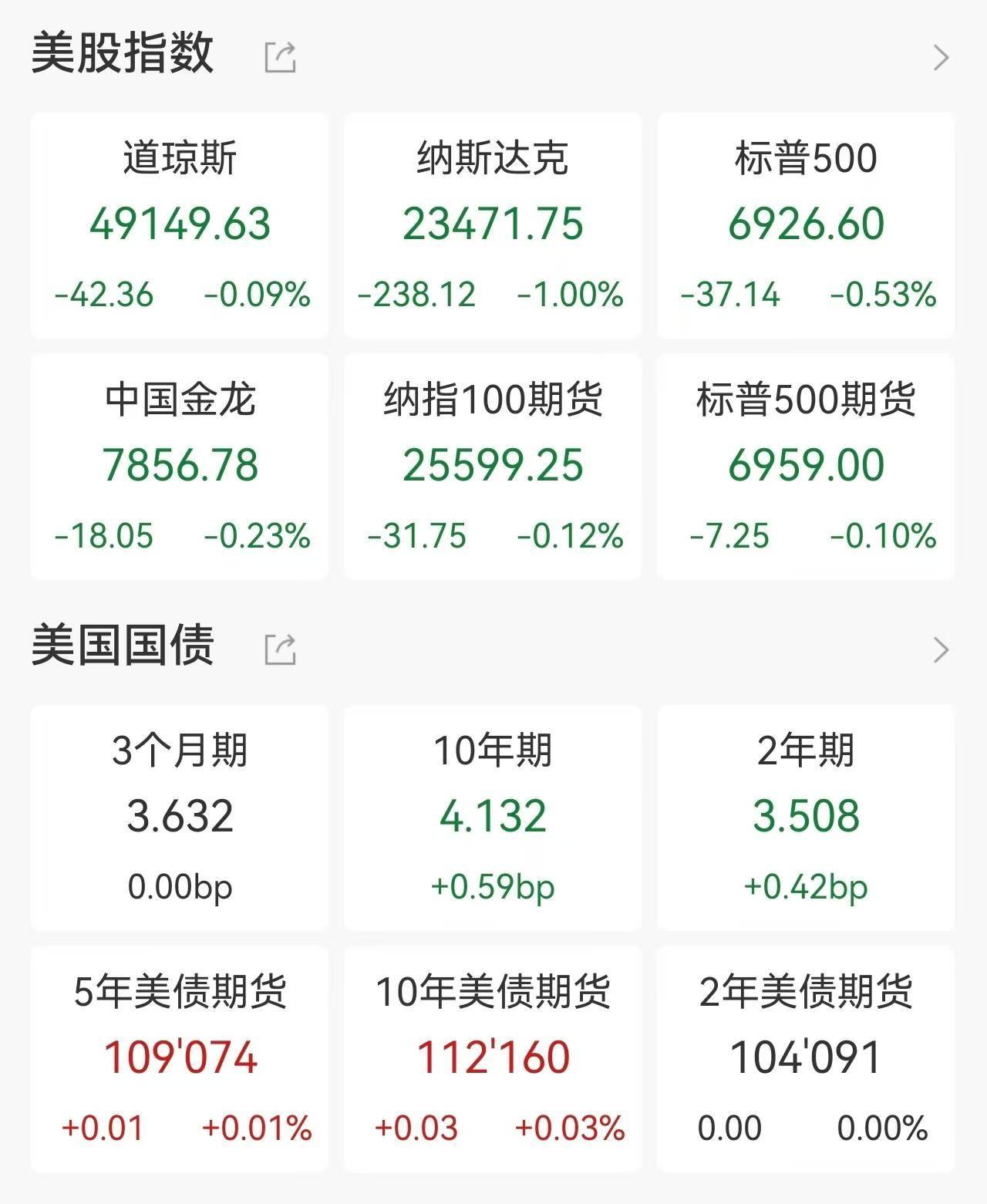
Market Performance - On January 14, 2026, the A-share market showed mixed results with the Shanghai Composite Index closing at 4126.09 points, down 0.31%, while the Shenzhen Component Index rose 0.56% to 14248.6 points, and the ChiNext Index increased by 0.82% to 3349.14 points. Over 2700 stocks rose, with total trading volume reaching 3.94 trillion yuan, an increase of 290 billion yuan from the previous trading day [1] - The Hong Kong stock market saw a late rally, with the Hang Seng Index rising 0.56% to 26999.81 points and a total trading volume of 340.39 billion HKD. The Hang Seng China Enterprises Index increased by 0.32%, while the Hang Seng Tech Index rose by 0.66% [1] - In the U.S. stock market, all three major indices closed lower, with the Dow Jones Industrial Average down 42.36 points (0.09%) at 49149.63 points, the Nasdaq down 238.12 points (1.00%) at 23471.75 points, and the S&P 500 down 36.75 points (0.53%) at 6926.99 points [1] New Stock Listings - A new stock, Zhixin Co., Ltd. (stock code 603352), was listed today with an issue price of 21.88 yuan per share and a price-to-earnings ratio of 26.85. The company specializes in the development, processing, production, and sales of automotive welding parts and related molds, serving major clients such as Changan Automobile, Geely, Ford, NIO, Li Auto, BYD, Great Wall Motors, and others [3] Regulatory News - The Shanghai Stock Exchange announced that some investors engaged in abnormal trading behavior during the trading of Guosheng Technology, leading to self-regulatory measures such as account trading suspensions. The exchange reiterated the importance of cautious investment and compliance with trading regulations [4] - A joint meeting was held by the Ministry of Industry and Information Technology, the National Development and Reform Commission, and the State Administration for Market Regulation to address the need for orderly competition in the new energy vehicle industry. The meeting emphasized the rejection of chaotic "price wars" and the importance of maintaining a fair market environment, with strict actions against non-compliant companies [6] Housing Policy - The Ministry of Finance, the State Taxation Administration, and the Ministry of Housing and Urban-Rural Development announced the continuation of personal income tax policies supporting residents' housing exchanges. From January 1, 2026, to December 31, 2027, taxpayers selling their own homes and purchasing new ones within one year will receive tax refunds based on the sale price of the old home [5]

美股震荡加剧!科技七巨头集体下跌 ,银行股遭财报与政策双重打击,白银狂飙破93美元创纪录,原油坐 "过山车"
Sou Hu Cai Jing· 2026-01-15 00:26
Market Overview - The U.S. stock indices closed lower, with the Dow Jones Industrial Average down 0.09% at 49,149.63 points, the S&P 500 down 0.53% at 6,926.60 points, and the Nasdaq down 1.00% at 23,471.75 points [1][2]. Technology Sector - Major technology stocks experienced significant declines, with Microsoft, Amazon, and Meta among the "seven giants" all seeing price drops. Broadcom fell by 4.2%, Oracle by 4.3%, and other tech giants like Apple, Google, and Nvidia also dropped over 1%. Analysts attribute this to high valuations and lackluster earnings, prompting investors to take profits [3][4]. Banking Sector - Bank stocks continued their downward trend, with Wells Fargo down 4.6% and Citigroup and Bank of America down over 3%. Wells Fargo's Q4 earnings fell short of market expectations due to weak investment banking performance. Concerns were raised by JPMorgan executives regarding proposed credit card interest rate caps potentially harming consumer interests and overall financial sector profitability [5]. Chinese Stocks - Chinese stocks showed mixed performance, with Ctrip plunging 17.1% due to antitrust investigations, while Pinduoduo fell 3.9%. However, Bilibili saw a 6% increase, indicating a divergence in market expectations for different Chinese companies [5][6]. Economic Data - U.S. retail sales rose by 0.6% month-on-month in November, the highest since July, surpassing the expected 0.4%. Core retail sales, excluding automobiles, increased by 0.5%. The Producer Price Index (PPI) rose by 0.2% month-on-month and 3.0% year-on-year, indicating persistent inflationary pressures [9][14]. Commodity Market - Silver prices surged, with COMEX silver futures rising by 5.81% to $90.86 per ounce, briefly surpassing $93, marking a historical high. In contrast, gold prices saw a slight decline of 0.42% [10][12]. The silver market is experiencing a supply shortage, with expectations of a significant supply gap by 2025 due to production constraints and new export regulations from China [13]. Geopolitical Factors - The U.S. government announced a 25% import tariff on semiconductors and manufacturing equipment, citing national security concerns. This move is expected to increase costs for major U.S. chip companies like Nvidia, AMD, and Intel, which rely on overseas manufacturing [8]. Additionally, geopolitical tensions regarding Iran have created market uncertainty, although recent statements from U.S. officials have temporarily eased concerns [8][14].

纳指收跌1%,甲骨文、博通跌超4%
Mei Ri Jing Ji Xin Wen· 2026-01-15 00:10
Market Overview - The three major U.S. stock indices closed lower, with the Dow Jones down 0.08%, the Nasdaq down 1.00%, and the S&P 500 down 0.53% [2] - Technology stocks experienced widespread declines, with Oracle and Broadcom falling over 4%, and Amazon, Microsoft, and Meta dropping over 2% [2] - Notably, Intel saw a contrary increase, rising over 3% [2] Chinese Stocks Performance - The Nasdaq Golden Dragon China Index decreased by 0.23%, with significant declines in several Chinese companies [2] - Ctrip fell over 17%, Pinduoduo dropped nearly 4%, and electric vehicle manufacturers such as Li Auto, NIO, and Xpeng, along with Bawang Tea, all declined over 2% [2] - In contrast, Bilibili experienced a rise of over 6% [2]


【1月15日IPO雷达】至信股份上市
Xuan Gu Bao· 2026-01-15 00:04
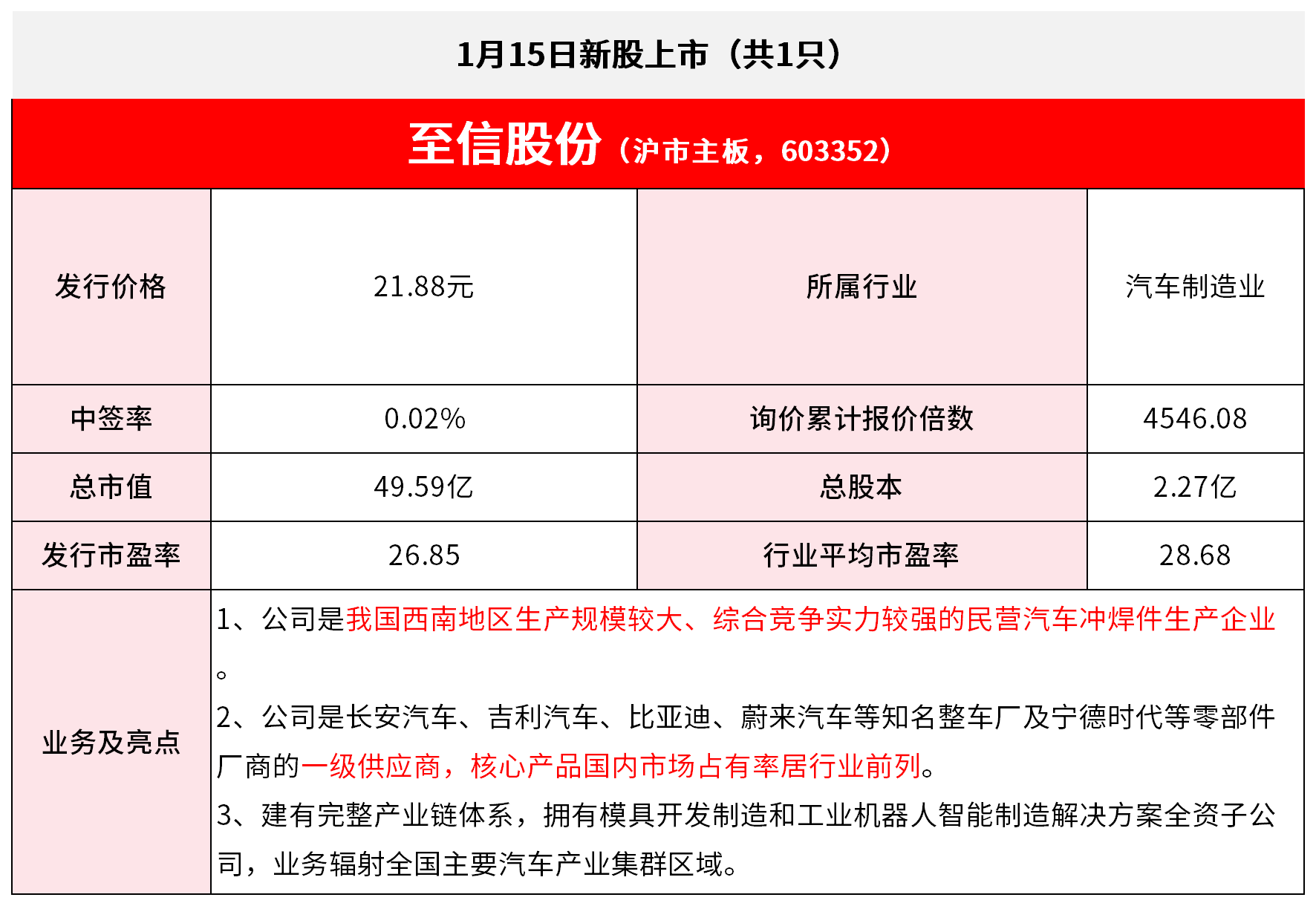
Core Viewpoint - The company is a significant player in the automotive supply chain in Southwest China, with a strong market position and comprehensive competitive advantages [2] Group 1: Financial Metrics - The issuance price is set at 21.88 yuan [2] - The total market capitalization is 4.959 billion yuan [2] - The issuance price-to-earnings ratio is 26.85 [2] - The subscription rate is 0.02% [2] Group 2: Business Highlights - The company is one of the major suppliers for leading automotive brands such as Changan Automobile, Geely Automobile, BYD, and NIO, with a core product market share leading in the domestic market [2] - The company has established a complete industrial chain system, including mold development and manufacturing, with business operations covering major automotive industry clusters across the country [2]
谷歌、苹果、英伟达、特斯拉、微软、亚马逊、Meta集体下跌
财联社· 2026-01-14 23:54
Market Overview - The US stock market saw a collective decline on Wednesday, with the Nasdaq index experiencing the largest drop. Technology stocks weakened as investors shifted funds to defensive sectors, while bank stocks continued to fall following mixed quarterly earnings reports [1] - Financial sector stocks had previously surged in 2025 but have been retreating this week due to concerns over President Trump's proposed credit card interest rate cap, which could squeeze consumer credit space and harm financial industry profits [1] Banking Sector - Bank stocks continued to decline, with Wells Fargo's share price dropping by 4.6%, significantly impacting the market. The bank's latest quarterly profit and revenue fell short of market expectations [1] - Despite better-than-expected earnings from Bank of America and Citigroup, their stock prices also fell, as traders believed these results were insufficient to support the overall market valuation, which is near historical highs [1] - Michael O'Rourke, Chief Market Strategist at JonesTrading, noted that after a decent rally, the banking sector is currently experiencing profit-taking and consolidation, although the market remains optimistic about the sector [1] Economic Indicators - The US Producer Price Index (PPI) for November increased by 3% year-on-year, surpassing the expected growth of 2.7%. The month-on-month PPI rose by 0.2%, in line with expectations. Core PPI also showed a year-on-year increase of 3%, with a month-on-month growth of zero, against an expected increase of 0.2% [2] - The Federal Reserve's latest Beige Book indicated that economic activity has recently grown in most regions, with stable employment conditions, but inflation pressures have not fully dissipated, supporting the Fed's decision to maintain interest rates in the short term [2] Interest Rate Outlook - The market widely anticipates that the US benchmark interest rate will remain unchanged in the first half of the year, including during the upcoming Federal Reserve meeting in January. Traders are currently pricing in at least two rate cuts within the year [3] Geopolitical Factors - Geopolitical uncertainties are also weighing on market risk sentiment, with the US military withdrawing personnel from the Udeid Air Base and Iran warning of retaliation if attacked. Additionally, Trump is pushing for US control over Greenland, stating that any outcome other than its incorporation into the US is "unacceptable" [4] Sector Performance - The S&P 500 index saw declines across various sectors, with consumer discretionary down by 1.75%, information technology down by 1.45%, and telecommunications down by 0.55%. Conversely, the energy sector rose by 2.26% [6] - In the ETF market, the network stock index ETF fell by 1.68%, while the energy sector ETF increased by 2.26% [6] Notable Stock Movements - Major tech stocks experienced declines, with Google A down by 0.04%, Apple down by 0.42%, Nvidia down by 1.44%, Tesla down by 1.79%, Microsoft down by 2.4%, Amazon down by 2.45%, and Meta down by 2.47% [7] - Biogen's stock plummeted by 5% due to increased R&D spending and other costs impacting expected profits in Q4 2025 [9] - Most popular Chinese concept stocks also fell, with the Nasdaq Golden Dragon China Index down by 0.23%, and notable declines in Ctrip (over 17%) and Pinduoduo (nearly 4%) [9]

美股三大指数集体收跌,热门中概股多数下跌,携程跌超17%
Feng Huang Wang· 2026-01-14 23:20
Market Overview - On January 15, US stock indices collectively declined, with the Nasdaq index experiencing the largest drop. Technology stocks weakened as investors shifted funds to defensive sectors, while bank stocks continued to fall after mixed quarterly earnings reports [1] - The financial sector, which had seen significant gains in 2025, has been retreating this week amid concerns over President Trump's proposed credit card interest rate cap, which could squeeze consumer credit space and harm financial industry profits [1] - Major banks like Wells Fargo saw a 4.6% drop in stock price after reporting quarterly profits and revenues below market expectations, while Bank of America and Citigroup also saw declines despite better-than-expected earnings [1][3] Economic Data - In November, the US PPI increased by 3% year-over-year, surpassing the expected 2.7%, while the core PPI also exceeded expectations at 3% year-over-year [2] - The Federal Reserve's Beige Book indicated that economic activity has recently grown in most regions, with stable employment conditions, but inflation pressures remain, supporting the Fed's decision to maintain interest rates in the short term [2] Sector Performance - The Dow Jones fell by 42.36 points (0.09%) to 49,149.63, the Nasdaq dropped by 238.12 points (1.00%) to 23,471.75, and the S&P 500 decreased by 36.75 points (0.53%) to 6,926.99 [3] - Among the 11 sectors in the S&P 500, consumer discretionary fell by 1.75%, technology by 1.45%, while the energy sector rose by 2.26% [3] Stock Performance - Major tech stocks experienced declines, with Google A down 0.04%, Apple down 0.42%, Nvidia down 1.44%, Tesla down 1.79%, Microsoft down 2.4%, and Amazon down 2.45% [4] - Energy stocks rose due to concerns over potential disruptions in Iranian oil supply, with Marathon Oil up 3%, Occidental Petroleum up 2.33%, and ExxonMobil up 2.9% [4] Company News - Google announced the testing of a new AI tool called "Personal Intelligence" within its Gemini application, which integrates information from various apps to provide personalized responses [6] - OpenAI signed a multi-year agreement with Cerebras Systems for over $10 billion in computing power to support its expanding AI infrastructure, aiming to enhance response speeds and unlock new application scenarios [6]
新能源车全年渗透率首超燃油车
Mei Ri Shang Bao· 2026-01-14 23:16
Core Insights - In 2025, China's passenger car retail reached 23.744 million units, a year-on-year increase of 3.8%, with new energy vehicles (NEVs) surpassing 57% penetration rate, marking a significant shift in market dynamics [1] - BYD topped the global pure electric vehicle sales with 4.6024 million units, while China's total vehicle exports exceeded 7 million units, setting a new historical record [1] - The competition in the automotive market has shifted from price wars to value comparisons, with models like Geely's Xingyuan and Wuling's Hongguang MINIEV leading their respective segments [1] Industry Performance - In the 2025 sales rankings, domestic brands occupied seven out of the top ten spots, with NEVs leading significantly; Geely's Xingyuan sold 465,775 units, becoming the annual "dark horse" [2] - Wuling Hongguang MINIEV ranked second with 435,599 units sold, contributing nearly half of SAIC-GM-Wuling's NEV sales [2] - The top three models included Nissan's Sylphy, which sold 319,990 units, maintaining a strong market presence despite the rise of NEVs [2] New Entrants and Innovations - Among new entrants, Xiaomi's SU7 performed well with 258,164 units sold, but faced challenges due to safety concerns and controversies [3] - Leap Motor led the new force segment with 596,600 units sold, achieving a completion rate of 119.3%, marking it as the fastest-growing new force brand [3] Upcoming Models and Market Trends - The 2026 automotive market is set to intensify with the release of several flagship models, focusing on diverse technologies and smart features [4] - New models include Xiaomi's SU7, which is set to launch at a starting price of 229,900 yuan, and NIO's flagship SUV ES9, aimed at competing with luxury models like BMW X7 and Mercedes GLS [4] - The market is expected to shift from "incremental expansion" to "stock competition," with domestic brands pushing for high-end development and joint ventures accelerating technological transitions [5]

汽车冲焊零部件核心供应商 理想汽车“小伙伴”今日上市 | 打新早知道
2 1 Shi Ji Jing Ji Bao Dao· 2026-01-14 23:10
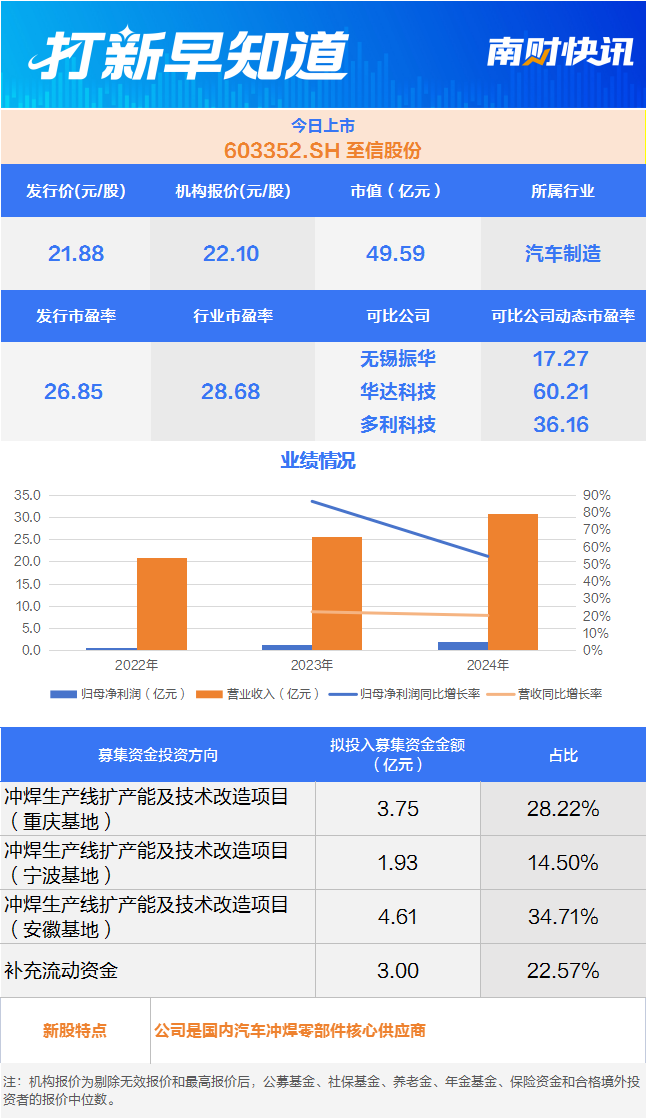
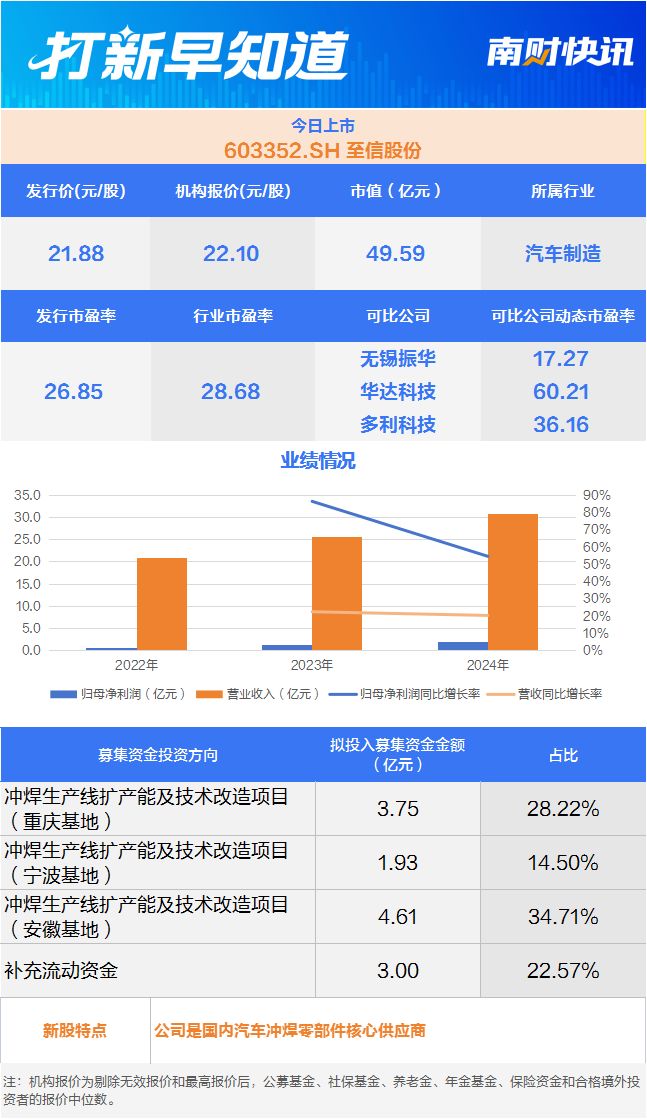
Group 1 - The core viewpoint of the article is the listing of Zhixin Co., Ltd. (603352.SH) on the Shanghai Stock Exchange, focusing on its business in automotive stamping parts and related molds [1][2]. - Zhixin Co., Ltd. was established in 1995 and is headquartered in Chongqing Liangjiang New Area, specializing in the development, processing, production, and sales of automotive stamping parts, including cold stamping parts, hot-formed parts, welding assemblies, and molds [1][2]. - The company has a market capitalization of 4.959 billion yuan and an issuance price of 21.88 yuan per share, with an issuance price-to-earnings ratio of 26.85, compared to the industry average of 28.68 [2]. Group 2 - The company plans to invest a total of 10.29 billion yuan in expanding production capacity and technological upgrades for its stamping production lines across various bases, including Chongqing, Ningbo, and Anhui [4]. - Zhixin Co., Ltd. has established itself as a significant player in the automotive parts sector in Southwest China, with a competitive edge in the market [8]. - The company is actively expanding its business in the new energy vehicle sector, collaborating with traditional clients like Changan Automobile and Geely, as well as new brands such as BYD and NIO [8]. Group 3 - The company has a high customer concentration risk, with sales to its top five customers accounting for 73.86%, 79.77%, 74.82%, and 68.00% of its revenue from 2022 to the first half of 2025 [9].
汽车冲焊零部件核心供应商,理想汽车“小伙伴”今日上市 | 打新早知道
2 1 Shi Ji Jing Ji Bao Dao· 2026-01-14 23:07
Core Viewpoint - Zhixin Co., Ltd. (603352.SH) has been listed on the Shanghai Stock Exchange, focusing on the development, processing, production, and sales of automotive stamping parts and related molds, with a significant market presence in the southwest region of China [1][4]. Company Overview - Established in 1995 and headquartered in Chongqing Liangjiang New Area, Zhixin Co., Ltd. specializes in cold stamping parts, hot-formed parts, welding assemblies, and molds [1]. - The company has become one of the larger private automotive parts manufacturers in southwest China, with a strong competitive position in the automotive stamping parts sector [4]. Financial Information - The initial public offering (IPO) price was set at 21.88 yuan per share, with an institutional offering price of 22.10 yuan per share, resulting in a market capitalization of 4.959 billion yuan [2]. - The company's earnings per share (EPS) is projected with a price-to-earnings (P/E) ratio of 26.85, compared to comparable companies such as Wuxi Zhenhua (17.27) and Huada Technology (60.21) [2]. Market Position and Growth - By mid-2025, Zhixin Co., Ltd. is expected to capture market shares of 6.21%, 4.85%, and 4.59% in cabin, side, and floor products, respectively [4]. - The company has actively expanded into the new energy vehicle (NEV) sector, collaborating with traditional clients like Changan Automobile and Geely, as well as new brands such as BYD and NIO [4]. Client Concentration Risk - The company faces a significant client concentration risk, with sales to its top five customers amounting to 1.544 billion yuan, 2.045 billion yuan, 2.310 billion yuan, and 1.091 billion yuan from 2022 to the first half of 2025, representing 73.86%, 79.77%, 74.82%, and 68.00% of total revenue, respectively [5].
国泰海通|汽车:中欧电动汽车反补贴案取得阶段性进展
国泰海通证券研究· 2026-01-14 12:25
Core Viewpoint - The article discusses the significant framework consensus reached between China and the EU regarding the anti-subsidy case against Chinese electric vehicles, transitioning from high tariffs to a constructive "minimum price commitment" mechanism [1][2]. Group 1: Framework Consensus - On January 12, 2026, the Chinese Ministry of Commerce announced that China and the EU have reached an important framework consensus to replace high tariffs with a minimum price commitment mechanism [1]. - The EU had previously imposed anti-subsidy taxes on Chinese electric vehicles, with rates reaching up to 35.3%, significantly impacting the profitability and competitiveness of Chinese automakers in the European market [1]. - The consensus was reached after ongoing negotiations since October 2023, with the EU officially imposing anti-subsidy taxes in April 2024 [1]. Group 2: Price Commitment Mechanism - The EU will issue guidelines for submitting price commitment applications, allowing eligible Chinese electric vehicle companies to replace anti-subsidy taxes with price commitments [2]. - This arrangement reflects the willingness of both parties to resolve differences through dialogue within the framework of multilateral trade rules, contributing to the stability of the automotive industry and supply chain [2]. - The implementation of the price commitment mechanism is expected to alleviate the tariff pressure on Chinese electric vehicle exports to Europe, potentially lowering overall export costs and improving profit margins [2]. Group 3: Investment Recommendations - The article recommends investing in Chinese electric vehicle companies that have established a solid presence in the European market, with strong channels and product foundations [3].