巨子生物

Search documents
开源证券晨会纪要-20250701
KAIYUAN SECURITIES· 2025-07-01 14:45
| 昨日涨跌幅后五行业 | | --- | 2025 年 07 月 02 日 他 研 究 开源晨会 0702 ——晨会纪要 沪深300 及创业板指数近1年走势 数据来源:聚源 -16% 0% 16% 32% 48% 64% 2024-07 2024-11 2025-03 沪深300 创业板指 昨日涨跌幅前五行业 | 行业名称 | 涨跌幅(%) | | --- | --- | | 综合 | 2.601 | | 医药生物 | 1.804 | | 银行 | 1.535 | | 有色金属 | 1.489 | | 公用事业 | 1.046 | | 数据来源:聚源 | | | 行业名称 | 涨跌幅(%) | | --- | --- | | 计算机 | -1.182 | | 商贸零售 | -0.788 | | 通信 | -0.452 | | 传媒 | -0.376 | | 电力设备 | -0.373 | 数据来源:聚源 吴梦迪(分析师) wumengdi@kysec.cn 证书编号:S0790521070001 观点精粹 总量视角 【宏观经济】"两重"接力支撑 PMI,预计 Q2 GDP 约 5.2%——兼评 6 月 PM ...

重仓年轻人,比任何时候都重要
点拾投资· 2025-07-01 13:41
Core Viewpoint - The investment landscape is shifting towards understanding the consumption patterns of the younger generation, particularly the post-95 demographic, which is driving new consumption trends focused on emotional value rather than just functional satisfaction [1][2]. Group 1: New Consumption Trends - The core driving force of new consumption has transitioned from "functional satisfaction" to "emotional value," with young consumers willing to pay a premium for experiences and cultural recognition [2]. - The Z generation's consumption preferences are reshaping the market, challenging traditional valuation frameworks used in mature industries like liquor and home appliances [2][36]. - Investment strategies must adapt to these changes by focusing on emotional needs and innovative product categories that resonate with younger consumers [2][36]. Group 2: Investment Strategies - To effectively invest in new consumption, it is suggested to leverage fund managers who understand the younger demographic, such as those from Penghua Fund, which employs post-95 fund managers [3][36]. - The Penghua Fund's "Here is China" series has successfully engaged young consumers by appealing to their patriotic sentiments, showcasing the importance of aligning investment products with youth culture [3][36]. - The Penghua Fund's investment approach includes a mix of active and passive products, targeting sectors that emphasize experiential and emotional consumption [2][4]. Group 3: Fund Performance and Manager Insights - Fund manager Xie Tianyuan, one of the youngest in the industry, has achieved a net value growth rate of 27.55% in 2025, indicating strong performance in the new consumption sector [6]. - Xie Tianyuan's portfolio includes significant holdings in companies like Pop Mart (10.48%) and other brands that cater to the emotional and experiential needs of young consumers [7][6]. - His dual identity as both an investor and a consumer allows him to understand the underlying narratives and cultural significance of various IPs, enhancing his investment decision-making [8][9]. Group 4: ETF Products - The Hong Kong Stock Consumption 50 ETF (159265) is highlighted as a stable investment option that aligns with the "self-pleasing" consumption characteristics of the Z generation [20][29]. - This ETF focuses on companies that resonate with the younger demographic, emphasizing local brands and experiences over traditional imported goods [20][21][23]. - The ETF's structure is designed to capture the growth potential of new consumption trends, differentiating itself from traditional indices that are heavily weighted towards mature sectors like liquor [30][32]. Group 5: Market Dynamics - The shift in consumer demographics is leading to a new era of investment opportunities, as younger entrepreneurs and companies emerge to meet the evolving demands of the market [35][36]. - The current economic transition from debt-driven to innovation and consumption-driven growth highlights the importance of investing in youth-oriented sectors [35][36]. - The emergence of new consumption patterns indicates that understanding and investing in the preferences of younger consumers will be crucial for future growth [36][37].


美护商社行业周报:锦波生物引入养生堂战略投资,老铺黄金加密上海布局-20250701
Guoyuan Securities· 2025-07-01 13:11
Investment Rating - The report maintains an "Overweight" rating for the industry, with a focus on new consumption sectors such as beauty care, IP derivatives, and gold jewelry [5][29]. Core Insights - The report highlights significant market performance for the week of June 23-27, 2025, with retail, social services, and beauty care sectors increasing by 4.56%, 4.61%, and 1.04% respectively, outperforming the Shanghai Composite Index which rose by 1.91% [14][17]. - Key events include the strategic investment of 3.4 billion yuan by Jianbo Biological into Yangshengtang, and the successful IPO of Yingtong Holdings on the Hong Kong Stock Exchange [3][28]. Summary by Sections Market Performance - The retail, social services, and beauty care sectors ranked 9th, 8th, and 24th among 31 primary industries, with notable increases in sub-sectors such as education, professional chains, and trade, which rose by 7.47%, 7.42%, and 5.2% respectively [14][17]. Key Industry Data and News - In the beauty care sector, significant developments include the entry of Kefu Mei into Malaysia's Watsons, becoming the first Chinese efficacy skincare brand in the region, and the announcement by the National Medical Products Administration regarding the management of cosmetic raw materials [23][24]. - Jianbo Biological's restructuring of its collagen product to a medical device category and the successful listing of Yingtong Holdings are also noteworthy [3][24]. Investment Recommendations - The report recommends focusing on companies such as Shangmei Co., Ltd., Juzhi Biological, Marubi Biological, Runben Co., Ltd., Proya, Chaohongji, Blukoo, and Furuida as potential investment targets within the highlighted sectors [5][29].


巨子生物承认检测方法有局限,华熙生物发文暗指其“伪科学”
Nan Fang Du Shi Bao· 2025-07-01 12:11
Core Viewpoint - The article discusses the ongoing dispute between Huaxi Biological and Juzhi Biological regarding the measurement and standards of recombinant collagen products, emphasizing the importance of scientific validation and the need for reliable testing methods [1][5][7]. Group 1: Huaxi Biological's Position - Huaxi Biological published an article asserting that claims without scientific testing are pseudoscience, specifically targeting the lack of unified testing methods for recombinant collagen [1][7]. - The company argues that if the actual content of recombinant collagen cannot be accurately measured, then claims about its presence or efficacy become unverifiable, thus lacking scientific credibility [7][8]. - Huaxi Biological emphasizes the need for collaborative efforts to explore the limitations of current testing methods and to develop more precise standards, rather than evading verification [7][8]. Group 2: Juzhi Biological's Response - Juzhi Biological acknowledged the limitations of its existing quality standards and testing methods in a statement, indicating a need for continuous optimization to meet industry advancements [5][6]. - The company defended its testing methods by referencing national standards, claiming that the methods used by critics were not validated and therefore produced inaccurate results [6][8]. Group 3: The Role of "Big Mouth Doctor" - The influencer "Big Mouth Doctor" (Hao Yu) has been involved in the dispute, previously criticizing Juzhi Biological for alleged false claims regarding recombinant collagen content [1][6]. - Despite being silenced on social media, "Big Mouth Doctor" published an article aligning with Huaxi Biological's views on the standards of scientific validation, quoting philosophers on the nature of science [9][12]. - There are speculations about a potential conflict of interest between "Big Mouth Doctor" and Huaxi Biological due to their financial connections, suggesting that the dispute may have underlying commercial motivations [12].

“中国首富”34亿投资了“山西女首富”!
商业洞察· 2025-07-01 10:30
Core Viewpoint - The strategic investment by Zhong Shanshan, the founder of Nongfu Spring, in Jinbo Biological represents a significant shift in the competitive landscape of the medical beauty industry in China, aiming to leverage the growing market for recombinant collagen products and enhance market presence through collaboration with established brands [1][36][37]. Group 1: Investment Details - Jinbo Biological announced a strategic partnership with Yangshengtang, raising 2 billion yuan through a private placement, marking a record for cash capital increases on the Beijing Stock Exchange [3][4]. - The investment will be used for developing a humanized collagen FAST database and product development, with 1.15 billion yuan allocated for this purpose and 850 million yuan for working capital [3]. - Following the announcement, Jinbo Biological's stock price surged, closing at 355.96 yuan per share, with a market capitalization of 40.96 billion yuan [6]. Group 2: Company Backgrounds - Zhong Shanshan, aged 71, is a legendary entrepreneur who founded Nongfu Spring and Yangshengtang, creating a business empire valued over 400 billion yuan [11]. - Yang Xia, the 51-year-old founder of Jinbo Biological, transitioned from academia to entrepreneurship, focusing on synthetic collagen for medical applications after identifying challenges in organ preservation [12][13]. Group 3: Market Potential - The recombinant collagen product market in China is projected to grow at a compound annual growth rate of 44.93%, reaching 58.57 billion yuan by 2025 and exceeding 219.38 billion yuan by 2030 [25][26]. - Jinbo Biological's revenue is expected to reach 1.443 billion yuan in 2024, reflecting an 84.92% year-on-year increase, with a net profit of 732 million yuan, up 144.27% [18]. Group 4: Strategic Synergies - The partnership is expected to enhance Yangshengtang's product line with high-end collagen ingredients, while Jinbo Biological can leverage Yangshengtang's extensive retail network of over 300,000 outlets to penetrate the consumer market [29][36]. - The collaboration aims to transform Jinbo Biological from a technology leader to a market leader, with the anticipated launch of new products in the third quarter [31]. Group 5: Competitive Landscape - The medical beauty industry is highly competitive, with Jinbo Biological facing challenges from established players like Huaxi Biological and Aimeike, which are also expanding into recombinant collagen [34]. - Jinbo Biological's dynamic price-to-earnings ratio of over 50 requires sustained high growth to maintain investor confidence, especially as sales expenses are projected to rise significantly [34][35].


钟睒睒,投了山西女首富
创业家· 2025-07-01 10:01
Core Viewpoint - The article discusses the significant investment by Zhong Shanshan in Jinbo Biological, a company specializing in recombinant collagen products, highlighting the potential for growth in the medical beauty industry and the strategic collaboration between the two entities [4][6][12]. Group 1: Investment Details - Jinbo Biological announced two transactions, including introducing Yangshengtang as a strategic investor, with a total transaction amount reaching 3.4 billion yuan [5][8]. - The strategic investment involves issuing up to 7.1757 million shares, representing 6.24% of the pre-issue total share capital, aiming to raise no more than 2 billion yuan [8]. - Yang Xia, the founder of Jinbo Biological, transferred 5.7533 million shares to Hangzhou Jiushi at a price of 243.84 yuan per share, totaling 1.403 billion yuan [9][10]. Group 2: Company Background - Jinbo Biological, founded by Yang Xia, focuses on recombinant human collagen products and has achieved a market value of 40 billion yuan [6][18]. - The company has developed a range of products, including recombinant type III collagen, which has been widely adopted in medical and cosmetic applications [22][23]. - Jinbo Biological's revenue for 2024 is projected to be 1.443 billion yuan, reflecting a year-on-year growth of 84.92%, with a net profit of 732 million yuan, marking an increase of over 140% [23]. Group 3: Market Dynamics - The medical beauty industry, particularly the recombinant collagen segment, is experiencing rapid growth, with high consumer interest and significant market potential [26][30]. - The article notes that the pursuit of beauty is a strong driver for repeat purchases, making this sector highly lucrative [30]. - Jinbo Biological's products have gained popularity, with its core product, the injectable recombinant type III collagen, being used in over 4,000 medical institutions [23][24].

医美化妆品5月月报:美丽田园股东CPE退出主要股东,618强品牌美妆龙头和新锐功效品牌脱颖而出-20250701
KAIYUAN SECURITIES· 2025-07-01 09:02
Investment Rating - The investment rating for the retail industry is "Positive" (maintained) [1] Core Views - The report highlights the strong performance of high-end brands and emerging effective brands in the beauty and medical aesthetics sectors, particularly during the 618 shopping festival, which saw a total e-commerce sales of 8,556 billion yuan, a year-on-year increase of 15.2% [8][36] - The medical aesthetics market is expected to grow significantly with the approval of new products, such as the first compliant lipolytic injection in China, which is projected to expand the market from 135 million yuan in 2023 to 805 million yuan by 2025 [31][32] Summary by Sections Market Review - The beauty care index rose by 2.55% in May 2025, ranking 14th among all primary industries, underperforming the overall market [16] - In May, the top performers in the medical aesthetics sector included Kedi-B (+61.3%), Sihuan Pharmaceutical (+36.1%), and East China Pharmaceutical (+15.1%) [21][26] - In the cosmetics sector, the leading companies were Lafang Jiahua (+28.0%), Shuiyang Co. (+24.5%), and Babi Co. (+19.1%) [27][29] Medical Aesthetics - The approval of Mai Nuo Wei's "Xian Su" injection marks a significant breakthrough in the domestic lipolytic market, with a projected market size increase to 8.05 billion yuan by 2025 [31][32] - The exit of CPE as a major shareholder in Meili Tianyuan is expected to optimize the company's governance structure and enhance its market position [32] Cosmetics - The 618 shopping festival saw a total GMV of 659.09 billion yuan in the beauty category, with international high-end brands showing resilience and growth due to strong brand effects [8][41] - Domestic brands like Pechoin and Han Shu led the sales on platforms like Tmall and Douyin, with significant growth rates for new brands [44] Investment Recommendations - The report recommends focusing on strong domestic beauty brands and those benefiting from high-growth segments, highlighting companies like Shangmei Co., Maogeping, and Pechoin as key investment opportunities [47][48] - In the medical aesthetics sector, companies like Aimeike and Kedi-B are recommended for their potential growth driven by new product launches and market expansion [47][48] Market Trends - The report notes a shift towards "emotional consumption" in the beauty sector, with consumers increasingly seeking products that offer aesthetic and therapeutic benefits [48] - The overall market is expected to continue evolving with new product introductions and innovative marketing strategies as the industry enters a seasonal transition [49]
华熙和巨子这场女首富之间的“脸面”之争,结果由“里子”决定
Sou Hu Cai Jing· 2025-07-01 04:42
Core Insights - The article discusses a significant commercial battle in the beauty industry, particularly focusing on the competition between two major players, Huaxi Biological and Juzhi Biological, over the standards of recombinant collagen products [3][4][8] - The conflict highlights deeper issues within the biotechnology sector, such as the lack of research and development (R&D) investment and the prevalence of concept marketing over scientific validation [9][13][20] Group 1: Industry Competition - The battle over recombinant collagen standards has been ongoing for over a month, revealing a struggle for market share and consumer trust in the beauty sector [3][4] - The conflict was ignited by a report from beauty blogger "Big Mouth Doctor" questioning the amino acid content in Juzhi Biological's product, leading to public scrutiny [4][6] - Juzhi Biological's stock price fell by 37.12% from its peak on May 20 to June 23, resulting in a market value loss of 33.2 billion HKD, while Huaxi Biological's stock saw a slight increase of approximately 1.9% during the same period [8] Group 2: Research and Development Shortcomings - Juzhi Biological admitted to the limitations of its current testing methods, indicating a lack of adequate R&D investment, which was only 1.9% of its revenue in 2024, down from 2.1% in 2023 [9][10] - In contrast, Huaxi Biological and Jinbo Biological had R&D expense ratios of 8.68% and 10.89% respectively, showcasing a significant disparity in investment in innovation [9] - The article emphasizes the need for Juzhi Biological to enhance its R&D efforts to avoid future crises and to better respond to market challenges [10][13] Group 3: Industry Standards and Consumer Trust - The absence of national standards for recombinant collagen testing has led to confusion among consumers, as different companies use varying testing methods, resulting in inconsistent product quality [6][15] - The article argues that the reliance on concept marketing rather than scientific validation is unsustainable and can lead to significant reputational damage for companies [16][20] - The ongoing battle serves as a wake-up call for the industry to prioritize scientific rigor and consumer trust over short-term marketing gains [17][21]

34亿,钟睒睒投了山西女首富
华尔街见闻· 2025-07-01 04:35
Core Viewpoint - The article discusses a significant strategic partnership between Jinbo Biological (832982.BJ) and Yangshengtang Co., Ltd., which involves a major share issuance and a substantial reduction in shareholding by Jinbo's controlling shareholder, Yang Xia [3][4][5][6]. Group 1: Strategic Partnership and Share Issuance - Jinbo Biological plans to issue 6.24% of its shares to Yangshengtang for an amount not exceeding 2 billion yuan, potentially marking the largest cash capital increase in the history of the Beijing Stock Exchange [5][21][22]. - Following the transaction, Yangshengtang will become the second-largest shareholder of Jinbo Biological, holding a total of 10.58% of the company's shares [23]. Group 2: Share Reduction by Controlling Shareholder - Yang Xia, the controlling shareholder of Jinbo Biological, will transfer 5% of her shares to a partnership controlled by Yangshengtang, with a total reduction amounting to 1.403 billion yuan, setting a record for the largest share reduction in the history of the Beijing Stock Exchange [6][18][20]. - This transaction is notable as it marks Yang Xia's first reduction of shares since the company's listing [16][18]. Group 3: Market Context and Implications - The total market capitalization of Jinbo Biological is approximately 40.959 billion yuan, representing 12.82% of the total market capitalization of 268 companies on the Beijing Stock Exchange [26][27]. - The article highlights the potential for increased sales and distribution capabilities for Jinbo Biological through the partnership with Yangshengtang, leveraging its extensive distribution network [11][34][35]. Group 4: Competitive Landscape and Future Prospects - Jinbo Biological faces increasing competition in the medical aesthetics market, particularly with its flagship product, Wei Yimei, as competitors like Juzhi Biological and Chuangjian Medical are entering the market [38][39]. - The partnership with Yangshengtang is seen as a strategic move to enhance Jinbo Biological's marketing and distribution efforts, particularly in skincare products, which currently represent a small portion of its revenue [40][41][42].

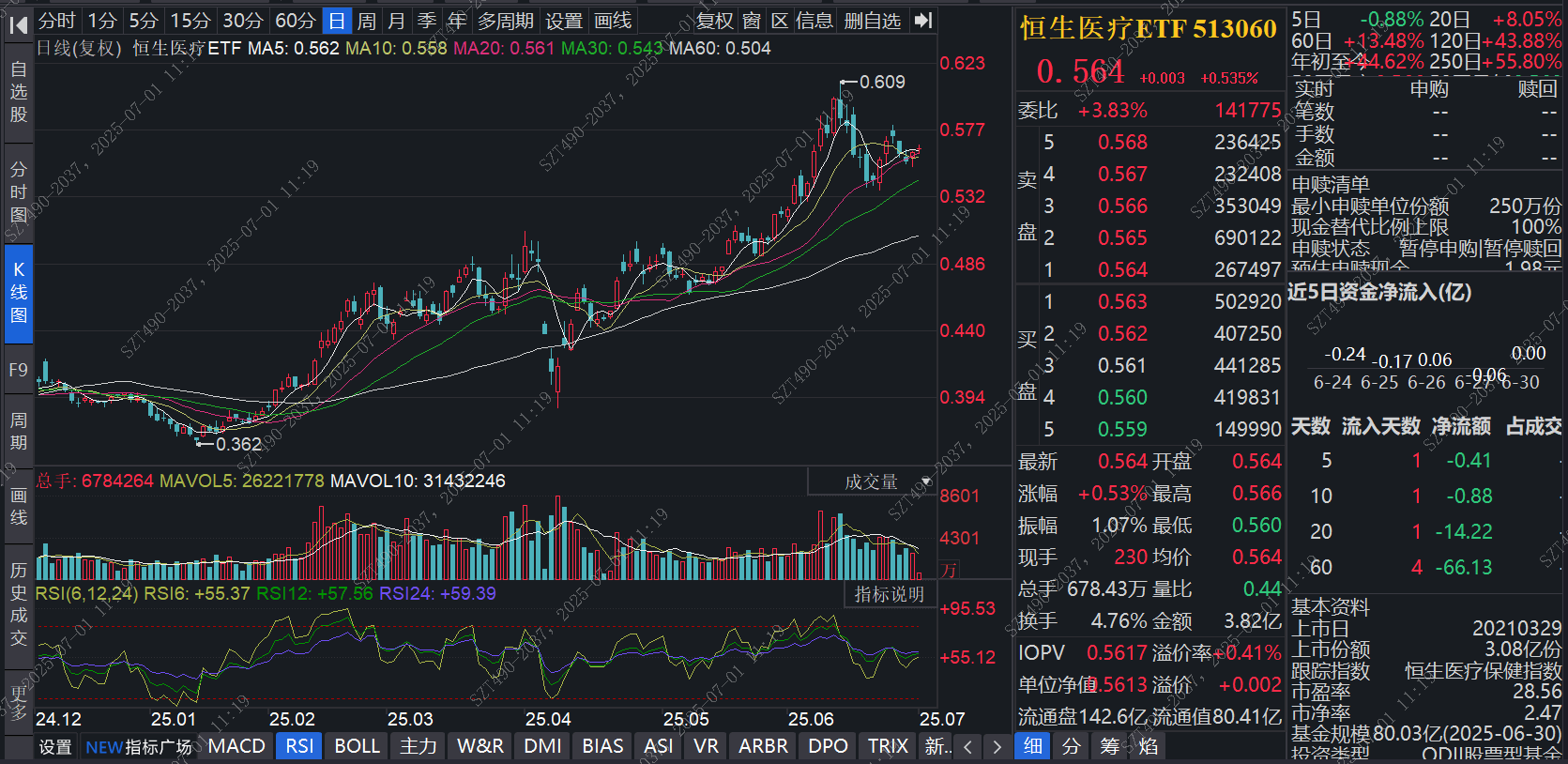
创新药全链条支持政策落地!恒生医疗ETF(513060)溢价交投火爆,估值修复双击启动
Sou Hu Cai Jing· 2025-07-01 03:44
Core Insights - The article highlights the significant policy changes aimed at supporting the development of innovative drugs in China, marking a new phase of systematic support for the industry [2][3][6] Group 1: Policy Framework - The policy document establishes a comprehensive support framework covering the entire lifecycle of innovative drugs, focusing on breaking through key bottlenecks in research, approval, payment, and application [3][4] - A major breakthrough is the strategic use of medical insurance data, which will be centralized on a national platform to inform drug development decisions, representing a milestone in the utilization of medical insurance data in China [3][4] - The introduction of a "commercial health insurance innovative drug catalog" creates a tiered protection system, allowing high-value innovative drugs to operate in an independent market space [3][4] Group 2: R&D and Market Transformation - The policy drives innovation in drug development and market transformation through multi-level institutional design, encouraging insurance capital to form "patient capital" to address long-term funding challenges [4][6] - A dual-track mechanism for dynamic adjustment of the medical insurance catalog and targeted policy guidance for enterprises significantly enhances approval efficiency [4][6] - The establishment of a multi-faceted payment system supports innovative drug cases exempt from payment by disease type, optimizing cash flow through prepayment and immediate settlement [4][5] Group 3: Implementation Challenges - The effective execution of the policy faces systemic challenges, particularly in hospital management efficiency and the awareness of clinical physicians regarding new drugs [5][6] - Data security and compliance boundaries require careful attention, as the specifics of operational standards and privacy protection need to be clarified [5][6] - The sustainability of payment capabilities is a long-term issue, necessitating a delicate balance between fund capacity and innovation incentives [5][6] Group 4: Strategic Shift and Global Competitiveness - The policy signifies a strategic shift towards a "demand-driven" model for innovative drug development, enhancing patient access and international competitiveness [6] - It emphasizes the importance of collaboration among various departments to leverage medical insurance data for research decisions and to break down barriers to clinical accessibility [6] - The policy also supports the globalization of innovative drugs through platforms in Hong Kong and Macau, aiming to convert domestic market advantages into international influence [6] Group 5: Investment Opportunities - The Hengsheng Medical ETF (513060) is positioned as a core vehicle for investing in innovative drugs, benefiting from the scarcity of underlying assets and the anticipated commercial value reassessment [7] - The ETF's holdings include leading companies that are direct beneficiaries of the policy changes, with over 40% of its biotech companies having overseas rights [7] - The article suggests that the policy is not a short-term benefit but rather a long-term growth engine through data-enabled research and dual-track payment systems [7]