博时基金

Search documents
1月PMI回落,关注后续工业品价格回调可能性
Xin Lang Cai Jing· 2026-02-09 08:04
Group 1: Market Liquidity and Monetary Policy - The central bank's net injection of 352.5 billion yuan on January 30 indicates a stable liquidity environment, with overnight funds becoming more relaxed [1] - The interbank liquidity remained stable with minor fluctuations in overnight rates, and the weighted DR007 rate decreased by 11 basis points to 1.48% on February 5 [1][12] - The central bank conducted a 3-month reverse repurchase operation of 800 billion yuan, with a net injection of 100 billion yuan due to the maturity of 700 billion yuan in reverse repos [1][12] Group 2: Economic Indicators - China's official manufacturing PMI for January recorded 49.3%, down from 50.1% in the previous month, indicating a contraction in the manufacturing sector [2][13] - The non-manufacturing PMI also fell to 49.4% from 50.2%, suggesting a decline in service sector activity [2][13] - The composite PMI dropped to 49.8% from 50.7%, reflecting overall economic weakness amid insufficient domestic demand and high industrial inventory levels [2][13] Group 3: Investment Opportunities - The Guokai ETF (159650) focuses on policy financial bonds, which are characterized by high credit ratings, large volumes, and good liquidity, making them attractive investment options [3][14] - The product features of Guokai ETF include good liquidity, low credit risk, and reasonable risk-return ratios, making it a suitable tool for short-duration allocations [3][14]
大幅净流出结束!ETF市场上周净流入百亿元,跨境股票ETF净流入174亿
Ge Long Hui· 2026-02-09 06:00
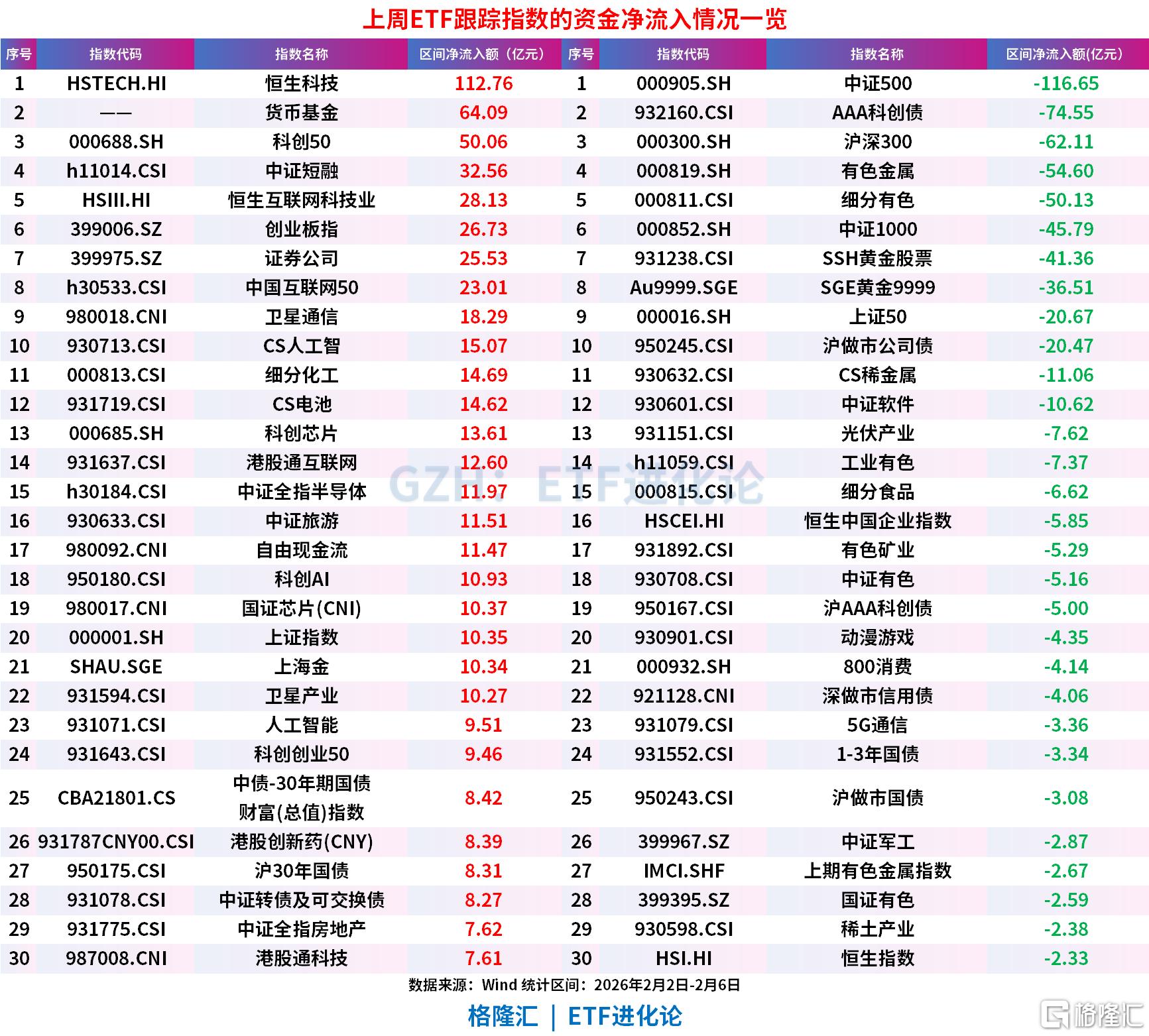
Market Performance - The A-share market saw a decline across major indices last week, with the small and medium-sized board index, Shanghai Composite Index, and CSI 300 Index showing returns of -1.16%, -1.27%, and -1.33% respectively. In contrast, the STAR 50, ChiNext Index, and CSI 500 Index had poorer returns of -5.76%, -3.28%, and -2.68% respectively [1] - Trading volume for major indices decreased last week, with the food and beverage, textile and apparel, and banking sectors leading in returns at 4.44%, 2.23%, and 2.08% respectively. Conversely, the non-ferrous metals, communication, and electronics sectors lagged with returns of -8.46%, -6.73%, and -5.09% respectively [1] Fund Flows - The ETF market experienced a net inflow of 148.79 billion yuan last week, with cross-border stock ETFs seeing a net inflow of 174.48 billion yuan, while stock ETFs had a net outflow of 14.52 billion yuan [2] - Major indices such as Hang Seng Tech, money market funds, STAR 50, and ChiNext Index saw net inflows of 112.76 billion yuan, 64.09 billion yuan, 50.06 billion yuan, and 26.73 billion yuan respectively. On the other hand, CSI 500, AAA STAR bonds, and CSI 300 experienced net outflows of 116.65 billion yuan, 74.55 billion yuan, and 62.11 billion yuan respectively [2][4] ETF Performance - Specific ETFs such as Huabao Tianyi ETF, Hang Seng Tech ETF, and STAR 50 ETF saw net inflows of 40.59 billion yuan, 38.84 billion yuan, and 30.31 billion yuan respectively. However, the CSI 500 ETF and CSI 300 ETF experienced significant net outflows of 107.94 billion yuan and 56.96 billion yuan respectively [5][9] - The average decline for stock ETFs was 12.22%, with the Hang Seng consumption ETFs showing a relatively high increase of 4.81% [13][15] New ETF Products - A total of 92 funds were reported last week, including 17 ETFs, with new products such as the Hang Seng A-share Electric Grid Equipment ETF and the National Index Oil and Gas ETF [21] - The domestic ETF market has become the largest in Asia, surpassing Japan in scale as of 2025, reflecting rapid growth and diversification since its inception in 2004 [22] New Index Launch - The Hang Seng Index Company introduced the Hang Seng Dual Technology Index, which allocates 75% of its weight to the Hang Seng Technology Index and 25% to the Hang Seng Biotech Index, aiming to reflect the market capitalization differences and represent dual themes [23]

云从科技股价涨5.09%,博时基金旗下1只基金位居十大流通股东,持有969.27万股浮盈赚取726.95万元
Xin Lang Cai Jing· 2026-02-09 05:22
Group 1 - The core viewpoint of the news is that CloudWalk Technology has seen a stock price increase of 5.09%, reaching 15.49 CNY per share, with a trading volume of 292 million CNY and a turnover rate of 2.29%, resulting in a total market capitalization of 16.087 billion CNY [1] - CloudWalk Technology, established on March 27, 2015, and listed on May 27, 2022, is based in Shanghai and focuses on providing efficient human-machine collaboration operating systems and industry solutions, aiming to promote the industrialization of artificial intelligence and the intelligent transformation of various industries [1] - The revenue composition of CloudWalk Technology is as follows: 75.55% from artificial intelligence solutions, 24.19% from human-machine collaboration operating systems, and 0.25% from other sources [1] Group 2 - Among the top ten circulating shareholders of CloudWalk Technology, one fund from Bosera Fund ranks, specifically the Bosera SSE STAR Market Artificial Intelligence ETF, which entered the top ten in the third quarter with 9.6927 million shares, accounting for 1.16% of circulating shares, resulting in an estimated floating profit of approximately 7.2695 million CNY [2] - The Bosera SSE STAR Market Artificial Intelligence ETF was established on March 11, 2025, with a current size of 1.21 billion CNY and a year-to-date return of 7.11%, ranking 1157 out of 5580 in its category; since inception, it has achieved a return of 26.88% [2] - The fund manager of the Bosera SSE STAR Market Artificial Intelligence ETF is Li Qingyang, who has been in the position for 2 years and 9 days, managing total assets of 9.348 billion CNY, with the best fund return during his tenure being 187.05% and the worst being 0.63% [2]

恒生科技指数“越跌越买”,近5日净流入超69亿元
Jing Ji Wang· 2026-02-09 02:06
Market Overview - The A-share market saw a rebound with the Shanghai Composite Index returning to 4100 points, while the ChiNext Index experienced a recovery after hitting a low [1] - The coal sector showed significant gains, and the space photovoltaic concept stocks continued their upward trend, whereas AI application stocks declined [1] ETF Market Dynamics - The stock ETF market experienced a net outflow of approximately 1.6 billion yuan, with notable outflows from products like the Huatai-PB CSI 300 ETF and the CSI 500 ETF [1] - The total scale of the stock ETF market reached 4.15 trillion yuan, with the Hang Seng Technology Index seeing a net inflow of 2.884 billion yuan, marking it as the top sector for fund inflows [3][5] Fund Inflows and Outflows - The top three ETFs by net inflow included the Hang Seng Technology Index ETF (1.021 billion yuan), the Hang Seng Internet ETF (957 million yuan), and the Sci-Tech 50 ETF (910 million yuan) [4] - The Huatai-PB CSI 300 ETF experienced the largest net outflow at 2.597 billion yuan, followed by the CSI 500 ETF with 1.662 billion yuan [8] Fund Management Insights - Leading fund companies like E Fund and Huaxia Fund reported significant net inflows across their ETFs, with E Fund's total ETF scale reaching 655.65 billion yuan, reflecting a net inflow of 2.33 billion yuan [5] - The market remains active with a high trading volume, particularly in the context of approaching the Chinese New Year holiday, indicating sustained liquidity support [9]

资金加仓恒生科技等赛道 宽基核心资产受关注
Zhong Guo Zheng Quan Bao· 2026-02-08 21:55
Group 1 - The consumer and photovoltaic sectors saw significant gains last week, with several related ETFs rising over 3% [1][2] - The A-share market's broad-based products experienced active trading, with ETFs tracking the CSI A500 index exceeding a total transaction volume of 250 billion yuan [1][2] - The market outlook for February suggests a continuation of the upward trend, driven by concentrated earnings forecasts and the recovery of leading companies' performance [1][4] Group 2 - The Hong Kong consumer sector performed strongly, with ETFs such as the Hang Seng Consumer ETF leading the gains [2] - Gold-related ETFs faced a downturn, with an average decline of over 5% across 14 commodity gold ETFs, and some gold stock ETFs dropping more than 13% [2] - The technology sector attracted significant capital inflow, with the Huatai-PineBridge Hang Seng Technology ETF seeing a net inflow of over 3.8 billion yuan last week [3] Group 3 - Several asset management institutions have released macro outlooks for China's equity market in 2026, highlighting diverse growth paths driven by the 14th Five-Year Plan [4][5] - Key investment areas identified include technology, manufacturing, renewable energy, healthcare, and emerging consumer sectors [4][5] - The market is expected to maintain a structural trend in February, with a focus on core growth assets that are currently at historical median valuation levels [5]
资金加仓恒生科技等赛道宽基核心资产受关注
Zhong Guo Zheng Quan Bao· 2026-02-08 20:22
Group 1 - The consumer and photovoltaic sectors saw significant gains, with several related ETFs rising over 3% last week, while gold and artificial intelligence sectors experienced declines, with some ETFs dropping over 9% [1][2] - A-shares market showed active trading in broad-based products, with ETFs tracking the CSI 500 index exceeding a total trading volume of 250 billion yuan, and those tracking the Sci-Tech 50 index surpassing 30 billion yuan [1][2] - The market outlook for February suggests a continuation of the upward trend, driven by concentrated earnings forecasts and the recovery of leading companies' performance, benefiting core assets [1][4] Group 2 - The Hong Kong consumer sector performed strongly, with ETFs such as the Hang Seng Consumer ETF leading the gains, while the photovoltaic sector also showed positive performance [1] - The gold sector underperformed, with commodity gold ETFs declining over 5%, and gold stock ETFs experiencing even greater declines, with some dropping over 13% [2] - The technology sector attracted significant capital inflow, with the Hang Seng Technology ETFs seeing substantial net inflows, particularly the Huatai-PineBridge Hang Seng Technology ETF, which had a net inflow of over 3.8 billion yuan last week [2] Group 3 - The satellite communication sector also experienced notable capital inflow, with the Yongying National Commercial Satellite Communication Industry ETF seeing a net inflow of over 1.8 billion yuan [3] - Several ETFs, including the Huazhong Gold ETF and the Southern CSI Nonferrous Metals ETF, reported net inflows exceeding 10 billion yuan this year [3] - Investment firms are focusing on five key areas for the Chinese equity market by 2026: technology, manufacturing, renewable energy, healthcare, and emerging experiential consumption [3] Group 4 - The market is expected to stabilize in February, with a shift in focus from January's credit and liquidity performance to macro and industry clues [4] - The "14th Five-Year Plan" is anticipated to provide a clearer framework for high-quality development and new growth drivers, stabilizing market perceptions of future growth [4] - Core assets are recommended for continued attention, as their valuations are at historical median levels, with stable profit expectations and increasing foreign capital inflow [4]
从“固收+”到“多元配置” 公募FOF乘风而起
Shang Hai Zheng Quan Bao· 2026-02-08 17:48
Group 1 - The core viewpoint of the articles highlights the significant growth and popularity of FOF (Fund of Funds) products in the A-share market, driven by strong demand from bank clients for diversified asset allocation in a low-interest-rate environment [1][6][7] - Since the beginning of 2026, FOF products have seen a surge in issuance, with many products being sold out in just one day, indicating a robust market interest [2][3] - The total issuance scale of new FOF products in 2026 has reached approximately 300 billion yuan, a substantial increase compared to 61.29 billion yuan in the same period of 2025 [2][3] Group 2 - Major banks are actively promoting FOF products, with several banks creating FOF preferred pools to enhance product visibility and growth [4][5] - The collaboration between banks and fund companies has led to significant increases in FOF product sizes, with some products reaching nearly 100 billion yuan in scale [5][6] - The shift from "fixed income +" to "multi-asset allocation" reflects a broader trend in the FOF market, as new products increasingly incorporate diverse asset classes, including equities and commodities [6][7] Group 3 - The unique advantage of FOF products lies in their ability to diversify investments and improve the risk-return profile, making them attractive in the current market environment where traditional fixed-income assets are underperforming [7] - FOF products are positioned as essential tools for investors seeking stable returns and wealth preservation in uncertain market conditions [7][8] - The focus for FOF management in 2026 will be on diversified allocation to mitigate risks rather than solely pursuing returns from individual asset classes [7]




“千亿ETF”仅剩3只!股票型ETF开年“失血”超7000亿元
Mei Ri Jing Ji Xin Wen· 2026-02-08 03:30
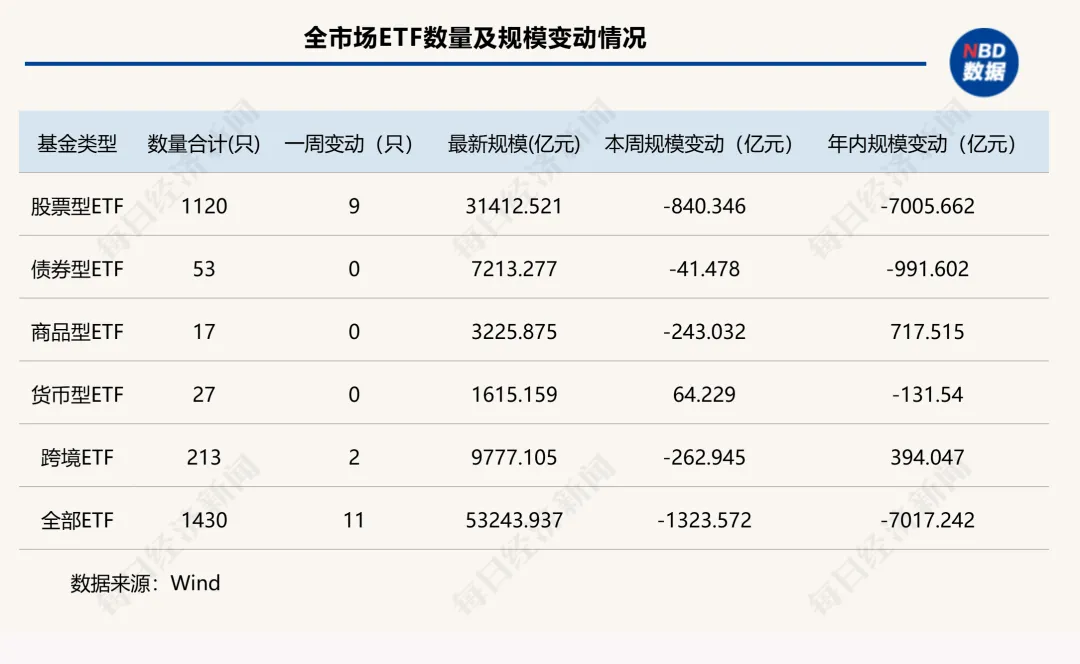
Market Overview - A-shares experienced fluctuations with major indices declining, including a 1.13% drop in the CSI 300 and a 3.28% drop in the ChiNext Index [1][16] - The ETF market is undergoing significant changes, with stock ETFs shrinking by over 700 billion yuan this year, reducing the number of "billion club" products to just three [1][16] ETF Market Dynamics - As of February 7, the total ETF market size decreased to 5.32 trillion yuan, with a weekly decline of 1,323 billion yuan [2][17] - Stock ETFs alone saw a reduction of 840.35 billion yuan, bringing their total size down to 31,412.52 billion yuan [3][18] - The number of ETFs listed reached 1,430, with 11 new ETFs introduced in the week, including 9 stock ETFs [2][17] Fund Management Changes - Fund size reshuffling is evident, with Guotai Fund maintaining its position in the top five, while Huabao Fund entered the top ten [1][22] - Major funds like Huaxia and E Fund have seen their ETF sizes shrink by over 100 billion yuan this year [1][22] Performance of Specific ETFs - The SGE Gold 9999 index saw a significant reduction of over 22 billion yuan, marking it as the largest decline among major indices [4][19] - The CSI 300 ETF managed by Huatai-PB has shrunk by over 2,000 billion yuan this year, now standing at 2,208.55 billion yuan [29][30] Institutional Fund Performance - Five institutions reported ETF size reductions exceeding 100 billion yuan, with Southern Fund experiencing the largest drop of 268.53 billion yuan [22][26] - Conversely, Huabao Fund and Hai Futong Fund both saw increases of over 30 billion yuan in their ETF sizes [23][26] Growth and Decline of ETFs - Only two products in the top 20 managed to achieve size growth, indicating a general trend of decline in the ETF market [26][27] - The "billion club" for ETFs has diminished, with only three members remaining due to widespread shrinkage [26][30]
基金大事件|恒生指数公司发布恒生双科技指数;公募FOF规模创历史新高.......
Zhong Guo Ji Jin Bao· 2026-02-07 09:10
Group 1: Industry Developments - The Ministry of Finance and the People's Bank of China have included electronic savings bonds in personal pension products to support the development of a multi-tiered pension system, which is expected to enhance investor enthusiasm and improve the quality of the personal pension system [2] - A shift in the collaboration model between banks and fund companies is observed, moving from a focus on product sales to a more service-oriented approach, emphasizing long-term customer value [4] - The Hong Kong Monetary Authority has released a financial technology promotion blueprint aimed at fostering responsible innovation and enhancing cross-border collaboration in the financial sector [12] Group 2: Market Trends - In January 2026, A-share new account openings surged to 4.9158 million, a 213% increase year-on-year, indicating a strong market interest [10] - The scale of public fund of funds (FOF) has reached a historical high of over 240 billion, driven by low interest rates and a demand for low-volatility products [11] - The semiconductor sector is highlighted as a key investment area, with fund managers noting significant growth potential in the domestic semiconductor industry over the next 3-5 years [15][16] Group 3: Regulatory Changes - The China Securities Regulatory Commission has introduced new guidelines for public fund performance benchmarks to address issues like "style drift" and ensure investor interests are prioritized [6][17] - The new regulations aim to standardize performance benchmarks and improve transparency in fund management practices [6][17] Group 4: Fund Launches - A total of 29 new public funds are set to launch in the first week of February 2026, with equity funds making up the majority [9] - The average subscription period for these new funds is approximately 12 days, indicating strong investor interest [9] Group 5: Stock Performance - In January 2026, 207 out of 307 recommended stocks by brokers saw price increases, with some stocks experiencing nearly 100% gains, reflecting a positive market outlook [14] - The Hang Seng Biotechnology Index recorded a 64.5% increase last year, marking its highest annual gain since inception [8]