
问界

Search documents
11月湖南车险上牌量发布,新能源车占比较上月增11%
Chang Sha Wan Bao· 2025-12-29 09:04
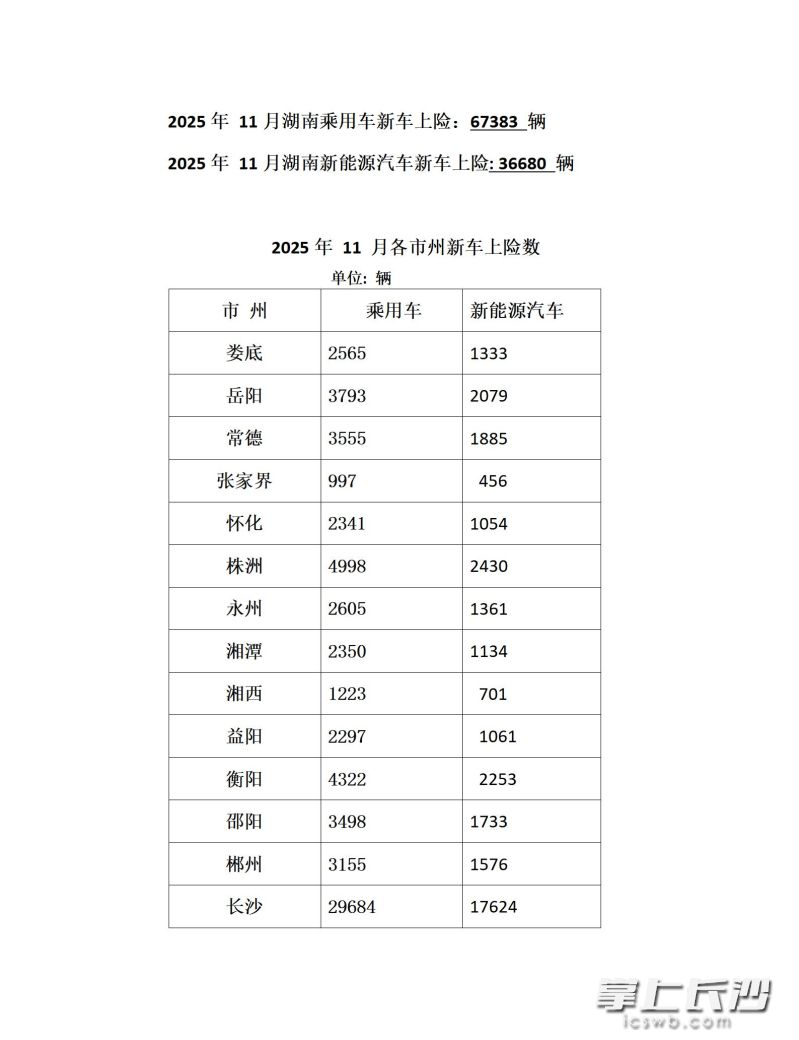
Core Insights - The report highlights a significant increase in new car registrations in Hunan Province, with a total of 67,383 vehicles registered in November, of which 36,680 were new energy vehicles (NEVs), representing 54.44% of the total, up from 43.33% the previous month [1][4]. Group 1: New Car Registrations - In November, Hunan Province saw a total of 67,383 new car registrations, with 36,680 being new energy vehicles, marking a month-over-month increase [1]. - The city of Changsha led the province with 29,684 new car registrations, followed by Zhuzhou with 4,998 and Hengyang with 4,322 [4]. Group 2: New Energy Vehicle Market - The proportion of new energy vehicles in Hunan's total new car registrations rose significantly, with seven cities reporting NEV registration rates above 50% in November [4]. - Changsha recorded the highest NEV registration rate at 59.37%, followed by Xiangxi Autonomous Prefecture at 57.32% and Yueyang at 54.81% [4]. Group 3: Leading Models and Brands - The top-selling model in November was the Wuling Hongguang MINI with 2,708 registrations, followed by the Nissan Sylphy with 1,607 and the Xiaomi YU7 with 1,007 [5]. - Notably, BYD secured six positions in the top 16 new car registrations, indicating its strong market presence despite no single model making it to the top three [5][8]. Group 4: Regional Performance - In Changsha, the Xiaomi YU7 was the best-selling model with 998 registrations, while the Wuling Hongguang MINI followed with 867 [9]. - Traditional fuel vehicles like the Nissan Sylphy and Toyota Camry continue to show strong demand, with the Camry ranking sixth in the overall provincial new car registration list [8].




2025车市盘点:蔚来新ES8狂降10万上市,集中爆发的大三排SUV还能火多久?
3 6 Ke· 2025-12-29 03:26
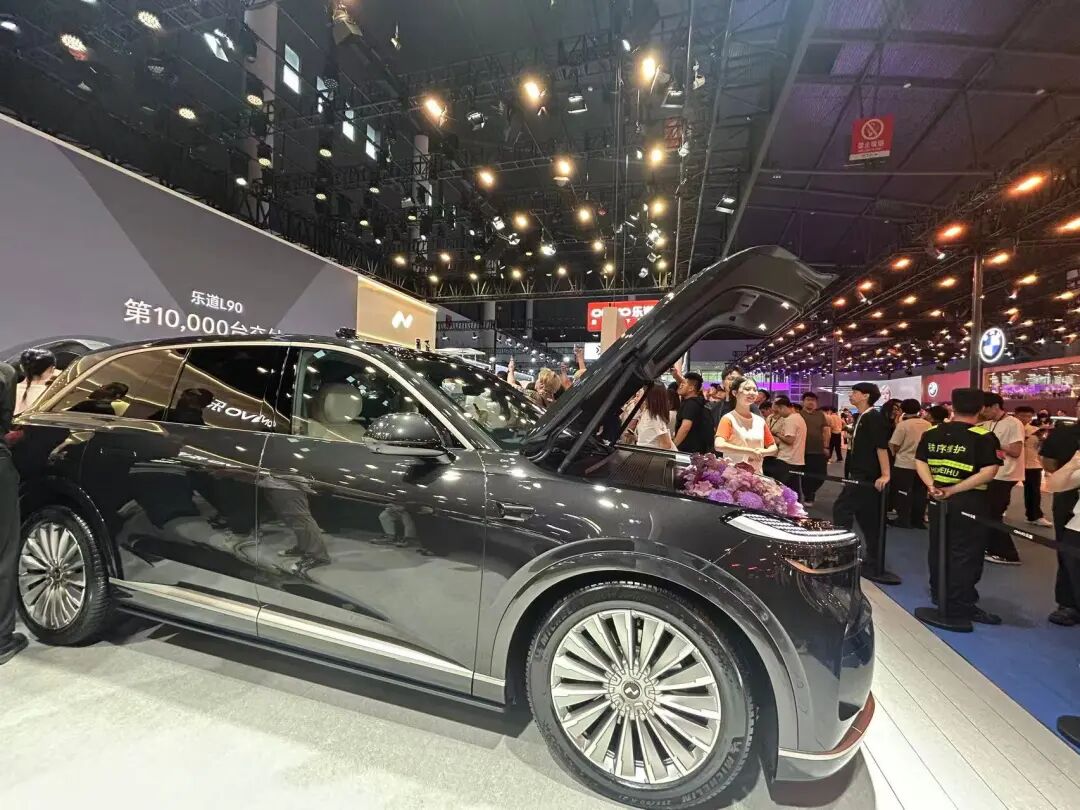
Core Insights - The SUV market is thriving in 2025, with Tesla's Model Y maintaining its position as the top-selling SUV from January to November, while Xiaomi's YU7 set a record by surpassing 200,000 pre-orders within three minutes of its launch [1][2]. SUV Market Performance - From January to November, SUV sales exceeded 10.699 million units, leading among sedans, SUVs, and MPVs, with a year-on-year growth rate of 7.3% [2]. - The market share of six-seat SUVs has increased from 3% in 2021 to 6.5% in the first half of this year, while seven-seat SUVs have maintained a stable share of around 5% [2]. New Model Launches - Numerous new three-row SUV models have been launched this year, including the Aito M8, Lido L90, and NIO ES8, with significant price adjustments and configurations to attract consumers [2][3][7]. - The Aito M8 and M9 have achieved sales of over 100,000 units each from January to November, ranking first and second in large SUV sales [9]. Market Trends and Consumer Demand - The demand for three-row SUVs is driven by the increasing number of multi-child families in China, which is expected to peak by 2035, indicating a long-term growth potential for this segment [4][15]. - The shift in family structure from "one-child" to "multi-child" is pushing consumer preferences from functional vehicles to those offering greater comfort and flexibility [4]. Pricing Strategies - The pricing landscape for three-row SUVs is becoming more competitive, with models like the Lido L90 and Galaxy M9 entering the market at significantly lower price points, making them more accessible [7][9]. - The introduction of aggressive pricing strategies, such as the Lido L90 starting at 26.58 million yuan and the Galaxy M9 at 19.38 million yuan, reflects the intense competition in this segment [8][9]. Future Outlook - Analysts predict that the three-row SUV market will continue to grow, with a focus on electric and hybrid models, as consumer preferences evolve towards more sustainable options [11][12]. - The future of three-row SUVs is expected to be shaped by family demand upgrades, product breakthroughs, and the acceleration of new energy trends, ensuring their position as optimal solutions for family travel [15].


一体铸造是画饼还是大趋势?大家吵得不可开交
3 6 Ke· 2025-12-29 01:28
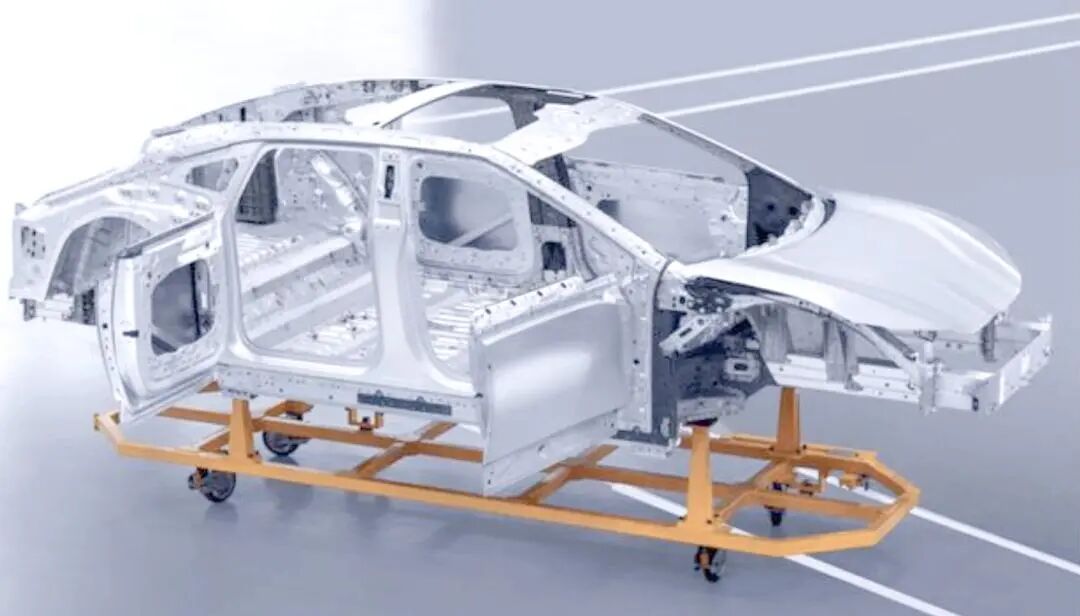
Core Viewpoint - The debate surrounding "integrated die-casting" technology in the automotive industry highlights a divide between traditional automakers focusing on lifecycle costs and new players emphasizing manufacturing efficiency and product performance [3][10]. Group 1: Integrated Die-Casting Technology - Integrated die-casting technology was popularized by Tesla's CEO Elon Musk in September 2020, announcing its use in the Model Y to replace over 370 traditional stamped and welded parts with 2-3 large castings, reducing manufacturing costs by approximately 40% [3][4]. - The technology significantly reduces the number of parts, leading to lower production line requirements and costs, while also simplifying the manufacturing process to just a few minutes [4][6]. - The lightweight nature of aluminum castings allows for a weight reduction of over 10% in the Model Y, directly enhancing electric vehicle range and improving vehicle rigidity and safety [4][6]. Group 2: Industry Response and Adoption - Following Tesla's lead, several Chinese automakers, including Li Auto and Xiaomi, have adopted integrated die-casting, emphasizing its benefits in production efficiency and vehicle performance [6][10]. - Traditional automakers are divided in their approach, with some, like Great Wall Motors, expressing skepticism about the technology's high repair costs and economic viability, while others, including Volvo and Volkswagen, are embracing it for future electric vehicle models [10][11]. Group 3: Challenges and Considerations - The high repair costs associated with aluminum components, which are difficult to repair after significant damage, pose a challenge for consumer acceptance and insurance costs [7][10]. - The initial investment in integrated die-casting technology is substantial, with equipment costs exceeding 50 million to 100 million yuan, making it a significant barrier for automakers with lower production volumes [8][10]. - The debate reflects a broader industry discussion on the balance between technological advancement and market acceptance, with integrated die-casting emerging as a key technology for high-end electric vehicles while other diverse manufacturing approaches remain relevant [11][13].

突发!美乌,超预期;重磅!“国补”明年继续;史诗级大涨,1盎司白银≥1桶美油
Sou Hu Cai Jing· 2025-12-29 00:41
Group 1: Economic Policy and Market Trends - The Ministry of Finance plans to significantly boost consumption in 2026 through special actions and funding support for consumer goods, including a focus on the replacement of old appliances [2] - By the end of 2024, the total ownership of household appliances in China is expected to exceed 3 billion units, with over 128 million units replaced in the first 11 months of this year, generating sales exceeding 2.5 trillion yuan [2] - The People's Bank of China aims to enhance the investment scale and proportion of long-term funds in the A-share market to support stable economic growth and high-quality development [3] Group 2: Commodity Market Developments - Silver prices surged over 5% to reach $83.16 per ounce, marking a historical high, while palladium futures rose by 4% to $2,107.5 per ounce [2] - The demand for silver remains strong across various sectors, including jewelry, medical devices, and electric vehicles, contributing to a continuous supply shortage in the global silver market for five consecutive years [2] - In contrast, the oil market is experiencing oversupply, with WTI crude oil prices dropping over 20% this year [2] Group 3: Corporate Announcements and Financial Performance - A total of 3,766 listed companies in China have implemented cash dividends this year, with a total payout of 2.64 trillion yuan, setting a new record [4] - The scale of China's ETFs has reached 6.03 trillion yuan, a growth of over 60% from the beginning of the year, with seven ETFs exceeding 1 billion yuan in size [5] - Long-term investment in the aerospace and aviation equipment manufacturing industry has seen a profit increase of 13.3% year-on-year, with significant growth in related sectors [5] Group 4: Industry Innovations and Developments - The commercial rocket sector is receiving priority support under the new listing standards on the Sci-Tech Innovation Board, with a focus on companies involved in national projects [5] - The establishment of a standardization committee for humanoid robots and embodied intelligence is expected to drive significant growth in the industry, with anticipated exponential increases in shipment volumes by 2026 [8] - The automotive industry is witnessing advancements in L3 autonomous driving technology, with companies like Changan and Deep Blue receiving conditional self-driving licenses [6] Group 5: Regulatory Changes and Market Adjustments - The National People's Congress has passed a revised foreign trade law, effective March 1, 2026, which includes measures to support new trade models and promote digital trade [10] - The central bank and the State Administration of Foreign Exchange have issued guidelines for managing funds for domestic companies listed abroad, allowing for the use of both domestic and foreign funds for share repurchases [4] - The China Securities Regulatory Commission has initiated administrative penalties against *ST Chang Medicine for financial data misrepresentation, potentially leading to delisting procedures [7]
又一电车冬季续航测试发布,小米YU7达成率超Model Y,小鹏P7全场最高
Jin Rong Jie· 2025-12-28 09:29
Core Insights - The latest winter testing results for electric vehicles were released by Auto Home, conducted in Yakeshi, Inner Mongolia, under extreme cold conditions of around -20°C, showcasing unexpected performances from various models [1] Electric Vehicle Performance Rankings - In the "Advanced Family 5-Seater Electric SUVs" category, the 2026 Wanjie M7 Pure Electric Itra Four-Wheel Drive version achieved a 44.4% range completion rate with an actual range of 282 km, ranking first [7] - The 2025 Xiaopeng P7 750 Four-Wheel Drive High-Performance Ultra version led the "Advanced Family Electric Cars" category with a 53.9% range completion rate and an actual range of 366.7 km [10] - The 2025 Nissan N7 625 Max topped the "Mainstream Family Electric Cars" category with a 47.4% range completion rate and an actual range of 296.3 km [16] - In the "Essential Commuter Electric Small Cars" category, the 2025 BYD Seagull Intelligent Driving version achieved a 43.8% range completion rate with an actual range of 177.2 km, ranking first [18] - The 2025 BYD Ti3 501 km Four-Wheel Drive Ultra version led the "Personalized Electric SUVs" category with a 44.9% range completion rate and an actual range of 224.7 km [19] Overall Rankings - The overall testing results indicated that the Xiaopeng P7 had the highest range completion rate among all tested models, while the Ideal i8 2025 Standard version had the lowest at 34.8% with an actual range of 250.3 km [21] - Among joint venture electric vehicles, the Nissan N7 had the highest range completion rate, ranking fifth overall [21]




大众集团首次关闭德国本土工厂
Cai Jing Wang· 2025-12-27 08:54
Core Viewpoint - Volkswagen is closing its factory in Dresden, Germany, marking the first closure of a domestic plant in its 88-year history, driven by economic pressures and a need for restructuring [1][3][5]. Group 1: Factory Closure Details - The last vehicle left the Dresden factory on December 16, 2025, and the site will be transformed into a research park focusing on AI, robotics, and chip development, while remaining open to the public as a tourist attraction [1][3]. - The Dresden factory, established in 2002, initially produced the luxury Phaeton but later shifted to electric vehicle assembly, including models like the e-Golf and ID.3 [4]. Group 2: Economic Context - The European automotive market is facing significant challenges, with increased competition and declining competitiveness of Germany as a manufacturing base, prompting Volkswagen to take decisive action [5]. - Volkswagen's management has decided to terminate its employment protection agreement, which has been in place since 1994, to facilitate necessary structural adjustments for improved competitiveness [9]. Group 3: Financial Performance - In Q3 2025, Volkswagen reported a revenue of €80.3 billion, a 2.3% increase year-on-year, but faced an operating loss of €1.3 billion compared to a profit of €2.8 billion in the same period last year [10][11]. - The company experienced a net loss of €1.07 billion in Q3 2025, a significant decline of 168.8% compared to a profit of €1.56 billion in the previous year [10][12]. - The decline in performance is attributed to increased production of low-margin electric vehicles and additional burdens totaling €7.5 billion, including U.S. import tariffs and strategic adjustments at Porsche [12][13]. Group 4: Porsche's Performance - Porsche also faced financial difficulties, reporting a 6% decline in revenue to €26.86 billion in the first three quarters of 2025, with a drastic drop in sales profit to €4 million, down 99% from €403.5 million year-on-year [13][15]. - The brand's sales in China fell by 26% in the first three quarters, impacted by competition from domestic electric vehicle brands and a lag in its own electrification efforts [15].

星闪:让万物互联“飙”进未来
Xin Lang Cai Jing· 2025-12-26 16:58
Core Viewpoint - The article highlights the emergence of "NearLink," a Chinese-developed short-range wireless communication technology that significantly enhances connectivity and performance for smart devices, addressing the limitations of existing technologies like Bluetooth and Wi-Fi [2][3]. Group 1: Technology Development - NearLink was initiated in 2020 by the Ministry of Industry and Information Technology, gathering over 400 organizations, including Huawei and China Mobile, to develop a faster, more responsive, energy-efficient, and stable short-range communication technology [2]. - The first technical standard for NearLink was published in 2022, and in 2023, Huawei launched the first terminal product supporting NearLink, enabling high-quality lossless audio transmission [3]. Group 2: Performance Metrics - NearLink operates in two modes: one for low-power scenarios with transmission speeds six times faster than traditional Bluetooth, and another for high-speed needs capable of transmitting 8K ultra-high-definition video [4]. - The latency of NearLink can reach as low as 20 microseconds, making it 1500 times faster than traditional Bluetooth and 500 times faster than Wi-Fi, surpassing human neural response speed [4]. Group 3: Application Scenarios - NearLink can connect up to 4096 devices simultaneously, significantly outperforming traditional Wi-Fi routers, which can only handle 32 devices [6]. - In smart home applications, devices using NearLink can operate seamlessly without interference, even in environments with many connected devices [6]. Group 4: Energy Efficiency - NearLink is designed to be energy-efficient, consuming 60% less power than traditional Bluetooth and 80% less than Wi-Fi, leading to extended battery life for devices [8]. - For instance, smartwatches equipped with NearLink can have their battery life extended by 30%, and industrial sensors can see battery life increase from three months to eight months [8]. Group 5: Industry Impact - In the automotive sector, NearLink enhances vehicle key functionalities, improving accuracy and responsiveness for features like automatic unlocking and guest welcome [10]. - In industrial applications, NearLink facilitates real-time data transmission, significantly reducing operational delays and improving efficiency in manufacturing and healthcare settings [11]. Group 6: Future Prospects - To achieve widespread adoption comparable to Bluetooth and Wi-Fi, NearLink needs to expand its ecosystem and reduce costs, as the current chip price is approximately 15 yuan, nearly double that of traditional Bluetooth chips [12]. - The anticipated reduction in chip costs by 30% by 2026 is expected to make NearLink more accessible to consumers and encourage broader adoption across various device categories [12].
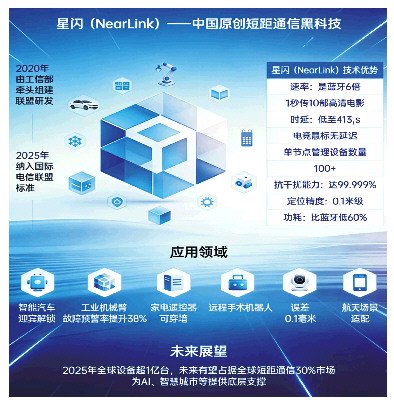
调研速递|深圳壹连科技接待华源证券等29家机构调研 CCS累计出货量破亿片 储能、低空经济等多领域布局提速
Xin Lang Zheng Quan· 2025-12-26 10:55
Core Business Performance - The company has achieved a cumulative shipment of over 100 million pieces of electric connection components (CCS), establishing itself as a leader in the CCS market [2] - CCS products are being widely used in popular new energy vehicles such as the AITO M8, Galaxy E5, Leap C11, Xpeng P7, and Zeekr 001 [2] - The company has entered the supply chains of major automotive manufacturers including Xpeng, Dongfeng Nissan, Changan Deep Blue, Geely, Volkswagen, and Great Wall in the flexible printed circuit board (FPC) sector [2] Emerging Business Developments - The company is making significant progress in emerging fields such as low-altitude economy, advanced industrial data centers (AIDC), and robotics [4] - It has begun bulk supply to leading companies in the low-altitude economy, including DJI and United Aircraft, with its aluminum wire products being widely used in low-altitude flying vehicles [4] - The AIDC business has seen breakthroughs, with significant orders from Bloom Energy in the U.S., and ongoing development with other clients [4] Future Growth Strategy - The company plans to enhance production capacity, with the Ningde new base expected to increase capacity by 2 billion yuan upon full operation [5] - The Slovakia production base is set to achieve SOP by 2026 and mass production by 2027, primarily serving European clients like Volkswagen and Volvo [5] - Research and development efforts are focused on cutting-edge fields such as embodied intelligence, AIDC, and new medical technologies, with future revenue growth expected from both existing market share expansion and exploration of new opportunities [5]
40万级豪车TOP10,有六辆国产了
3 6 Ke· 2025-12-25 04:00
Core Insights - The traditional luxury car dealership model is facing significant challenges, exemplified by the sudden closure of a major Porsche dealership in Zhengzhou, leaving customers without support and highlighting the struggles of established luxury brands [1][3] - Emerging domestic high-end brands are gaining traction, with consumers increasingly opting for experiences at user centers that offer high-quality services, contrasting sharply with the declining offerings at traditional dealerships [1][3] Group 1: Market Dynamics - The market share of traditional luxury brands like Porsche has dropped from 24% to 19% in the first three quarters of the year, with significant declines in sales for models like the Macan [9] - The loyalty of BMW, Mercedes-Benz, and Audi owners has fallen below 18%, indicating a loss of consumer confidence in these brands [7] - Domestic brands such as AITO and NIO are capturing a growing share of the market, with 36.81% and 27.22% of their potential customers coming from existing BBA users [3][7] Group 2: Sales Performance - In November, the top-selling models in the 400,000 RMB segment included six domestic vehicles, with the AITO M8 leading sales at 16,284 units, while traditional luxury models like the Audi A6L and BMW 5 Series saw significant declines [8] - The NIO ES8 experienced a staggering year-on-year sales increase of 1768.7%, while traditional luxury brands generally reported double-digit sales declines [8] - The new luxury model, the ZunJie S800, sold over 2,000 units in November, surpassing the combined sales of the Mercedes S-Class, BMW 7 Series, and Audi A8 [11] Group 3: Strategic Responses - Traditional luxury brands are initiating a counter-offensive to reclaim market share, with new electric models being introduced, such as Audi's E5 Sportback and Mercedes' new electric CLA, although initial sales have been underwhelming [13][15] - BMW is focusing on the upcoming iX3, which aims to compete directly with established domestic models, but faces challenges due to delayed market entry [15][17] - The competitive landscape is intensifying, with domestic brands planning to expand their offerings, including new flagship models and MPVs, to further penetrate the luxury market [18] Group 4: Future Outlook - The year 2026 is anticipated to be a critical period for traditional luxury brands as they launch new models and strategies to compete in the electric vehicle market [19] - The success of these brands will depend on their ability to adapt to changing consumer preferences and technological advancements in the automotive industry [19]

2025,中国汽车业定格局之年|36氪年度透视④
3 6 Ke· 2025-12-23 09:25
Group 1 - The core viewpoint is that the Chinese automotive market is reaching a saturation point where too many brands cannot coexist, leading to a shift from competition based on price to one focused on differentiation and technology [2][10] - The automotive industry is experiencing a significant transformation where profit margins are becoming the ultimate measure of success, with companies like Seres and Xiaomi maintaining a gross margin above 20%, while traditional leaders like Tesla and BYD face unprecedented profit pressure [4][10] - The old order is collapsing and being reshaped, with companies like WM Motor effectively clearing out competition in the luxury car market and Xiaomi capturing a significant share of the 200,000-300,000 RMB market segment with a single product [7] Group 2 - The automotive battlefield in 2025 is evolving from a focus on price competition to a comprehensive "value war" that encompasses technology definition, global pricing power, and control over the supply chain [10] - The trend of going global is becoming essential, as evidenced by BYD's overseas sales doubling and new entrants directly investing in factories and capital worldwide [7]
