
陕西煤业

Search documents
从全球视角看电力供需,煤电仍是压舱石
GUOTAI HAITONG SECURITIES· 2025-09-11 11:23
Investment Rating - The report maintains an "Overweight" rating for the coal sector, highlighting the sustained demand for coal in the global energy landscape [5][11]. Core Insights - The fundamental cause of frequent global electricity shortages is the rapid growth in electricity demand, which is not matched by effective solutions to supply-side structural bottlenecks. Traditional energy sources, particularly coal, remain crucial for the stability of the global electricity system in the medium to long term [3][11]. - Global electricity demand is projected to grow at a rate of 4.4% in 2024, significantly outpacing the global GDP growth of 2.9%. This growth is driven by three main factors: deep electrification in industrial sectors, rapid expansion of data centers driven by artificial intelligence, and increased electricity demand due to extreme weather events caused by climate change [9][15][27]. Summary by Sections Investment Recommendations - The report suggests that the pressure on coal resources may have peaked, and it anticipates a continued increase in global coal demand over the next 5-10 years. Recommended companies include China Shenhua, China Coal Energy, Shaanxi Coal and Chemical Industry, Yanzhou Coal Mining, and Jinneng Holding Group [11][12]. Global Electricity Demand Growth - The report notes that global electricity demand is expected to grow significantly, with emerging economies maintaining high growth rates and developed economies beginning to recover. By 2024, electricity demand in China is projected to increase by 6.8%, contributing 54% to global demand growth [19][20]. - The International Energy Agency (IEA) forecasts that global electricity demand will continue to grow at an average annual rate of 3.3% in 2025 and 3.7% in 2026, despite potential slowdowns due to trade tariffs and economic uncertainties [15][19]. Global Electricity Supply Challenges - The report highlights that the supply side has not effectively addressed structural bottlenecks, leading to frequent electricity shortages. Despite significant investments in renewable energy, issues such as aging grid infrastructure and inadequate energy storage systems hinder the effective absorption and utilization of new clean energy sources [10][55]. - The report emphasizes that traditional coal-fired power generation remains a critical stabilizing force in the global electricity system, especially as developed countries like the U.S. are expected to restart coal power generation to meet rising electricity demands [11][56]. Traditional Energy's Role - Coal power is projected to continue playing a vital role in the global energy landscape, with the U.S. expected to see a 6% increase in coal consumption by 2025. This shift indicates a potential adjustment in energy strategies among developed nations [11][56]. - The report also notes that while the share of coal in global energy generation is decreasing, it still represents the largest source of electricity generation globally [11][56].





共享基经丨同名ETF对比(八):绿电ETF、能源ETF,跟踪的指数有何不同?
Sou Hu Cai Jing· 2025-09-11 09:35
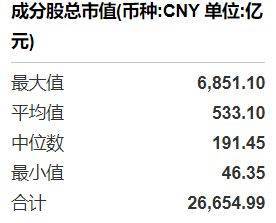
Group 1: Green Energy ETFs - There are two ETFs named Green Energy ETF, one managed by Guotai Fund tracking the Guozheng Green Power Index, and the other managed by Huaxia Fund tracking the Zhongzheng Green Power Index [2][3] - The Guozheng Green Power Index consists of 50 stocks with an average market capitalization of approximately 533 billion, while the Zhongzheng Green Power Index also has 50 stocks with an average market capitalization of about 530 billion [2][3] - Both indices share 38 common stocks, with 12 unique stocks in each index [4] - The performance comparison shows that the Guozheng Green Power Index performed better in the past year, while the Zhongzheng Green Power Index has a significantly higher annualized return over the past five years [7] - The current valuation indicates that the Guozheng Green Power Index's TTM P/E ratio is above the historical 50th percentile, while the Zhongzheng Green Power Index's TTM P/E ratio is around the historical 35th percentile [8] Group 2: Energy ETFs - There are two ETFs named Energy ETF, one managed by Huitianfu Fund tracking the Zhongzheng Energy Index, and the other managed by ICBC Credit Suisse Fund tracking the Zhongzheng National New State-Owned Enterprises Modern Energy Index [11][12] - The Zhongzheng Energy Index consists of 25 stocks with an average market capitalization of approximately 279 billion, while the Zhongzheng National New State-Owned Enterprises Modern Energy Index has 50 stocks with an average market capitalization of about 345 billion [11][12] - The two indices share only 10 common stocks, with 15 unique stocks in the Zhongzheng Energy Index and 40 unique stocks in the Zhongzheng National New State-Owned Enterprises Modern Energy Index [13] - The performance comparison indicates that the Zhongzheng National New State-Owned Enterprises Modern Energy Index has shown greater gains over the past year, with a TTM P/E ratio above the historical 70th percentile, while the Zhongzheng Energy Index's TTM P/E ratio is below the historical 40th percentile [17][20]

资金连续8天净流入,涨幅接近1%,自由现金流ETF基金备受关注
Sou Hu Cai Jing· 2025-09-11 06:13
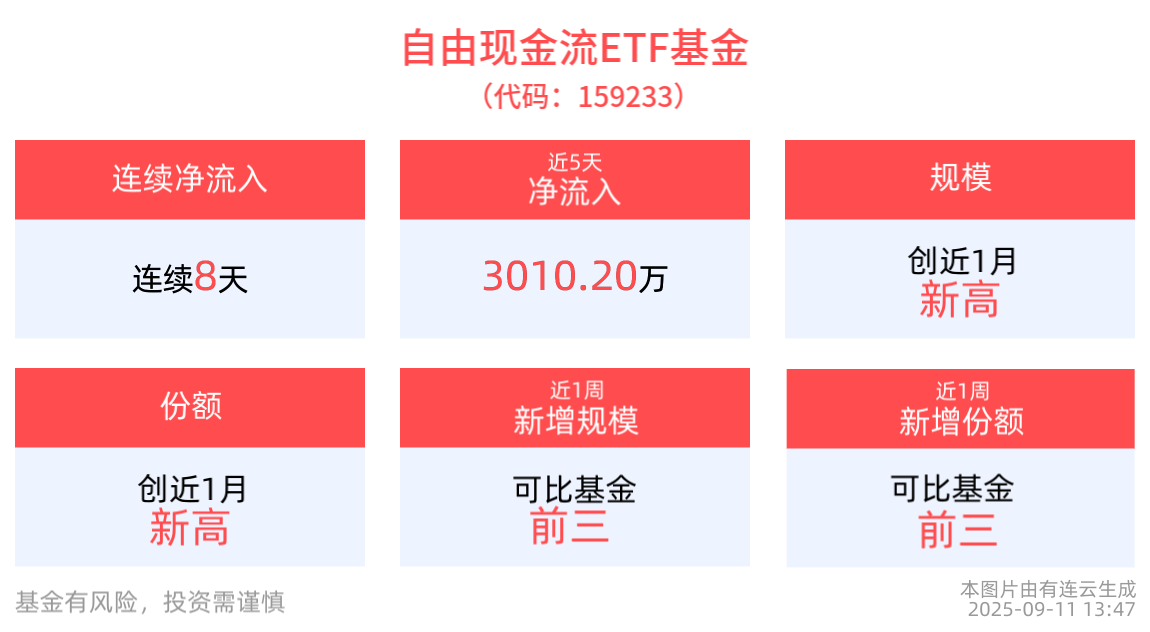
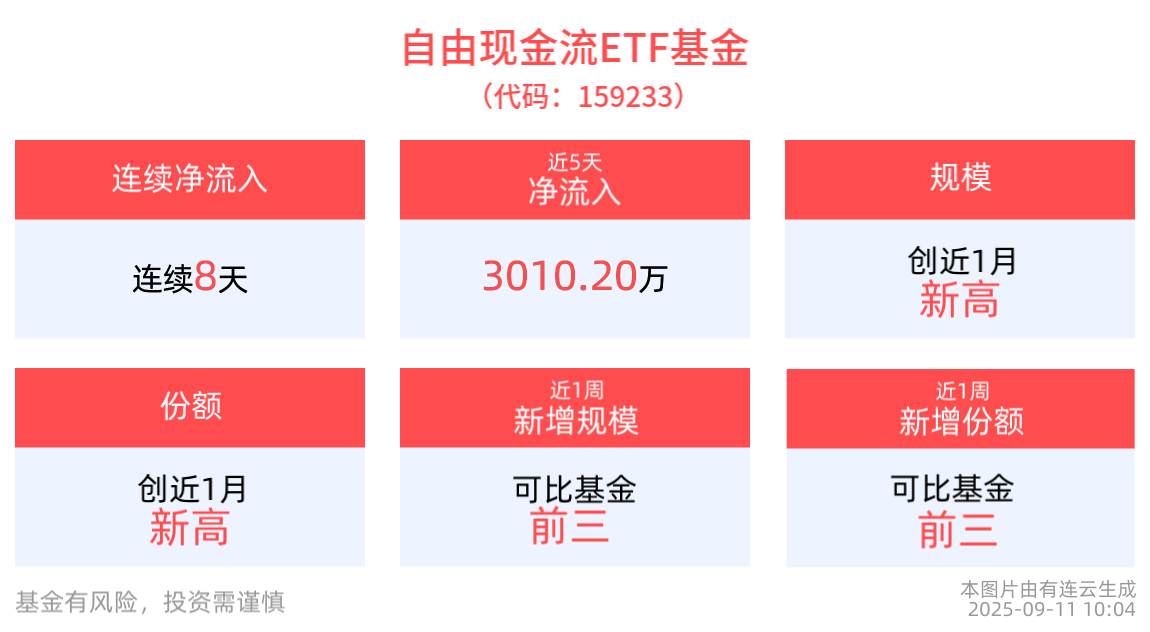
Group 1 - The core index, the CSI All Share Free Cash Flow Index (932365), increased by 0.80% as of September 11, 2025, with notable stock performances including Xinhua Department Store (600785) up 10.03% and Guiding Compass (300803) up 8.06% [3] - The Free Cash Flow ETF Fund (159233) rose by 0.90%, reaching a latest price of 1.13 yuan, and has seen a cumulative increase of 4.10% over the past month [3] - The Free Cash Flow ETF Fund recorded a trading volume of 650.66 million yuan with a turnover rate of 3.98% [3] Group 2 - The Free Cash Flow ETF Fund has achieved a maximum monthly return of 7.80% since its inception, with a longest consecutive monthly gain of 3 months and an average monthly return of 4.07% [4] - The fund's maximum drawdown since inception is 3.76%, with a tracking error of 0.073% over the past month [4] - The fund closely tracks the CSI All Share Free Cash Flow Index, which includes 100 listed companies with high free cash flow rates [4] Group 3 - As of August 29, 2025, the top ten weighted stocks in the CSI All Share Free Cash Flow Index include China National Offshore Oil Corporation (600938) and Wuliangye (000858), collectively accounting for 57.03% of the index [5] - The Free Cash Flow ETF Fund includes various stocks, with Midea Group (000333) showing a slight decline of 0.61% and China Shenhua (601088) down 0.05% [7]
炭本溯源系列3:中国煤炭成本十年变迁:刚性抬升重塑安全边际
Changjiang Securities· 2025-09-11 05:36
Investment Rating - The report maintains a "Positive" investment rating for the coal industry [11]. Core Insights - The report emphasizes that the systematic increase in coal costs over the past decade has solidified the safety margin for coal prices, with current cash cost support for port thermal coal prices at approximately 550 RMB/ton [3][9]. - It highlights that the coal price bottom is unlikely to return to the low levels seen in 2015, reinforcing the profitability and dividend safety margins for coal companies [3][9]. Summary by Sections Introduction - The report introduces the importance of cost research in establishing the safety margin for coal prices, indicating that a high cost-supported price bottom can enhance dividend value [6][20]. Overall Cost Trends - Over the past decade, coal company costs have increased by nearly 50%, with a CAGR of approximately 4% [6][24]. - The weighted average sales cost for coal in 2024 is projected to be 300 RMB/ton, down 2% year-on-year, while the complete cost is expected to be 380 RMB/ton, down 3% year-on-year [6][24]. Cost Structure - The cost structure for coal companies in 2024 is composed of labor costs (32%), other expenses (30%), raw materials (14%), depreciation (12%), safety costs (9%), and manufacturing costs (3%) [7][41]. - Labor costs, depreciation, and safety expenses have seen the most significant increases over the past decade, with labor costs rising by 28 RMB/ton [7][41]. Cost Curve Analysis - The cash cost curve for port thermal coal has shifted, with the 90th percentile cash cost now supporting prices around 550 RMB/ton [8][9]. - The complete cost curve for thermal coal has also increased, with the 90th percentile complete cost now between 370-423 RMB/ton [8][9]. Investment Recommendations - The report suggests that the systematic increase in costs has solidified the safety margin for coal prices, recommending several companies for investment based on their resilience and growth potential [9][11]. - Recommended companies include Yanzhou Coal Mining Company, Jinneng Holding, and China Shenhua Energy [9].


煤价带动8月PPI环比企稳
Huafu Securities· 2025-09-11 05:24
Investment Rating - The industry rating is "Strongly Outperforming the Market," indicating that the overall return of the industry is expected to exceed the market benchmark index by more than 5% over the next 6 months [15]. Core Insights - The August PPI data shows a year-on-year decline of 2.9%, with a narrowing of the decline by 0.7 percentage points compared to the previous month, marking the first narrowing since March 2025. Month-on-month, the PPI remained flat after a previous decline of 0.2% [3][4]. - The main contributors to the PPI stabilization in August were the coal mining and washing industry, black metal mining, and black metal smelting and rolling processing industries, with month-on-month increases of 2.8%, 2.1%, and 1.9% respectively. This indicates a strong correlation between coal prices and PPI [5][6]. - The narrowing of the year-on-year decline in PPI is attributed to the continuous optimization of domestic market competition, which has led to a reduction in price declines across several industries, including coal processing and black metal smelting [5][6]. Summary by Sections PPI Data Analysis - In August 2025, the year-on-year PPI decline was -2.9%, with a month-on-month change from a decline of 0.2% to flat [3][4]. - The average PPI from January to August 2025 was -2.9%, while the average purchase price index was -3.3% [3]. Coal Price Impact - The improvement in coal prices has been a significant factor in stabilizing the PPI in August, reflecting the immediate effects of policies aimed at curbing overproduction [5][6]. - The report anticipates that the positive contributions to PPI from coal prices may gradually manifest around February to March 2026 [6]. Investment Opportunities - The report suggests several dimensions for capturing investment opportunities in coal: 1. Companies with excellent resource endowments and stable operating performance, such as China Shenhua, China Coal Energy, and Shaanxi Coal Industry [7]. 2. Companies with production growth potential benefiting from the bottoming of coal prices, including Yanzhou Coal Mining, Huayang Co., Guanghui Energy, Jinkong Coal Industry, and Gansu Energy [7]. 3. Companies with globally scarce resources benefiting from long-cycle supply tightness, such as Huaibei Mining, Pingmei Shenma, Shanxi Coking Coal, Lu'an Environmental Energy, and Shanmei International [7]. 4. Companies with coal-electricity integration models that stabilize cyclical fluctuations, including Shaanxi Energy, Xinji Energy, and Huaihe Energy [7].
2025年1-7月陕西省能源生产情况:陕西省发电量1825.7亿千瓦时,同比增长0.3%
Chan Ye Xin Xi Wang· 2025-09-11 03:50
Group 1 - The core viewpoint of the news highlights the growth in electricity generation in Shaanxi Province, with a total generation of 324.5 billion kWh in July 2025, representing a year-on-year increase of 13.7% [1] - From January to July 2025, Shaanxi Province generated 1,825.7 billion kWh of electricity, showing a slight year-on-year growth of 0.3% [1] - The breakdown of electricity generation by type for January to July 2025 indicates that thermal power accounted for 1,565 billion kWh (85.7% of total generation), with a year-on-year decrease of 0.5% [1] - Hydropower generation was 33.1 billion kWh (1.8% of total), experiencing a significant year-on-year decline of 26.6% [1] - Wind power generation reached 127.1 billion kWh (7% of total), marking a year-on-year increase of 14.8% [1] - Solar power generation was 100.54 billion kWh (5.5% of total), with a year-on-year growth of 11.1% [1] Group 2 - The report referenced is the "2025-2031 China Energy Industry Market Research Analysis and Investment Prospect Assessment Report" published by Zhiyan Consulting [1] - The statistical scope of the report includes large-scale industrial enterprises with annual main business income of 20 million yuan and above [2] - The report emphasizes the importance of consistent statistical criteria for year-on-year comparisons, noting that changes in the scope of large-scale industrial enterprises may affect data comparability [2]

连涨8天,不含金融、地产的自由现金流ETF备受关注
Xin Lang Cai Jing· 2025-09-11 02:43
Core Insights - The China Securities Index Free Cash Flow Index (932365) has shown a positive performance, with a 0.58% increase as of September 11, 2025, and notable gains in constituent stocks such as Xinhua Department Store (600785) up by 10.03% and Muyuan Foods (002714) up by 6.53% [3][4]. Performance Summary - The Free Cash Flow ETF Fund (159233) has increased by 0.63%, with a latest price of 1.12 yuan, and has seen a cumulative increase of 4.10% over the past month [3]. - The fund's trading volume was 117.53 million yuan with a turnover rate of 0.72%, and the average daily trading volume over the past year was 24.01 million yuan [3]. - The fund's latest scale reached 163 million yuan, marking a new high for the past month, with a total of 146 million shares outstanding [3]. Fund Inflows - The Free Cash Flow ETF Fund has experienced continuous net inflows over the past eight days, with a peak single-day net inflow of 19.19 million yuan, totaling 62.83 million yuan in net inflows, averaging 7.85 million yuan per day [3]. Return Metrics - Since its inception, the Free Cash Flow ETF Fund has achieved a maximum monthly return of 7.80%, with the longest streak of monthly gains being three months and a maximum cumulative gain of 12.56% [4]. - The fund has a historical monthly profit percentage of 100.00% and a monthly profit probability of 93.10%, with a 100.00% probability of profit over a three-month holding period [4]. Risk and Fee Structure - The maximum drawdown since inception is 3.76%, with a relative benchmark drawdown of 0.24% [4]. - The management fee for the fund is 0.50%, and the custody fee is 0.10% [4]. Index Composition - As of August 29, 2025, the top ten weighted stocks in the China Securities Index Free Cash Flow Index include China National Offshore Oil Corporation (600938), Wuliangye (000858), and COSCO Shipping Holdings (601919), collectively accounting for 57.03% of the index [5].
国海证券晨会纪要-20250911
Guohai Securities· 2025-09-11 02:32
Group 1: Market Overview - The primary market projects are progressing smoothly, while the secondary market yields continue to improve, indicating a positive trend in asset allocation [3][4] - The REITs index has seen an increase, with the market capitalization of public REITs reaching 219.17 billion yuan, reflecting a slight growth from the previous week [4] - The coal price has bottomed out, and with the current recovery in coal prices and low sector congestion, there are opportunities for bottom-fishing in the coal sector [19][26] Group 2: Company Performance - China Chemical - In the first half of 2025, China Chemical achieved operating revenue of 90.72 billion yuan, a slight decrease of 0.35% year-on-year, while net profit attributable to shareholders increased by 9.26% to 3.10 billion yuan [6][8] - The company signed new contracts worth 206.09 billion yuan in the first half of 2025, marking a year-on-year increase of 1.24% [8][9] - The company’s chemical engineering segment achieved revenue of 74.8 billion yuan, with a gross margin of 10.17%, reflecting a year-on-year increase [7] Group 3: Company Performance - Transsion Holdings - In the first half of 2025, Transsion Holdings reported revenue of 29.08 billion yuan, a decline of 15.86% year-on-year, with a net profit of 1.21 billion yuan, down 57.48% [15][16] - The company’s gross margin for Q2 2025 improved to 20.76%, indicating a recovery trend despite a year-on-year decline [15][16] - Transsion holds a leading market share in Africa at 51% and is expanding its presence in Southeast Asia, with a market share of 18% [16][17] Group 4: Industry Analysis - Coal Sector - In the first half of 2025, the coal industry saw a significant decline in performance, with a total revenue of 553.91 billion yuan, down 17.8% year-on-year, and a net profit of 72.28 billion yuan, down 31.5% [19][20] - The average sales price of coal decreased by 20% year-on-year, while the average sales cost fell by only 9%, leading to a decline in profitability [21][22] - The coal sector is expected to recover as prices have started to rebound, with the average price of port coal reaching 665 yuan per ton by early September 2025 [25][26] Group 5: Investment Strategy - The report suggests that the coal sector presents bottom-fishing opportunities due to low congestion and high dividend yields, with a recommendation to focus on companies like China Shenhua and Yancoal [26] - The "14th Five-Year Plan" is expected to create investment opportunities, with historical patterns indicating significant market movements around key planning milestones [29][30]
下游库存累积 焦煤期货呈现弱势格局
Jin Tou Wang· 2025-09-10 06:09
Group 1 - The core viewpoint indicates a weak performance in the coking coal futures market, with the main contract reported at 1123.5 yuan/ton, reflecting a decline of 1.36% as of September 10 [1] - On September 10, ETT Company from Mongolia conducted an online auction for coking coal, with a starting price of 64.8 USD/ton for 6.4 million tons, all sold at the base price, with delivery to be made within 52 days after payment [2] - Shaanxi Coal Industry reported an increase in coal production to 14.30 million tons in August, a year-on-year growth of 5.27%, and a total electricity generation of 5.239 billion kWh, up 15.3% year-on-year [2] Group 2 - According to Ningzheng Futures, the short-term coking coal market is characterized by weak fundamentals, influenced by accumulated downstream inventory and slow demand recovery [3] - Jianxin Futures noted that after a significant correction since mid-August, the dual coking futures have released most of the bullish risks, with limited room for price reduction in the future due to low inventory levels at coking plants and steel mills [3] - The future rebound in the coking coal and coke market is anticipated, although there may be short-term fluctuations, with attention needed on the recovery pace of material profits and the willingness of steel and coking plants to replenish raw material inventories [3]
煤炭开采行业2025年中报综述:煤价筑底拖累2025H1业绩,现阶段煤价回升叠加板块低拥挤度,煤炭迎来底部配置机遇
Guohai Securities· 2025-09-10 05:03
Investment Rating - The report maintains a "Recommended" rating for the coal mining industry [1] Core Viewpoints - The coal price has reached a bottom, leading to a potential investment opportunity as prices rebound alongside low sector congestion [1][12] - The performance of the coal mining sector in the first half of 2025 has been negatively impacted by falling coal prices, with significant declines in revenue and profit for major coal companies [33][36] - Despite the challenges, the report suggests that the current market pessimism regarding coal prices has been largely priced in, indicating a potential for recovery [12] Summary by Sections 1. Overview of H1 2025 - In H1 2025, the coal supply-demand balance was loose, resulting in a decline in the average coal price [19][21] - The total revenue for 28 key coal companies was CNY 553.918 billion, down 17.8% year-on-year, with net profit dropping 31.5% to CNY 72.284 billion [33][36] - Coal production increased by 1.6% to 615 million tons, while sales volume decreased by 1.8% to 561 million tons [50] 2. Financial Performance - The average sales price of coal fell by 20% to CNY 480 per ton, while the average cost decreased by 9% to CNY 306 per ton, leading to a 33% drop in gross profit [5][8] - The average gross margin for the 28 coal companies was 36%, down 7.4 percentage points year-on-year [8] - Operating cash flow decreased by 27% to CNY 1,042.20 billion, with a slight increase in the average debt-to-asset ratio to 53.2% [9][12] 3. Market Dynamics - The coal price for Q2 2025 continued to decline, but signs of recovery were noted in Q3 due to seasonal demand and supply constraints [10][12] - The report highlights that the coal sector's low congestion levels and high dividend yields present a compelling case for bottom-fishing investments [12] 4. Investment Strategy - The report recommends focusing on companies with strong fundamentals and cash flow, such as China Shenhua, Shaanxi Coal, and Yanzhou Coal [12][14] - It emphasizes the importance of monitoring the evolving supply-demand dynamics and potential policy impacts on the coal market [12][19]