
格力电器

Search documents
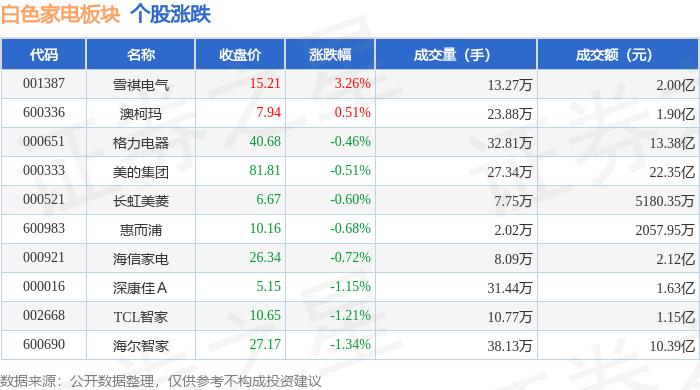
白色家电板块12月8日跌0.65%,海尔智家领跌,主力资金净流出1.79亿元
Zheng Xing Xing Ye Ri Bao· 2025-12-08 09:04
从资金流向上来看,当日白色家电板块主力资金净流出1.79亿元,游资资金净流入2505.07万元,散户资 金净流入1.54亿元。白色家电板块个股资金流向见下表: 证券之星消息,12月8日白色家电板块较上一交易日下跌0.65%,海尔智家领跌。当日上证指数报收于 3924.08,上涨0.54%。深证成指报收于13329.99,上涨1.39%。白色家电板块个股涨跌见下表: | 代码 | 名称 | 收盘价 | 涨跌幅 | 成交量(手) | 成交额(元) | | | --- | --- | --- | --- | --- | --- | --- | | 001387 | 雪祺电气 | 15.21 | 3.26% | 13.27万 | | 2.00亿 | | 600336 | 澳柯玛 | 7.94 | 0.51% | 23.88万 | | 1.90亿 | | 000651 | 格力电器 | 40.68 | -0.46% | 32.81万 | | 13.38亿 | | 000333 | 美的集团 | 81.81 | -0.51% | 27.34万 | | 22.35亿 | | 000521 | 长虹美菱 | 6.67 | - ...


董明珠与孟羽童再度合体,格力冬测抗寒大考来了
Xin Lang Cai Jing· 2025-12-08 04:44
Group 1 - Gree Electric Appliances will conduct a "100-hour live extreme cold survival challenge" event in Fuyuan City, Heilongjiang from December 11 to 15 [1] - On December 14, Gree's Chairman Dong Mingzhu will be present at the event alongside Meng Yutong to demonstrate the heating capabilities of Gree air conditioners in extreme cold conditions [1]

现在的格力电器,到底是一只股票还是债券?
晚点LatePost· 2025-12-08 03:20
Core Viewpoint - Gree Electric Appliances is a leading company in the A-share market known for its substantial and consistent dividend payouts, which have become a core value label for the company. However, concerns about the sustainability of these dividends and the company's growth prospects are evident, as Gree faces challenges in revenue growth and strategic alignment [5][6][7]. Group 1: Dividend and Financial Performance - Gree's cumulative dividends have exceeded 170 billion yuan since its listing, while the company has only raised 5 billion yuan from the market, highlighting a significant disparity between dividends and capital raised [5]. - The company has maintained a high dividend payout ratio of over 50% in recent years, likening its dividends to a perpetual bond that provides fixed returns to shareholders [25][28]. - Despite a rolling PE ratio of approximately 7, significantly lower than competitors like Haier and Midea, Gree's stock price remains stable due to its consistent dividend policy [25][28]. Group 2: Revenue and Business Structure - Gree's revenue has stagnated around 200 billion yuan from 2018 to 2024, with a projected decline of about 7% year-on-year for 2025, indicating a passive development situation amid increasing market competition [7][22]. - The company's revenue is primarily derived from its manufacturing business, with a smaller portion from other business activities, which have fluctuated due to market conditions [10][11]. - The share of Gree's air conditioning business has decreased from 97.4% in 2011 to 86.6% in 2023, while the share of home appliances has seen minimal growth, reflecting challenges in diversifying its product offerings [13][15]. Group 3: Market Position and Competition - Gree's international business remains underdeveloped, with its market share not exceeding 20%, trailing behind competitors like Midea and Haier, primarily due to its conservative approach to overseas expansion [18][19]. - The company faces significant competition from both established players and emerging brands, complicating its efforts to regain market share and achieve growth in a challenging environment [50][51]. - Gree's channel reform efforts aim to streamline operations and improve profitability, but the effectiveness of these reforms in driving growth remains uncertain [51][60]. Group 4: Challenges and Strategic Outlook - Gree is currently navigating multiple internal and external challenges, including a prolonged inventory destocking cycle and declining demand in both domestic and international markets [22][48]. - The company's reliance on a high dividend payout may limit its ability to invest in growth initiatives, creating a paradox where maintaining dividends could hinder long-term strategic flexibility [60][61]. - The ongoing channel reforms are critical for Gree to adapt to market changes, but the complexity of its governance structure and the need for consensus among diverse stakeholders pose significant hurdles [59][61].

风险因子调降释放红利,300红利低波ETF(515300)有望持续受益
Xin Lang Cai Jing· 2025-12-08 03:11
Group 1 - The core viewpoint of the news is the adjustment of risk factors for insurance companies' holdings in certain indices, which is expected to encourage long-term capital investment in the market [1][2] - The Financial Regulatory Authority announced a reduction in the risk factor for stocks held by insurance companies for over three years in the CSI 300 Index and the CSI Dividend Low Volatility 100 Index from 0.3 to 0.27 [1][2] - The adjustment is based on a weighted average holding period over the past six years, indicating a trend towards strengthening long-term capital in the market [1][2] Group 2 - As of November 28, 2025, the top ten weighted stocks in the CSI 300 Dividend Low Volatility Index include China Shenhua, Shuanghui Development, Sinopec, Gree Electric Appliances, and others, accounting for a total of 35.7% of the index [1] - The CSI 300 Dividend Low Volatility ETF (515300) closely tracks the CSI 300 Dividend Low Volatility Index, highlighting its advantages in a volatile market [2] - Investors without stock accounts can access investment opportunities through the corresponding CSI 300 Dividend Low Volatility ETF linked fund (007606) [3]
唯特偶(301319) - 2025年12月5日投资者关系活动记录表
2025-12-08 02:44
Group 1: Core Technology and Business Strategy - The company's core technological barriers are established in fields such as ultra-fine particle welding materials and low-temperature high-reliability welding materials, successfully narrowing the technological gap with international leaders [1] - The company has implemented a "multi-product matrix" strategy, achieving a leap from a single electronic assembly materials segment to a dual-segment model of "electronic assembly materials + reliability materials" [2] - The reliability materials segment focuses on three technical dimensions: mechanics, corrosion resistance, and thermal properties, providing modular solutions that reduce procurement and management costs for clients [2] Group 2: Financial Performance and Cost Management - The company's net profit in Q3 increased due to higher product sales and effective cost control strategies [3] - Raw material costs, specifically tin and silver, have risen approximately 7% and 23% year-on-year, respectively; however, the company has established a "long-term agreement + futures" dual-hedging strategy to stabilize profits [4] Group 3: Client Base and Market Position - The company serves a diverse range of industries, including consumer electronics, telecommunications, and new energy vehicles, with notable clients such as ZTE, Gree Electric, and BYD [5] - The company has built a strong reputation and established long-term relationships with numerous domestic and international clients, effectively mitigating risks associated with industry cycles [5] Group 4: Emerging Markets and Future Growth - The rapid development of new industries such as electric vehicles and AI is driving demand for high-end microelectronic welding materials, which the company produces [6] - The company aims to become a global supplier of electronic assembly and reliability materials solutions, focusing on R&D innovation to create sustainable long-term value for shareholders [6] Group 5: Dividend Policy and Domestic Substitution - The company has maintained a high dividend payout ratio since its listing and plans to continue optimizing shareholder return mechanisms [7] - The company is actively pursuing domestic substitution strategies, achieving performance levels in core products that meet international standards, thereby capturing market share in key sectors [8]
【华鑫固收&资配】流动性高点确认,关注事件性冲击——资产配置周报
Xin Lang Cai Jing· 2025-12-08 01:33
Group 1: National Balance Sheet Analysis - The latest data shows that the growth rate of liabilities in the real sector for October 2025 is recorded at 8.7%, slightly down from the previous value of 8.9%, which is in line with expectations. It is anticipated that the growth rate will stabilize around 8.7% in November and trend downward, returning to a contraction phase by year-end, with an expected decline to approximately 8.2% [1][10][56] - The government work report for 2025 emphasizes aligning the growth of social financing and money supply with economic growth and price level expectations, indicating that the direction of stabilizing the macro leverage ratio remains unchanged. China is still in a marginal contraction phase, which reduces the probability of large-scale defaults and liquidity risks, thereby enhancing overall societal expectations [1][10][56] Group 2: Fiscal and Monetary Policy - In the last week, the net increase in government debt (including national and local bonds) was 16 billion yuan, exceeding the planned net decrease of 73.3 billion yuan. It is planned that next week, government debt will decrease by 510.2 billion yuan. The growth rate of government liabilities at the end of October 2025 was 13.9%, down from 14.5%, and is expected to continue declining to around 13.1% in November, with a projected year-end rate of approximately 12.0% [2][11][56] - Weekly average calculations indicate that the volume of funds traded increased week-on-week, while the price of funds decreased. The overall liquidity remains marginally relaxed. The one-year government bond yield fluctuated slightly, closing at 1.40%, with an estimated lower bound of around 1.3% and a central tendency near 1.4% [2][11][56] Group 3: Economic Outlook and Industry Recommendations - The economic data for October shows a continued weakening trend compared to September, with a focus on when the economy may stabilize or show marginal improvement. The annual economic growth target for 2025 is set at around 5%, with a nominal growth target of 4.9% derived from the deficit and deficit ratio [3][12][57] - In the context of a contraction phase, the price-performance ratio between stocks and bonds is expected to favor equities, particularly those with value characteristics. Recommended stocks should not expand their balance sheets, have good profitability, and be sustainable. The A+H dividend stock combination includes 13 stocks, with a focus on sectors such as banking, telecommunications, oil and petrochemicals, and transportation [7][49][56]

中国白电专家电话会要点:以旧换新补贴存不确定性下的 2026 年展望_ China Consumer Appliances Sector _ White goods expert call takeaway_ 2026 outlook amid uncertainties on trade-in subsidies
2025-12-08 00:41
Summary of the China Consumer Appliances Sector Conference Call Industry Overview - **Industry**: China Consumer Appliances Sector - **Focus**: White goods, specifically air conditioners (AC), washing machines (WM), and refrigerators Key Points from the Expert Call 1. **4Q25 Shipment Revisions**: - Shipments for AC, WM, and fridges have been revised down to -20%, -1%, and -3% year-over-year (YoY) respectively. - This decline is attributed to weak domestic demand due to fading trade-in subsidies, a high base from 4Q24, and rising copper prices [3][4]. 2. **Domestic Subsidies Outlook**: - There are diverging opinions on whether domestic trade-in subsidies will be extended into 2026. - Some experts believe extensions are likely due to unreleased replacement demand and the 2027 recycling target, while others argue for an end to subsidies due to diminishing impacts and low availability in the second half of 2025 [3][4]. 3. **2026 Domestic Shipment Forecast**: - Expected changes in shipments with subsidies: AC -2.0%, WM +1.9%, fridge -1.5% YoY. - Without subsidies, the forecast is: AC -5.4%, WM -2.2%, fridge -4.1% YoY. - The outlook is lower than previous forecasts due to recent cuts in 2025 shipment numbers. - The demand for WM is expected to remain stronger than for refrigerators in 2026, influenced by product upgrades and previous demand pull-forward during COVID [4]. 4. **Overseas Market Outlook**: - Global white goods volume is expected to grow by 1.5% YoY in 2026, with specific growth rates for AC, WM, and fridges at +2.5%, +1.2%, and +0.5% YoY respectively, assuming stable US tariffs. - Chinese export volumes for AC, WM, and fridges are projected to decline by -4.0%, +0.2%, and -4.3% YoY due to rising overseas capacities and high US tariffs. - Key export markets for China in 2026 include Latin America, Africa, Indonesia, and Japan, although increased production capacities in Southeast Asia may reduce reliance on Chinese exports [4]. Stock Implications - **Caution on Sector**: The outlook for the China home appliance sector is cautious due to a post-subsidy down-cycle expected from Q3 2025 to 2027, with intensified competition. - **Preferred Stocks**: Midea and Haier are favored for their overseas growth potential and strong defensiveness, while Gree is viewed with caution as it is primarily a domestic AC player [5]. Risks Identified - **Sector Risks**: - Risks include a downturn in the property market affecting demand, elevated raw material prices, and global supply chain constraints impacting exports [7]. - **Company-Specific Risks**: - **Gree**: Risks include reduced demand due to property policy tightening, rising raw material prices, foreign exchange losses, increased competition, and lower-than-expected dividends [8]. - **Midea**: Risks include tighter property market policies, RMB exchange rate fluctuations, and slowing growth in the global robot market [9]. - **Haier**: Risks include declining refrigerator demand, slow adoption of smart appliances, and high raw material costs [9]. This summary encapsulates the key insights and forecasts from the conference call regarding the China consumer appliances sector, highlighting both opportunities and risks for investors.

如何看待降息周期美国家电市场表现?
Changjiang Securities· 2025-12-07 13:15
Investment Rating - The report maintains a "Positive" investment rating for the home appliance industry [11]. Core Insights - The Federal Reserve announced a 25 basis point reduction in the federal funds rate to a target range of 4.00%-4.25% on September 18, 2025, marking a return to a rate cut cycle after nine months. This cycle is expected to continue for the remainder of the year and into the next two years [2][5]. - The impact of the rate cut on the supply side of the U.S. home appliance industry is significant and has a higher transmission efficiency compared to the demand side, which typically shows improvement with a delay of 1-2 quarters after the end of the rate cut cycle [6][24]. - The revenue contribution from the recent rate cut to domestic appliance companies may not be evident in the short to medium term, necessitating further observation of the U.S. economic fundamentals [8][48]. Summary by Sections Introduction - The report analyzes the effects of the Federal Reserve's monetary policy easing on domestic appliance companies that have established a significant presence in the U.S. market [5][16]. Response of the U.S. Home Appliance Industry to Rate Cuts - On the supply side, U.S. appliance manufacturers typically see a turning point in new order amounts immediately following the initiation of a rate cut cycle, with shipment growth rates usually aligning with new orders or lagging by one quarter [6][22]. - On the demand side, while historical data shows that demand for home appliances improves after rate cuts, this improvement is often delayed until 1-2 quarters after the last rate cut [24][30]. Stock Performance of Appliance Companies During Rate Cuts - Anticipation of rate cuts tends to boost stock prices of U.S. appliance companies initially, but actual performance is often driven by valuation post-announcement. Recent cycles have shown muted stock performance due to the industry's maturity [7][34]. - Historical analysis of Whirlpool's stock performance indicates that while the stock tends to perform well before rate cuts, it often experiences a pullback after the cuts are implemented [34][38]. Investment Recommendations - The report suggests focusing on high-quality industry leaders with structural growth and high dividend returns, recommending companies like Midea Group, Haier Smart Home, and Gree Electric for their strong domestic and emerging market sales [8][48]. - Additionally, it highlights brands with global reach and product diversification, such as Anker Innovations and Ninebot, as potential investment opportunities [8][48].
如何看新兴市场白电景气度与格局?
Changjiang Securities· 2025-12-07 11:56
行业研究丨深度报告丨家用电器 [Table_Title] 如何看新兴市场白电景气度与格局? %% %% %% %% research.95579.com 1 丨证券研究报告丨 报告要点 [Table_Summary] 受益于居民户均收入突破临界拐点,过去几年东南亚、拉美及中东非等新兴市场家电渗透率迎 来加速提升,行业长期保持高景气,同时国内企业凭借深入的本地化布局与产品及性价比等方 面优势正逐步抢占日韩系与欧美系企业份额。展望后续,国内市场面临潜在的基数与需求前置 压力,增长中枢或边际放缓,海外成熟地区家电也已基本进入存量阶段,而新兴市场当前渗透 率仍处于相对低位,且国内品牌保有较大份额提升潜力,有望为国内家电企业规模增长贡献长 期势能。 分析师及联系人 [Table_Author] 陈亮 SAC:S0490517070017 SFC:BUW408 请阅读最后评级说明和重要声明 2 / 20 %% %% %% %% research.95579.com 2 [Table_Title2] 如何看新兴市场白电景气度与格局? [Table_Summary2] 新兴市场家电景气度如何? 国内出口表现与上市公司财报的交 ...
行业ETF配置模型2025年超额16.4%
GOLDEN SUN SECURITIES· 2025-12-07 10:20
Quantitative Models and Construction Methods 1. Model Name: Industry Mainline Model (Relative Strength Index, RSI) - **Model Construction Idea**: The model aims to identify leading industries by calculating their relative strength index (RSI) over different time frames[1][9] - **Model Construction Process**: 1. Use primary industry indices as configuration targets, totaling 31 primary industries 2. Calculate the price changes over the past 20, 40, and 60 trading days for all industries, obtaining the cross-sectional rankings of these changes, then normalize all rankings to get RS_20, RS_40, and RS_60 3. Calculate the average of these three rankings to get the final industry relative strength index: $$ RS = \frac{RS_{20} + RS_{40} + RS_{60}}{3} $$ 4. If an industry shows an RS signal greater than 90% before the end of April, it is likely to be a leading industry for the year[9] - **Model Evaluation**: The model effectively identified leading industries in 2024, such as coal, power and utilities, home appliances, banks, oil and petrochemicals, communications, non-ferrous metals, agriculture, forestry, animal husbandry, and fishery, and automobiles[1][9] 2. Model Name: Industry Rotation Model (Prosperity-Trend-Crowding Framework) - **Model Construction Idea**: The model uses a three-dimensional framework of prosperity, trend, and crowding to recommend industry allocations[1][2][6] - **Model Construction Process**: 1. Define two industry rotation schemes: "strong trend-low crowding" and "high prosperity-strong trend" 2. Allocate industry weights based on the framework: Media 16%, Agriculture, Forestry, Animal Husbandry, and Fishery 15%, Non-bank Financials 12%, Computers 12%, Home Appliances 9%, Coal 9%, Building Materials 7%, Banks 7%, Light Industry Manufacturing 7%, Retail 6% 3. Recommend ETFs tracking indices such as CSI Steel, CSI Agriculture, Securities Companies, Communication Equipment, CSI Media, Sub-segment Chemicals, CS Artificial Intelligence, Animation Games, Sub-segment Machinery, All Information, Building Materials, etc.[2][6][15] - **Model Evaluation**: The model performed well in 2025, with an excess return of 16.4% relative to the CSI 800 index and 4.2% relative to the Wind All A index[2][6][18] 3. Model Name: Left-Side Inventory Reversal Model - **Model Construction Idea**: The model aims to capture the reversal of industries in distress by analyzing sectors with low inventory pressure and long-term analyst optimism[24] - **Model Construction Process**: 1. Identify sectors currently or previously in distress with potential for inventory replenishment 2. Analyze sectors with low inventory pressure and long-term analyst optimism 3. Recommend sub-sectors such as cloud services, other light industries, oil service engineering, components, agricultural chemicals, animal husbandry, consumer electronics, special materials, and biomedicine[24][25] - **Model Evaluation**: The model achieved an absolute return of 25.4% in 2025, with an excess return of 5.4% relative to the industry equal weight index[24][27] Model Backtest Results 1. Industry Mainline Model (RSI) - **Absolute Return**: Various industries showed significant returns after the RSI signal appeared, such as banks (32.1%), communications (24.0%), home appliances (25.8%), and automobiles (12.8%)[10][12] 2. Industry Rotation Model (Prosperity-Trend-Crowding Framework) - **Annualized Return**: 21.7% - **Excess Annualized Return**: 13.8% - **Information Ratio (IR)**: 1.5 - **Maximum Drawdown**: -8.0% - **Monthly Win Rate**: 67% - **Excess Return in 2023**: 7.3% - **Excess Return in 2024**: 5.7% - **Excess Return in 2025**: 4.2%[13][14] 3. Left-Side Inventory Reversal Model - **Absolute Return in 2023**: 13.4% - **Excess Return in 2023**: 17.0% - **Absolute Return in 2024**: 26.5% - **Excess Return in 2024**: 15.4% - **Absolute Return in 2025**: 25.4% - **Excess Return in 2025**: 5.4%[24][27]