
绿城中国

Search documents
地王之王,这次有点不一样
3 6 Ke· 2025-08-15 02:42
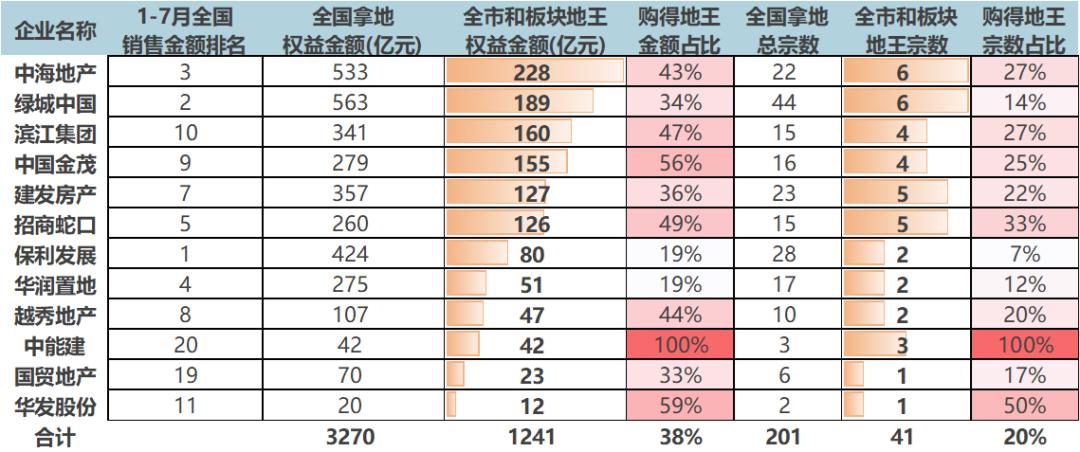
Group 1 - The core point of the article highlights that the top 20 real estate companies in China have acquired over 40 "land kings" (high-value land parcels) in the first seven months of 2025, which represents more than 20% of their total land acquisitions, with the value of these land kings accounting for 38% of their total land rights value [1][2][3] - Leading real estate companies are focusing on "core cities, key areas, and high-quality land parcels," while showing caution towards lower-tier cities and uncertain market performances [1][2] - China Overseas and Greentown have both acquired six land kings each, with their respective land rights values reaching 228 billion and 189 billion yuan, representing 43% and 34% of their total land acquisition amounts [2][3] Group 2 - Shanghai and Hangzhou are the most competitive cities for land kings, with 11 and 10 land kings acquired respectively, followed by Chengdu [5][6] - The article discusses the importance of four key factors for the successful realization of land king value: location and supporting facilities, industrial foundation, competitive environment, and product quality [8][9] - Companies like China Overseas and Greentown are adapting their strategies to focus on high-end customer needs and product differentiation, which is becoming increasingly important in a competitive market [11][12]

申万宏源证券晨会报告-20250815
Shenwan Hongyuan Securities· 2025-08-15 00:42
Group 1: Company Overview - The report focuses on Greentown China (03900), a leader in high-quality residential development, with a strong presence in key cities like Hangzhou, Shanghai, and Beijing [2][11] - Greentown China has a mixed ownership structure, with major shareholders including China Communications Construction Company (28.94%) and Kowloon Warehouse (22.95%) [2][11] - The company has a competitive advantage due to its combination of state-owned enterprise credit and market-oriented mechanisms [2][11] Group 2: Land Acquisition and Inventory - Greentown China has been actively acquiring land since 2017, with an average land acquisition to sales ratio of 58% from 2017 to 2024, and a 55% ratio in the first half of 2025 [2][11] - The company focuses on land acquisition in key cities, with over half of its land value concentrated in ten core cities [2][11] - As of the end of 2024, the total land reserve area is 27.47 million square meters, with a total land reserve value of 449.6 billion yuan [2][11] Group 3: Sales and Product Strength - Greentown China's self-invested sales in the first half of 2025 reached 80.3 billion yuan, with a sales price of 35,000 yuan per square meter, ranking fifth in the industry [2][11] - The company has a strong product offering, with eight product series and a verified premium pricing ability, averaging a 15% premium [2][11] - The company’s construction system and property management services contribute to its competitive edge [2][11] Group 4: Financial Performance and Valuation - The company has recognized impairment provisions totaling 11.4 billion yuan from 2019 to 2024, with a 5.9% average for major real estate companies [2][11] - As of the end of 2024, the pre-receivable account is 147 billion yuan, covering 1.0 times the real estate settlement income for 2024 [2][11] - The target market capitalization for Greentown China is set at 33.3 billion HKD, based on a price-to-book ratio of 0.85X [2][11] Group 5: Industry Insights on Organic Silicon - The organic silicon industry is experiencing a structural transformation, with domestic consumption expected to maintain high growth due to strong demand from the photovoltaic and electric vehicle sectors [10][12] - China's organic silicon consumption accounts for approximately 60% of global demand, with a projected apparent consumption of 1.82 million tons in 2024, a year-on-year increase of 21% [10][12] - The domestic production capacity of organic silicon is expected to peak at 3.44 million tons by the end of 2024, with a high industry concentration [10][14] Group 6: Cloud Computing and AI Sector - Major cloud service providers like Google and Microsoft have exceeded expectations, with Microsoft Azure's revenue growth accelerating to 39% in FY25Q4 [13][14] - The overall capital expenditure (Capex) for the cloud industry is projected to exceed 350 billion USD in FY25, reflecting strong demand for AI cloud services [13][14] - The report highlights the competitive advantages of these companies in the AI cloud sector, driven by increased computational capacity and strategic partnerships [13][14]
绿城中国(03900):好房子引领者,理顺机制再出发
Shenwan Hongyuan Securities· 2025-08-14 13:40
Investment Rating - The report initiates coverage with a "Buy" rating for Greentown China [3][8]. Core Views - Greentown China is positioned as a leader in high-quality housing, leveraging a mixed-ownership structure that combines state-owned enterprise credibility with market-oriented mechanisms. The company has demonstrated strong product capabilities and a competitive edge in the housing market, particularly in first- and second-tier cities [7][8]. Company Overview - Greentown China Holdings Limited was established in 1995 in Hangzhou and has evolved into a national developer with a focus on high-end residential projects. The company has a diversified product portfolio, including luxury villas and urban landmarks, and has maintained a leading position in the industry through its commitment to quality [17][18]. - The major shareholders include China Communications Construction Company (29% stake) and Kowloon Warehouse Group (22.95% stake), with the founder holding 8.03% [19][23]. Land Acquisition & Inventory - The company has been actively acquiring land since 2017, with an average land acquisition to sales ratio of 58% from 2017 to 2024. In the first half of 2025, this ratio was 55%. The focus is on key cities such as Beijing, Shanghai, and Hangzhou, with over half of the land value concentrated in ten core cities [7][39]. - As of the end of 2024, Greentown's total land bank was 27.47 million square meters, with a total land value of 449.6 billion yuan, of which 53% is located in the core ten cities [7][39]. Sales & Product Strength - The company reported self-invested sales of 80.3 billion yuan in the first half of 2025, with a sales price of 35,000 yuan per square meter, leading the industry. Greentown's competitive advantage lies in its strong product development capabilities and market-validated premium pricing [7][8]. - The company has established eight product series tailored to market needs, demonstrating a verified ability to command price premiums averaging 15% [7][8]. Financials & Valuation - Greentown's financial performance is expected to improve, with projected net profits of 1.01 billion yuan in 2025, down 36.8% year-on-year, followed by a recovery in 2026 and 2027. The target market capitalization is set at 33.3 billion HKD, based on a price-to-book ratio of 0.85 [6][8]. - The company has recognized impairment provisions totaling 11.4 billion yuan from 2019 to 2024, indicating a relatively adequate level of impairment compared to industry averages [7][8].
司徒正襟:中国房地产市场的人口拐点、存量革命与制度重构
Sou Hu Cai Jing· 2025-08-14 13:20
Core Viewpoint - The Chinese real estate market is transitioning from a "high leverage, high turnover, high growth" model to a phase of "stock optimization" and "institutional restructuring" due to unprecedented structural challenges, including negative population growth and declining housing demand [1][3]. Group 1: Population Structure Changes - The birth rate in China has drastically declined, with 2023 recording only 9.02 million births, a birth rate of 6.39‰, down over 50% from 2016 [3][4]. - The core home-buying demographic (ages 25-39) is shrinking, with predictions indicating that by 2030, the annual birth rate may drop below 7 million, leading to sustained population decline [3][8]. - The demand for housing is shifting from "availability" to "quality," as the total housing demand decreases while the need for quality housing increases [9][10]. Group 2: Urbanization Process - China's urbanization rate is nearing its peak, with a current rate of 67%, indicating a shift from "incremental development" to "stock renewal" [12]. - The government is promoting high-quality urban renewal, with various innovative models being explored, such as comprehensive area updates and functional transformation [13]. - The residential quality standards are undergoing a revolution, with new regulations emphasizing safety, comfort, and sustainability [14]. Group 3: Institutional Challenges - The pre-sale system in real estate has led to significant issues, including unclear responsibilities and inadequate maintenance of common areas, reflecting systemic risks in the market [16][17]. - The public area allocation disputes and the binding of property management to developers have resulted in low service quality and operational inefficiencies [16][17]. Group 4: Land System Reform - International experiences suggest that flexible land use policies can better balance housing supply and demand, contrasting with the rigid controls seen in the U.S. [18][20]. - China's collective land system reform is exploring new models to activate "sleeping assets," with local innovations facing challenges in rights clarification and market circulation [22][23]. Group 5: Conclusion and Outlook - The future of the Chinese real estate market will be characterized by "decreasing total volume and differentiated structure," necessitating a shift from developers to comprehensive operators [24]. - Companies that respect demographic trends and focus on long-term operations will thrive, as the market increasingly values quality over quantity in housing [26].

楼市,一个重大信号
2 1 Shi Ji Jing Ji Bao Dao· 2025-08-14 02:40
Core Viewpoint - The real estate market is stabilizing due to various policies aimed at supporting the housing market, leading to a noticeable reduction in the sales decline of real estate companies [1][4]. Group 1: Sales Performance - In the first seven months of 2025, the total sales of the top 100 real estate companies reached 2.07 trillion yuan, representing a year-on-year decline of 13.3%, a significant narrowing compared to a 40.1% decline in the same period last year [3][11]. - Poly Development ranked first in sales, achieving a signed area of 8.0453 million square meters and a sales amount of 163.185 billion yuan, down 26.81% and 17.85% year-on-year, respectively [3][5]. - Other companies like Greentown, China Overseas, China Resources, and China Merchants also entered the billion-yuan sales club, but all experienced varying degrees of sales decline compared to last year [5][10]. Group 2: Pricing Strategies - Many real estate companies adopted a "price for volume" strategy, resulting in average sales prices generally lower than last year, indicating a shift in sales tactics [4][11]. - For instance, Greentown's average sales price in July was 26,733 yuan per square meter, down from 29,755 yuan per square meter in July of the previous year [10][12]. - The trend of lowering prices is prevalent among listed real estate companies, with many reporting decreased sales prices compared to the previous year [10][12]. Group 3: Market Outlook - Analysts suggest that the narrowing sales decline reflects a bottoming out of the real estate market, with potential for further stabilization as policies continue to support the sector [4][11]. - Positive signals from policy changes, such as the recent easing of purchase restrictions in Beijing, may contribute to a recovery in the housing market, particularly in core cities [13]. - Despite the ongoing challenges, some companies like Jinmao reported sales growth, indicating that certain segments of the market may be more resilient [10][12].




数据背后的地产行业图景(2025上半年总结):地产基本面重新转弱,但房企洗牌接近尾声
Guoxin Securities· 2025-08-14 02:32
Investment Rating - The report maintains an "Outperform" rating for the real estate sector [6][8]. Core Views - The real estate fundamentals are weakening, but the reshuffling of property companies is nearing completion [4]. - New home sales have turned negative again, with a 4% year-on-year decline in sales area for new residential properties in the first half of 2025 [1][16]. - The proportion of existing home sales is increasing, with second-hand homes accounting for 46% of total residential transactions in 2024, up 16 percentage points from the lowest point in 2021 [2][92]. - The competition landscape is becoming clearer, with major state-owned enterprises dominating sales rankings [4]. Summary by Sections New Home Sales and Market Dynamics - In the first half of 2025, the total sales area of new homes was 4.6 billion square meters, down 4% year-on-year, while the sales area of new residential properties was 3.8 billion square meters, accounting for 84% of total sales [1][16]. - The average selling price of existing homes was 0.8 million yuan per square meter, while the average price for new homes was 1.1 million yuan per square meter [1][37]. Second-Hand Housing Market - The transaction volume of second-hand homes has been steadily increasing, with a 13% year-on-year growth in the first half of 2025 [2][112]. - The average ratio of second-hand to new home transactions in major cities has risen to 2.3, indicating a shift towards second-hand homes [2][112]. Land Transaction and Competition - The structure of land transactions is changing, with a 28% year-on-year increase in total transaction value for residential land in the first half of 2025, despite a 3% decline in transaction area [3][65]. - Major state-owned enterprises continue to lead in sales and land acquisition, with the top four companies maintaining their positions [4][4]. Investment Recommendations - Given the current weakening fundamentals in the real estate sector, the report suggests that while there may not be a strong upward trend in real estate stocks, recent policy changes in Beijing could signal the beginning of a new round of easing [5][5]. - Recommended stocks include China Jinmao, China Overseas Grand Oceans Group, Beike-W, and Wo Ai Wo Jia [5][8].



楼市,一个重大信号
21世纪经济报道· 2025-08-14 02:29
Core Viewpoint - The real estate market is stabilizing under various supportive policies, with a noticeable reduction in the sales decline of real estate companies in the first seven months of 2025 compared to the previous year [1][3]. Sales Performance - In the first seven months of 2025, the total sales of the top 100 real estate companies reached 2.07 trillion yuan, a year-on-year decline of 13.3%, significantly narrowing from a 40.1% drop in the same period last year [3][7]. - Poly Development ranked first in sales, achieving a signed area of 8.0453 million square meters and a sales amount of 163.185 billion yuan, down 26.81% and 17.85% year-on-year, respectively [3]. - Other companies like Greentown, China Overseas, China Resources, and China Merchants also entered the billion-yuan sales club, but all experienced varying degrees of sales decline compared to last year [3]. Pricing Strategy - The prevailing strategy among real estate companies is to lower prices to boost sales volume, with many companies reporting average sales prices below last year's levels [4][5]. - For instance, Greentown's average sales price in July was 26,733 yuan per square meter, down from 29,755 yuan per square meter in July of the previous year [4]. Market Trends - The real estate market continues to be in an adjustment phase, with a general trend of declining sales performance among listed companies [4][8]. - Despite the overall decline, a few companies like Jinmao and Yuexiu reported sales growth, indicating some resilience in specific segments of the market [4]. Profitability Concerns - The strategy of lowering prices to increase sales volume has led to profit losses for many companies, with 11 out of 62 listed real estate companies forecasting losses for the first half of 2025 [8][9]. - Factors contributing to poor performance include increased asset impairment provisions and rising interest expenses on debt [9]. Policy Impact - Recent policy measures, such as the easing of purchase restrictions in Beijing, are expected to positively influence the market, potentially leading to a recovery in new home sales [10]. - Analysts suggest that while August may continue to show seasonal trends, core cities could see stable transaction volumes due to policy support and pricing strategies [10].


港股异动丨内房股拉升 美的置业大涨超13%领衔 业界期待政策放松节奏提速
Ge Long Hui· 2025-08-14 02:08
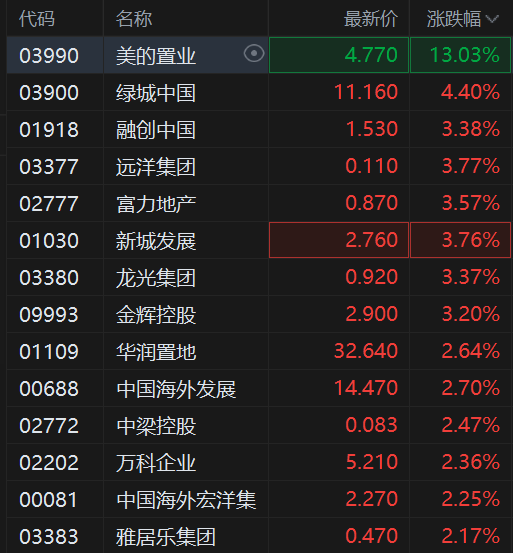
Group 1 - The core viewpoint of the article highlights a significant rise in Hong Kong's real estate stocks, driven by positive industry policies and market sentiment [1] - Midea Real Estate led the gains with an increase of over 13%, while other companies like Greentown China and Sunac China also saw notable rises [1][1] - Recent supportive policies include housing provident fund support for down payments in cities like Tianjin, and new regulations in Changsha and Fuzhou aimed at easing pressure on developers [1][1] Group 2 - The article notes that in the context of a deep adjustment in the real estate industry, some small to medium-sized listed real estate companies are turning their focus to the technology sector through mergers and acquisitions [1] - Industry insiders believe that cross-industry mergers and acquisitions could provide a second growth curve for these companies during the industry adjustment period, enhancing their cyclical resilience [1][1]

二手房价格同环比均下跌 成交量预计整体保持平稳
3 6 Ke· 2025-08-14 02:03
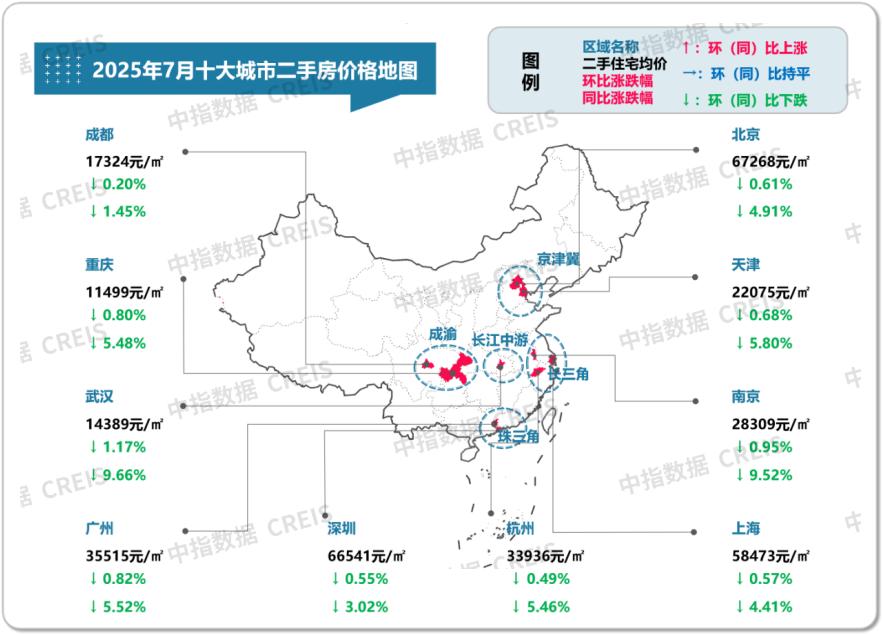
Group 1 - The core viewpoint of the article indicates that the real estate market in major cities is experiencing a traditional off-season in July, with a general decline in second-hand housing transaction volumes and a continuation of the "price for volume" phenomenon [1][60] - On the policy front, the central government is shifting its focus from large-scale expansion to improving existing stock, with key tasks outlined in the recent Central Urban Work Conference [1] - The State Council has introduced the "Housing Rental Regulations" to encourage the use of private housing for rental purposes and to support the revitalization of old properties for rental [1] Group 2 - In July, the average price of second-hand residential properties in 100 cities fell by 0.77% month-on-month and 7.32% year-on-year, while the top ten cities saw a month-on-month decline of 0.64% and a year-on-year decline of 5.10% [5] - Major cities like Wuhan and Nanjing experienced significant price drops, with Wuhan's month-on-month decline at 1.17% and year-on-year at 9.66% [5][36] - Beijing's second-hand housing transactions decreased by 15.6% month-on-month and 17.9% year-on-year, with prices down 0.61% month-on-month and 4.91% year-on-year [8][6] Group 3 - In Shanghai, second-hand housing transactions fell by 7.9% month-on-month and 6.7% year-on-year, with prices down 0.57% month-on-month and 4.41% year-on-year [13] - Guangzhou's second-hand housing prices decreased by 0.82% month-on-month and 5.52% year-on-year, with significant downward pressure on prices [20] - Shenzhen's second-hand housing market showed a slight increase in transaction volume, with 4,656 units sold, reflecting a 3.4% month-on-month growth [28] Group 4 - Chengdu's second-hand housing market remained active with 20,202 transactions in July, a 5.1% month-on-month increase, while prices fell by 0.20% month-on-month [43] - The overall sentiment in the real estate market is cautious, with high inventory levels leading to continued price pressures, despite some cities showing resilience [60][1] - The political bureau meeting on July 30 provided a positive outlook for the macroeconomic situation, which may help stabilize the market [60]
在各项稳楼市政策的推动下 前七月头部房企销售趋稳
2 1 Shi Ji Jing Ji Bao Dao· 2025-08-14 00:31
在各项稳楼市政策的推动下,市场趋稳,房地产企业的销售业绩也出现止跌迹象。 近日,多家房企发布2025年前7月销售业绩。虽然多数房企的销售规模仍低于去年同期,但跌幅普遍收 窄。 从已经公布销售单价的房企来看,企业的销售均价普遍低于去年,体现出以价换量的策略。 分析人士指出,房企销售降幅收窄,侧面反映出楼市正出现筑底迹象。政策仍有加力空间,从而推动市 场进一步止跌回稳。 以价换量是主流 今年前7月,央国企继续占据销售榜前列。从已公布销售业绩的房企来看,除保利外,绿城以1368亿元 的销售业绩位居第二,中海、华润、招商的销售规模分别为1320亿元、1236亿元、1046亿元。 这也是前7月仅有的五家迈入千亿阵营的企业。中指研究院指出,与去年同期相比,千亿阵营房企减少1 家。 与去年同期相比,这五家企业的销售额有不同程度的下滑。其中,保利的销售额下滑17.85%,绿城、 中海、华润、招商分别下滑7.3%、18.3%、11.8%、11%。 其余上市房企的销售业绩也以下降为主。 根据中指研究院的统计,2025年1~7月,TOP100房企销售总额为2.07万亿元,同比下降13.3%。与去年 同期约四成的销售跌幅相比,收窄明 ...