
小米集团

Search documents
全球大公司要闻 | 苹果将发布新品,千问进军AI硬件领域
Wind万得· 2026-03-02 00:58
// 热点头条 // 1. 苹果:将于本周举行春季新品发布会,新品价格或下探,涵盖低价机型;触控版MacBook Pro确认 2026年底推出,坚持Mac与iPad产品线独立。此外,Anthropic大模型Claude在美区Apple Store免费APP 排名升至第一,此前因美国国防部AI权限争端被特朗普政府"拉黑"。 2. SpaceX:正考虑最快于3月秘密递交首次公开募股文件,据知情人士透露,公司可能会在IPO中寻 求"超过1.75万亿美元"的估值,募资规模可能高达500亿美元,这将成为近年来全球规模最大的IPO之 一。 3. OpenAI:创始人奥特曼表示,公司与美国国防部就使用其AI模型和工具达成潜在协议,目前合同尚 未签署。OpenAI将保留对技术保障措施实施方式、模型部署对象及区域的控制权,并将部署范围限定 于云端环境,美国政府同意将OpenAI设定的"红线"纳入合同条款。 4. 英伟达:计划发布一款专为OpenAI及其他客户定制的全新AI处理器,以助力打造更快、更高效的工 具。这款新平台将在圣何塞举办的GTC开发者大会上正式公布,将整合初创公司Groq设计的芯片。同 时,与全球电信巨头合作,发 ...






万人大厂因AI一夜爆裁4000人,「留下的压力也很大」;网友晒椰树广告图被指低俗:「女员工胸这么大」引争议;SpaceX最早3月秘密申请IPO
雷峰网· 2026-03-02 00:43
要闻提示 NEWS REMIND 1. 万人大厂因AI一夜爆裁4000人,"留下的压力也很大" 2.网友晒椰树广告图被指低俗:"女员工胸这么大"引争议 3.BOSS直聘回应网传伊朗急招炮兵图:是假的,P图 4.传腾讯天美裁员数百人?接近人士:系项目调整,百余名员工正在活水 5.不排除出售可能!魅族StarV AR品牌被曝寻求独立融资 6.宗馥莉砍掉娃哈哈机器人业务,精机公司解散清算 7. OpenAI踩着Anthropic拿下美国军方大单,后者遭封杀 8.SpaceX最早3月秘密申请IPO:估值超1.75万亿美元 今日头条 HEADLINE NEWS 万人大厂因AI一夜爆裁4000人,"留下的压力也很大" 3月1日消息,据报道,近日,由推特前CEO杰克・多西创立、旗下拥有Square和Cash App的支付公司 Block宣布裁员计划,此次裁员比例达40%,涉及超4000名员工。杰克・多西同时作出预言,受人工智能 技术发展影响,未来一年内绝大多数企业都会做出类似的结构性人员调整。对于此次裁员的核心原因,杰 克・多西在致股东的信件中明确指向人工智能工具的快速发展,他直言 "智能工具已改变了创建和运营一 家公司的 ...



宗馥莉砍掉娃哈哈机器人业务,精机公司解散清算;荣耀人形机器人Robot表演后空翻;小米携手Gran Turismo发布中国首款VGT概念超跑丨邦早报
创业邦· 2026-03-02 00:09
完整早报音频,请点击标题下方小耳机收听 【荣耀人形机器人 Robot 亮相,现场表演后空翻】 3 月 1 日晚间消息,在荣耀 MWC 2026 全球发 布会上,荣耀 CEO 李健发表演讲。发布会上,荣耀人形机器人 Robot 以及荣耀机器人手机 Robot Phone 同台亮相,并与荣耀 CEO 李健现场互动。荣耀人形机器人 Robot 还在现场表演了舞蹈、后 空翻等动作。(新浪科技) 【宗 馥莉砍掉娃 哈哈机器人业务,精机公司解散清算】 2026 年 2 月 24 日,杭州娃哈哈精密机械 有限公司发布解散公示,正式进入清算程序,员工劳动合同于 2 月 28 日终止。该公司为娃哈哈商业 股份全资持股,实际控制人为宗馥莉,曾承担集团智能化、机器人研发与智能装备制造业务。据了 解,娃哈哈精机成立于 2011 年, 2023 、 2024 年社保人数分别为 281 人、 261 人。此次注销 原因为决议解散,清算组负责人为宗馥莉旗下宏胜系核心高管严学峰。接近娃哈哈的人士表示,此举 与宗庆后时期多元化思路不同,宗馥莉意在剥离非核心业务,将资源聚焦食品饮料主业。(每日经济 新闻) 【三星拟于 2030 年前在 AI 驱 ...





陆家嘴财经早餐2026年3月2日星期一
Wind万得· 2026-03-01 22:49
3、 中信证券表示,美军军事调动、伊朗政局变化、冲突外溢范围三个关键信号是否出现潜在变化,将 决定全球市场影响为2025年6月"十二日战争"的放大版,还是走向更极端的情景。 中信证券复盘1970年 以来中东地区八场重大冲突的市场影响,可总结为以下规律:避险资产黄金较美元更优,油价长期仍看 供需,美股表现与美国军事介入程度和战局走势直接相关,而对中国资产并无显著影响。 4、 本周全球市场大事不断!国内方面,2026年全国两会开幕,将讨论政府工作报告与" 十五五 "规 划;中国2月PMI、外汇及黄金储备数据将公布;阿里千问将于3月2日发布AI眼镜。 国际方面,伊朗局 势备受瞩目;俄罗斯、美国及乌克兰将进行新一轮谈判;美联储褐皮书及2月非农就业报告将陆续发 布;2026年世界移动通信大会开幕;苹果将于3月4日举行新品发布会。财报方面,MiniMax、京东、B 站等将发布最新业绩。 • 哈梅内伊遇袭身亡, 伊朗将很快选举最高领袖 • 美国总统特朗普:对伊朗军事行动可能持续4周 • 美以军事打击伊朗, 霍尔木兹海峡航运停摆 • 本周市场聚焦中国两会、伊朗局势, 非农报告及黄金原油走势备受关注 • 造车新势力2月销量遇冷 ...

又生变!造车新势力最新销量出炉!比亚迪跌破重要关口
Zhong Guo Ji Jin Bao· 2026-03-01 21:49
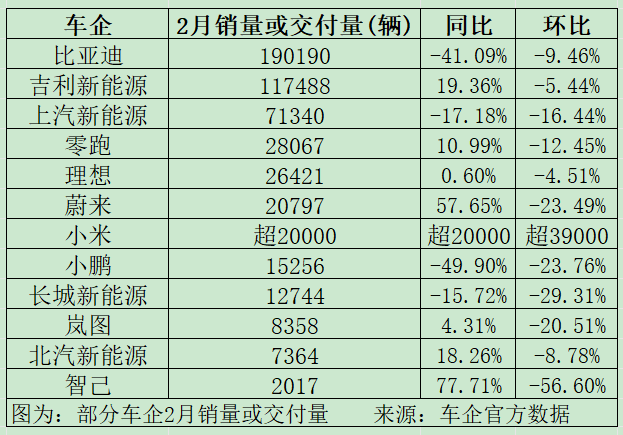
2026年春节假期叠加新能源汽车购置税新政,成为车企2月销量总体"遇冷"的重要原因。2026年春节假期较长导致汽车行业的有效产销时间大幅缩 减。 2月成为汽车行业的消费淡季,但仍有部分车企表现突出。比如,吉利旗下高端新能源汽车品牌极氪,2月销量同比增长70%至2.39万辆。 【导读】车企竞争格局又生变:零跑重夺新势力销冠,比亚迪跌破20万辆大关 3月1日,多家车企披露2月销量,总体"遇冷"成为关键词。 2月份比亚迪、上汽的销量,同比分别下降41.09%、8.64%。其中比亚迪月度销量为19.02万辆,在近年来的月度销量中首次跌破20万辆大关。 2月,头部造车新势力的竞争门槛下降至2万辆,其中零跑重夺造车新势力月度销冠,销量为2.81万辆。 接下来,汽车市场的竞争变数颇多。小米创办人,董事长兼CEO雷军发布微博称:"新一代SU7正在紧锣密鼓地准备。" | 车企 | 2月销量或交付量(辆) | 同比 | 环比 | | --- | --- | --- | --- | | 比亚迪 | 190190 | -41.09% | -9. 46% | | 吉利新能源 | 117488 | 19. 36% | -5. 44% | ...

中国消费:评估 “全球化” 的成功 - 从供应链效率到品牌力;解答五大核心问题-China Consumer_ Assessing the success of _going global_ – from supply chain efficiency to brand power; answering 5 key questions
2026-03-01 17:23
Summary of Key Points from the Conference Call Industry Overview - The report focuses on the **Chinese consumer industry**, particularly the global expansion strategies of Chinese consumer companies in response to slowing domestic growth and competitive strengths [1][6] - The expansion strategy is evolving from cost and supply chain advantages to a focus on **innovation and brand power** [1][6] Current Globalization Stage - Chinese consumer companies are at different stages of globalization, with sectors like **home appliances, auto, and consumer electronics** being pioneers, while others like **restaurants, jewelry, and cosmetics** are still in early stages [8][9] - The report identifies **seven successful stocks** in the coverage: Midea, Pop Mart, Roborock, Miniso, and potential success stories like Anta and Eastroc [6][8] Path to Success - A **five-dimensional framework** is introduced to evaluate success in global markets: 1. Product strength 2. Competition landscape 3. Channel build-up complexity 4. Branding 5. Policy and regulation risks [6][10] Triggers and Accelerators - **Triggers** for overseas expansion include a mix of 'push' and 'pull' factors, while **accelerators** consist of cross-border e-commerce, social media, outbound direct investment (ODI), and mergers & acquisitions (M&A) [6][10] Margin Trajectory - Margin dilution is common during the early stages of overseas expansion, but long-term margin accretion is achievable with strong pricing power, favorable cost structures, and scale enlargement [6][10] Key Risks - Risks involved in going global are categorized into **external** (geopolitical, legal compliance, competition, cultural) and **internal** (organization/talent, partner relationships, cost management, supply chain/operation) [6][10] Market Positioning - Chinese consumer companies show different positions in developed vs. emerging markets, with a shift towards a **Brand-Premium quadrant** as brands develop core competitiveness [10][17] - Significant international revenues are concentrated in OEM-heavy categories, with **83%** of apparel/footwear OEMs and **56%** of pet care brands expected to derive revenues from overseas by FY25E [17][19] Historical Context - The overseas footprint of Chinese consumer companies has evolved through four phases since the 1980s, with the current focus on localization, brand building, and risk management [9][10] Comparative Analysis - Compared to Japanese consumer companies, Chinese brands have a more concentrated overseas revenue exposure, particularly in OEM-driven categories, while Japanese brands show more diversified success across various sectors [17][21] Future Expectations - The report anticipates a shift in positioning dynamics towards premium branding as Chinese companies enhance their competitiveness through the outlined five dimensions [10][21] Conclusion - The report emphasizes the importance of understanding the evolving landscape of the Chinese consumer industry as companies navigate their global expansion strategies, highlighting both opportunities and risks involved in this transition [1][6][10]





四维图新20260226
2026-03-01 17:23
四维图新 20260226 公司战略转型 Tier 1 供应商,从地图商向软硬件一体化解决方案提供商 转型,历时三年,产品以中低阶智驾方案为主,2026 年将正式量产交 付中高阶智驾方案,形成全栈智驾系统交付能力。 通过 2.5 亿元现金+智驾子公司资产作价的方式,获得建智机器人 39% 股权成为第一大股东,合并智驾团队与建智算法团队,形成 500-600 人 规模的智驾方案交付团队,承担全产品线交付。 智驾芯片方面,延续与地平线的合作,同时保留跨平台能力,支持地平 线和高通方案,面向 2026 年以后量产的订单仍以地平线全系合作为主。 客户结构上,低阶产品客户包括比亚迪、北汽、长城,通过整合滴滴智 驾团队补齐舱泊算法能力,新增东风客户,国际品牌客户方面,广丰成 为主要下单主体,G6B 为广丰采用地平线芯片的全球车型首发项目,计 划在 2026 年上半年量产。 2024-2025 年智驾收入增长受单一车企集中量产节奏影响,2026 年后 客户结构多元化,预计至少 4 家车厂同时进入量产周期,2025 年智驾 收入约 2 亿元。 Q&A 2025 年以来,公司从地图商向面向 OEM 的软硬一体 Tier 1 转 ...

AI时代大分化下的投资逻辑系列电话会议
2026-03-01 17:23
Summary of Key Points from Conference Call Records Industry and Company Overview - The conference call discusses the impact of AI on various industries, particularly focusing on software, cloud services, and energy sectors. It highlights the structural changes in investment logic due to AI advancements and the resulting market dynamics. Core Insights and Arguments 1. **AI's Impact on Software Stocks**: Large model companies are actively replacing enterprise IT budgets, leading to valuation pressure on software stocks. This creates opportunities for selective stock picking rather than broad sector rebounds [1][5]. 2. **Cloud Companies' Financial Strategies**: There is a slowdown in buybacks and dividends among cloud companies, with net cash flow turning negative when excluding these factors. However, capital expenditures (CAPEX) continue to increase, contradicting traditional investment paradigms [1][3][5]. 3. **"AI Tax" on Traditional Hardware**: Some traditional hardware companies, such as Lenovo and Cisco, are experiencing profit margin declines due to rising storage prices, referred to as the "AI tax," which pressures their short-term operations and valuations [1][6]. 4. **Shift Towards Real Assets**: The U.S. stock market is showing a preference for tangible assets, particularly in the electricity sector, with utilities and construction performing well. This trend is driven by expectations of power expansion and infrastructure development [1][7]. 5. **Political Factors Influencing Energy Needs**: By 2026, political factors are expected to drive cloud companies to build their own power sources, with natural gas being favored due to its environmental benefits and domestic advantages [1][8]. 6. **Resource Diplomacy and Pricing**: The U.S. is focusing on setting reference prices for key resources through tariffs and strategic reserves, aiming to provide long-term high price expectations for resource commodities [1][9]. 7. **Oil Market Dynamics**: There are signs of a potential reversal in the oil market, driven by changes in production dynamics and the U.S. adopting a more defensive stance compared to OPEC [1][10]. Additional Important Insights 1. **K-Shaped Economic Impact of AI**: AI is expected to create a K-shaped economic recovery, benefiting certain sectors while suppressing overall consumer spending, particularly among lower-income groups [2][11]. 2. **Investment Opportunities in AI**: The focus should be on upstream AI-related infrastructure and companies that are not directly impacted by AI disruptions. There is potential for significant returns in sectors like energy and resource management [12][16]. 3. **Market Mispricing Risks**: There is a risk of mispricing in the market, where companies perceived as unaffected by AI may face long-term challenges due to ongoing AI developments [13][14]. 4. **2026 Market Outlook**: The overall market outlook for 2026 is cautious, with expectations of limited returns and the need to monitor macroeconomic indicators and geopolitical developments closely [15][31]. 5. **SaaS and Software Valuation Pressures**: The SaaS sector is experiencing significant valuation pressures, with many companies facing sell-offs despite strong earnings. The traditional pricing models are being challenged by the rise of Agentic AI [22][25][23]. Conclusion The conference call highlights the transformative impact of AI across various sectors, emphasizing the need for investors to adapt their strategies in response to changing market dynamics. Key areas of focus include selective stock picking, understanding the implications of political and economic factors, and recognizing the potential for mispricing in the current market environment.
优刻得20260226
2026-03-01 17:23
Company and Industry Summary Company Overview - The company has strategically reduced unprofitable businesses since 2021 and has built its own IDC, effectively improving gross margins. AI-related revenue has increased to nearly 40%, aiming for its first quarterly profit in Q4 2025, marking a critical turning point [2][3]. Core Industry Insights - The company is focusing on AI and globalization, particularly in the European and American markets, to leverage time zone differences and stronger AI demand from clients in these regions [2][5]. - The Ulanqab IDC benefits from low electricity prices, with a utilization rate of 60%. Plans include adding 1,800 cabinets by March 2026, with production expected in 2027. The Shanghai Qingpu IDC has a clear location advantage but higher electricity costs, with expansion dependent on demand [2][6]. Customer Structure - The customer base is diversified, with the top five clients accounting for less than 25% of total revenue. Key clients include companies from gaming (Zhiyu), mobile (Vivo, OPPO, Xiaomi), automotive (Xiaopeng, Changan), and finance (Dongfang Wealth) [2][7]. GPU Resource Management - The company has issued a price increase notice due to tight GPU resources, with AI-related services expected to see price hikes of approximately 15%-20% starting mid-July 2025, applicable only to new orders [2][8]. Financial Performance and Projections - The company has been operating at a loss for nearly five years, but losses have been shrinking, with a projected first quarterly profit in Q4 2025. The improvement in gross margins and reduction in losses is attributed to strategic business adjustments and increased AI revenue [3][11]. - The gross margin has improved from single digits to 25% by 2025, with expectations for gradual increases in the future [16][17]. Pricing Strategy - The pricing mechanism is characterized by individual negotiations with clients, making it difficult to implement blanket price increases. The company has begun the process of raising prices for AI-related services, with the actual impact still under observation [8][9]. International Expansion - The company is actively expanding its overseas presence, with plans to establish new nodes in the U.S. and enhance its global footprint. The overseas revenue accounted for about 20% in the first three quarters of 2025, primarily from services to Chinese companies operating abroad [5][14]. Technology and Service Capabilities - The company emphasizes its neutrality as a cloud provider, which alleviates client concerns about data security. It also highlights its operational flexibility and technical capabilities, which are crucial in a rapidly changing industry [10][26]. Future Directions - The focus will remain on increasing AI and overseas revenue proportions, with a particular emphasis on the growing demand for AI capabilities across various industries [5][18]. - The company is also exploring strategic partnerships with key clients, particularly in emerging fields like brain-computer interfaces, to deepen collaboration beyond traditional customer relationships [24][25]. Conclusion - The company is positioned to capitalize on the growing AI market and international opportunities, with a clear strategy to enhance profitability and operational efficiency. The upcoming quarters will be critical in validating its growth trajectory and financial health [27][30].

力合微20260226
2026-03-01 17:23
Summary of Conference Call for Lihewei Industry and Company Overview - **Company**: Lihewei - **Industry**: Smart Grid and IoT (Internet of Things) Key Points and Arguments Electric Grid Business - The company expects significant benefits from the "14th Five-Year Plan" starting in 2026, with bidding and delivery anticipated to outperform 2025, which was negatively impacted by the end of the previous generation of electric meter replacement cycles [2][4] - The bidding and delivery in Q1 2026 are expected to be better than Q1 2025, influenced by the first year of the "14th Five-Year Plan" and the company's increased sales efforts after a challenging 2025 [5][12] - The market share for the electric grid side is estimated at 7%-10%, with leading competitors holding approximately 60%-70% [8] Non-Electric Grid IoT Business - The non-electric grid IoT business has maintained around 30% growth over the past two years, with expectations for better performance in 2026 due to market expansion and consumer education [2][4] - The partnership with Atour Hotel Group, which has adopted PLC technology as its standard, is seen as a milestone that could lead to broader adoption among hotel groups, enhancing company performance [2][4][23] Technology and Product Pricing - The price of electric grid PLC modules is relatively high, around 30-40 RMB per unit, with older products expected to decrease in price [2][6] - New generation technologies may lead to re-pricing due to added functionalities, but older products are unlikely to see price increases [6] - The company is transitioning to dual-mode high-speed solutions, with future developments expected to include ultra-high-speed and multi-mode products [2][4][9] Market Competition and Pricing Trends - The electric grid sector faced challenges in 2025 due to increased competition and price pressures following the maturity of chip technology [7][12] - Price increases in the electric grid sector are considered unlikely, with overall pricing trends expected to remain downward due to competitive pressures [7][12] Smart Home and AI Integration - The integration of AI and smart home technologies is expected to accelerate, with the company actively participating in collaborations with major brands like Xiaomi and Huawei [3][13][14] - The company is focusing on the stability and reliability of PLC technology in smart home applications, particularly in larger appliances [14][15] Hotel and Real Estate Applications - The hotel sector is seen as a significant growth area, with the Atour project serving as a model for future expansions into other hotel groups [20][24] - The real estate market is showing signs of recovery, with potential demand for smart home technologies in new constructions and renovations [25] Future Outlook - Overall, 2026 is expected to be a better year for both electric and non-electric grid businesses compared to 2025, with non-electric grid sectors being particularly promising [4][12] - The company is committed to ongoing research and development in PLC technology, aiming to enhance its applications in both electric grid and smart home environments [13][20] Additional Important Insights - The company has established a strong position in the PLC market, with a focus on providing open connectivity solutions that support multiple brands and devices [20] - The collaboration with traditional and ecological home appliance manufacturers is being strategically balanced to maximize growth potential [19][20] - The hotel sector's demand for stable connections for smart technologies is driving the need for reliable PLC solutions [21][22]
