陕西煤业

Search documents
陕西煤业(601225):煤价下行拖累业绩,煤电一体化稳步推进
Guoxin Securities· 2025-09-01 09:43
Investment Rating - The investment rating for Shaanxi Coal and Chemical Industry (601225.SH) is "Outperform the Market" [5][21]. Core Views - The report indicates that the decline in coal prices has negatively impacted the company's performance, but the integration of coal and electricity operations is progressing steadily [1][16]. - The company is actively working on resource succession and expects capacity growth despite the challenges posed by falling coal prices [2][8]. - The company plans to distribute a mid-term cash dividend of 0.039 CNY per share, with a dividend payout ratio of 5% [3][16]. Summary by Sections Financial Performance - In the first half of 2025, the company achieved revenue of 77.98 billion CNY, a year-on-year decrease of 14.2%, and a net profit attributable to shareholders of 7.64 billion CNY, down 31.2% year-on-year [1][7]. - For Q2 2025, revenue was 37.82 billion CNY, down 20.5% year-on-year and 5.8% quarter-on-quarter, with a net profit of 2.83 billion CNY, reflecting a year-on-year decline of 54.6% and a quarter-on-quarter decline of 41.0% [1][7]. Coal Business - The company's coal production and sales remained relatively stable, with H1 2025 coal production/sales of 87.4 million/125.99 million tons, both up 1% year-on-year [2][8]. - The average selling price of self-produced coal in H1 2025 was 420 CNY per ton, down 118 CNY per ton year-on-year [2][8]. - The company is pushing for capacity increases in coal mining, with a 2 million ton increase in the Yuan Datang coal mine's capacity to 10 million tons [2][8]. Power Business - In H1 2025, the total power generation/sales were 17.8 billion/16.6 billion kWh, down 12%/11% year-on-year [3][14]. - The average selling price of electricity was 408 CNY per MWh, an increase of 0.79 CNY per MWh year-on-year, while the total generation cost remained stable at 343 CNY per MWh [3][14]. Profit Forecast and Financial Indicators - The profit forecast for 2025-2027 is adjusted to 15.8 billion/16.2 billion/16.7 billion CNY, down from previous estimates of 18.7 billion/19.0 billion/19.4 billion CNY [3][16]. - Key financial metrics for 2025 include a projected revenue of 150.5 billion CNY, a net profit of 15.8 billion CNY, and an earnings per share of 1.63 CNY [4][19].

多行业联合红利资产8月报:A股25H1分红扩围增量-20250901
Huachuang Securities· 2025-09-01 06:17
证 券 研 究 报 告 【策略月报】 A 股 25H1 分红扩围增量 ——多行业联合红利资产 8 月报 策略研究 策略月报 2025 年 09 月 01 日 华创证券研究所 证券分析师:姚佩 邮箱:yaopei@hcyjs.com 执业编号:S0360522120004 证券分析师:吴一凡 邮箱:wuyifan@hcyjs.com 执业编号:S0360516090002 证券分析师:徐康 电话:021-20572556 邮箱:xukang@hcyjs.com 执业编号:S0360518060005 证券分析师:杨晖 邮箱:yanghui@hcyjs.com 执业编号:S0360522050001 证券分析师:欧阳予 邮箱:ouyangyu@hcyjs.com 执业编号:S0360520070001 证券分析师:韩星雨 邮箱:hanxingyu@hcyjs.com 执业编号:S0360525050001 证券分析师:单戈 邮箱:shange@hcyjs.com 执业编号:S0360522110001 证券分析师:刘欣 邮箱:liuxin3@hcyjs.com 执业编号:S0360521010001 相关研究报告 ...
煤炭行业2025年中报综述:煤价阶梯探底趋稳,业绩回落降幅明显
Changjiang Securities· 2025-09-01 04:41
Investment Rating - The report maintains a "Positive" investment rating for the coal industry [11]. Core Insights - The coal price has been stabilizing after a downward trend, with significant declines in performance metrics observed in the first half of 2025. The coal sector reported a revenue of CNY 548.55 billion, down 19.5% year-on-year, and a net profit of CNY 52.76 billion, down 31.6% year-on-year [2][51]. - The report suggests that the bottom of coal enterprise profits is becoming apparent, indicating potential opportunities for recovery in the sector, especially as the market enters a phase of policy effect verification [9]. Summary by Sections Operating Conditions - In the first half of 2025, the coal sector's revenue was CNY 548.55 billion, a decrease of 19.5% year-on-year, with a net profit of CNY 52.76 billion, down 31.6% year-on-year. In Q2 2025, revenue was CNY 269.17 billion, down 19.6% year-on-year and 3.7% quarter-on-quarter, with a net profit of CNY 24.12 billion, down 35.5% year-on-year and 15.8% quarter-on-quarter [2][51]. Thermal Coal - The thermal coal segment saw a revenue of CNY 434.9 billion in the first half of 2025, a decline of 17% year-on-year. The average price for Q2 2025 was CNY 632 per ton, down 26% year-on-year and 12% quarter-on-quarter [7][6]. - The segment's net profit was CNY 51 billion, down 28% year-on-year, with a profit margin of 30.5% [7]. Coking Coal - The coking coal segment reported a revenue of CNY 831 billion in the first half of 2025, down 29% year-on-year. The average price for Q2 2025 was CNY 1,315 per ton, down 37% year-on-year and 9% quarter-on-quarter [8][6]. - The segment's net profit was CNY 31 billion, down 65% year-on-year [8]. Investment Recommendations - The report highlights potential recovery opportunities in the coal sector, recommending companies such as Yancoal Energy, Jinneng Holding, and China Shenhua Energy for their strong fundamentals and growth potential [9].


尿素2025年9月报:供需转变,价格区间或扩大-20250901
Chang Jiang Qi Huo· 2025-09-01 02:23
Report Overview - Report Title: Urea September 2025 Monthly Report: Supply-Demand Shift, Price Range May Widen [1] - Report Date: September 1, 2025 [1] - Report Author: Zhang Ying from the Energy and Chemical Industry Service Center of the Industrial Service Headquarters of Yangtze River Futures Co., Ltd. [1] 1. Report Industry Investment Rating There is no information about the industry investment rating in the report. 2. Core Viewpoints - The supply and demand of urea are both changing. The supply is expected to increase with capacity expansion and increased daily production in September, while demand will also gradually show an increasing trend. It is necessary to pay attention to the rhythm changes, and the price fluctuation range is expected to expand [41]. 3. Summary by Directory 3.1 Urea Market Review - In August, the urea futures price oscillated, briefly surging before falling back. On August 29, the Urea 01 contract closed at 1,746 yuan/ton, up 29 yuan/ton from the end of July. The spot price was firm but actual trading was weak. On August 29, the Henan market price was 1,727 yuan/ton, down 38 yuan/ton from the end of July [5]. 3.2 Urea Capacity and Production Analysis - In August, the number of urea production device overhauls increased, and the operating rate first rose and then fell. By the end of the month, the operating rate was 81.73%, down 3.2 percentage points from the end of last month. The operating rate of natural gas - based urea continued to decline, reaching 71.8% at the end of the month, down 6.82 percentage points from the end of last month [9]. - In August, three new production capacities were put into operation, with a total of 200,000 tons from Shandong Jinkong Riyue New Materials Co., Ltd., 1 million tons from Xinjiang Xinji Energy Chemical Co., Ltd., and 800,000 tons from Anhui Jinmei Zhongneng Chemical Co., Ltd. From January to August 2025, the total new urea production capacity put into operation was about 4.4 million tons [9]. - In August, the daily average urea output was still higher than the historical value, ranging from a minimum of 189,800 tons to a maximum of 194,400 tons, and currently maintaining at the level of 190,000 - 200,000 tons. The estimated urea output in August was 6.0605 million tons, a decrease of 27,500 tons month - on - month and an increase of 829,500 tons year - on - year. From January to August, the estimated urea output was 48.154 million tons, an increase of nearly 5.68 million tons year - on - year, with a supply growth rate of 13.37% [12]. 3.3 Urea Cost and Profit Analysis - In August, the market price of anthracite first rose and then stabilized. The average monthly gross profit margin of coal - based urea was estimated to be 2.58%, a decrease of 5.68 percentage points month - on - month and 3.66 percentage points year - on - year. The estimated average monthly gross profit margin of gas - based urea in July was - 10.03%, a decrease of 1.97 percentage points month - on - month and 14.05 percentage points year - on - year [16]. 3.4 Urea Demand Analysis - From January to July 2025, the apparent consumption of urea was 41.455 million tons, an increase of about 4.428 million tons year - on - year, with a year - on - year increase of 11.96%. In August 2025, the urea production - sales ratio was maintained at 95.4% - 96.6%, at a relatively high level [19]. 3.5 Urea Agricultural Demand Analysis - In 2024, the national grain sown area was 1.79 billion mu, an increase of 5.258 million mu from the previous year, a growth of 0.3%, and it has been increasing for five consecutive years. With the construction of high - standard farmland, the single - yield level of grain is expected to be effectively improved. The demand for summer fertilizers such as rice and corn is being released [21]. 3.6 Urea Compound Fertilizer and Industrial Demand Analysis - In August, the operating rate of compound fertilizers first rose and then fell. The estimated output of compound fertilizers in August was 4.76 million tons, an increase of 1.48 million tons month - on - month and a decrease of 770,000 tons year - on - year. From January to August, the estimated output of compound fertilizers was 33.62 million tons, an increase of 180,000 tons year - on - year, with a year - on - year increase of 0.54%. In September, it is expected to gradually enter the peak sales season, and the probability of dealers' centralized pick - up will increase [27]. - In August, the average operating rate of melamine enterprises in China was 54.36%, a decrease of 7.06 percentage points from the previous month. The monthly output was 115,200 tons, a decrease of 18,800 tons from the previous month [30]. 3.7 Urea and Fertilizer Export Analysis - From January to July 2025, the total fertilizer exports in China were 22.83 million tons, an increase of 7.156 million tons year - on - year, with a year - on - year increase of 45.65%. The export volume of mineral nitrogen fertilizers and chemical nitrogen fertilizers was 12.33 million tons, an increase of 3.767 million tons year - on - year, with a year - on - year increase of 43.99%. The urea export volume was 644,000 tons, an increase of 426,700 tons year - on - year [33]. 3.8 Urea Inventory Level Analysis - At the end of August, the urea enterprise inventory was 1.003 million tons, an increase of 246,000 tons from the beginning of the month, changing from destocking to inventory accumulation. At the end of August, the urea port inventory was 790,000 tons, an increase of 270,000 tons from the end of last month. The number of registered urea warehouse receipts was 6,473, equivalent to 129,460 tons of urea, an increase of 64,800 tons from the end of last month [35][38]. 3.9 Urea Market Outlook - Supply: There is still an expectation of continuous urea capacity release. The concentrated overhaul period of coal - based urea devices has passed. Although the overall operating rate of gas - based devices is lower than in previous years, the overall urea supply may maintain a year - on - year growth rate of 8 - 12%, and the daily average urea output will maintain at the level of 190,000 - 200,000 tons. - Demand: (1) Agricultural demand: The concentrated fertilization period for summer harvest and sowing is over, and other agricultural fertilization is sporadic. (2) Industrial demand: Compound fertilizers are in the pre - sale stage of autumn fertilizers. As the pre - sale progresses, the operating rate of fertilizer enterprises will gradually increase in the second half of the month, and the production of autumn fertilizers will start. In September, it is the traditional sales stage of compound fertilizers. In the middle and late ten days, the pick - up volume of dealers will increase, and the production of fertilizer enterprises will also increase simultaneously. The industrial demand for melamine, urea - formaldehyde resin, desulfurization and denitrification will fluctuate slightly. (3) Export demand: The urea export volume in July was lower than expected, while the urea port inventory exceeded the previous export peak level. It is expected that the export volume will be concentrated in August - September. - Market outlook: Recently, the number of urea device overhauls has decreased, and the supply has recovered month - on - month, with the daily output running at 190,000 - 200,000 tons. The agricultural fertilization demand is sporadic. After the continuous increase in the operating rate of compound fertilizers, it began to decline. The peak operating rate of compound fertilizers is lower than in previous years. It is expected that the progress of compound fertilizers this year will be delayed, and other industrial demand will remain stable. The downstream of urea continues to hold a wait - and - see attitude, and the limited actual transactions have led to continuous inventory accumulation of enterprises. In September, with capacity release and expected increase in daily output, the demand will also gradually show an increasing trend. Both supply and demand are changing, and attention should be paid to the rhythm changes. It is expected that the price fluctuation range may expand. Key points to focus on include urea capacity release, urea device production cuts and overhauls, compound fertilizer operating rate, export policies, coal prices, and the macro - environment [41].
非电煤接棒将利多煤价,煤炭布局稳扎稳打 | 投研报告
Zhong Guo Neng Yuan Wang· 2025-09-01 02:15
Core Viewpoint - The coal industry is experiencing a slight price decline in thermal coal, with the Qinhuangdao Q5500 thermal coal closing price at 690 RMB/ton as of August 29, marking a decrease of 14 RMB/ton or 1.99% from the previous period. This is the first time the price has fallen below 700 RMB after a rebound above that level. The upcoming demand for non-electric coal during the "golden September and silver October" period is expected to be a highlight for the market [1][2]. Group 1: Thermal Coal Market - As of August 29, the Qinhuangdao Q5500 thermal coal price is 690 RMB/ton, down 14 RMB/ton or 1.99% from the previous week, marking a return below 700 RMB after a recent rebound [1][2]. - The current market is transitioning from summer to autumn, with a decrease in daily consumption by power plants, but the demand for non-electric coal is anticipated to rise in the coming months [1][2]. - Key supportive factors for a potential rebound in coal prices include low operating rates at coal mines, with a reported operating rate of 79.9% for 442 coal mines in Shanxi, Shaanxi, and Inner Mongolia, down 1.8 percentage points [1][2]. Group 2: Coking Coal Market - As of August 29, the price of coking coal at Jingtang Port is 1610 RMB/ton, rebounding from a low of 1230 RMB/ton in early July. Coking coal futures have seen a significant increase from 719 RMB in early June to 1151 RMB, a cumulative rise of 60.1% [1][2]. - The coking coal market is characterized by strong expectations but weak realities, with supply tightening due to regulatory measures on overproduction [1][2]. Group 3: Investment Logic - The investment logic suggests that both thermal and coking coal prices are at a turning point, with expectations for thermal coal prices to recover to long-term contract prices around 700 RMB. The forecast for thermal coal prices to reach 750 RMB by 2025 is based on the profitability balance for coal and power companies [2]. - The target prices for coking coal are derived from the price ratio between coking coal and thermal coal, with current ratios indicating target prices of 1608 RMB, 1680 RMB, 1800 RMB, and 2064 RMB for coking coal corresponding to various target prices for thermal coal [2]. Group 4: Investment Recommendations - The coal sector is viewed as having dual attributes of cyclical and dividend potential, with current low holdings indicating an opportune time for investment. Four main lines of stock selection are recommended: - Cycle logic: Jin控煤业, 兖矿能源 for thermal coal; 平煤股份, 淮北矿业, 潞安环能 for metallurgical coal - Dividend logic: 中国神华, 中煤能源, 陕西煤业 - Diversified aluminum elasticity: 神火股份, 电投能源 - Growth logic: 新集能源, 广汇能源 [3].
周期论剑|布局周期的确定性
2025-09-01 02:01
Summary of Key Points from Conference Call Records Industry Overview - The conference call discusses the Chinese market, focusing on various sectors including integrated circuits, artificial intelligence, petrochemicals, coal, and steel industries. The overall sentiment is optimistic about the market's future performance, with expectations of a bull market lasting at least two years due to several converging factors [1][4][8]. Core Insights and Arguments 1. **Market Outlook**: The Chinese stock market is expected to continue rising, potentially breaking the 4,000-point barrier, with a focus on mid-cap and low-valued blue-chip stocks as key drivers of the next market phase [2][8]. 2. **Economic Transformation**: China's rapid transformation in sectors like integrated circuits and AI is reducing uncertainty in social development, leading to a historical trend of long-term capital entering the market [3][4]. 3. **Policy Support**: The likelihood of new economic support measures and the easing of monetary policy by the People's Bank of China (PBOC) are anticipated, which will further bolster market confidence [5][6]. 4. **Traditional Industries**: Traditional sectors are entering a destocking phase, with improved visibility for stabilization expected between 2026 and 2027. The focus should be on overall trends and policy support rather than specific industries [7][8]. 5. **Investment Strategies**: Recommendations include focusing on cyclical stocks, especially in the petrochemical sector, and monitoring the performance of rare earth materials and copper-tin lines in the non-ferrous sector [9][12]. Important but Overlooked Content 1. **Coal Industry Dynamics**: The coal sector is facing profitability pressures, but leading companies like China Shenhua are showing stable performance and increasing dividend rates, signaling strong investment potential despite overall industry challenges [18][19]. 2. **Petrochemical Sector**: The petrochemical industry is recommended for investment, particularly in polyester filament and refining sectors, which are expected to benefit from seasonal demand and supply-side reforms [12][14]. 3. **Steel Industry Challenges**: The steel industry is currently experiencing a transition from off-peak to peak demand, with concerns about inventory levels and pricing pressures due to weak manufacturing demand [25][26][28]. 4. **Regulatory Changes**: New regulations in the coal mining sector are expected to increase operational costs but will enhance safety, providing a long-term stabilizing effect on coal prices [22]. 5. **Investment Recommendations**: Specific companies are highlighted for investment, including China Shenhua, China Coal Energy, and leading steel firms like Huaneng Steel and Baosteel, which are expected to perform well in the current market environment [24][30]. This summary encapsulates the key points discussed in the conference call, providing insights into the current state and future expectations of various industries within the Chinese market.
煤市:8月供给库存双降,价格怎么看
2025-09-01 02:01
Summary of Coal Industry Conference Call Industry Overview - The coal supply side is tightening, with coal supply in the Shanxi, Shaanxi, and Inner Mongolia regions decreasing by 2.3 percentage points week-on-week, and thermal coal supply down by 6 percentage points year-on-year, indicating a contraction in supply that may support coal prices [1][3] - Current market coal prices are approaching long-term contract prices, with the market price for 5,500 kcal coal at 674 RMB/ton, close to the long-term contract price of 668 RMB/ton, suggesting limited downside for market coal prices [1][4] Key Insights - High Dividend Yields: Several coal companies have dividend yields exceeding 4%, such as China Shenhua (5%) and Shaanxi Coal (4.5%), indicating potential value for left-side positioning in the sector [1][5] - Downstream Demand Disparity: Electricity demand has decreased, with daily consumption remaining flat year-on-year; however, steel demand has increased by 10% year-on-year, while chemical coal usage has risen by 16% year-on-year [1][7] - International Risks: The unrest in Indonesia may impact the international thermal coal supply chain, necessitating close monitoring of developments [1][8] - Railway Freight Increase: On August 31, railway freight rates were raised, increasing downstream shipping costs by 10-20 RMB/ton, potentially up to 30 RMB for shipments to Yunnan, providing strong cost support for coal prices [1][9] Market Dynamics - Port Inventory: Coal inventories at major Chinese ports are nearing the five-year average, and prices are expected to rise when inventories fall below this average, especially with upcoming holiday supply and heating season procurement needs [2] - Recent Stock Performance: Last week, Anyuan Coal experienced the highest increase at 17%, driven by non-ferrous metal logic, while Shaanxi Coal saw the largest decline, presenting a potential buying opportunity [1][6] Future Outlook - Price Trends: Despite recent declines in port and production prices, downstream demand is expected to rebound post-parade, with power plants considering holiday supply factors and heating season procurement in November, which will support prices [1][10] - Inventory Levels: Current inventory data indicates that major Chinese port inventories are close to the five-year average, suggesting that prices may continue to rise when inventory levels drop below this average, presenting a left-side positioning opportunity [1][10]
煤价破七百回落,后续怎么看?
Changjiang Securities· 2025-08-31 09:44
Investment Rating - The report maintains a "Positive" investment rating for the coal industry [8] Core Views - The coal price has dropped below 700 RMB/ton, but the bottom is expected to be established due to tightening supply under the "anti-involution" context, leading to potential profit recovery for coal companies in the future [6][7] - Short-term excess returns in the coal sector may not be significant, but the probability of achieving absolute returns is high, with a focus on long-term investment opportunities in companies like Yanzhou Coal Mining Company, China Power Investment Corporation, Lu'an Mining, and Shaanxi Coal and Chemical Industry [6][7] Summary by Sections Weekly Tracking Summary - The coal index (Yangtze River) fell by 2.71%, underperforming the CSI 300 index by 5.42 percentage points, ranking last among all sectors [13] - As of August 29, the market price for Qinhuangdao thermal coal was 690 RMB/ton, down 14 RMB/ton week-on-week [13] Supply and Demand Situation - As of August 28, the daily coal consumption in 25 provinces was 602.7 million tons, down 6.2% week-on-week [14] - The available days of inventory for power plants in these provinces increased to 19.8 days, up 1.1 days week-on-week [14] Price Trends - The report indicates that the price of thermal coal is expected to stabilize and potentially rise to 700-750 RMB/ton due to limited supply and upcoming replenishment demand [6][14] - The average price of thermal coal in Q3 2025 is projected to improve, with the average price as of August 29 being 663 RMB/ton, an increase of 5% from Q2 [6][7] Company Performance - Major coal companies reported significant profit declines in Q2 2025 due to falling coal prices, but profits are expected to recover in Q3 2025 [6][7] - Specific companies highlighted for potential investment include Yanzhou Coal Mining Company, China Shenhua Energy, and Shaanxi Coal and Chemical Industry, which are seen as stable profit leaders [7]
煤炭开采行业周报:海外再生扰动,关注进口煤边际变化-20250831
EBSCN· 2025-08-31 06:32
Investment Rating - The report maintains an "Accumulate" rating for the coal mining industry [7]. Core Viewpoints - Recent developments in Indonesia, including large-scale protests, may impact coal production and exports, as Indonesia accounts for 9% of global coal production and 29.8% of global coal trade [2]. - The report highlights a decrease in domestic coal prices, with Qinhuangdao port's average price at 695 RMB/ton, down 1.14% week-on-week [3]. - Coal mine operating rates have declined, with power coal mines at 89.4% and coking coal mines at 84.0% [4]. - The report suggests that recent policies aimed at reducing overproduction may improve long-term coal price expectations, recommending investments in specific coal stocks [5]. Summary by Sections 1. Market Overview - Indonesia's coal production for 2024 is projected at 840 million tons, with exports at 540 million tons [2]. - Domestic coal prices have seen a decline, with notable decreases in both Qinhuangdao and Shaanxi regions [3]. 2. Production and Utilization - The capacity utilization rate for power coal mines is 89.4%, down 2.72 percentage points week-on-week, while coking coal mines are at 84.0%, down 1.37 percentage points [4]. - Daily average pig iron production is reported at 2.4006 million tons, reflecting an 8.7% year-on-year increase [4]. 3. Inventory Levels - Qinhuangdao port coal inventory has increased to 6.1 million tons, up 4.27% week-on-week, while the inventory in the Bohai Rim ports is at 23 million tons, down 1.18% [4]. 4. Investment Recommendations - The report recommends stocks such as China Shenhua, China Coal Energy, and Shaanxi Coal and Chemical Industry, highlighting the potential for significant valuation and profit increases [5].



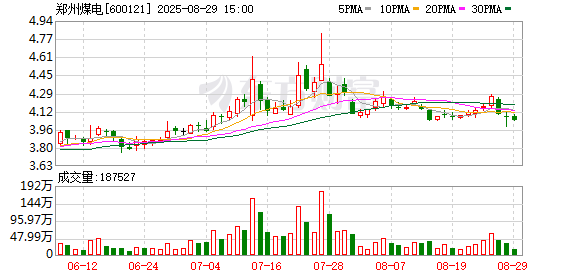
煤价处近5年低位,郑州煤电净利下滑2256.68%
Hua Xia Shi Bao· 2025-08-30 11:49
Core Viewpoint - The coal industry is facing significant challenges due to declining coal prices, leading to substantial losses for several coal companies, including Zhengzhou Coal Electricity [2][6]. Group 1: Company Performance - Zhengzhou Coal Electricity reported a 15.01% decline in revenue for the first half of the year, with a total profit drop of 189.82% and a staggering net profit decrease of 2256.68% [2][3]. - The company's average coal price fell by approximately 19% year-on-year, resulting in a sales revenue decrease of 25.52 million yuan [3]. - Other coal companies, such as Anyuan Coal Industry and China Coal Energy, also reported significant declines in performance, with net profit losses expanding [2][6]. Group 2: Cost Structure - Despite the drop in coal prices, Zhengzhou Coal Electricity's operating costs remained relatively stable, with total costs reaching 1.978 billion yuan, only slightly down from 2.076 billion yuan the previous year [4]. - Direct costs, including labor, materials, and safety, constitute a significant portion of expenses, with employee compensation being a major factor [5][6]. - Indirect costs, such as sales, management, and financial expenses, have not decreased significantly, complicating the company's financial situation [4][5]. Group 3: Market Outlook - The coal market is expected to remain under pressure, with Zhengzhou Coal Electricity predicting a continuation of the "strong supply, weak demand" scenario, which may lead to sustained low prices [7][8]. - Recent price increases in coal have been noted, but the overall sentiment remains cautious regarding the sustainability of these gains [7][8]. - The coal industry is anticipated to experience limited price rebounds due to ongoing market conditions and regulatory factors [8].