
中国财险

Search documents
中证港股通非银行金融主题指数下跌0.21%,前十大权重包含中信证券等
Jin Rong Jie· 2025-07-29 12:14
Group 1 - The core viewpoint of the article highlights the performance of the China Securities Index for Non-Bank Financials, which has shown significant growth over the past months, with a year-to-date increase of 47.05% [1] - The index, which reflects the overall performance of up to 50 listed companies in the non-bank financial sector within the Hong Kong Stock Connect, has seen a monthly increase of 13.51% and a three-month increase of 45.76% [1] - The top ten weighted companies in the index include China Ping An (15.03%), AIA Group (13.65%), and Hong Kong Exchanges and Clearing (13.34%), indicating a concentration in major financial institutions [1] Group 2 - The index is composed entirely of companies from the financial sector, with the Hong Kong Stock Exchange representing 100% of the holdings [2] - The index samples are adjusted biannually, with changes implemented on the next trading day following the second Friday of June and December [2] - Special adjustments to the index can occur under certain circumstances, such as delisting or significant corporate actions like mergers and acquisitions [2]

中国财险(2328.HK):纯财险标的 龙头优势稳固 增长潜力可期
Ge Long Hui· 2025-07-29 11:24
Core Viewpoint - China Pacific Insurance maintains a leading position in the property insurance sector, with a market share of 37.5% in 2024, significantly higher than its competitors [1] Group 1: Company Strengths - The company has a stable underwriting profit with a combined ratio below 100% for nearly 15 years, projected at 96.8% in 2024, outperforming the industry median of 102.8% [1] - Excellent cost control is evident, with a combined expense ratio approximately 7 percentage points lower than smaller competitors, aided by an increasing direct sales channel [1] - Strong shareholder backing from the Ministry of Finance, holding 68.98% of shares, provides long-term resource support and policy synergy [1] Group 2: Auto Insurance Business - Auto insurance, accounting for 55% of the company's revenue, is a key profit driver, contributing an underwriting profit of 9.285 billion yuan in 2024 [1] - The company excels in refined operational capabilities, with a 74.3% share of personal auto premiums and a renewal rate of 77.8%, which reduces claims risk [1] - The company leads in new energy vehicle insurance, with 11.59 million vehicles insured in 2024, a 57.3% increase, and premium income of 50.9 billion yuan, up 58.7% [1] - Policy reforms in non-auto insurance are expected to further enhance pricing power and reduce expense ratios by 1 percentage point [1] Group 3: Non-Auto Insurance Business - Non-auto insurance, making up 45% of the company's revenue, is projected to generate 240.7 billion yuan in premium income in 2024, with a CAGR of 10.9% over the past six years [2] - Despite a short-term underwriting loss of 3.572 billion yuan, structural optimization is underway, with profitable segments like health insurance and agricultural insurance contributing positively [2] - The agricultural insurance market share reached 42.7% in 2022, benefiting from government policies [2] Group 4: Investment Performance - The company shows resilience in its investment portfolio, with a total investment return rate of 5.2% in 2024, and a low volatility compared to peers [2] - The dividend CAGR from 2011 to 2024 is 12.8%, with an average dividend payout ratio of 36.5%, and a projected dividend of 0.54 yuan per share in 2024 [2] Group 5: Future Projections - The company is expected to continue leading the industry, with projected insurance service revenues of 508.3 billion yuan, 533.4 billion yuan, and 560.3 billion yuan for 2025-2027 [2] - Forecasted net profits for 2025-2027 are 38.3 billion yuan, 41.4 billion yuan, and 44.9 billion yuan, with corresponding EPS of 1.72 yuan, 1.86 yuan, and 2.02 yuan per share [2]
中国灾后恢复“隐形资本”大考
和讯· 2025-07-29 11:02
Core Viewpoint - The article emphasizes the critical role of insurance in disaster recovery and risk management, particularly in the context of extreme weather events exacerbated by climate change. Insurance is portrayed as an "invisible capital" that enhances regional resilience and supports economic recovery after disasters [1][8]. Group 1: Insurance Response to Disasters - Following the heavy rainfall in Beijing, insurance companies quickly activated emergency response measures, including establishing on-site claims centers and providing essential supplies to affected areas [3][4]. - As of July 29, 2023, major insurance companies reported thousands of claims related to the flooding, with significant amounts already processed for compensation [2][3]. Group 2: Evolution of Insurance Mechanisms - Insurance is evolving towards a "responsive recovery" model, where companies simplify claims processes and implement mechanisms like pre-claims and fast claims to enhance the recovery experience for affected individuals and businesses [5][11]. - The insurance sector is transitioning from merely providing post-disaster compensation to becoming an integral part of comprehensive risk management that includes pre-disaster planning and real-time response [10][11]. Group 3: Agricultural Insurance Challenges - The article highlights the challenges faced by agricultural insurance due to extreme weather conditions, particularly in key agricultural regions like Henan, which has experienced severe drought and high temperatures [6][7]. - The efficiency of insurance payouts directly impacts the recovery speed of agricultural producers, emphasizing the need for timely compensation to mitigate risks of crop failure [7][8]. Group 4: Public Awareness and Accessibility - There is a noted gap in public awareness regarding the importance of insurance for low-frequency, high-loss risks, as many individuals did not purchase necessary coverage before the recent disasters [14][15]. - Strategies to enhance public understanding of insurance include integrating insurance education into community programs and promoting basic disaster insurance products through government collaboration [14][15].



海通证券晨报-20250729
Haitong Securities· 2025-07-29 02:06
Group 1: Insurance Sector Insights - The recent adjustment in the predetermined interest rate for life insurance is expected to alleviate the pressure of interest rate losses, maintaining an "overweight" rating for the industry [2][5][24] - The insurance industry association has announced a new predetermined interest rate of 1.99%, triggering a mechanism for rate adjustments, with major insurers planning to switch to new products by September [3][4][22] - The adjustment of the predetermined interest rates is anticipated to improve the cost of liabilities, with a focus on transforming towards floating income products [4][24] Group 2: Fixed Income Market Analysis - The bond market has experienced significant fluctuations due to various factors, including tightening liquidity and rising commodity prices, leading to a notable decline in bond prices [7][9] - The current high duration and leverage in the bond market limit the strategic flexibility of investors, making them more vulnerable to market volatility [8] - The recent rise in commodity prices poses a greater threat to the bond market than previous stock market gains, as it contradicts the fundamental pricing of bonds [9] Group 3: Investment Recommendations - The report suggests increasing holdings in major insurance companies such as New China Life, China Life, China Pacific Insurance, and Ping An Insurance due to expected improvements in profitability and asset-liability matching [5][24] - The insurance sector is projected to see stable profit growth in the first half of 2025, driven by a recovery in the stock and bond markets [22][24] - The report emphasizes the importance of focusing on undervalued insurance stocks for potential valuation recovery opportunities [24]
又爆了!韩国股民加码“扫货” 猛买这些港股、A股(名单)
Zhong Guo Ji Jin Bao· 2025-07-28 14:57
Summary of Key Points Core Viewpoint - Korean investors are significantly increasing their purchases of Hong Kong and A-shares, with a notable focus on specific stocks such as Alibaba and BYD, reflecting a strong bullish sentiment in the market [1][4][10]. Group 1: Investment Trends - As of July 25, 2025, Korean investors have accumulated a total transaction amount of $57.64 billion in Chinese stocks, making China the second-largest overseas stock market for Korean investors [1][2]. - The net purchase amounts for the top ten Hong Kong stocks from July 21 to 25 include Alibaba with $20.39 million, CATL with $17.95 million, and BYD with $7.24 million [4][5][10]. - The overall net buying activity by Korean investors increased significantly during the week, with Alibaba's net purchase rising from $13.38 million the previous week to $20.39 million [7][10]. Group 2: A-Share Investments - The top net purchases of A-shares from July 21 to 25 include Hengli Hydraulic with $2.94 million, Proya with $0.36 million, and Kweichow Moutai with $0.28 million [11][12]. - Year-to-date, Korean investors have net purchased $1.69 billion in Xiaomi Group-W, $1.01 billion in BYD, and $899.29 million in Alibaba [13][14]. Group 3: Market Sentiment and Financing - The KOSPI index has risen by 33.79% as of July 25, indicating a strong bullish sentiment among Korean retail investors [18]. - The outstanding balance of margin financing in the Korean stock market reached a new high of 21.83 trillion KRW, reflecting increased investor activity and confidence [18].

中国财险(02328):纯财险标的,龙头优势稳固,增长潜力可期
HUAXI Securities· 2025-07-28 12:45
Investment Rating - The report assigns a rating of "Buy" for the company [5] Core Views - The company maintains a leading position in the property insurance sector, with a market share of 37.5% in premium income as of 2024, significantly higher than its competitors [1][16] - The company's car insurance business is a key profit driver, contributing 92.85 billion yuan in underwriting profit in 2024, supported by strong operational capabilities and a leading position in the new energy vehicle insurance market [2][46] - Non-car insurance business is positioned for growth, with premium income reaching 240.7 billion yuan in 2024, despite a short-term underwriting loss [3][74] Summary by Sections 1. Domestic Property Insurance Leader - The company is the largest property insurance provider in China, with a premium income market share of 37.5% and a net profit market share of 47.3% as of 2024 [1][16] - The company has a strong state-owned background, with the Ministry of Finance holding 68.98% of shares, providing long-term resource support [32] - The profit structure is clear, driven by both underwriting and investment [35] 2. Business: Steady Development in Property Insurance and Resilient Investments 2.1. Underwriting: Strong Car Insurance Advantage, Significant Non-Car Potential - Car insurance constitutes 55% of the company's total premium income, with a 2024 underwriting profit of 92.85 billion yuan [2][48] - The company leads in new energy vehicle insurance, with 11.59 million vehicles insured in 2024, reflecting a 57.3% increase [2][66] - Non-car insurance has shown a compound annual growth rate (CAGR) of 10.9% over the past six years, with premium income reaching 240.7 billion yuan in 2024 [3][74] 3. Investment Resilience and Stable Dividend Returns - The total investment return rate for 2024 is 5.2%, with fixed income assets accounting for 60.2% of the portfolio [8] - The company has maintained a stable dividend policy, with a CAGR of 12.8% in cash dividends from 2011 to 2024 [8][43] - The dividend payout ratio averaged 36.5% over the years, with a per-share dividend of 0.54 yuan in 2024 [8][43] 4. Profit Forecast and Investment Recommendations - The company is expected to continue leading the industry, with projected insurance service revenues of 508.3 billion yuan in 2025 and net profits of 38.3 billion yuan [9] - The report provides a first-time coverage with a "Buy" rating based on the company's strong cost control in car insurance and growth potential in non-car insurance [9]
暴雨突袭北京:两险企已接报案近700件 车泡水、房受损怎么赔
Xin Jing Bao· 2025-07-28 09:48
Core Viewpoint - The recent heavy rainfall in Beijing has led to significant property damage, prompting a surge in insurance claims, particularly in auto and home insurance sectors [1][3]. Group 1: Insurance Claims Data - From July 24, 18:00 to July 28, 08:00, PICC Beijing received a total of 445 claims, with preliminary losses estimated at 13.5 million yuan, primarily from auto and home insurance [1][3]. - During the period from July 26 to July 28, Ping An Property & Casualty received 235 claims related to vehicle flooding, with 17 cases already closed [1][3]. - Home insurance claims have become a significant portion of the reports, with 200 home insurance claims filed alongside 241 auto insurance claims by PICC [3]. Group 2: Insurance Coverage Details - Vehicle damage due to flooding is covered under auto insurance, provided the vehicle was stationary or damaged during operation, excluding engine damage caused by restarting the vehicle after flooding [1][2]. - Home insurance typically covers damages from natural disasters like heavy rain and flooding, protecting the structure and contents of the home [3][4]. - For agricultural losses, insurance companies are actively assisting farmers in filing claims, with a quick response time for damage assessment and compensation [4].
利好“炸场”!港A保险股热浪席卷,新华保险猛飙新高
Ge Long Hui· 2025-07-28 08:34
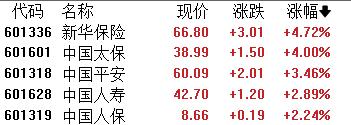
Core Viewpoint - The insurance sector in the A-share market experienced a significant surge, with major companies like Xinhua Insurance, China Pacific Insurance, and China Life Insurance seeing substantial gains, driven by favorable regulatory changes regarding insurance product interest rates [1][4]. Group 1: Market Performance - As of July 28, Xinhua Insurance's stock price rose by 4.72% to 66.80, while China Pacific Insurance and China Life Insurance also saw increases of 4.00% and 2.89% respectively [2]. - In the Hong Kong market, Yunfeng Financial surged over 7%, and AIA Group rose nearly 5%, with other major insurers following suit [3]. Group 2: Regulatory Changes - The China Insurance Industry Association indicated that the current benchmark interest rate for ordinary life insurance products is set at 1.99%, triggering a necessary adjustment in the maximum preset interest rates for new products [4]. - Major insurers like China Life, Ping An Life, and China Pacific Life have already announced reductions in their traditional life insurance product rates from 2.5% to 2.0%, and the guaranteed rate for participating insurance has been adjusted from 2% to 1.75% [4]. Group 3: Industry Outlook - Analysts predict that the adjustment in preset interest rates will alleviate the pressure on insurers' interest margins and lower liability costs, enhancing the profitability of new business [5]. - The dynamic adjustment mechanism for preset interest rates is expected to improve the liability costs and net investment returns for life insurance companies, thereby reducing asset allocation pressures and interest margin risks [5]. Group 4: Anti-Competition Measures - The insurance industry has been receiving signals to combat "involution," with the central government emphasizing the need to regulate low-price competition [6]. - The Guangdong financial sector has taken steps to prevent "involution" by issuing self-regulatory agreements to resist malicious price wars and ensure fair competition [6]. Group 5: Future Prospects - Analysts from CITIC Securities believe that regulatory guidance will encourage the development of participating insurance, allowing leading insurers to achieve healthy balance sheet expansion while reducing liability costs [7]. - The market outlook remains optimistic, with expectations of continued growth in new business value (NBV) for life insurers and significant improvements in the combined operating ratio (COR) for property insurers [7].




低空经济:万亿产业图景下的金融适配模型
Jin Rong Shi Bao· 2025-07-28 06:02
Core Viewpoint - The "low-altitude economy" has transitioned from a policy slogan to a crowded investment sector, with the market expected to exceed 3.5 trillion yuan by 2035, equivalent to creating a new electric vehicle industry [1] Group 1: Market Potential and Challenges - The low-altitude economy encompasses various emerging fields such as general aviation, drones, and electric vertical takeoff and landing (eVTOL) aircraft, presenting significant funding needs, long return cycles, and difficult risk assessments [1][2] - Despite the establishment of over 1.1 billion yuan in low-altitude economic industry funds across 20 provinces, there remains a gap between available and accessible financing [1] Group 2: Financial Support and Innovation - Financial institutions primarily rely on traditional credit support for low-altitude economy enterprises, with innovative financing tools like intellectual property pledges and supply chain finance accounting for less than 20% of support [2] - A proposed three-tier pyramid structure for the low-altitude economy includes infrastructure, core technology, and commercial operations, each requiring different financial tools and risk management strategies [2] Group 3: Case Studies and Regulatory Developments - In Shanghai, a 1 billion yuan "equity + debt + lease" combination was designed for Volant Aviation, addressing the full lifecycle funding needs of the company [3] - Shenzhen has implemented a digital voucher system to enhance credit access for small and medium-sized enterprises in the supply chain, while Beijing is allowing "airspace usage rights" as collateral for loans [3] - Insurance products are evolving to address specific needs in the low-altitude economy, such as flight-hour-based insurance and bundled policies for passenger safety [3] Group 4: Future Outlook - The essence of the low-altitude economy lies in the digital repricing of airspace resources, with financial innovation aimed at transforming airspace into tradable, financeable, and value-added assets [4]
预定利率再度迎来下调,全市场孤品港股通非银ETF(513750)盘中涨超2%,居全市场ETF首位!
Xin Lang Cai Jing· 2025-07-28 02:09
Core Viewpoint - The non-bank financial sector in Hong Kong is experiencing significant growth, as evidenced by the strong performance of the CSI Hong Kong Stock Connect Non-Bank Financial Theme Index and its associated ETF, which have seen substantial increases in both value and trading volume [1][2]. Group 1: Market Performance - As of July 28, 2025, the CSI Hong Kong Stock Connect Non-Bank Financial Theme Index rose by 2.06%, with key stocks such as Guotai Junan International and China Life Insurance showing notable gains [1]. - The Hong Kong Stock Connect Non-Bank ETF achieved a 93.14% increase in net value over the past year, ranking in the top 1.06% among 2,938 index stock funds [2]. - The ETF's trading volume reached a record high of 1.95 billion yuan, with an average daily trading volume of 1.81 billion yuan over the past week [1][2]. Group 2: Fund Flows and Size - The Hong Kong Stock Connect Non-Bank ETF has seen continuous net inflows over the past 18 days, totaling 5.4 billion yuan, with a single-day peak inflow of 820 million yuan [1]. - The ETF's total size reached 10.753 billion yuan, marking a new high since its inception, with the number of shares also hitting a record of 6.477 billion [1]. Group 3: Index Composition and Changes - The top ten weighted stocks in the CSI Hong Kong Stock Connect Non-Bank Financial Theme Index account for 77.92% of the index, with major players including China Ping An and AIA Group [3]. - Recent adjustments to the life insurance industry's preset interest rates are expected to impact various insurance products, potentially leading to a shift in business structure towards participating insurance [3][4]. Group 4: Industry Outlook - The reduction in preset interest rates is anticipated to lower the cost of liabilities for life insurance companies, encouraging a transition towards participating insurance products, which are expected to become more attractive to customers [4]. - The non-bank financial sector, particularly insurance, is positioned to benefit from favorable market conditions, including stable long-term interest rates and a strong stock market [4].