
南方航空

Search documents
股市热度下反内卷板块的机会展望
2025-08-24 14:47
Summary of Key Points from Conference Call Records Industry Overview - The petrochemical industry is facing a new round of policy adjustments, with refineries under 2 million tons potentially being eliminated and older facilities over 20 years old undergoing adjustments, which will constrain domestic capacity utilization [1][2][3] - The petrochemical sector has entered a downward cycle since the second half of 2022, with significant declines in safety investments and capital expenditures [1][4] - The China Chemical Industry Index PB percentile is at historical lows, and leading companies like Wanhua, Hualu, and Yangnong are expected to see significant gains in the next year and a half due to favorable policies [1][6] Policy Impacts - The recent policies targeting the petrochemical industry began in July 2023, focusing on assessing and potentially shutting down or upgrading older capacities [2][3] - The actual capacity ceiling is between 950 million to 1 billion tons, with small refineries (under 2 million tons) accounting for approximately 35 to 40 million tons, which may be eliminated [3] - The coal sector is also affected by stricter production limits, with coal prices expected to fluctuate between 650-750 RMB depending on policy enforcement [1][8] Market Dynamics - The aluminum and copper sectors are experiencing accelerated industrial upgrades due to the cancellation of export tax rebates, with demand from AI driving up processing fees for certain copper products [1][16][17] - The express delivery industry has seen significant price increases, particularly in Guangdong, where average prices rose by about 0.5 RMB, which is expected to enhance profitability for major express companies [1][19] Economic Indicators - The dovish stance of the Federal Reserve has raised expectations for interest rate cuts, which is likely to lead to price increases for upstream resources like copper, aluminum, and gold [1][18] - Recent macroeconomic indicators such as M1 and M2 growth rates have rebounded, driven by increased demand for currency exchange and a high trade surplus [1][24] Investment Outlook - The petrochemical sector is expected to enter an upward trend, with leading companies likely to benefit from upcoming policy support [1][6] - The coal sector's profitability will depend on the strictness of policy enforcement regarding production limits [1][8] - The express delivery sector's price increases are anticipated to provide substantial earnings elasticity for listed companies [1][19] Additional Insights - The complexity of the current capacity reduction differs from previous supply-side reforms, as many capacities are relatively new and require more coordination among local governments and ministries [1][7] - The overall market liquidity is expected to increase, benefiting various asset classes, although the stock market may experience some marginal outflows to the bond market [1][27]
交通运输产业行业周报:7月顺丰业务量增速领跑,油运景气度拐点向上-20250824
SINOLINK SECURITIES· 2025-08-24 13:27
Investment Rating - The report recommends investing in SF Holding, Hainan Airlines, and Southern Airlines due to their strong performance and market positioning [2][4]. Core Views - The express delivery sector is experiencing significant growth, with SF Express leading the way with a 34% increase in business volume in July. The overall express delivery market is expected to see price increases due to rising costs in grain-producing areas and the upcoming peak season [2]. - The logistics sector is focusing on smart logistics, with Hai Chen Co. launching AI and robotics research initiatives to enhance operational efficiency [3]. - The aviation sector shows a positive trend, with domestic flights increasing by 3.07% year-on-year. Airlines are expected to benefit from supply-demand optimization, leading to potential fare increases and profit elasticity [4]. - The shipping sector is witnessing a recovery in oil transportation indices, with expectations of increased demand due to OPEC+ production adjustments and sanctions on Iran and India [5]. - The road and rail sectors are showing stable growth, with highway truck traffic increasing by 3.06% week-on-week, indicating a robust logistics environment [6][78]. Summary by Sections Express Delivery - In July, SF Express achieved a business volume growth of 34%, leading the industry. The total express delivery volume for the week of August 11-17 was approximately 3.523 billion pieces, with a year-on-year increase of 11.81% [2]. - The market shares for major players in July 2025 are as follows: SF Express (8.4%), Yunda (13.2%), YTO (15.8%), and Shentong (13.3%) [2]. Logistics - The chemical product price index is at 4024 points, down 10.3% year-on-year. The domestic sea freight price for liquid chemicals is 158 RMB/ton, down 8.4% year-on-year [3]. - Hai Chen Co. is focusing on AI and robotics to enhance logistics efficiency, indicating a shift towards smart logistics solutions [3]. Aviation - The average daily flight operations increased to 17,321 flights, a year-on-year increase of 4.18%. Domestic flights saw a 3.07% increase, while international flights increased by 11.87% compared to 2019 [4]. - The Brent crude oil price is at $67.73/barrel, reflecting a 2.85% increase week-on-week, which may impact airline operational costs [4][65]. Shipping - The China Export Container Freight Index (CCFI) is at 1174.87 points, down 1.5% week-on-week and down 40.5% year-on-year. The Shanghai Export Container Freight Index (SCFI) is at 1415.36 points, down 3.1% week-on-week and down 52.2% year-on-year [5][21]. - The oil transportation index (BDTI) is at 1019 points, reflecting a 0.5% increase week-on-week and a 9.2% increase year-on-year [5][34]. Road and Rail - The national railway passenger volume in July was 455 million, a year-on-year increase of 6.6%. The railway freight volume was 452 million tons, up 4.5% year-on-year [78]. - The national highway freight traffic for the week of August 11-17 was 54.93 million vehicles, a week-on-week increase of 3.06% and a year-on-year increase of 4.65% [6][82].



申万宏源交运一周天地汇(20250817-20250822):美股油轮股年内新高,淡季超预期进入右侧区间,船舶板块有望共振
Shenwan Hongyuan Securities· 2025-08-23 15:13
Investment Rating - The report maintains a "Positive" outlook on the shipping sector, particularly highlighting the potential for VLCC (Very Large Crude Carrier) rates to strengthen in the upcoming months [4]. Core Insights - The report indicates that tanker rates have exceeded expectations during the off-season, with VLCC rates expected to perform strongly from September to December due to reduced exports from Iran and increased production in the Middle East [4]. - The report recommends specific companies such as China Merchants Energy Shipping and highlights the potential for consolidation in the Chinese shipping industry [4]. - The report emphasizes the resilience of freight volumes in rail and highway transport, suggesting steady growth in these sectors [4]. Summary by Sections Shipping Sector - VLCC rates increased by 32% this week, reaching $45,800 per day, driven by limited supply and increased demand from the Atlantic market [4]. - The report notes that the average export volume from Iran has decreased to 1.3-1.5 million barrels per day, down from 1.7-1.9 million barrels per day in July [4]. - The Suez crude oil tanker rates rose by 15% to $59,563 per day, supported by strong demand from the West African market [4]. Dry Bulk Shipping - The Baltic Dry Index (BDI) fell by 4.9% to 1,944 points, primarily due to a decline in large vessel rates, while smaller vessels showed stronger performance [5]. - The report remains optimistic about the Capesize bulk carrier market in the second half of the year, citing expected increases in shipments from major miners [4]. Air Transport - The report suggests that the "anti-involution" policy from the Civil Aviation Administration is likely to optimize competition in the airline industry, benefiting airline profitability in the long term [4]. - Recommended airlines include China Eastern Airlines, Spring Airlines, and China Southern Airlines, with a focus on the potential for improved earnings due to supply constraints and demand recovery [4]. Express Delivery - The report anticipates a price increase in the express delivery sector driven by the "anti-involution" policy, with expectations for sustained profitability in the e-commerce delivery segment [4]. - Companies such as Shentong Express and YTO Express are highlighted as having strong potential for recovery and valuation improvement [4]. Rail and Highway Transport - Data from the Ministry of Transport indicates that rail freight volume increased by 1.22% week-on-week, while highway freight traffic rose by 3.06% [4]. - The report identifies two main investment themes in the highway sector: high dividend yield stocks and potential value recovery in undervalued stocks [4].



暑运观察·精细化服务畅通“铁路+飞机”无缝衔接“软硬联通”
Yang Shi Wang· 2025-08-23 06:12
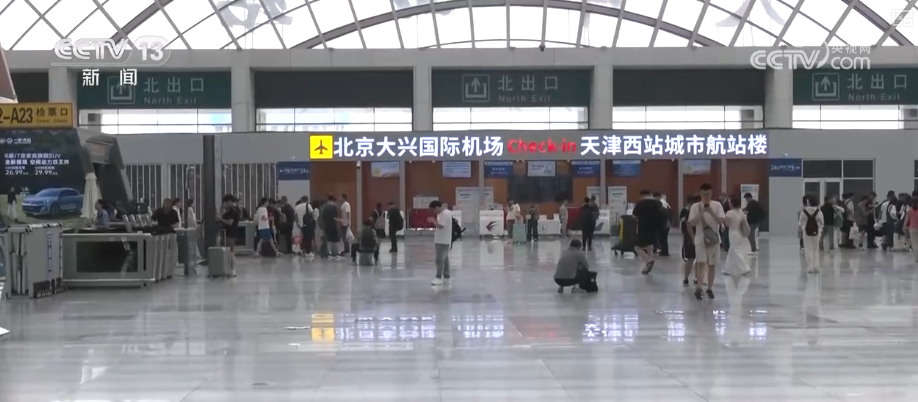
Core Viewpoint - The integration of air and rail transport in China is enhancing travel convenience, particularly during peak travel seasons, with seamless connections between high-speed rail stations and airports [1][5][20] Group 1: Infrastructure Development - The Tianjin West Station city terminal, recently opened, is the first city terminal in the Beijing-Tianjin-Hebei region built on national railway infrastructure, featuring an open design that integrates with the high-speed rail waiting area [2][3] - As of now, 22 airports in China have adopted integrated or adjacent layouts with railway stations, allowing passengers to transfer on foot, while 19 airports utilize interconnecting services [6][7] Group 2: Service Enhancements - The city terminal at Tianjin West Station offers six check-in counters and comprehensive services including flight display, check-in, and luggage transport for specific train services [2][3] - Airlines are increasingly providing refined and personalized services to improve the air-rail transfer experience, breaking down service barriers between aviation and rail [8][13] Group 3: Emergency Solutions - The "Urumqi-Turpan air-rail intermodal transport" plan has been established to address seasonal weather challenges, allowing passengers to transfer from Turpan Airport to Urumqi via high-speed rail when flights cannot land in Urumqi [17][19] - Since the mechanism's establishment in 2019, it has facilitated the transfer of over 28,000 passengers, significantly reducing average wait times and complaints [19] Group 4: Future Developments - The Civil Aviation Administration of China and the National Railway Group are working on a task list to promote high-quality development of air-rail intermodal transport from 2025 to 2027, focusing on service innovation and international passenger integration [20][23]

南方航空(600029):坐拥北京广州双核心枢纽,营收居三大航之首
Bank of China Securities· 2025-08-22 11:30
Investment Rating - The report initiates coverage with an "Accumulate" rating for the company [1][5]. Core Views - China Southern Airlines has the largest fleet size in the country and leads in passenger capacity among domestic airlines. The growth rate of China's civil aviation fleet is showing a "step-down" trend, while the ongoing recovery in the tourism market is expected to boost air travel demand. The average price of aviation kerosene has decreased compared to the same period last year, which is beneficial for enhancing the company's profitability [1][5][8]. Company Overview - China Southern Airlines is the leading air transport service provider in China, with a well-established fleet and a focus on building dual hubs in Guangzhou and Beijing. The company has maintained the highest passenger transport volume among domestic airlines for 44 consecutive years. The airline operates a diverse fleet, including Boeing and Airbus models, and has a significant market share in terms of flight frequency and route network [16][24][25]. Financial Data - The company's total revenue for 2024 reached approximately 174.22 billion RMB, marking a 8.94% year-on-year increase, and is the highest in nearly a decade. The company has experienced continuous losses for four years since the pandemic, but the financial performance is showing signs of recovery, with a significant increase in revenue in 2023 [39][41][43]. Industry Overview - The aviation industry in China has seen a 172.8% growth in passenger transport over the past 15 years, with a gradual marketization of air ticket pricing. The three major airlines (Air China, China Eastern Airlines, and China Southern Airlines) account for over 62.64% of the total transport turnover in the market. The domestic passenger transport volume is expected to reach 730 million in 2024, a year-on-year increase of 17.86% [47][48][49].
中银证券:首次覆盖南方航空给予增持评级
Zheng Quan Zhi Xing· 2025-08-22 11:16
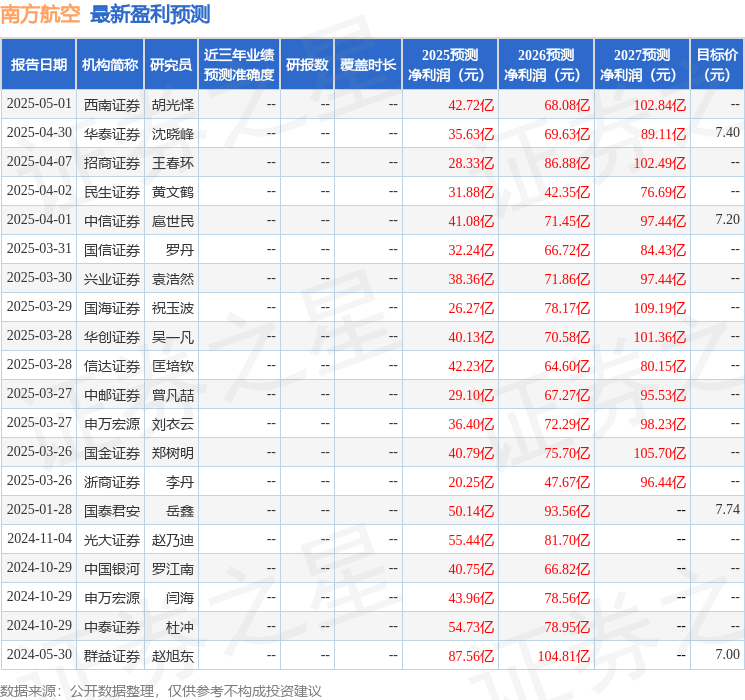
Company Overview - China Southern Airlines has the largest fleet size in the country and leads in passenger capacity among domestic airlines, being the first airline in China to exceed 100 million in transport volume [2][3] - The company operates major hubs in Beijing and Guangzhou, with a market share in route numbers, flight frequency, and passenger transport volume that ranks first among domestic airlines [3] Financial Performance - For 2024, the company is projected to achieve revenue of 174.22 billion yuan, representing a year-on-year growth of 8.94%, with a gross profit margin of 8.41% [3] - In Q1 2025, revenue is expected to be 43.41 billion yuan, a decrease of 2.68% year-on-year, with a sales gross profit margin of 8.48% [3] - The company’s revenue for 2025-2027 is forecasted to be 185.40 billion yuan, 196.82 billion yuan, and 207.76 billion yuan respectively, with net profits of 3.69 billion yuan, 6.69 billion yuan, and 9.26 billion yuan [5] Industry Insights - The aviation industry has seen a 172.8% increase in passenger transport over the past 15 years, with domestic passenger transport volume expected to reach 730 million in 2024, a year-on-year increase of 17.86% [4] - The cargo transport volume is projected to be 8.98 million tons in 2024, reflecting a year-on-year growth of 22.15% [4] - Key factors influencing the industry include aircraft supply constraints due to global supply chain disruptions, increasing travel demand driven by rising GDP and tourism, and favorable oil prices which have decreased by 14.8% year-on-year [4]
交通运输行业周报:“武鄂”首条低空货运航线开通,上海口岸暑运出入境客流持续高位-20250822
Bank of China Securities· 2025-08-22 11:14
Investment Rating - The transportation industry is rated as "Outperform" [2] Core Insights - The opening of the first low-altitude cargo route between Wuhan and Ezhou, along with high passenger traffic at Shanghai ports during the summer season, indicates growth in logistics and transportation [2][3] - Oil shipping rates remain low and fluctuating, while shipping rates for routes to Europe and the US continue to decline [3][16] - Joby Aviation successfully completed the world's first manned eVTOL flight between airports, showcasing advancements in aviation technology [3][17] - National railway coal shipments reached 1.02 billion tons in the first half of 2025, reflecting strong demand in the transportation sector [3][27] Industry Dynamics Shipping and Logistics - Oil shipping rates are experiencing low-level fluctuations, with the China Import Crude Oil Composite Index at 1064.60 points, up 0.7% from the previous week [15] - The shipping market is showing signs of weakness, with rates for routes to Europe and the US declining by 7.2% and 3.5% respectively [16] - The first low-altitude cargo flight between Ezhou and Wuhan was completed, marking a significant development in regional logistics [25][26] Passenger Transport - Shanghai's passenger traffic has remained high, averaging 129,000 daily entries and exits, a year-on-year increase of over 14% [18] - The peak day recorded 157,000 passengers, indicating a strong recovery in air travel [18] Freight and Rail Transport - In the first half of 2025, national railways transported 1.98 billion tons of goods, with coal shipments accounting for 1.02 billion tons [27] - The average daily loading of coal cars was 182,400, reflecting a 3.0% year-on-year increase [27] High-frequency Data Tracking - Air cargo prices have shown a slight decline, with the Shanghai outbound air freight price index at 4455.00 points, down 4.1% year-on-year [28] - The domestic air cargo flight volume increased by 7.61% year-on-year in July 2025, while international flights rose by 23.31% [37] Investment Recommendations - Focus on the equipment and manufacturing export chain, recommending companies such as COSCO Shipping, China Merchants Energy Shipping, and Huamao Logistics [5] - Consider opportunities in low-altitude economy investments, particularly in companies like CITIC Offshore Helicopter [5] - Explore investment opportunities in the road and rail sectors, with recommendations for Gansu Expressway, Beijing-Shanghai High-Speed Railway, and others [5] - Pay attention to the express delivery sector, recommending companies like SF Express, Jitu Express, and Yunda [5]
中加航线再增班!
Di Yi Cai Jing· 2025-08-22 09:54
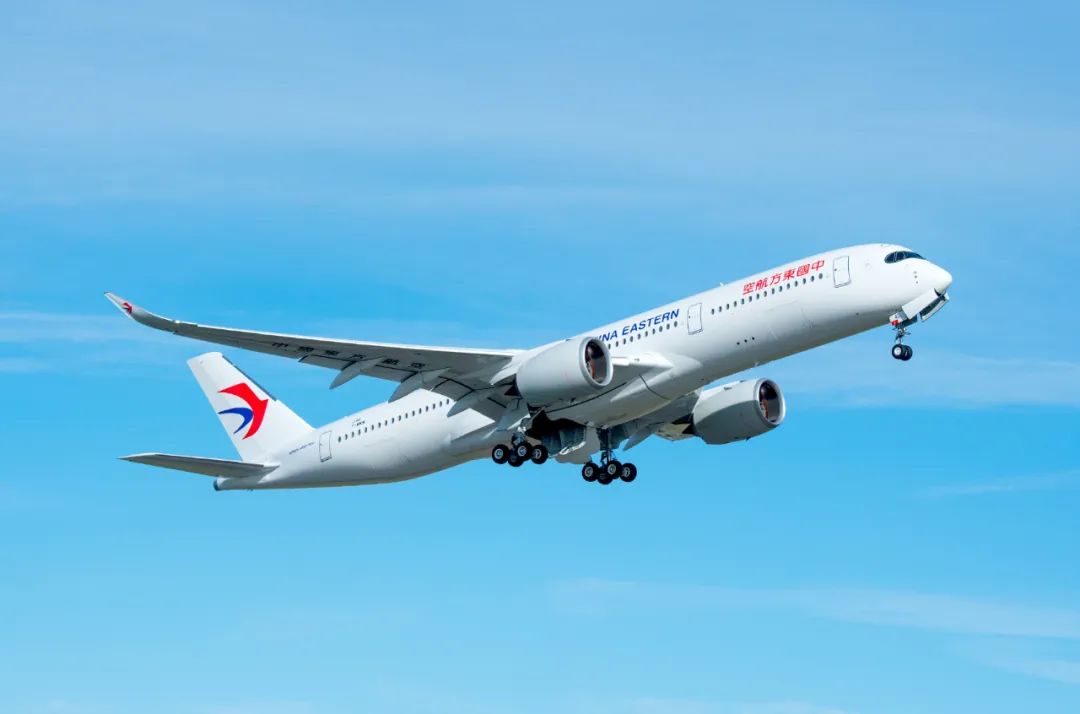
2025.08.22 目前执飞中加航线的内地航司主要有6家,分别是国航,东航,南航,厦航,川航和海航,疫情前曾飞加拿大的首都航空尚未恢复中加航线,而加拿大方 面只有加拿大航空一家在飞。 本文字数:1701,阅读时长大约3分钟 作者 |第一财经陈姗姗 中国东航(600115)今日宣布,将自9月25日起恢复上海至温哥华直飞往返航线,每周一、四执飞,采用A350-900宽体机型执飞。 上海至温哥华的直飞航线疫情前一直在飞,疫情中停飞后一直未能复航,主要由于中加之间的航权限制。 第一财经记者了解到,疫情后,中加航线的恢复比中美航线还要缓慢,导致票价也是居高不下,不过三大航近期都已获批增班。 中加增班受限 在东航之前,南航和国航也披露了增班加拿大的计划,其中南航自9月16日起新增一周2班广州-加拿大温哥华航班,国航自8月27日起,北京-温哥华从每 周1班增加到2班,北京-多伦多从每周2班增加到3班。 也就是说,国有三大航此次一共获批新增一周6班中加航班,令中国内地航司执飞的中加航班量增加到每周24班。 据记者了解,疫情后的中加航班恢复缓慢,主要是由于加拿大对中方航司的增班数量有限制,中方航司的航班总数要与加方航司对等, ...

航空机场板块8月22日跌0.92%,中国东航领跌,主力资金净流出1.78亿元
Zheng Xing Xing Ye Ri Bao· 2025-08-22 08:46
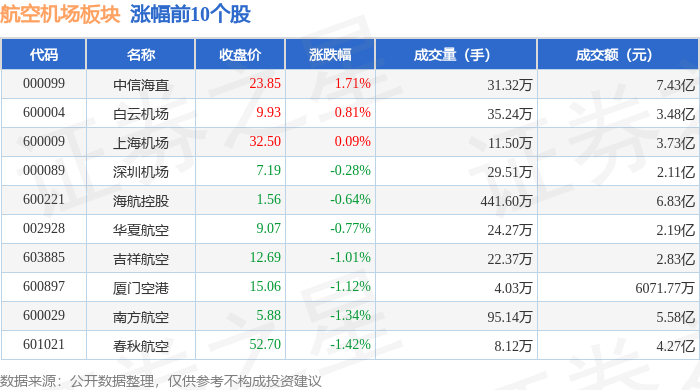
Market Overview - On August 22, the aviation and airport sector declined by 0.92%, with China Eastern Airlines leading the drop [1] - The Shanghai Composite Index closed at 3825.76, up 1.45%, while the Shenzhen Component Index closed at 12166.06, up 2.07% [1] Stock Performance - Key stocks in the aviation and airport sector showed mixed performance, with notable declines in several major companies: - China Eastern Airlines (code: 600115) closed at 4.08, down 1.69% with a trading volume of 952,200 shares and a turnover of 389 million yuan [2] - China Southern Airlines (code: 600029) closed at 5.88, down 1.34% with a trading volume of 951,400 shares and a turnover of 558 million yuan [2] - Spring Airlines (code: 601021) closed at 52.70, down 1.42% with a trading volume of 81,200 shares and a turnover of 427 million yuan [2] Capital Flow - The aviation and airport sector experienced a net outflow of 178 million yuan from institutional investors, while retail investors saw a net inflow of 191 million yuan [2] - The capital flow for individual stocks indicated that: - CITIC Hainan Airlines (code: 6600000) had a net inflow of 42.84 million yuan from institutional investors [3] - Shenzhen Airport (code: 000089) had a net inflow of 41.85 million yuan from institutional investors [3] - China Eastern Airlines saw a net outflow of 14.21 million yuan from institutional investors [3]

小机场如何带动新客流?丨记者观察
2 1 Shi Ji Jing Ji Bao Dao· 2025-08-22 08:33
Core Insights - The article discusses the challenges faced by small airports in China, particularly regarding low passenger traffic and flight frequency, which affects operational efficiency and cost management [2][3][4] - It highlights the efforts by the Civil Aviation Administration of China (CAAC) to promote connecting flights and integrate air and rail transport to enhance accessibility and increase passenger flow to small airports [3][4][5] Group 1: Small Airport Challenges - Many small airports, like Anyang Hongqiqu Airport, experience low flight frequency and limited routes, with only six routes and an average of three to four flights per day [1][2] - As of 2024, 33% of China's 263 airports have passenger traffic below 300,000, indicating a significant challenge in attracting travelers [2] - The current air route network in China is characterized by a dense trunk line system and sparse branch lines, with branch airports accounting for 70.7% of the total but only 9.5% of passenger flights [2][3] Group 2: Solutions and Innovations - The CAAC is promoting connecting flights to link trunk and branch lines, which has shown to significantly increase passenger transport volume from branch airports [3] - The integration of air and rail transport, as demonstrated by the Ordos Airport's 40% increase in passenger traffic, is a promising strategy for enhancing accessibility to small airports [3][4] - Airlines are exploring new models, such as the "Cloud Bus" service by Huaxia Airlines, which connects hub cities with branch airports, improving efficiency and passenger flow [4] Group 3: Industry Collaboration and Development - The integration of aviation with tourism is proving effective in attracting passengers, as seen with the Sanqing Mountain Airport, which has maintained high growth rates through combined travel packages [5] - The development of small airports relies heavily on local government funding and must adapt to local characteristics while promoting collaboration with various industries for sustainable growth [5]