
重庆银行

Search documents
又见“85后”升任副行长!上市银行女副行长扩容
券商中国· 2025-07-08 23:25
Core Viewpoint - Jiangyin Bank has appointed Yu Xiaoyun as the new vice president, pending regulatory approval, highlighting the increasing presence of women in leadership roles within the bank [1][6][8]. Group 1: Appointment and Background - Yu Xiaoyun, born in 1985, is currently the general manager of the asset management department at Jiangyin Bank [2]. - She has a career history that includes roles at Agricultural Bank of China and various leadership positions within Jiangyin Bank since 2011 [6]. - The appointment follows the resignation of the previous vice president, Wang Kai, due to a job transfer [5][6]. Group 2: Gender Representation in Leadership - Among A-share listed banks, there are at least 24 female vice presidents, predominantly from the "70s" generation, with "85s" being relatively rare [3][12]. - Jiangyin Bank's leadership team includes a female chairperson and two female vice presidents, indicating a significant representation of women in its executive ranks [7][8]. - The trend of female leadership is noted across various banking institutions, although female "heads" remain scarce [9][10]. Group 3: Broader Context of Female Executives - Female executives are notably present in roles such as vice president, board secretary, and heads of finance, risk, and compliance departments [10][11][13]. - The role of board secretary is particularly concentrated with female executives, primarily from the "70s" generation [13]. - In rural commercial banks, there is a younger demographic of female executives, with many being from the "80s" generation [14][17].



银行转债存量“缩编”机构底仓资产如何腾挪
Zhong Guo Zheng Quan Bao· 2025-07-08 20:50
Core Viewpoint - The banking sector has shown strong performance in 2023, leading to a significant increase in bank convertible bonds, with many set to exit the market, raising questions about asset allocation for institutional investors [1][2][3]. Group 1: Market Dynamics - Several bank convertible bonds, including Hangzhou Bank and South Bank, have completed their market conversion and delisting, with a total estimated reduction of around 100 billion yuan in bank convertible bonds this year [1][2]. - The strong redemption mechanism of convertible bonds is closely linked to the performance of the underlying bank stocks, which have been rising recently [1][2]. - The total outstanding convertible bonds as of July 8 was approximately 664.65 billion yuan, a decrease of 68.98 billion yuan since the beginning of the year, with projections suggesting it may fall below 600 billion yuan by the end of the year [3][6]. Group 2: Institutional Investment Trends - Convertible bonds have become a key asset in the "fixed income plus" strategy for asset management products, with institutions increasingly favoring them due to their low volatility and high returns [3][4]. - The demand for bank convertible bonds remains high due to their strong credit quality and risk resistance, despite a slowdown in new issuances [3][4]. - Institutions are now seeking to diversify their asset allocation strategies, looking for alternative high-yielding base assets as the supply of convertible bonds decreases [5][7]. Group 3: Future Outlook - The shrinking supply of bank convertible bonds and the ongoing demand may lead to a situation where valuations become difficult to maintain, prompting institutions to explore other investment opportunities [6][7]. - Analysts suggest that the current market conditions may create short-term trading opportunities in bank convertible bonds, despite their high valuations [6][7]. - The focus may shift towards convertible bond ETFs and other asset classes like REITs and thematic ETFs as institutions adapt to the changing market landscape [6][7].


17家银行宣布:不再设立!
新华网财经· 2025-07-08 11:34
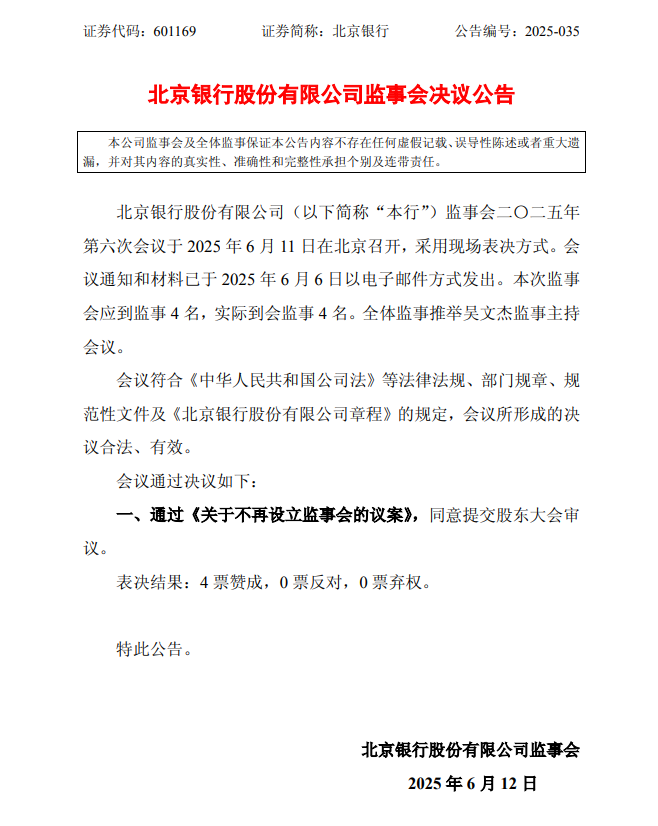
Core Viewpoint - The article discusses the ongoing trend of listed banks in China abolishing their supervisory boards in response to the new Company Law, which allows for the establishment of audit committees within the board of directors to assume the supervisory functions previously held by supervisory boards [6][7]. Group 1: Legislative Changes - The new Company Law, effective from July 1, 2024, permits joint-stock companies to set up audit committees composed of directors, which can perform the functions of supervisory boards [7]. - The National Financial Regulatory Administration has issued guidelines that align with the new Company Law, allowing financial institutions to choose whether to retain supervisory boards or delegate their functions to audit committees [7]. Group 2: Industry Trends - As of June 2023, 17 listed banks have announced the abolition of their supervisory boards, including major state-owned banks and various smaller banks [5]. - On June 27, 2023, five major state-owned banks held shareholder meetings to approve the removal of their supervisory boards [5]. Group 3: Implementation and Challenges - The audit committees will take over the supervisory functions, which include financial inspections and oversight of the bank's financial status and management [7]. - Concerns have been raised regarding the independence of audit committees, as they are composed of board members who may face conflicts of interest when supervising the board itself [8].
【资产配置快评】总量“创”辩第106期:年中大类资产盘点
Huachuang Securities· 2025-07-08 11:28
Group 1: Macro Analysis - The narrative that the dollar will enter a prolonged decline akin to the 70s and 80s needs reassessment, as the fastest decline of the dollar may have already passed[13] - The U.S. economy's growth rate relative to Europe and Japan remains superior, suggesting potential dollar strength in the medium term[13] - The dollar index has shown a long-term divergence from the U.S. economic share, with the index rising despite a declining economic share post-2008 financial crisis[15] Group 2: Fixed Income Market Insights - In July, the bond market is expected to face downward pressure, with credit outperforming rates[29] - Government bond net financing is projected to increase to between 1.5 trillion and 1.7 trillion yuan in July due to accelerated local government bond issuance[27] - The average decline in the 10-year government bond yield from 2021 to 2024 is approximately 4.4 basis points, indicating a trend of decreasing yields[29] Group 3: Equity Market Trends - The total position of stock funds increased to 94.90%, up by 97 basis points from the previous week, indicating a bullish sentiment[36] - The average return of stock funds this week was 1.31%, reflecting positive market performance[38] - The Hang Seng Index saw a decline of 1.52%, suggesting a mixed outlook for Hong Kong equities[39] Group 4: CIPS Regulatory Changes - The People's Bank of China is revising CIPS rules to enhance participant management and flexibility, allowing for easier access to the system[43] - The CIPS system processed 821.69 million transactions worth 175.49 trillion yuan in 2024, marking a 42.60% increase year-on-year[42] - The new rules include risk management requirements and clarify the roles of domestic and foreign participants in the CIPS framework[43]
银行深度:历次存款整改和利率下调回顾与复盘
China Post Securities· 2025-07-08 09:44
Industry Investment Rating - The industry investment rating is maintained at "Outperform" [1] Core Insights - The report discusses the impact of deposit rate adjustments on banks, indicating that the adjustments have a limited impact on financial outflows [4][7] - The establishment of a market-oriented deposit rate adjustment mechanism aims to align deposit rates with market rates, thereby reducing banks' funding costs and facilitating lower loan rates [14][17] - The report highlights a significant shift in deposit structures due to regulatory changes, with a notable migration of deposits from large banks to smaller banks and non-bank financial institutions [6][37] Summary by Sections 1. Reasons for Deposit Rate Adjustments - The adjustments are aimed at promoting interest rate marketization and improving policy transmission, breaking the rigid link between deposit rates and benchmark rates [4][14] - The adjustments are expected to lower banks' funding costs, which constitute over 70% of their liabilities, thereby creating room for loan rate reductions [17][18] 2. Review of Past Adjustments - Historical adjustments include the reduction of structured deposits from CNY 15.4 trillion to zero between 2019 and 2020, and the optimization of deposit rate ceilings in June 2021 [5][22] - The establishment of a market-oriented adjustment mechanism in April 2022 has led to multiple rounds of deposit rate reductions, with long-term deposit rates decreasing more than short-term rates [23][24] 3. Market Impact Review - The report notes that during the initial adjustment phases, there was a significant outflow of structured deposits to wealth management and insurance products [6][37] - The adjustments have generally resulted in a shift of deposits from large banks to smaller banks, as well as a migration towards wealth management and insurance products [6][37] 4. Future Outlook and Investment Recommendations - The report anticipates a significant volume of maturing fixed-term deposits in the third quarter, with potential outflows to non-bank institutions [7] - It suggests focusing on banks that may benefit from reduced funding costs and improved net interest margins, highlighting specific banks such as Bank of Communications and Chongqing Bank as potential investment targets [7]




17家银行宣布:不再设立
Jin Rong Shi Bao· 2025-07-07 11:38
Core Viewpoint - The recent trend of abolishing supervisory boards among listed banks in China is driven by the implementation of the new Company Law and regulatory policies, allowing for a shift towards audit committees within boards of directors to assume supervisory roles [6][7][8]. Group 1: Legislative Changes - The new Company Law, effective from July 1, 2024, permits joint-stock companies to establish audit committees composed of directors, which can perform the functions of supervisory boards [6]. - The National Financial Regulatory Administration has issued guidelines that align with the new Company Law, allowing financial institutions to choose whether to maintain supervisory boards or delegate their responsibilities to audit committees [7]. Group 2: Industry Trends - As of June 2023, 17 listed banks have announced the abolition of their supervisory boards, including major state-owned banks and various smaller banks [5]. - On June 27, five major state-owned banks held shareholder meetings to approve the removal of supervisory boards, marking a significant shift in governance structure [1][5]. Group 3: Implementation and Challenges - The audit committees will take over the supervisory functions previously held by supervisory boards, focusing on financial oversight and internal control assessments [7][8]. - Concerns have been raised regarding the independence of audit committees, as they are composed entirely of board members, which may lead to conflicts of interest in their supervisory roles [8].


转债周策略:银行、红利板块的持续性如何看
Huafu Securities· 2025-07-06 13:21
Group 1 - The report indicates that the banking and dividend sectors have shown stable performance recently, with a strong likelihood of continued inflow of insurance funds, making the dividend sector a cost-effective investment option [3][11]. - Since 2022, the balance of insurance fund utilization has steadily increased, primarily due to the expansion of premium scales, while the stock investment scale within insurance funds has also shown a fluctuating upward trend [3][11]. - A correlation analysis between the average March price fluctuations of the CSI 300 index and the growth rate of insurance stock investment positions reveals a strong relationship, suggesting that the current recovery in stock market sentiment may lead to a rebound in insurance stock investment positions [3][11]. Group 2 - From the perspective of convertible bond investment, the report suggests screening dividend convertible bonds based on market capitalization, profitability stability, and dividend yield, which align with insurance capital investment preferences [4][12]. - The report identifies several leading dividend ETFs, including Huatai-PB SSE Dividend ETF and Tianhong CSI Low Volatility 100 ETF, and lists convertible bonds associated with these ETFs that are expected to yield excess returns if the dividend sector maintains strong performance [4][12]. - The overall economic stability in China suggests limited downside for the stock market, with expectations of a structural market characterized by range-bound fluctuations, particularly benefiting sectors with stable profitability such as finance and public utilities [5][25]. Group 3 - The report emphasizes the importance of new production capabilities in China's industrial upgrade process, which may reflect positively in the stock market, highlighting the need to focus on popular themes from this year [5][25]. - Recommendations include focusing on companies driving the industrialization of AI models and robotics, as well as those in the undervalued sectors, particularly convertible bonds from firms like Xingye, Lantian, and Yifeng [5][25]. - The report anticipates a recovery in the new energy and automotive parts sectors in the second half of the year, suggesting attention to companies such as Mingli, Huayou, and Yihui [5][25].
银行业周报(20250630-20250706):CIPS规则修订,为何改?改了什么?-20250706
Huachuang Securities· 2025-07-06 12:16
Investment Rating - The report maintains a "Recommended" investment rating for the banking sector, expecting the sector index to outperform the benchmark index by more than 5% in the next 3-6 months [24]. Core Insights - The report highlights the recent revisions to the CIPS (Cross-border Interbank Payment System) rules, which aim to enhance the management of participants and adapt to the growing cross-border e-commerce trade, projected to reach approximately 2.71 trillion yuan in 2024, a 14% year-on-year increase [3][4]. - The CIPS system processed 8.2169 million transactions amounting to 175.49 trillion yuan in 2024, reflecting a significant year-on-year growth of 42.60% [3]. - The report emphasizes the flexibility introduced in the new CIPS rules, allowing financial market infrastructure participants to open CIPS accounts based on business needs rather than strict management requirements [4]. Summary by Sections CIPS Overview - CIPS is a clearing system for cross-border payments in RMB, distinct from SWIFT's messaging system, and has seen a substantial increase in participation, with 174 direct participants and 1,509 indirect participants across 120 countries [2][3]. Recent Developments - The new rules include relaxed entry conditions for system participants, allowing for a more flexible approach to participant management [4]. - The rules specify that foreign direct participants must select domestic direct participants as fund custodians, as foreign banks lack CNAPS accounts [4]. Risk Management Enhancements - The updated regulations detail business processing and risk management requirements, mandating that participants establish robust risk management frameworks and adhere to international anti-money laundering standards [4]. Market Performance - The banking sector index rose by 3.77% during the reporting period, outperforming the CSI 300 index by 2.23 percentage points [8]. - The report suggests a focus on banks with high dividend yields and strong asset quality, recommending major state-owned banks and select regional banks for investment [9]. Company Forecasts - Key banks such as Ningbo Bank, Jiangsu Bank, and China Merchants Bank are highlighted with positive earnings forecasts and investment ratings, indicating strong potential for returns [10].



本周聚焦:5月重点省市信贷投放情况如何?
GOLDEN SUN SECURITIES· 2025-07-06 09:34
Investment Rating - The report indicates a positive outlook for the banking sector, suggesting that certain stocks may benefit from policy catalysts and cyclical recovery [3]. Core Viewpoints - The report highlights that while tariff policies may cause short-term impacts on exports, long-term domestic policies aimed at stabilizing the real estate market, promoting consumption, and enhancing social welfare are expected to support economic growth [3]. - The banking sector is anticipated to benefit from these policies, with specific banks such as Ningbo Bank, Postal Savings Bank, China Merchants Bank, and Changshu Bank being recommended for investment [3]. - The report also emphasizes the potential for continued dividends from banks like Shanghai Bank, China Merchants Bank, Jiangsu Bank, and Chongqing Bank, which are showing positive fundamental changes [3]. Summary by Sections Credit Growth - As of the end of May 2025, the overall loan growth rate in China was 6.6%, with household and corporate loans growing at 3.0% and 8.5% respectively [1]. - Provinces such as Sichuan, Jiangsu, and Anhui led in credit growth, with growth rates exceeding 9% [1][2]. - Corporate loans in Sichuan, Jiangsu, and Shandong showed impressive growth rates of 13.8%, 13.6%, and 13.4% respectively [2]. Key Data Tracking - The average daily trading volume in the stock market was 14,415.38 billion yuan, a decrease of 453.04 billion yuan from the previous week [4]. - The balance of margin financing and securities lending increased by 1.12% to 1.85 trillion yuan [5]. - The issuance of non-monetary funds decreased significantly, with a total of 53.28 billion yuan issued this week, down 273.46 billion yuan from the previous week [5]. Interest Rate Market Tracking - The issuance scale of interbank certificates of deposit was 2,435.10 billion yuan, a decrease of 4,828.40 billion yuan from the previous week [6]. - The average interest rate for interbank certificates of deposit was 1.62%, down 2 basis points from the previous week [10]. - The average yield on 10-year government bonds remained stable at 1.64% [10]. Sector Performance - The banking sector's performance is closely monitored, with specific stocks showing varying degrees of growth and decline [30]. - The report includes detailed charts tracking the performance of various financial stocks and their respective movements [30][36].



固定收益周报:股债跷跷板环境下转债维持偏高估值-20250706
Huaxin Securities· 2025-07-06 09:24
Report Industry Investment Rating No relevant content provided. Core Viewpoints of the Report - In the environment of the stock - bond seesaw, convertible bonds maintain a relatively high valuation. Although the overall valuation premium has been compressed last week, some industries actively increased their valuations, and there were even cases where the underlying stocks fell while the convertible bonds rose. Currently, the cost - effectiveness of convertible bonds is limited, with the median price of the entire convertible bond market rising to 124 yuan and the valuation remaining at a relatively high level, narrowing the space for bond selection [2]. - Next week may be an important time point for the end of the current round of capital idling. It is necessary to focus on whether the stock - bond cost - effectiveness can return to favoring bonds. At the current level, long - term bonds have a slightly better cost - effectiveness than value - style equity assets. If the value - style equity assets continue to decline, a good entry window may appear [3]. - The latest convertible bond portfolio has a zero position in equity - style convertible bonds and is fully allocated to value - style double - low and low - price convertible bonds (bond - like assets), with a total position of 70%. Among them, value - style low - price convertible bonds have a long remaining time and the expectation of downward adjustment, and the liquidity brought by the delisting of bank convertible bonds should be gradually deployed at low levels. Value - style double - low convertible bonds currently have dual advantages in terms of underlying stocks and convertible bonds [4]. Summary by Related Catalogs Stock - Bond and Convertible Bond Market Review - Last week, the theme of the equity market rotated rapidly. Affected by overseas news and capital market fluctuations, the stock - bond seesaw was obvious. On Monday, the stock index rose collectively, with military, stablecoin concept, brain - computer interface, and semiconductor leading the gains. The bond market adjusted comprehensively, with bearish sentiment prevailing. On Tuesday, after the cross - quarter, the capital market eased, the bond market strengthened, and the stock market fluctuated and adjusted. On Friday, the US June non - farm payrolls far exceeded expectations, reducing the probability of the Fed cutting interest rates in July and September. The cross - border payment, bank, game, power, steel, and innovative drug sectors led the gains, and the bond market oscillated strongly without a clear trading theme [1]. Convertible Bond Market Analysis - Valuation: Currently, convertible bonds still maintain a relatively high valuation compared to the underlying stocks. Last week, the overall valuation premium was compressed, but some industries actively increased their valuations. The median price of the entire convertible bond market rose to 124 yuan, and the valuation remained at a relatively high level. The space for bond selection has narrowed, and the proportion of inert convertible bonds with pending valuation adjustment is the largest. The median conversion premium rate decreased slightly to 28.9% (historical quantile of 58%), the implied volatility remained at around 30% (historical quantile of 65%), and the median implied volatility difference remained at around - 15% (historical quantile of 36%) [2]. - Market sentiment: Last week, the average daily trading volume of the entire convertible bond market was 60.2 billion yuan, a 7% increase from the previous week. The trading of traditional speculative bonds such as newly issued bonds, low - rated convertible bonds, and double - high convertible bonds remained sluggish. In the volatile stock - bond market environment, the market tends to trade varieties with stronger option elasticity, such as small - cap stocks and newly issued AAA - rated convertible bonds, whose valuations are suppressed [2]. Market Outlook and Strategy Recommendations - Market outlook: Next week may be an important time point for the end of the current round of capital idling. It is necessary to focus on whether the stock - bond cost - effectiveness can return to favoring bonds. At the current level, long - term bonds have a slightly better cost - effectiveness than value - style equity assets. If the value - style equity assets continue to decline, a good entry window may appear [3]. - Strategy recommendations: The top - down broad - based portfolio view is an 80% position in equity value - style assets and a 20% position in 30 - year treasury bond ETFs. The latest convertible bond portfolio has a zero position in equity - style convertible bonds and is fully allocated to value - style double - low and low - price convertible bonds (bond - like assets), with a total position of 70%. The convertible bond broad - based portfolio underperformed the CSI Convertible Bond Index by 0.42 percentage points last week. Since its establishment in July 2024, it has outperformed the CSI Convertible Bond Index by 15.5 percentage points, with a maximum drawdown of 7.7% (compared to 7.5% for the CSI Convertible Bond Index during the same period) [4].