
易方达基金

Search documents
两市ETF两融余额减少4.53亿元丨ETF融资融券日报
2 1 Shi Ji Jing Ji Bao Dao· 2025-12-22 06:49
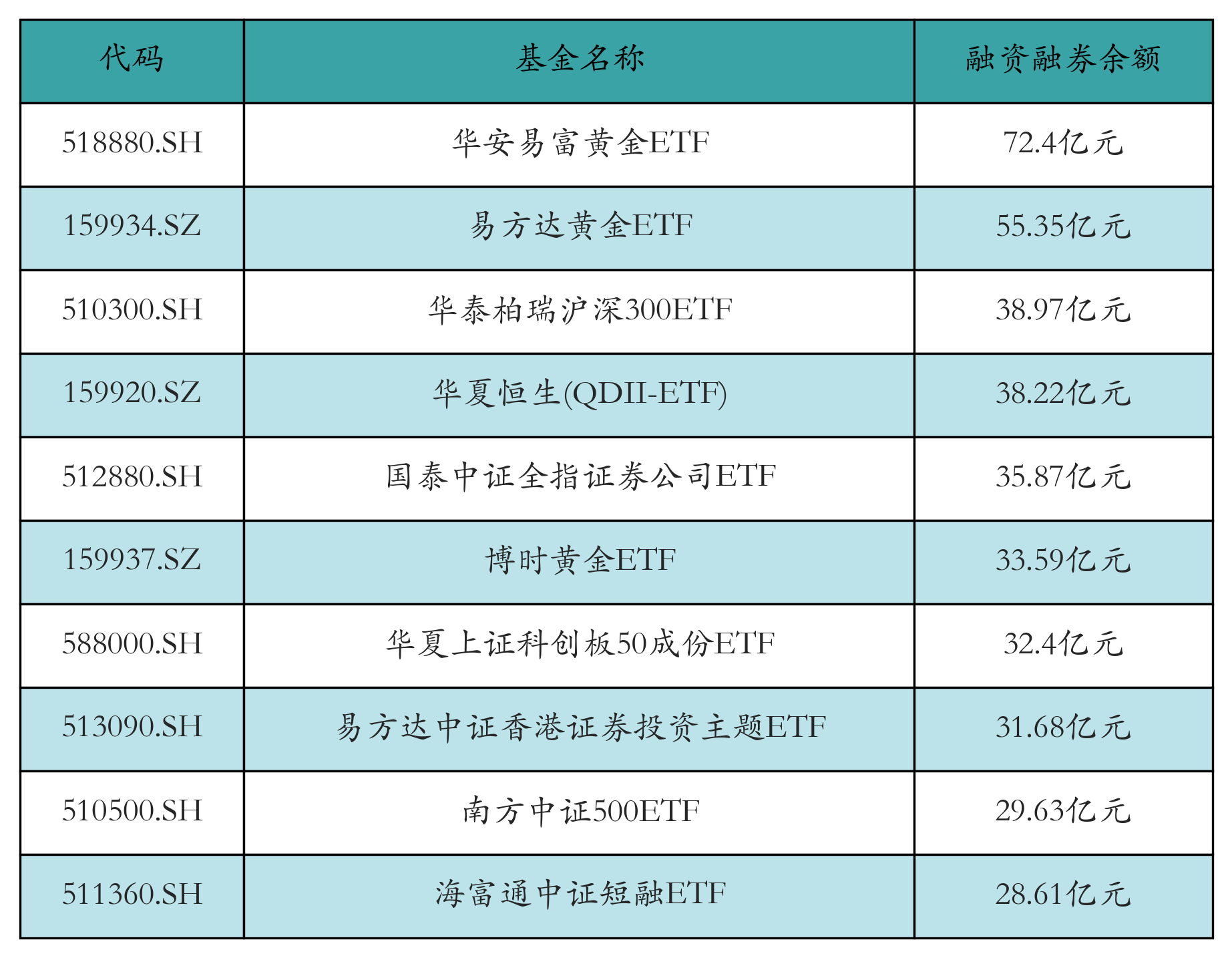
Market Overview - As of December 19, the total ETF margin balance in the two markets is 119.13 billion yuan, a decrease of 0.453 billion yuan from the previous trading day [1] - The financing balance is 111.87 billion yuan, down by 0.37 billion yuan, while the securities lending balance is 7.26 billion yuan, reduced by 83.13 million yuan [1] - In the Shanghai market, the ETF margin balance is 83.61 billion yuan, a decrease of 0.28 billion yuan, with a financing balance of 77.25 billion yuan, down by 0.213 billion yuan [1] - In the Shenzhen market, the ETF margin balance is 35.53 billion yuan, a decrease of 0.173 billion yuan, with a financing balance of 34.62 billion yuan, down by 0.157 billion yuan [1] ETF Margin Financing Balances - The top three ETFs by margin financing balance on December 19 are: - Huaan Yifu Gold ETF (7.24 billion yuan) - E Fund Gold ETF (5.535 billion yuan) - Huatai-PB CSI 300 ETF (3.897 billion yuan) [2] ETF Financing Buy Amounts - The top three ETFs by financing buy amounts on December 19 are: - Hai Futong CSI Short Bond ETF (1.465 billion yuan) - E Fund CSI Hong Kong Securities Investment Theme ETF (1.31 billion yuan) - Huatai-PB Southbound Hang Seng Technology Index (0.869 billion yuan) [4] ETF Financing Net Buy Amounts - The top three ETFs by financing net buy amounts on December 19 are: - Huabao CSI Bank ETF (178 million yuan) - Huaxia Shanghai Stock Exchange Sci-Tech Innovation Board 50 ETF (70.336 million yuan) - E Fund CSI Hong Kong Securities Investment Theme ETF (58.834 million yuan) [6] ETF Securities Lending Sell Amounts - The top three ETFs by securities lending sell amounts on December 19 are: - Southern CSI 500 ETF (18.5254 million yuan) - Huatai-PB CSI 300 ETF (16.5763 million yuan) - GF CSI 1000 ETF (9.4158 million yuan) [8]

超136亿元,买入!
Zhong Guo Ji Jin Bao· 2025-12-22 06:41
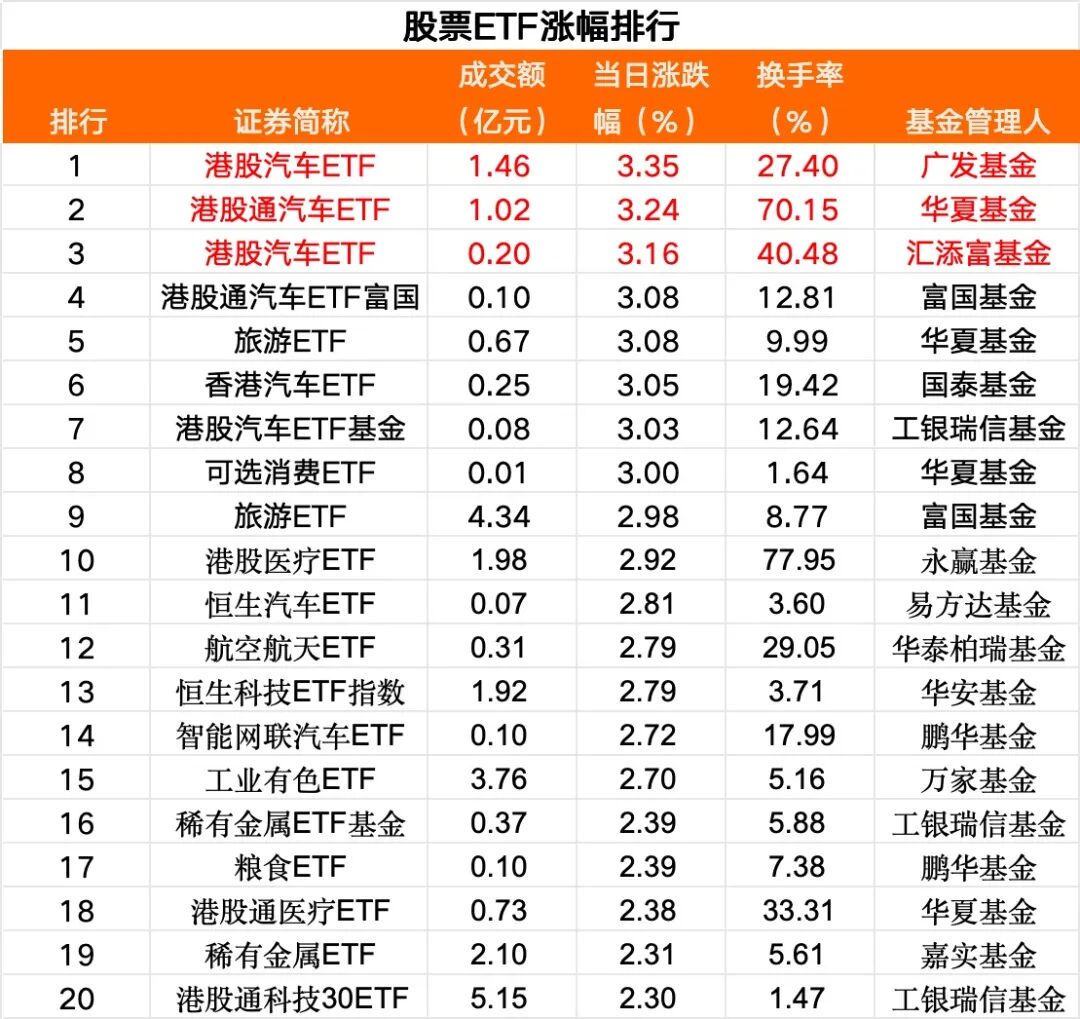
Group 1 - The core viewpoint of the article highlights a strong inflow of funds into stock ETFs in the Chinese market, with a net inflow exceeding 13.6 billion yuan on December 19, 2023, and a total inflow of over 60 billion yuan for the week [1][5][6] - The A-share market experienced a broad rally, with all three major indices closing higher and a total trading volume of 1.74 trillion yuan on December 19 [1][5] - The top-performing ETFs included those tracking the CSI A500 index, which attracted over 32.6 billion yuan, and the Hang Seng Technology-related ETFs, which saw a net inflow of over 5.2 billion yuan [1][6] Group 2 - As of December 19, the total scale of stock ETFs in the market reached 4.65 trillion yuan, with a trading volume of 190.57 billion yuan on that day, an increase of over 15 billion yuan compared to the previous trading day [3][6] - The leading ETFs by trading volume included the A500 ETF from Huatai-PB, which had a transaction volume of 13.37 billion yuan, and the Hong Kong Securities ETF from E Fund, which reached 10.43 billion yuan [3][6] - The performance of stock ETFs showed that the Hong Kong automotive sector led the gains, with several ETFs in this category rising over 3% [2][4] Group 3 - The inflow of funds into stock ETFs was driven by significant contributions from major fund companies, with E Fund's ETFs seeing a total scale increase of 227.1 billion yuan since the beginning of 2025, including a net inflow of 71.54 billion yuan [9] - The top three ETFs by net inflow on December 19 were the A500 ETF from Southern Fund, the A500 ETF from E Fund, and the A500 ETF from Huatai-PB, with net inflows of 20.43 billion yuan, 17.01 billion yuan, and 15.68 billion yuan respectively [7][9] - The article also notes that certain sectors, such as energy and banking, experienced outflows, with the CSI 300 ETF and military industry ETFs among those with significant net outflows [8]
超136亿元,买入!
中国基金报· 2025-12-22 06:37
Core Viewpoint - The A-share market experienced a broad rally with significant inflows into stock ETFs, indicating strong investor confidence and market recovery [2][7]. Group 1: Market Performance - On December 19, the A-share market saw all three major indices rise, with total trading volume reaching 1.74 trillion yuan [2]. - Stock ETFs, including cross-border ETFs, recorded a net inflow of over 13.6 billion yuan on the same day, with a cumulative inflow exceeding 60 billion yuan over the week [8][9]. - The China A500 index-related ETFs attracted substantial inflows, totaling over 32.6 billion yuan, while the Hang Seng Technology ETFs saw inflows of over 5.2 billion yuan [9]. Group 2: ETF Trading Activity - As of December 19, the total scale of stock ETFs in the market reached 4.65 trillion yuan, with a trading volume of 190.57 billion yuan on that day, an increase of over 15 billion yuan compared to the previous trading day [4]. - The top-performing ETFs included the A500 ETF from Huatai-PB, which had a trading volume of 13.37 billion yuan, and the Hong Kong Securities ETF from E Fund, which traded over 10.43 billion yuan [4]. Group 3: Sector Performance - The automotive sector led the gains among Hong Kong stock ETFs, with multiple ETFs in this category rising over 3% [5][6]. - Conversely, energy and banking-related ETFs underperformed, with declines of less than 1% [5]. Group 4: Fund Inflows and Outflows - On December 19, 39 stock ETFs recorded net inflows exceeding 1 billion yuan, with the top three inflows coming from Southern, E Fund, and Huatai-PB's A500 ETFs [8]. - The total net inflow for the entire ETF market on December 19 was 13.39 billion yuan, with broad-based ETFs and bond ETFs leading the inflows [8]. - Notably, the China A500 index saw a net inflow of 7.71 billion yuan, while the CSI 300 index experienced a net outflow of 1.15 billion yuan [9]. Group 5: Fund Management Insights - Fund managers from E Fund and Fuquan Fund expressed optimism about the market's potential for continued recovery, driven by policy support and industry developments [13].

生物股份股价涨5.01%,易方达基金旗下1只基金重仓,持有23.91万股浮盈赚取17.93万元
Xin Lang Cai Jing· 2025-12-22 05:47
Group 1 - The core point of the news is that Jin Yu Biological Technology Co., Ltd. has seen a stock price increase of 5.01%, reaching 15.72 yuan per share, with a trading volume of 779 million yuan and a turnover rate of 4.53%, resulting in a total market capitalization of 17.477 billion yuan [1] - The company, established on March 13, 1993, and listed on January 15, 1999, primarily engages in the research, production, and sales of veterinary biological products, with main business revenue composition being 94.42% from biopharmaceuticals, 3.18% from other income, and 2.40% from supplementary sources [1] Group 2 - From the perspective of major fund holdings, E Fund has one fund heavily invested in Jin Yu Biological, specifically the E Fund CSI Modern Agriculture Theme ETF (562900), which increased its holdings by 19,600 shares in the third quarter, totaling 239,100 shares, accounting for 2.79% of the fund's net value, ranking as the eighth largest holding [2] - The E Fund CSI Modern Agriculture Theme ETF (562900) was established on December 2, 2021, with a latest scale of 826.209 million yuan, showing a year-to-date return of 10.69% and a one-year return of 8.05%, with a cumulative loss of 20.3% since inception [2]

基金双周报:ETF市场跟踪报告-20251222
Ping An Securities· 2025-12-22 05:36
ETF Market Overview - The performance of ETFs varied, with the CSI 500 showing the highest increase among major broad-based ETFs, while the military industry theme ETF had the largest gain among sector and thematic products [2][9] - In the past two weeks, the net inflow of funds was led by the CSI A500, STAR 50, and CSI 500 ETFs [2][9] - The market saw a total of 9 new ETFs established in the last two weeks, with a total issuance of 3.3 billion shares, all of which were stock ETFs [23] Fund Flow Analysis - Broad-based ETFs experienced a shift from net outflows to net inflows, particularly in the A series ETFs, with significant inflows into the CSI 300 ETF and others, while the SSE 50 ETF saw a net outflow [10][15] - Sector and thematic ETFs saw significant inflows in the past two weeks, particularly in the dividend and manufacturing sectors, while the financial and military sectors experienced accelerated outflows [15][31] Thematic ETF Tracking - The AI-themed ETFs had an average return of 0.38% over the past two weeks, but saw a net outflow of 3.042 billion yuan [2] - The robotics-themed ETFs had a net inflow of 1.476 billion yuan despite an average return of -3.44% [2] - The renewable energy-themed ETFs experienced a net inflow of 1.171 billion yuan, with an average return of -1.88% [2] Product Structure Distribution - Compared to the end of 2024, the scale of various ETFs has increased significantly, with bond ETFs up by 327.08%, commodity ETFs by 225.98%, and industry + dividend ETFs by 109.16% [23] - The largest ETF management scale is held by Huaxia Fund at 929.154 billion yuan, with significant growth observed in both Huaxia and E Fund, each expanding by over 250 billion yuan compared to the previous year [24]
金融期权策略早报-20251222
Wu Kuang Qi Huo· 2025-12-22 05:30
1. Report Industry Investment Rating - No relevant content provided 2. Core Viewpoints of the Report - The stock market shows a high - level volatile upward trend, with the Shanghai Composite Index, large - cap blue - chip stocks, small and medium - cap stocks, and ChiNext stocks all in this market condition [3] - The implied volatility of financial options has declined to a level below the historical average [3] - For ETF options, it is suitable to construct a partial long - side seller strategy and a bull spread combination strategy of call options; for stock index options, it is suitable to construct a partial long - side seller strategy, a bull spread combination strategy of call options, and an arbitrage strategy of synthetic futures long and futures short [3] 3. Summary by Relevant Catalogs 3.1 Financial Market Index Overview - The Shanghai Composite Index closed at 3,890.45, up 14.08 points or 0.36%, with a trading volume of 738.1 billion yuan and an increase of 33.2 billion yuan in trading volume [4] - The Shenzhen Component Index closed at 13,140.21, up 86.24 points or 0.66%, with a trading volume of 987.8 billion yuan and an increase of 37.3 billion yuan in trading volume [4] - The Shanghai 50 Index closed at 3,004.34, up 5.82 points or 0.19%, with a trading volume of 94.9 billion yuan and an increase of 12.2 billion yuan in trading volume [4] - The CSI 300 Index closed at 4,568.18, up 15.39 points or 0.34%, with a trading volume of 371.6 billion yuan and a decrease of 10.5 billion yuan in trading volume [4] - The CSI 500 Index closed at 7,169.55, up 68.72 points or 0.97%, with a trading volume of 292.7 billion yuan and an increase of 17.2 billion yuan in trading volume [4] - The CSI 1000 Index closed at 7,329.81, up 57.40 points or 0.79%, with a trading volume of 362.3 billion yuan and an increase of 13.4 billion yuan in trading volume [4] 3.2 Option - Based ETF Market Overview - The Shanghai 50 ETF closed at 3.078, up 0.014 or 0.46%, with a trading volume of 8.6607 million shares and an increase of 8.623 million shares, and a trading value of 2.665 billion yuan and an increase of 1.51 billion yuan [5] - The Shanghai 300 ETF closed at 4.688, up 0.020 or 0.43%, with a trading volume of 8.3179 million shares and an increase of 8.2501 million shares, and a trading value of 3.902 billion yuan and an increase of 0.732 billion yuan [5] - Other ETFs' closing prices, price changes, trading volume changes, and trading value changes are also provided in the report [5] 3.3 Option Factor - Volume and Position PCR - For different option varieties such as the Shanghai 50 ETF, Shanghai 300 ETF, etc., the trading volume, trading volume changes, open interest, open interest changes, volume PCR, volume PCR changes, position PCR, and position PCR changes are presented [6] 3.4 Option Factor - Pressure and Support Points - For each option variety, the underlying closing price, at - the - money strike price, pressure point, pressure point deviation, support point, support point deviation, maximum long position of call options, and maximum long position of put options are given [8] 3.5 Option Factor - Implied Volatility - The at - the - money implied volatility, weighted implied volatility, weighted implied volatility changes, annual average, call implied volatility, put implied volatility, 20 - day historical volatility, and implied - historical volatility difference of different option varieties are provided [11] 3.6 Strategy and Suggestions - The financial options sector is divided into large - cap blue - chip stocks, small and medium - sized boards, and the ChiNext board. Different sectors include corresponding option varieties [13] - **Shanghai 50ETF**: The underlying shows a volatile consolidation pattern. The implied volatility is at a relatively low level, the position PCR is around 1.00. The pressure level is 3.20 and the support level is 3.10. Suggested strategies include a neutral - biased seller combination strategy, a spot long - covered call strategy [14] - **Shanghai 300ETF**: The underlying shows a rebound after over - decline. The implied volatility is at a relatively low level, the position PCR is around 1.00. The pressure level is 4.80 and the support level is 4.60. Suggested strategies include a short - volatility strategy of selling call and put options, a spot long - covered call strategy [14] - **Shanghai 500ETF**: The underlying shows a rebound and then a decline. The implied volatility is below the historical average, the position PCR is above 1.00. The pressure level is 7.50 and the support level is 7.00. Suggested strategies include a short - volatility strategy of selling call and put options, a spot long - covered call strategy [15] - **Shenzhen 100ETF**: The underlying shows a rebound and then a decline in a long - biased trend. The implied volatility fluctuates around the average, the position PCR is above 1.00. The pressure level is 3.40 and the support level is 3.30. Suggested strategies include a short - volatility strategy of selling call and put options, a spot long - covered call strategy [15] - **ChiNext ETF**: The underlying shows a bullish trend with high - level volatility. The implied volatility is at a high level, the position PCR is above 1.00. The pressure level is 3.20 and the support level is 3.00. Suggested strategies include a short - volatility strategy, a spot long - covered call strategy [16] - **CSI 1000**: The underlying shows a decline from a high level. The implied volatility fluctuates below the average, the position PCR is around 0.90. The pressure level is 7400 and the support level is 7000. Suggested strategies include a short - volatility strategy of selling call and put options with dynamic adjustment of positions to keep the delta short [16]
公募上周调研覆盖89只个股 长安汽车L3级自动驾驶成焦点
Zhong Guo Jin Rong Xin Xi Wang· 2025-12-22 04:25
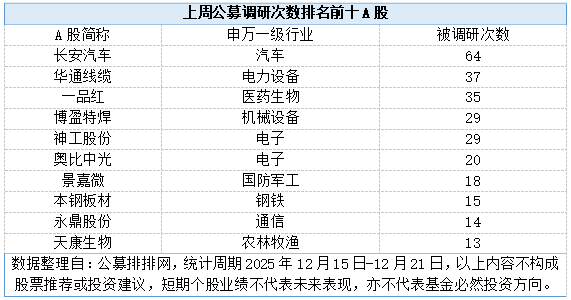
| 上周公募调研次数排名前十 A 股 | | | | --- | --- | --- | | A 股简称 | 申万一级行业 | 被调研次数 | | 长安汽车 | 汽车 | ୧୯ | | 英通线缆 | 电力设备 | 37 | | 品红 | 医药生物 | 35 | | 博盈特焊 | 机械设备 | 29 | | 神工股份 | 电子 | 29 | | 興比中光 | 車子 | 20 | | 景嘉微 | 国防军工 | 18 | | 本钢板材 | 钢铁 | 15 | | 永鼎股份 | 通信 | 14 | | 天康生物 | 农林牧渔 | 13 | | 数据整理自:公募排排网,统计周期 2025年 12月15日-12 月 21 日,以上内容不构成 | 股票推荐或投资建议,短期个股业绩不代表未来表现,亦不代表基金必然投资方向。 | | 转自:新华财经 新华财经上海12月22日电(林郑宏)年末公募快马加鞭赶调研,前瞻布局2026年投资主线。据公募排排 网数据显示,上周(2025年12月15日-12月21日)120家公募机构合计开展A股调研达545次,调研范围 覆盖到23个申万一级行业中的89只个股,展现出公募机构对市场机会的深度挖 ...

QDII基金2025年业绩爆发:17只收益率超70%,2026年该怎么投?
Sou Hu Cai Jing· 2025-12-22 03:17
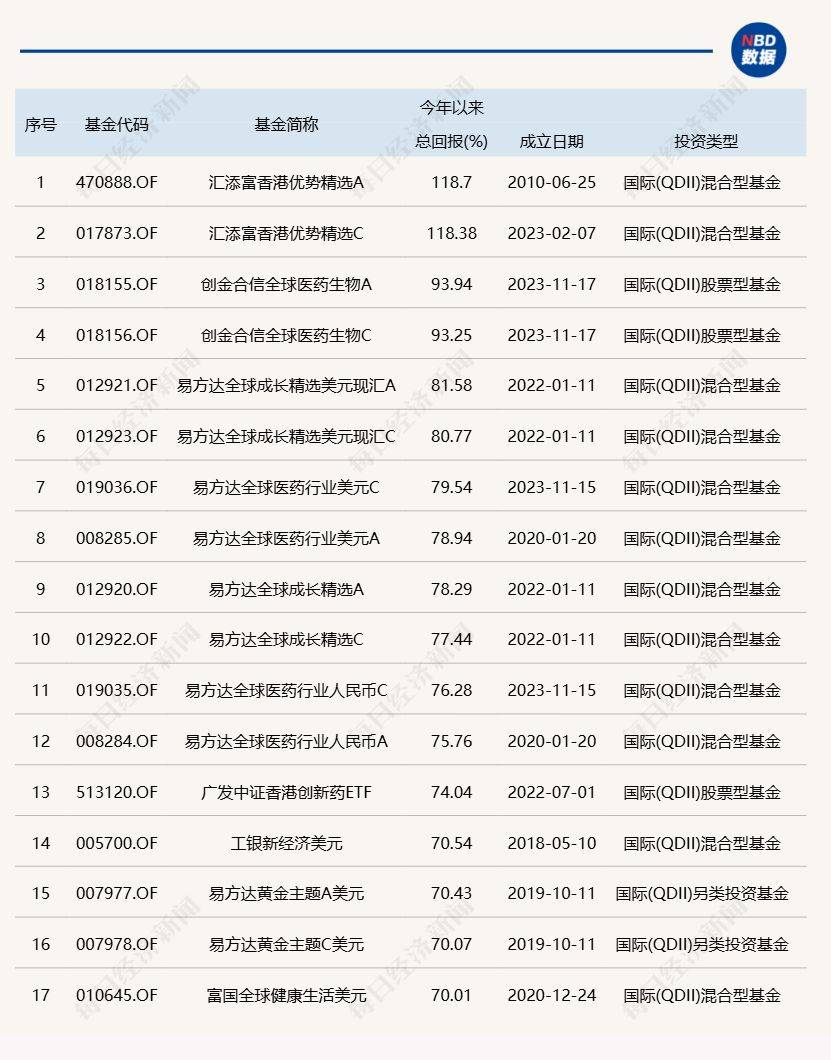
Core Viewpoint - QDII funds have emerged as a significant channel for investors to participate in global wealth growth amid increasing volatility in global capital markets and diversified asset allocation needs [1]. Group 1: 2025 Performance Overview - As of December 18, 2025, the QDII fund market showed a clear trend of "overall improvement with partial differentiation," with most products achieving positive returns [2]. - Over half of the QDII products recorded returns exceeding 15%, with more than 50 products surpassing 50%, and 17 products achieving returns over 70%, with some top products exceeding 100% [2]. - Notable performers include Huatai-PineBridge Hong Kong Advantage Selection A and C classes, with total returns of 118.70% and 118.38% respectively, leading the market [3]. Group 2: 2026 Investment Outlook - The market is optimistic about investment opportunities in QDII funds for 2026, particularly in Hong Kong and U.S. stocks, with a focus on sectors like innovative pharmaceuticals and new consumption [4][5]. - Analysts suggest that the structural trends in the innovative pharmaceutical sector are expected to continue, despite some short-term risks related to high valuations and geopolitical disturbances [5]. - The Hong Kong market is viewed positively due to its expanding asset base and increasing participation from mainland investors, with a notable reduction in the AH premium [5]. Group 3: Investment Strategy for 2026 - Investment strategies for 2026 recommend allocating to broad-based index QDII funds tracking major indices like the Nasdaq 100 and S&P 500, as well as comprehensive index funds covering the Hong Kong market [6]. - Given potential market volatility, a systematic investment approach such as dollar-cost averaging is advised to mitigate risks associated with short-term market fluctuations [7]. - Investors are encouraged to consider the management capabilities of fund managers, the research strength of fund companies, and fee structures when selecting QDII funds to build a diversified portfolio for long-term asset appreciation [7].
基金忠言|个人养老金怎么管?多家公司成“活教材”
Sou Hu Cai Jing· 2025-12-22 01:33
Core Insights - The personal pension system is set to be implemented nationwide starting December 15, 2024, following trials in 36 cities since November 25, 2022, with public funds launching Y-share funds to cater to this market [2] - Some fund companies have faced significant challenges, including fund liquidations, which can undermine investor confidence in long-term pension investments [2] - Conversely, certain companies have successfully navigated this space, with the total market size for personal pension Y-share funds reaching approximately 15.1 billion yuan by the end of Q3 2025, with leading firms like Huaxia and E Fund capturing over one-third of this market [3] Group 1: Challenges Faced by Fund Companies - Several fund companies, including Penghua and Chuangjin Hexin, have experienced fund liquidations, with Penghua's Longle Stable Pension Y-share fund being liquidated when its net value fell below 1 yuan [2] - The small scale of pension target funds from companies like Penghua (approximately 200 million yuan) and Yongying (only about 570,000 yuan) highlights the challenges in attracting substantial investment [2] Group 2: Successful Strategies and Experiences - As of Q3 2025, the leading Y-share fund, Xingquan Antai, has surpassed 1.2 billion yuan in scale, making it the only fund above 1 billion yuan [3] - Xingquan Global has emphasized early and significant investment in personal pension business, establishing a dedicated pension management department in 2018 with a diverse team of 22 members [5] - The company employs a research-driven, multi-asset allocation strategy, focusing on long-term investments and risk management, which has proven effective in generating profits for investors [6][7] - Xingquan Global has achieved a cumulative return of 80.44% for its Xingquan Antai Balanced Pension fund since its inception, ranking it first among all pension target funds [7] Group 3: Investor Education Initiatives - Xingquan Global prioritizes investor education, providing clear risk definitions and maintaining low tracking errors to enhance investor experience and mitigate losses from market volatility [7][8] - The company actively engages in educational initiatives, including publishing investment guides and hosting forums to foster a better understanding of pension investments among investors [8]

公募新发数量创近4年新高,股基赶超债基站上“C位”
Zheng Quan Shi Bao· 2025-12-22 00:24
Core Insights - The public fund issuance market has seen a significant shift since 2025, with equity funds taking center stage, marking a departure from the previously dominant bond funds [1][4][10] - A total of 1,468 new funds were established in 2025, the highest number in nearly four years, indicating a return of market vitality and a shift towards a more refined approach in fund management [2][3][10] Fund Issuance Trends - The total fundraising scale for new funds in 2025 reached 11,637.62 billion, remaining stable compared to previous years, reflecting a more rational and detailed market issuance rather than reliance on a few blockbuster products [3][10] - The number of new equity funds reached 807, with a fundraising scale of 4,083.62 billion, accounting for 35.96% of the total new fund issuance, the highest proportion in nearly a decade [4][5] Structural Changes in Fund Types - The proportion of bond funds has significantly decreased from 70.19% in 2024 to 41.22% in 2025, indicating a clear shift in market risk appetite [6][10] - Mixed funds saw an increase in issuance to 13.66% (1,551.03 billion), but still far from the peak of 56.58% in 2021, suggesting a preference for clearer investment styles among investors [7][10] Innovation in Fund Products - The market has seen a surge in innovative products, with FOFs (Fund of Funds) growing to 81 new funds and a scale of 810.68 billion, reflecting increasing demand for professional asset allocation [8][10] - Public REITs have also expanded, with 19 new products and 10.5 billion shares issued, providing new channels for investors to participate in physical assets [9][10] - QDII funds have shown a focus on strategy diversity, with recent products covering various international markets, indicating an active global investment approach [10] Future Outlook - The public fund industry is expected to play a more critical role in supporting the transformation of the real economy and meeting the wealth management needs of residents, driven by the clarity of equity investment and the development of diverse tools like FOFs, REITs, and QDIIs [11]