小米汽车

Search documents
开年多家车企密集降价促销
Zhong Guo Zhi Liang Xin Wen Wang· 2026-01-15 09:12
Group 1 - Multiple car manufacturers have launched price reduction promotions at the beginning of the year, with over 20 companies and 70 models participating in various limited-time promotional activities since January 1 [1] - BMW China announced price adjustments for 31 key models, including a significant reduction of 301,000 yuan for the flagship electric model i7 M70L, and the entry-level X1 model dropping below 250,000 yuan [1] - Other luxury brands such as Volvo and Cadillac have also implemented notable price cuts, while Tesla introduced financial incentives for its Model 3 and Model Y vehicles [1][2] Group 2 - GAC Group's promotional policies cover multiple brands and models, offering tax rebates, financial subsidies, and trade-in incentives [2] - New energy vehicle manufacturers like NIO and Xiaomi are also providing targeted promotional offers to attract customers [2] - The recent price reductions are closely linked to policy adjustments, including a halving of the purchase tax for new energy vehicles and changes to the old-for-new vehicle subsidy program [2][4] Group 3 - The increase in inquiries following price cuts indicates a shift in consumer behavior, with high-end brands becoming more accessible to a broader audience [3] - The traditional high-end brands are experiencing a reduction in brand premium, as consumers now have more options within their budget [3] - The competitive landscape is intensifying, with traditional and new energy vehicle brands needing to lower prices to capture market share [3][4] Group 4 - The widespread price reductions reflect intensified competition in the automotive market, characterized by overcapacity and high inventory levels [4] - Data shows that in the first 11 months of 2025, China's automotive production and sales exceeded 31 million units, with new energy vehicle penetration nearing 60% [4] - Industry experts predict a positive growth trend in the automotive market for the first quarter of the year, driven by policy support and increased competition based on product quality [4]
2025年汽车产销超3400万辆,10家车企集团稳居“百万俱乐部”
Zhong Guo Jing Ji Wang· 2026-01-15 06:41
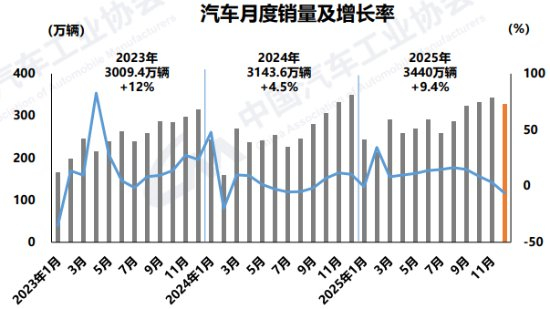
Group 1 - The core viewpoint of the article highlights the robust growth of China's automotive industry in 2025, achieving a total vehicle sales target of approximately 32.3 million units, with a notable increase in new energy vehicle (NEV) sales reaching around 15.5 million units, reflecting a year-on-year growth of about 20% [1][10] - The China Association of Automobile Manufacturers (CAAM) reported that in 2025, the production and sales of automobiles reached 34.5 million and 34.4 million units respectively, marking a year-on-year increase of 10.4% and 9.4%, maintaining China's position as the world's largest automotive market for 17 consecutive years [1][3] - NEV production and sales in 2025 were 16.6 million and 16.5 million units respectively, with year-on-year growth of 29% and 28.2%, indicating that NEVs accounted for over 50% of the domestic market, solidifying their dominance [1][10] Group 2 - In 2025, the automotive industry faced external pressures such as trade protectionism and global supply chain restructuring, yet it demonstrated resilience and vitality, achieving both scale and quality improvements in production and sales [3] - The export of automobiles reached 7.1 million units in 2025, with a year-on-year increase of 21.1%, becoming a key driver for positive growth in the Chinese automotive market [3][10] - The passenger vehicle market saw a significant surge, with production and sales surpassing 30 million units for the first time, achieving 30.3 million and 30.1 million units respectively, reflecting year-on-year growth of 10.2% and 9.2% [3][4] Group 3 - Ten automotive groups achieved sales exceeding one million units in 2025, collectively accounting for 83.9% of total automotive sales, with notable players including BYD, SAIC, and Geely [4] - The market share of domestic brands in the passenger vehicle segment increased, with a market share of 68.8% in December 2025, up 2.7 percentage points from the previous year [4][5] - The sales of traditional fuel vehicles continued to decline, with 13.4 million units sold in 2025, a decrease of 4% year-on-year, highlighting a shift towards electric vehicles [5][10] Group 4 - The article emphasizes the importance of the transition to electric vehicles, noting that while NEVs have not yet achieved a majority in overall sales, they have surpassed 50% in domestic sales [8][10] - The automotive market is transitioning from a growth phase to a more mature phase, with consumer behavior influenced by various factors including policy changes and income expectations [12] - Looking ahead to 2026, the forecast predicts total automotive sales of 34.75 million units, with NEV sales expected to reach 19 million units, reflecting a year-on-year growth of 15.2% [12]




2025年度新势力销量分析:零跑强势登顶 头部阵营再重构
Zhong Guo Zhi Liang Xin Wen Wang· 2026-01-15 03:32
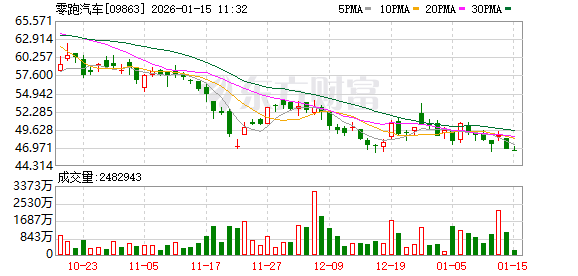
Core Insights - The competition in the Chinese new energy vehicle market is intensifying, with a clear shift from "price competition" to "value competition" among new car manufacturers [3] Group 1: Top Performers - Leap Motor achieved a remarkable delivery of 596,555 vehicles in 2025, marking a 103% year-on-year increase and exceeding its annual target of 500,000 vehicles with a completion rate of 119.3% [2][5] - Hongmeng Zhixing delivered 589,107 vehicles, a 32% increase year-on-year, but only reached 58.91% of its ambitious target of 1 million vehicles [5][7] - Xiaopeng Motors delivered 429,445 vehicles, achieving a 126% year-on-year growth and surpassing its target of 350,000 vehicles with a completion rate of 122.69% [9][10] Group 2: Emerging Players and Challenges - Xiaomi Motors entered the market with over 410,000 deliveries, achieving a completion rate of over 114% against its target of 350,000 vehicles, indicating a successful first full sales year [10][12] - Li Auto faced challenges with a total delivery of 406,343 vehicles, down 19% year-on-year, and only achieving 63% of its target of 640,000 vehicles [12][14] - Deep Blue delivered 333,117 vehicles, a 36.6% increase, but faced declining sales in the last two months of the year, highlighting transition pressures [16] Group 3: Diverse Growth Patterns - NIO achieved a record delivery of 326,028 vehicles, a 46.9% increase, with a completion rate of 74.1% against its target [18] - Zeekr delivered 224,000 vehicles, with a slight increase of 0.9%, but fell short of its target of 320,000 vehicles, indicating growth pressures in a competitive market [19][21] - Avita delivered over 120,000 vehicles, but only achieved 60% of its target, reflecting challenges in scaling amidst intense competition [25] Group 4: Market Dynamics and Future Outlook - The market is transitioning from rapid expansion to high-quality development, with brands needing to focus on technological capabilities and precise market positioning to succeed [27] - The implementation of new national subsidy policies in 2026 is expected to accelerate industry reshuffling, intensifying competition in the mainstream price segment [27]


四大板块齐头并进——车企2025产销快报解析
Zhong Guo Qi Che Bao Wang· 2026-01-13 09:43
Core Insights - The Chinese passenger car market is projected to retail 23.78 million units in 2025, reflecting a 4% year-on-year growth, supported by policies like "trade-in" [2] - Major domestic automakers such as BYD, Geely, Changan, and Leap Motor have achieved significant progress, while several joint venture companies are showing signs of recovery in China [2] Domestic Automakers Performance - BYD achieved a record annual sales of 4.60 million units in 2025, a 7.73% increase, with pure electric vehicle sales reaching 2.25 million units, up 27.85%, surpassing Tesla in global sales [3] - SAIC Group sold 4.51 million vehicles in 2025, a 12.3% increase, with its new energy vehicle sales growing by 33.1% to 1.64 million units [3] - China FAW's total vehicle sales reached 3.30 million units, a 3.2% increase, with its new energy vehicle sales soaring by 71% to 366,000 units [4] - Geely's total sales reached 3.02 million units, a 39% increase, with new energy vehicle sales hitting 1.69 million units, up 90% [4] - Changan's sales reached 2.91 million units, an 8.5% increase, with new energy vehicle sales growing by 51% to 1.11 million units [5] - Chery Group achieved a record high of 2.81 million units sold, with new energy vehicle sales increasing by 54.9% to 903,800 units [5] Joint Venture Automakers Performance - Joint venture automakers are under pressure but some have found ways to adapt, with FAW-Volkswagen leading in sales with 1.59 million units sold [7] - SAIC Volkswagen achieved sales of 1.06 million units, maintaining a strong position in the market [8] - Toyota's joint ventures in China reported positive growth, with FAW Toyota selling 805,500 units, a 3-year consecutive growth [8] New Energy Vehicle Market - New energy vehicles are a common highlight across major domestic automakers, with significant growth in sales and market penetration [3][4][5] - New entrants like Leap Motor and NIO are also showing strong growth, with Leap Motor achieving 596,600 units sold, a 103% increase [10] - Xpeng Motors delivered 429,400 units, a 126% increase, while NIO delivered 326,000 units, a 46.9% increase [11] Export Growth - China's automobile exports are expected to exceed 7 million units in 2025, marking a historic high [13] - Chery led the export of Chinese passenger cars with 1.34 million units, a 17.4% increase [13] - BYD's overseas sales surpassed 1 million units, a 145% increase, with significant growth in Europe [14] - New energy vehicle exports are also on the rise, with companies like Leap and Xpeng expanding their international presence [16]

四大证券报精华摘要:1月13日
Xin Hua Cai Jing· 2026-01-13 03:11
新华财经北京1月13日电四大证券报内容精华摘要如下: 中国证券报 ·四部门:加强政府投资基金布局规划和投向指导投资鼓励类产业要防止盲目跟风、一哄而上 国家发展改革委1月12日消息,为加强对政府投资基金布局规划和投向指导,更加突出政府引导和政策 性定位,国家发展改革委、财政部、科技部、工业和信息化部制定了《关于加强政府投资基金布局规划 和投向指导的工作办法(试行)》。国家发展改革委同步制定了《政府投资基金投向评价管理办法(试 行)》,引导政府投资基金落实国家产业调控要求,支持现代化产业体系建设。这是首次在国家层面对 政府投资基金的布局和投向作出系统规范。中国宏观经济研究院经济所研究员刘国艳表示,两项办法协 同实施,有助于引导金融资源更精准地流向实体经济急需的领域,尤其是周期长、风险高、社会资本初 期投入不足的环节,从而有效发挥政府投资基金"引导、补缺、撬动"的功能。 ·中欧电动汽车案实现"软着陆" 欧方将发布价格承诺指导文件 商务部12日发布关于中欧电动汽车案磋商进展的通报。根据通报,欧方将发布《关于提交价格承诺申请 的指导文件》。业内人士指出,这意味着经过多轮磋商,案件实现"软着陆"。通报指出,为落实中欧领 ...
全球最大的液冷展会来了|2026深圳国际液冷产业展会及论坛
Sou Hu Cai Jing· 2026-01-13 01:51
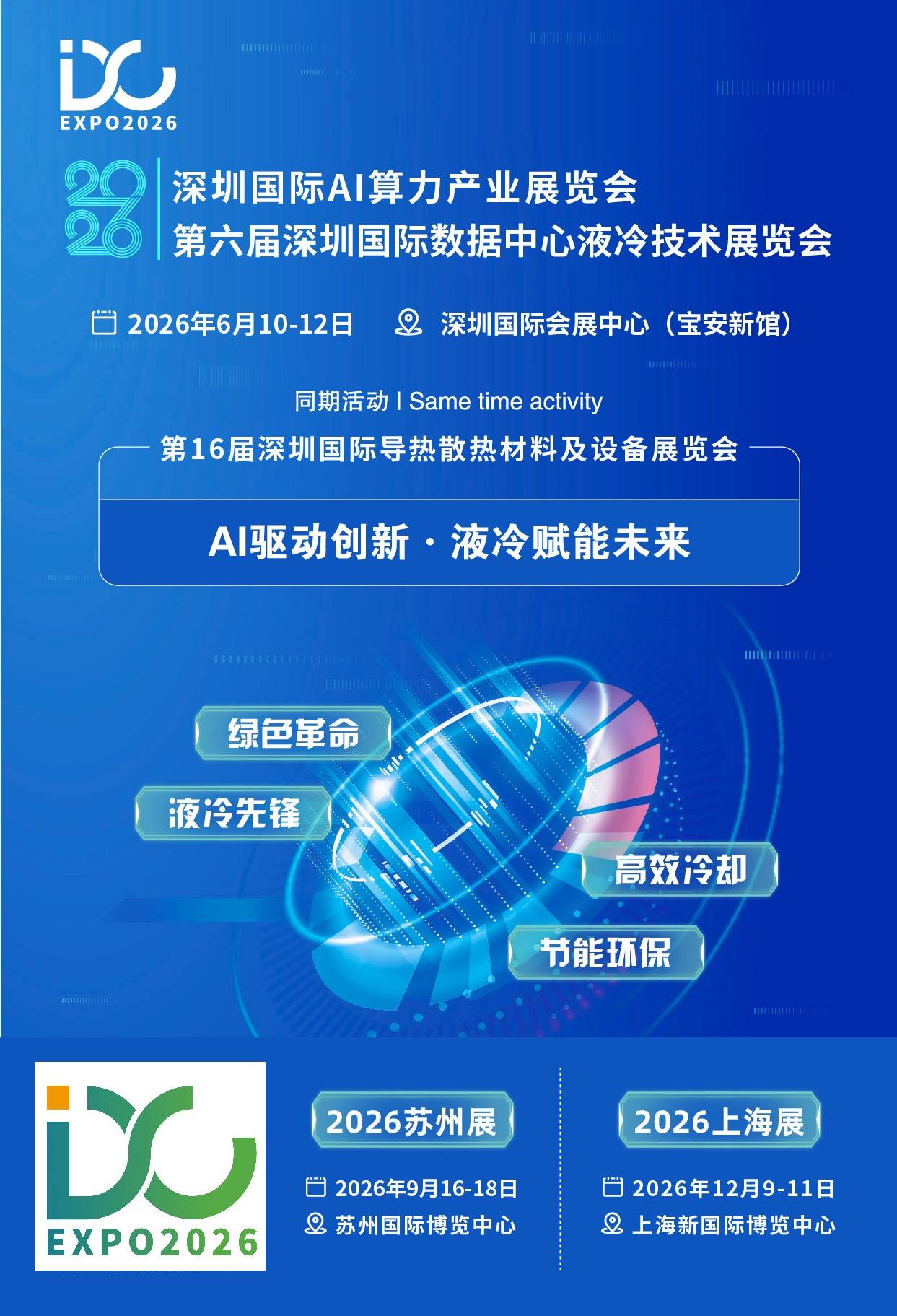
Group 1 - The 2026 Shanghai International Liquid Cooling Industry Exhibition will take place from December 9-11, 2026, at the Shanghai New International Expo Center [3] - The 2026 China (Shenzhen) International Liquid Cooling Industry Technology Exhibition is scheduled for June 10-12, 2026, at the Shenzhen International Convention and Exhibition Center [3] - The 2026 Suzhou Exhibition will occur from September 16-18, 2026, at the Suzhou International Expo Center [5] Group 2 - The rapid growth of big data has increased the demands on data center servers, necessitating higher power density in server cabinets [14] - Liquid cooling technology is becoming essential for data center efficiency, especially with the rise of 5G, edge computing, and AI applications [14][18] - The exhibitions aim to showcase the latest products and technologies in the liquid cooling industry, attracting professional audiences from data centers, power, electronics, edge computing, AI, and renewable energy sectors [14] Group 3 - The 2026 IDC exhibition is expected to cover an area of 15,000 square meters and will feature participation from major organizations such as the National Supercomputing Center in Shenzhen and Tencent [18] - Various technical exchange activities will be held during the IDC 2026 exhibition, focusing on industry hot topics and promoting diversified marketing strategies [19] - The exhibition will include a wide range of products covering cooling liquids, refrigerants, and various cooling devices, showcasing over a thousand new products across the entire industry chain [56] Group 4 - Shenzhen Angpai Technology Co., Ltd. is currently in the A-share IPO guidance stage, with plans to expand production capacity and R&D investment to capture market growth in liquid cooling [66] - The company has a registered capital of 90 million RMB and aims to leverage its professional R&D team and partnerships with universities to enhance its technological capabilities [66][68] - Angpai Technology's product offerings include liquid cooling module design, thermal management system integration, and innovative compressor technologies, with a focus on high reliability and efficiency [71][72]
从规模冲刺到结构优化 车企2026年销量目标透露发展新逻辑
Zheng Quan Ri Bao· 2026-01-12 17:00
Core Viewpoint - The 2026 sales targets of various automotive companies reflect a divergence in strategy, with new energy vehicle companies focusing on aggressive growth while traditional automakers prioritize stability and gradual progress [1][3]. Group 1: New Energy Vehicle Companies - New energy vehicle companies, such as Leap Motor, NIO, and Xiaomi, have set ambitious sales targets for 2026, with Leap Motor aiming for 1 million units, representing a year-on-year growth of approximately 67.6% [2]. - NIO's sales target ranges from 456,400 to 489,000 units, indicating a year-on-year growth of about 40% to 50%, while Xiaomi targets 550,000 units, reflecting a growth of around 34% [2]. - The aggressive targets are driven by the need for scale and market share, with companies like Leap Motor focusing on overseas expansion and local production to support their goals [2]. Group 2: Traditional Automakers - Traditional automakers, including Geely, Chery, and Great Wall Motors, have set more conservative sales targets, with Geely aiming for 3.45 million units and Chery targeting 3.2 million units, which represents a year-on-year growth of about 14% [3]. - Great Wall Motors has a target of 1.8 million units, reflecting a year-on-year growth of approximately 36%, while Dongfeng Group aims for 3.25 million units [3]. - The conservative approach is influenced by market pressures, policy changes, and the need to balance profitability with product structure, as the domestic market shows signs of weakening [3][4]. Group 3: Strategic Focus - Chery Group emphasizes a multi-faceted strategy involving "new fuel, new energy, new overseas markets, new businesses, and new technologies" to achieve its sales targets [4]. - The focus on overseas expansion is critical for traditional automakers, as uncertainties in export growth, particularly for electric vehicles, are anticipated in 2026 [4]. - Overall, the differentiation in sales targets reflects the industry's competitive landscape, with new energy vehicle companies aiming for rapid scale while traditional automakers focus on maintaining profitability and structural resilience [4].


年终盘点2025汽车市场的“龙门一跃”:油退电进,全球登顶
3 6 Ke· 2026-01-12 10:37
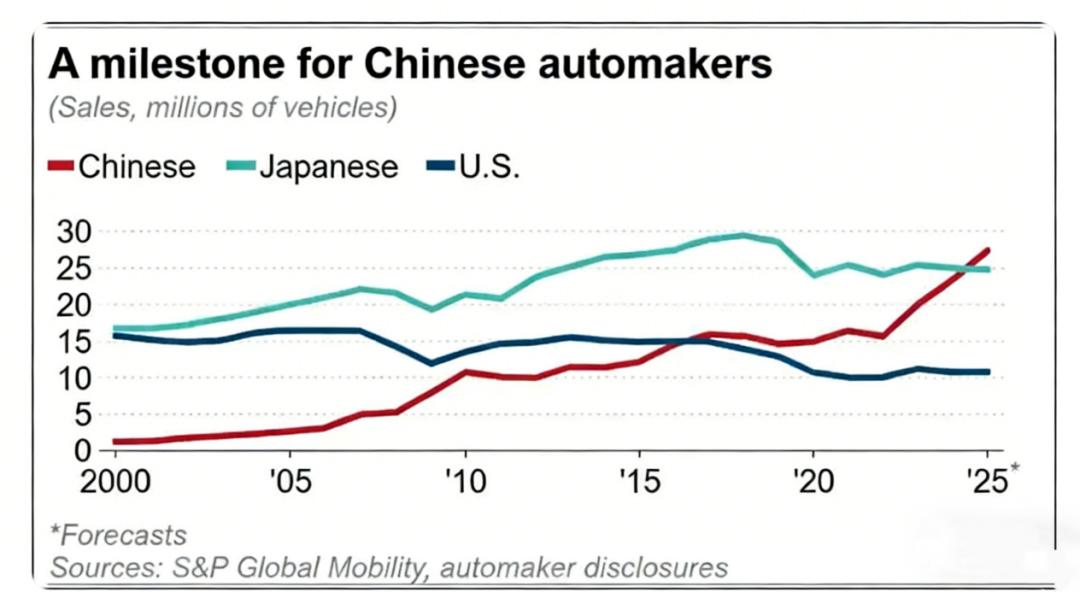
Core Insights - The penetration rate of new energy vehicles (NEVs) in China has surpassed 50%, marking a significant shift in the automotive market dynamics, transitioning from a "policy-driven" to a "product-driven" model [1][10] - The year 2025 is seen as a pivotal moment for the Chinese automotive industry, with the market experiencing a fundamental transformation akin to a "Nokia moment" [1] - The competition is evolving from price wars to value wars, emphasizing technology and product quality over mere volume [11] Industry Overview - In 2025, China's automotive manufacturers are projected to achieve global sales of 27 million vehicles, securing the top position in the global new car sales rankings for the first time [2] - China has overtaken Japan to become the world's largest automobile exporter, with NEVs accounting for a significant portion of this growth [4] - The domestic market's NEV sales are nearing 60%, reflecting a structural change in consumer preferences [4] Sales and Market Penetration - By November 2025, the retail penetration rate of NEVs reached 53.6%, with projections for the full year estimating a rate of 54.0% [6] - The rapid increase in NEV penetration is attributed to a combination of policy support, technological advancements, infrastructure development, and market demand [7] Policy and Technological Developments - The exit of purchase subsidies in 2023 has been offset by continued tax exemptions and various local incentives, which have helped maintain consumer interest in NEVs [7] - 2025 is expected to be a year of technological breakthroughs in NEVs, with advancements in high-voltage platforms, solid-state batteries, and smart driving technologies [8] Infrastructure and Consumer Experience - The expansion of charging infrastructure is crucial for alleviating consumer concerns about range anxiety, with projections of 20 million charging stations by the end of 2025 [9] - The cost advantages of NEVs are becoming increasingly apparent, with electric vehicles offering significantly lower operating costs compared to traditional fuel vehicles [9] Competitive Landscape - The shift from price competition to value competition is reshaping the industry, with companies focusing on technological innovation and profitability [11] - Some companies, like Leap Motor, have emerged as strong competitors, achieving significant sales growth and profitability [13] Global Expansion - In 2025, China's automotive exports are expected to exceed 7 million units, with NEV exports alone projected to reach 2.315 million units, marking a 102.9% increase [21] - Chinese automakers are transitioning to a "global + local" model, emphasizing localized production and R&D to better penetrate international markets [22] Challenges and Future Outlook - Despite rapid growth, challenges such as trade protectionism and compliance costs remain significant hurdles for Chinese automakers in global markets [24] - The automotive industry is expected to continue evolving, with a focus on sustainable growth and value creation as it navigates the transition from a subsidy-driven to a market-driven environment [25]


汽车行业周报:全年销量符合预期,智驾引领再提速-20260112
Guoyuan Securities· 2026-01-12 09:47
Investment Rating - The report maintains a "Recommended" investment rating for the automotive and automotive parts industry [6] Core Insights - The overall sales of passenger vehicles met expectations with a year-on-year growth of 9%, while new energy passenger vehicles saw a growth of 25% [1][2] - In December 2025, the retail sales of passenger vehicles were 2.296 million units, a year-on-year decrease of 13%, but a month-on-month increase of 3%. Cumulatively, retail sales for the year reached 23.779 million units, a year-on-year increase of 4% [1][20] - The report highlights the rapid advancements in intelligent driving technologies, with multiple automakers updating their systems and competing in the autonomous driving sector [3][4] Summary by Sections Sales Performance - In December 2025, wholesale sales of passenger vehicles were 2.759 million units, a year-on-year decrease of 10%, with cumulative wholesale sales for the year reaching 29.524 million units, a year-on-year increase of 9% [1][20] - For new energy vehicles, December retail sales were 1.387 million units, a year-on-year increase of 7%, with cumulative retail sales for the year at 12.859 million units, a year-on-year increase of 18% [1][20] Industry Developments - Several automakers, including Zeekr and Geely, are enhancing their intelligent driving systems, indicating a shift towards integrated decision-making models in vehicle technology [3][4][32] - The report emphasizes the importance of continued policy support for the automotive industry and the potential investment opportunities arising from advancements in autonomous driving technology [4] Market Trends - The automotive sector saw a 2.53% increase in the week of January 3-9, 2026, with most related sub-sectors also experiencing growth [12] - The report notes that the intelligent driving technology is becoming a key competitive area among automakers, with significant investments and innovations being made [3][4][39]
【月度排名】2025年12月厂商销量排名快报
乘联分会· 2026-01-12 09:28
Core Viewpoint - The article highlights the performance of the Chinese automotive market in December 2025, noting a decline in retail sales for traditional vehicles while emphasizing growth in the new energy vehicle (NEV) sector and exports. The market is expected to transition into 2026 with a focus on new energy vehicles and a recovery in demand [4]. Sales Performance - In December 2025, the domestic narrow passenger car market retail sales reached 2.261 million units, a year-on-year decrease of 14.0% but a month-on-month increase of 1.6%. Cumulative sales for the year totaled 23.744 million units, reflecting a year-on-year growth of 3.8% [2]. - The wholesale sales ranking for December 2025 shows BYD leading with 414,784 units sold, followed by Geely and Chery with 236,817 and 234,736 units, respectively. Notably, BYD's sales decreased by 12.7% month-on-month and 18.6% year-on-year [5]. - For the entire year of 2025, BYD also topped the wholesale sales with 4.545 million units, marking a 6.9% increase year-on-year, while Geely's sales surged by 39.0% to 3.025 million units [6]. New Energy Vehicle Market - In December 2025, the NEV wholesale sales ranking was led by BYD with 414,784 units, despite a month-on-month decline of 12.7% and a year-on-year drop of 18.6%. Geely followed with 154,264 units, showing a year-on-year increase of 38.7% [9]. - The retail sales for NEVs in December 2025 also saw BYD at the forefront with 339,854 units sold, a month-on-month increase of 10.9% but a year-on-year decrease of 15.7% [13]. - For the full year, BYD maintained its dominance in the NEV sector with 3.485 million units sold, although this represented a year-on-year decline of 6.3% [14]. Market Trends and Future Outlook - The article notes that the end of the year typically sees a surge in vehicle purchases, but the depletion of subsidy funds across provinces has tempered this effect, leading to a more stable demand outlook heading into 2026 [4]. - The performance of various manufacturers indicates a competitive landscape, with traditional automakers facing challenges while NEV manufacturers like BYD and Geely continue to show resilience and growth potential [6][9].