高通

Search documents
车企角逐智能驾驶军备赛,寻找下一个增长极
Xin Jing Bao· 2025-11-11 09:20
Core Insights - The Chinese automotive industry is in a competitive race towards intelligent driving, with the "14th Five-Year Plan" emphasizing the need for smart and integrated development, accelerating the transition to intelligent and green manufacturing [1][2] - AI capabilities are becoming a new valuation anchor for automotive companies, shifting the focus from mechanical performance to intelligent experiences, with significant implications for investment and market perception [2][4] - The industry is witnessing a shift from hardware competition to software competition, with companies increasingly focusing on self-developed chips and partnerships with major chip manufacturers [3][4] Group 1 - The "14th Five-Year Plan" aims to promote technological upgrades and the digital transformation of manufacturing, leading to the emergence of new business models such as "software-defined vehicles" [2][4] - The competition in intelligent driving is characterized by a "computing power arms race," with companies needing substantial AI computing resources to develop and train intelligent driving models [2][3] - The automotive industry is evolving into a comprehensive sector that integrates advanced technologies from AI, energy, chips, and digital services, reflecting a deep interconnection with various industries [7][8] Group 2 - The relationship between automotive and chip industries is becoming increasingly symbiotic, with new business models and value growth points emerging from this integration [8] - Companies are exploring the potential of utilizing excess computing power from vehicles as distributed computing nodes within the broader digital economy [8] - The competitive landscape is marked by different collaboration models, with companies like Huawei providing full-stack solutions, while others focus on self-research to maintain control over core technologies [7][8]
半导体行业月报:海外云厂商25Q3继续加大资本支出,国内存储器厂商业绩表现亮眼-20251110
Zhongyuan Securities· 2025-11-10 09:00
Investment Rating - The report maintains an "Outperform" rating for the semiconductor industry [1]. Core Insights - The semiconductor industry continues to experience steady growth, with domestic memory manufacturers showing impressive performance in Q3 2025. The industry's revenue reached 174.18 billion yuan, a year-on-year increase of 6.07%, while net profit attributable to shareholders grew by 48.93% [3][6]. - Global semiconductor sales increased by 25.1% year-on-year in September 2025, marking the 23rd consecutive month of growth, with a month-on-month increase of 7.0%. The forecast for 2025 indicates an 11.2% year-on-year growth in global semiconductor sales [3][6]. - Major cloud service providers in North America, including Google, Microsoft, Meta, and Amazon, significantly increased their capital expenditures, totaling $96.4 billion in Q3 2025, a 67% year-on-year increase [7][3]. Summary by Sections 1. Market Performance in October 2025 - The semiconductor industry underperformed relative to the CSI 300 index, with a decline of 6.18% in October 2025, while the CSI 300 remained flat. Year-to-date, the semiconductor industry has risen by 45.44% [12][3]. - The Philadelphia Semiconductor Index rose by 13.48% in October 2025, outperforming the Nasdaq 100, which increased by 4.77% [12][18]. 2. Q3 2025 Industry Summary - The semiconductor industry showed robust growth in Q3 2025, with a revenue of 1741.84 billion yuan and a net profit of 394.68 billion yuan, reflecting a year-on-year increase of 6.07% and 48.93%, respectively [3][6]. - Domestic memory manufacturers, including Jiangbolong and Demingli, turned profitable in Q3 2025, with significant revenue and profit growth expected in Q4 due to rising memory prices [3][6]. 3. Capital Expenditure and Price Trends - North American cloud service providers are increasing their capital expenditures, with a combined total of $96.4 billion in Q3 2025, indicating strong demand for AI computing hardware infrastructure [7][3]. - The prices of DRAM and NAND Flash memory saw significant increases in October 2025, with DRAM prices expected to rise by 18-23% in Q4 2025 [3][6].
被产业链“寄予厚望”,AIPC现在如何了?
Jing Ji Guan Cha Wang· 2025-11-08 05:26
Core Insights - The article discusses the rise of AIPC (Artificial Intelligence Personal Computer) as a new category in the tech industry, highlighting Lenovo's launch of the "Lenovo Savior AI Edition" laptops equipped with AI capabilities through the integration of NPU (Neural Processing Unit) alongside traditional CPU and GPU [2][3] - The demand for AIPC has surged since the introduction of ChatGPT, prompting major tech companies to accelerate their AIPC strategies and product offerings [3][4] - Despite the growing market interest, challenges remain regarding the software ecosystem and practical applications of AIPC, with many users reporting underwhelming AI experiences [5][6] Industry Trends - AIPC sales have been increasing, with Lenovo's AIPC series seeing a production priority shift due to rising demand [3] - Intel reported a revenue increase of 2.8% in Q3 2025, attributed to AIPC, and anticipates supplying processors for over 100 million AIPC units by the end of 2025 [3][8] - Other companies, such as iFlytek, are also entering the AIPC market, aiming to create a comprehensive ecosystem with domestic CPUs and operating systems [4][10] Market Dynamics - The AIPC market is characterized by a fragmented software ecosystem and insufficient practical applications, leading to consumer dissatisfaction despite hardware advancements [5][6] - The hardware foundation of AIPC relies on a heterogeneous computing architecture (CPU+GPU+NPU), with various chip manufacturers, including Intel, AMD, and Qualcomm, competing in this space [6][8] - The operating system landscape is dominated by Microsoft, which has set standards for AIPC, while domestic players like iFlytek are adapting their systems to local needs [9][10] Supply Chain and Manufacturing - ODM manufacturers like Huaqin Technology are experiencing significant growth in AIPC-related revenues, with expectations of over 30% revenue growth in 2025 [11] - The demand for AIPC is driving up the prices of components, such as heat dissipation structures, which are expected to increase by around 30% due to higher cooling requirements [12] - The transition to AIPC is creating a complete supply chain that includes high-value products and improved profit margins for manufacturers [14] Consumer Experience and Challenges - Despite the hardware advancements, many consumers report that the AI functionalities of AIPC are not meeting expectations, often describing them as inadequate or frustrating [16][18] - The current AIPC offerings are seen as traditional computers with AI features rather than fully realized AI systems, indicating a gap between consumer expectations and actual performance [18][19] - Industry experts suggest that the true potential of AIPC will not be realized until the software ecosystem matures and AI applications become more robust and user-friendly [19]




止跌企稳,银行、科技双双反转,中概股延续弱势
Ge Long Hui· 2025-11-08 05:20
Market Overview - The three major indices showed mixed results at the close, with the Dow Jones up by 0.16%, the Nasdaq down by 0.21%, and the S&P 500 rising by 0.13% [1] Banking Sector - The banking sector stabilized after a decline, with notable gains from Zions Bank up by 1.93%, Alliance West Bank up by 1.66%, and US Bancorp up by 1% [3] - Major banks like JPMorgan Chase and United Bank also saw slight increases, while Bank of America, Citigroup, Goldman Sachs, and US Steel experienced minor declines [3] Technology Sector - The technology sector continued to show weakness but with significant differentiation among stocks, as Tesla fell sharply by 3.68%, Google down by 2.08%, Qualcomm down by 1.33%, and AMD down by 1.75% [3] - Conversely, Intel saw a notable increase of 2.39%, while other tech giants like NVIDIA, Amazon, Netflix, and META had slight gains [3] Chinese Concept Stocks - Chinese concept stocks continued to struggle, with the China Golden Dragon index down by 0.95% at the close [3] - Specific declines included XPeng Motors down by 6.15%, Tencent Music down by 4.62%, NIO down by 4.19%, and Bilibili down by 2.08%, while Alibaba, Baidu, JD.com, and iQIYI also saw minor declines [3] Gold Market - COMEX gold opened higher and experienced a day of fluctuating gains, closing up by 0.42% at $4007.8 per ounce, with a low of $3981.6 and a high of $4035.8 during the trading session [3]

日韩股市全线下挫,万亿巨头大跳水
Mei Ri Jing Ji Xin Wen· 2025-11-07 06:21
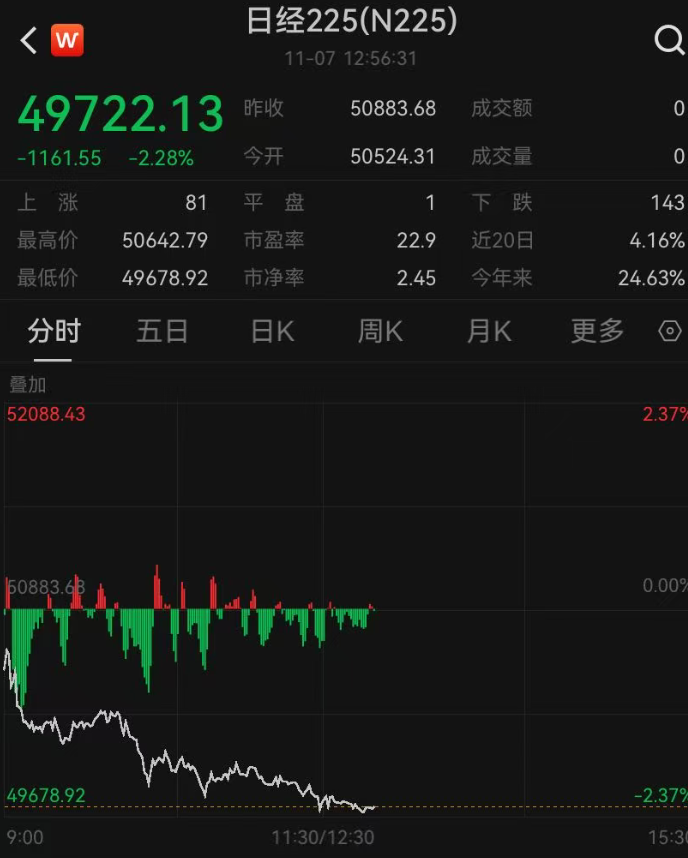
11月7日软银集团股价大跌,截至发稿,跌幅为9.64%,目前总市值30万亿日元(约合人民币1.4万亿元)。 11月7日,日韩股市走低。 日经225指数跌破50000点关口,截至发稿,跌幅超2%。 韩国KOSPI指数一度翻红,随后快速跳水,现跌2.78%。 美东时间周四,美股科技股也集体下跌,超威半导体跌超7%,英伟达市值一夜蒸发1733亿美元,微软7 连跌,特斯拉、高通跌逾3%。 市场越来越担心泡沫随时破裂。在次贷危机前精准做空了美国房地产市场的"大空头"Michael Burry正在 部署做空美国的AI泡沫。他暗示称,当前支出过度且回报过低将使得AI热潮中许多领先公司最终崩 溃。 据21世纪经济报道,近日,高盛与摩根士丹利认为全球(美国)股市由于科技股泡沫,在未来1~2年内可 能出现10%到20%的回调,但他们看好中国股市,特别是中国的人工智能、电动汽车和生物技术等领 域。 渣打中国财富管理部首席投资策略师王昕杰表示,市场一旦出现恐慌性的抛售行为,大概率是会从估值 过高、累积较多涨幅的板块开始抛售。虽然AI板块的估值较高,但这一板块很大程度仍有美联储降息 和企业盈利支撑。王昕杰认为,市场对于科技股的担忧,是 ...
康希通信20251106
2025-11-07 01:28
Summary of the Conference Call for 康希通信 Company Overview - **Company**: 康希通信 (Kangxi Communication) - **Industry**: Wireless Communication Technology Key Points Financial Performance - **Q3 Revenue Growth**: Revenue for Q3 increased by 3.21% year-on-year, reaching a record high for a single quarter, with total revenue of 526 million yuan for the first three quarters, a 39.32% increase year-on-year [2][3] - **Net Profit**: The company reported a net loss of 30.53 million yuan in Q3, although the loss narrowed compared to the previous year [2][3] - **Gross Margin**: Gross margin for the first three quarters was 23.13%, up 2.32 percentage points year-on-year, with Q3 gross margin at 24.43%, an increase of 5.63 percentage points year-on-year [2][3] Product Development and Market Position - **WiFi 7 Products**: WiFi 7 products have become the core growth engine, accounting for over 50% of revenue. The company has established deep partnerships with major SoC manufacturers like Broadcom, Qualcomm, and MediaTek, leading to continuous order and shipment growth [2][4] - **Future Technology**: The company is proactively developing WiFi 8 technology, with plans to launch related products in 2026 [2][5] - **UWB Technology**: The company is collaborating with invested enterprises to develop Ultra Wide Band (UWB) products, targeting applications in tracking, radar, and data transmission. The UWB market in China is expected to reach 20 billion yuan by 2028 [4][9] Diversification and Strategic Initiatives - **Business Diversification**: The company is expanding into low-altitude economy and industrial IoT sectors, with successful orders for high-efficiency drone RF front-end chips and smart control wireless communication chips [2][6] - **Strategic Focus**: The company is focusing on four strategic directions: building a moat around WiFi products, diversifying product offerings, protecting intellectual property, and enhancing market value management [2][8] Legal Challenges - **337 Investigation**: The company is involved in a 337 investigation initiated by Skyworks, with three patents withdrawn due to insufficient infringement evidence. The remaining two patents have completed court hearings. Legal expenses related to this investigation totaled approximately 50.6 million yuan for the first three quarters, significantly impacting net profit [2][7][22] - **Impact of Legal Costs**: Excluding these legal costs, the core business has returned to profitability. The company expects a significant decrease in related expenses in Q4 and anticipates a gradual reduction in the impact of these legal issues on overall performance in 2026 [7][8][10] Market Outlook and Competitive Landscape - **Market Expansion**: The company is targeting overseas markets, particularly Europe and South Asia, with expectations of overseas sales accounting for 6%-7% of total sales for the year [10] - **Competitive Position**: The merger between Skyworks and Qorvo may create a monopolistic giant, but it also presents opportunities for domestic manufacturers like 康希通信 to become key suppliers for major clients [11][19] Future Growth and Challenges - **Mobile WiFi Market**: The company is working to increase its market share in the mobile WiFi sector, which is crucial for future growth. Currently, WiFi 6 accounts for about 40% of revenue, while WiFi 7 contributes over 50% [12][16] - **Emerging Trends**: The company is observing a shift from Bluetooth to WiFi connections in certain applications, particularly in IoT and wearable devices, which may drive future product development [13][14][15] Shareholder Activity - **Shareholder Reduction**: Two major shareholders reduced their holdings, but this has not significantly impacted the company's operations or strategic direction [21] Conclusion - 康希通信 is positioned for growth with a strong focus on WiFi technology, diversification into new markets, and proactive management of legal challenges. The company remains optimistic about its future profitability and market expansion despite current challenges.
光大证券晨会速递-20251107
EBSCN· 2025-11-07 01:09
Macro Analysis - The recent rise of the US dollar index above 100 is attributed to increased internal disagreements within the Federal Reserve regarding potential rate cuts in December, alongside rising US Treasury yields supporting the dollar's strength [2] - The dollar is expected to remain volatile around the 100 mark in Q4, influenced by potential dovish signals from the new Fed chair and ongoing uncertainties regarding tariff judicial decisions and Japan's currency management [2] Industry Research - The carbon neutrality initiatives in China and the EU are expected to enhance domestic companies' revenue sources due to high carbon prices in Europe [5] - The global shipping industry is accelerating its decarbonization efforts, with the International Maritime Organization (IMO) promoting green fuel policies, leading to sustained high prices for green methanol amid rising demand and limited supply [5] - Hydrogen and ammonia methanol are emerging as significant directions for new energy consumption and applications in non-electric sectors, likely attracting more investments and driving the development of hydrogen production equipment and biomass gasification technologies [5] Company Research - For Yutong Optical (300790.SZ), the rapid advancement of products in new consumption and automotive sectors has led to an upward revision of net profit forecasts for 2025-2026 to 263 million and 402 million yuan, respectively, with a new forecast for 2027 at 452 million yuan, maintaining a "buy" rating [8] - For Maijie Technology (300319.SZ), Q3 2025 revenue reached 1.107 billion yuan, a year-on-year increase of 18.75%, while net profit slightly decreased by 1.11% year-on-year to 96 million yuan, with a "buy" rating maintained due to strong order volumes in various product lines [9] - Qualcomm (QCOM.O) exceeded expectations for FY2025, with net profit forecasts for FY2026-2027 set at 11.5 billion and 12.5 billion USD, respectively, reflecting a year-on-year growth of 108% and maintaining a "buy" rating [10] - Shanghai Fudan (1385.HK) reported significant year-on-year growth in revenue and profit for Q3 2025, with net profit forecasts adjusted to 530 million, 976 million, and 1.191 billion yuan for 2025-2027, maintaining a "buy" rating due to recovering demand in high-reliability and storage sectors [11]
【高通(QCOM.O)】FY2025业绩超预期,高端手机SoC需求提升,汽车、IoT业务收入维持高速增长——FY2025业绩点评
光大证券研究· 2025-11-06 23:03
Core Viewpoint - Qualcomm's FY2025 performance and FY26Q1 guidance exceeded expectations, leading to a 3.98% increase in stock price after the announcement [4]. Group 1: FY2025 Performance - Qualcomm achieved Non-GAAP revenue of $44.141 billion for FY2025, surpassing Bloomberg's consensus estimate of $43.690 billion, representing a year-on-year increase of 13% [4]. - The QCT business generated revenue of $38.367 billion, up 16% year-on-year, while the QTL business revenue remained flat at $5.582 billion [4]. - Due to the impact of the Inflation Reduction Act, Qualcomm will recognize $5.7 billion in tax expenses in FY25Q4, resulting in a GAAP net profit of $5.541 billion compared to a Non-GAAP net profit of $13.298 billion [4]. - The Non-GAAP EPS for FY2025 was $12.03, exceeding the consensus estimate of $11.92 [4]. Group 2: FY26Q1 Guidance - Qualcomm's guidance for FY26Q1 indicates Non-GAAP revenue of $11.8 to $12.6 billion, above the consensus estimate of $11.592 billion [4]. - The company expects Non-GAAP diluted EPS to be between $3.30 and $3.50, compared to the consensus estimate of $3.255 [4]. Group 3: QCT Mobile Business - The mobile business revenue reached $27.793 billion in FY2025, reflecting a 12% year-on-year increase, driven by higher demand for high-end Snapdragon chips from Android OEMs [5]. - Qualcomm launched the new Snapdragon 8 Elite Gen5 SoC in September 2025, which will be featured in flagship models from brands like Xiaomi, OnePlus, and iQOO [5]. - The company anticipates maintaining a high supply share of 75% for Samsung's mobile chips [5]. Group 4: QCT IoT Business - The IoT business generated revenue of $6.617 billion in FY2025, marking a 22% year-on-year increase, primarily due to higher shipments in consumer, industrial, and edge network products [6]. - Qualcomm completed the acquisition of Arduino, enhancing its competitive edge in the edge AI sector with a community of over 30 million users [6]. - The company expects over 150 high-end PC models to feature Snapdragon SoCs by 2026 [6]. Group 5: QCT Automotive Business - The automotive business revenue was $3.957 billion in FY2025, a 36% year-on-year increase, driven by higher shipments of vehicles equipped with Qualcomm's smart cockpit technology [8]. - Qualcomm is collaborating with BMW to launch the Snapdragon RidePilot system for L2+ assisted driving, currently validated in over 60 countries and set to expand to 100 countries by 2026 [8].

高通(QCOM):FY2025 业绩点评:FY2025 业绩超预期,高端手机 SoC 需求提升,汽车、IoT 业务收入维持高速增长
EBSCN· 2025-11-06 14:30
Investment Rating - The report maintains a "Buy" rating for Qualcomm (QCOM.O) [6] Core Insights - Qualcomm's FY2025 performance exceeded expectations, driven by increased demand for high-end mobile SoCs and robust growth in automotive and IoT business segments [1][2][3][4] - The company reported Non-GAAP revenue of $44.141 billion for FY2025, a 13% year-over-year increase, surpassing Bloomberg consensus estimates of $43.690 billion [1] - For FY26Q1, Qualcomm's guidance also exceeded expectations, projecting Non-GAAP revenue between $11.8 billion and $12.6 billion, compared to the consensus estimate of $11.592 billion [1] Summary by Sections QCT Mobile Business - FY2025 mobile business revenue reached $27.793 billion, a 12% increase year-over-year, primarily due to rising demand for high-end Snapdragon chips from Android OEMs [2] - The launch of the Snapdragon 8 Elite Gen5 SoC is expected to enhance Qualcomm's market position, with Samsung's supply share projected to remain high at 75% [2] QCT IoT Business - FY2025 IoT revenue was $6.617 billion, reflecting a 22% year-over-year growth, driven by increased shipments in consumer, industrial, and edge network products [3] - The acquisition of Arduino is expected to strengthen Qualcomm's competitive edge in the edge AI sector [3] - New SoCs for high-end PCs and strong demand for XR and AI glasses are anticipated to contribute to future growth [3] QCT Automotive Business - FY2025 automotive revenue reached $3.957 billion, a significant 36% increase year-over-year, attributed to higher shipments of vehicles equipped with Qualcomm's smart cockpit technology [4] - The collaboration with BMW on the Snapdragon RidePilot system for L2+ driving assistance is being validated in over 60 countries, with plans for expansion [4] Financial Forecast and Valuation - The report forecasts GAAP net profits of $11.5 billion for FY2026, $12.5 billion for FY2027, and $13 billion for FY2028, reflecting year-over-year growth rates of 108%, 8%, and 4% respectively [4] - Current price corresponds to FY2026-2028 P/E ratios of 17X, 15X, and 15X [4]

突然全线爆发!发生了什么?
Ge Long Hui· 2025-11-06 08:54
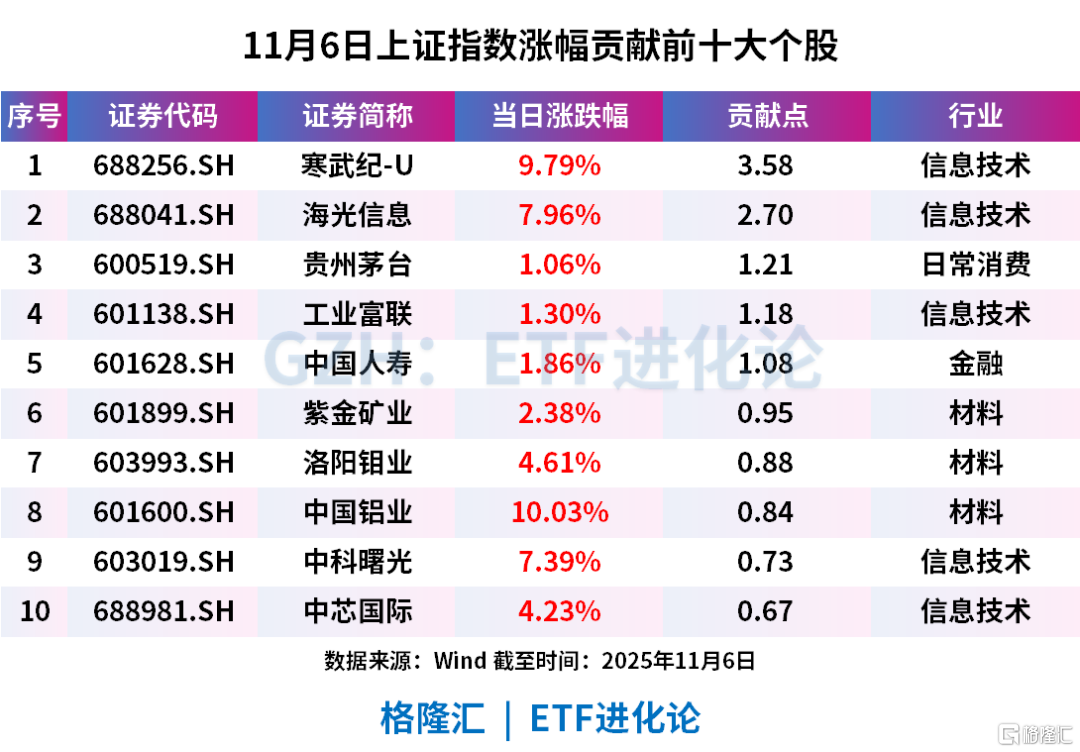
Core Viewpoint - The A-share market has returned to the 4000-point level, driven by significant gains in the semiconductor sector, particularly by companies like Cambrian and Haiguang Information, which have led to substantial increases in related ETFs [1][4]. Semiconductor Industry Performance - The semiconductor sector has experienced a broad-based surge, contributing over 40% to the Shanghai Composite Index, with key ETFs like E Fund Semiconductor Equipment ETF and STAR 50 ETF rising by 3.84% and 3.39% respectively [4]. - The semiconductor sector's rebound is attributed to several factors, including a significant short-term correction of 9%-10% since October 14, creating a demand for a rebound [4]. - The ongoing dynamics in the semiconductor industry, particularly the continuous price increases in memory chips, have fueled this surge [5][6]. Price Increases in Memory Chips - Following price hikes by major players like Samsung and SK Hynix, the prices of storage products, including DRAM and NAND, have been raised again, with HBM4 prices increasing by 50% compared to previous generations [6][7]. - The demand for storage chips from AI servers is reportedly eight times that of regular servers, leading to a supply-demand imbalance that is driving the current price increase cycle [9]. Financial Performance of Semiconductor Companies - Recent earnings reports from U.S. semiconductor companies, such as Arm and Qualcomm, have confirmed the industry's high growth potential, with Arm's second-quarter results exceeding analyst expectations and Qualcomm reporting a 10% year-over-year revenue increase [11]. Capital Movements in the Semiconductor Sector - Domestic semiconductor companies are actively pursuing capital operations, with IPO processes for firms like Muxi and Moore Threads advancing rapidly, and strategic investments from national funds being secured [12]. ETF Inflows and Market Trends - The E Fund Semiconductor Equipment ETF has seen a net inflow of 172 million yuan over the past 20 days, focusing on key areas of semiconductor equipment and materials, which are crucial for domestic substitution [12]. - The STAR 50 ETF, which tracks the STAR 50 Index with a 65.5% weight in semiconductors, has also attracted significant capital inflows, indicating strong investor interest in leading companies in the sector [14]. MSCI Index Adjustments - MSCI has announced the inclusion of 17 A-shares in its China Index, reflecting a net increase in stocks for the first time since February 2024, with many of the newly included stocks belonging to high-tech sectors such as semiconductors and AI [18].