三星

Search documents
亚太精选ETF南方(159687)盘中涨近3% 亚太股市迎来最强年度开局 亚洲领跑全球AI竞赛
智通财经网· 2026-01-12 03:03
Group 1 - The core viewpoint of the article highlights the strong performance of the Asia-Pacific stock market, with major indices in Japan and South Korea reaching record highs, driven by improved global liquidity expectations and favorable regional economic growth prospects [1] - The Asia-Pacific stock market's strength reflects a re-evaluation of the value of the region's innovations and upgrades in frontier industries such as artificial intelligence, high-end manufacturing, and biotechnology [1] - Citigroup notes that global long-term investors are continuously increasing their holdings in Asian technology stocks due to their significant role in the semiconductor supply chain and potential for profit growth [1] Group 2 - The Southern Fund's Asia-Pacific Select ETF (159687) is the only ETF tracking the Asia-Pacific Select Index, covering 11 countries and regions in the Asia-Pacific [1] - This ETF includes high-quality dividend assets from the Asia-Pacific region, such as Toyota, Tencent, Alibaba, and Mitsubishi Group, as well as leading semiconductor companies like TSMC, Samsung, Tokyo Electron, and MediaTek [1]
离谱!印度强要手机厂商核心源代码,全球巨头就差直接骂人了。网友:这是要明抢啊
程序员的那些事· 2026-01-12 02:58
Core Viewpoint - The Indian government is pressuring Apple to provide the source code of iOS as part of a new security standard proposal, which is unlikely to be realized due to strong opposition from major tech companies [1][3]. Group 1: Government Proposal - The Indian government is preparing a new security standard plan that includes 83 items across various fields [3]. - The proposal requires tech companies to notify the government of major updates, retain security audit logs for 12 months, regularly prompt users to review permissions, and submit source code to government-designated labs for testing and vulnerability assessment [3]. Group 2: Industry Response - Major companies like Apple, Samsung, Google, and Xiaomi have collectively opposed the new regulations, arguing that source code is a core business secret and its disclosure could jeopardize technological security [4]. - The Indian industry organization MAIT has directly opposed the requirements, stating that they are impractical and has requested the government to withdraw the proposal [4]. - Concerns have been raised regarding the 12-month log storage and mandatory malware scanning, which could either consume phone storage or significantly drain battery life [4].





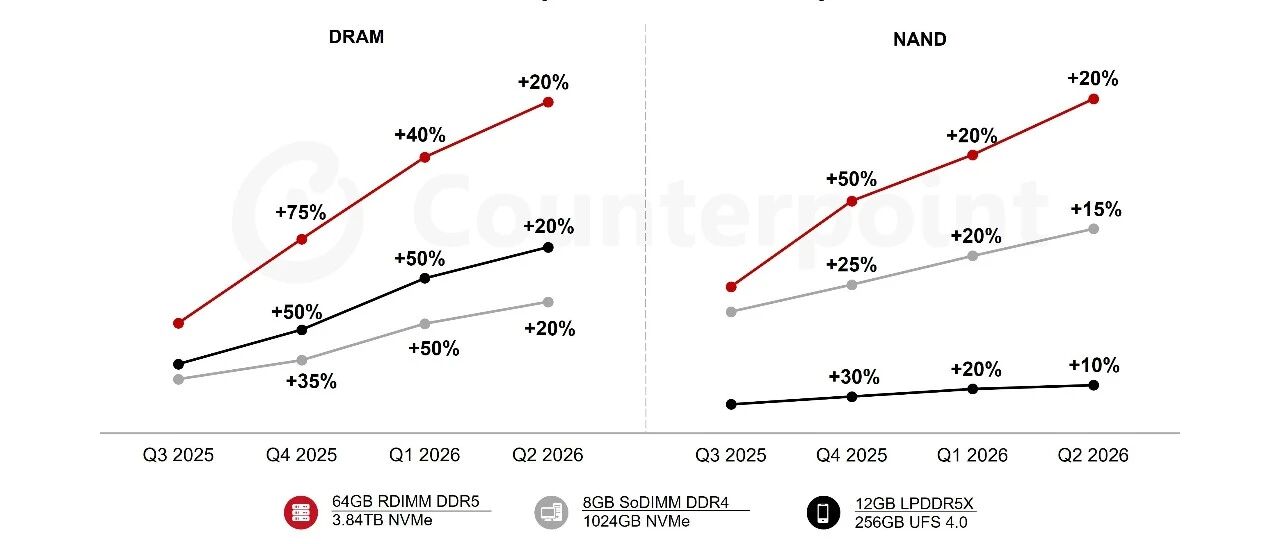
存储价格飙升 50%涨势将延续至 2026 年
Counterpoint Research· 2026-01-12 02:45
Core Viewpoint - The storage market has entered a "super bull market" phase, surpassing historical highs from 2018, driven by the increasing demand for AI and server capacity. Supplier bargaining power has reached an all-time high, with storage prices expected to rise significantly in the coming years [4]. Price Trends - The price of 64GB RDIMM storage has surged from $255 in Q3 2025 to $450 in Q4 2025, with expectations to further increase to $700 by March 2026. A price point of $1,000 (approximately $1.95/Gb) within this year is plausible, nearly double the 2018 peak of $1.00/Gb [5]. Cost Structure Changes - The ongoing rise in storage prices is fundamentally altering the Bill of Materials (BoM) for hardware manufacturers. Although capital expenditures are increasing, the supply-demand gap remains, with DRAM production expected to grow by 24% year-on-year in 2026 [6]. Smartphone Impact - By 2025, storage will account for over 10% of the BoM in the iPhone 17 Pro Max, up from about 8% in the iPhone 12 Pro Max in 2020. For flagship models with 16GB–24GB LPDDR5X memory and 512GB–1TB UFS 4.0 storage, the storage cost may exceed 20% of the BoM due to current price increases. The supply of older technologies like LPDDR4 and eMMC is rapidly shrinking as leading manufacturers shift production to more profitable server DDR5 storage [10].
端侧AI近况如何-有哪些投资机会
2026-01-12 01:41
Summary of Key Points from the Conference Call Industry Overview: Edge AI Market - **Increased Attention on Edge AI**: Since Apple introduced the Apple Intelligence project in 2024, the market's focus on edge AI has been rising, with advancements in large models and computing power laying the groundwork for AI applications by 2026 [1][2]. - **Maturity of AI Hardware**: Edge AI hardware forms, such as AI glasses and toys, have matured, with wearable devices increasingly capturing consumer interest. At CES 2026, AI interaction features became standard in consumer electronics and home products [1][2]. - **Policy Support**: National subsidy policies now include wearable devices like smartwatches, expected to drive growth by approximately 20% year-on-year. The inclusion of Rokid glasses in a procurement project for the disabled indicates demand stimulation through targeted promotions [1][4]. Key Drivers of Investment Opportunities - **Computing Power Upgrades**: The maturity of technology and models, alongside a competitive arms race in computing facilities, is making conditions for AI application deployment more favorable by 2026 [2]. - **Hardware Iteration**: The current maturity of edge AI hardware, particularly in wearables, is seen as a catalyst for growth. Despite skepticism about blockbuster products in 2025, devices like Rokid AI glasses are gaining traction among consumers [2]. - **Resilience of Edge AI**: In the face of rising storage costs, wearable devices are less affected compared to traditional consumer electronics, which are more vulnerable to cyclical fluctuations. The edge AI market remains in a high-growth phase with significant supply chain premium potential [1][4]. Product Launch and Shipment Forecasts - **AI Glasses Shipment Projections**: Meta anticipates shipping between 20 to 25 million units of AI glasses by 2027, while other brands like Thunder and Roku expect shipments of 300,000 to 500,000 units. Total shipments across all brands are projected to approach 3 million units by 2027, representing significant growth compared to 2025 [3][7]. - **Product Release Schedule**: Meta plans to launch three new products in 2026 and a new brand of AI glasses in 2027. Samsung and Huawei are expected to release new products by the end of Q1 or early Q2 2026, while Xiaomi may iterate its first-generation product this year [5][6]. Investment Recommendations - **Top Investment Picks**: GoerTek is highlighted as a leading company in the AI glasses market, expected to benefit significantly from market growth. Other recommended companies include Luxshare Precision, Lianyi Manufacturing, Lens Technology, Yutong Optical, Changying Precision, and Longqi Technology, all of which have promising market prospects [8]. SOC Sector Insights - **Investment Value of SOC Sector**: The SOC sector is viewed as having high potential due to the anticipated shift from cloud to edge computing over the next two to three years. SOC components represent the highest cost proportion in edge devices, with Chinese A-share SOC companies showing strong market share potential [9]. - **Volume-Price Dynamics**: The SOC sector is driven by new product cycles and flagship product releases, which are expected to enhance average selling prices (ASP). For instance, AI-enabled chips are projected to increase in price from $2 to $4 [10][11]. - **Inventory Adjustments**: Following a chip shortage in late 2021, inventory levels have normalized by early 2024, positively impacting earnings per share (EPS) for companies like Rockchip and Hengxuan, which saw stock prices rise by 30-40% during high inventory periods [12]. Future Outlook for SOC Industry - **Growth Projections**: The period from 2026 to 2027 is expected to see rapid growth in flagship products from leading companies, driven by national subsidy policies and the explosion of new AI products. The current low market expectations for the SOC sector suggest significant upside potential once market conditions improve [13].


芯片行业,再破纪录
半导体行业观察· 2026-01-12 01:31
Core Viewpoint - The global semiconductor market is experiencing a significant growth phase driven by AI, with sales reaching a historical high of $75.3 billion in November 2025, marking a month-over-month increase of 3.5% and a year-over-year increase of 29.8% [1][4]. Group 1: Regional Performance - The Asia-Pacific region is the strongest growth driver, with a year-over-year increase of 66.1% and a month-over-month increase of 5%, reflecting full manufacturing capacity and ongoing supply chain restructuring [2][3]. - The Americas market shows a year-over-year increase of 23% and a month-over-month increase of 3%, driven by strong demand for AI computing power and data center investments [1][3]. - The Chinese mainland market maintains steady growth with a year-over-year increase of 22.9% and a month-over-month increase of 3.9% [1][2]. - The European market experiences moderate growth with an 11.1% year-over-year increase and a 1.2% month-over-month increase [2]. - Japan is the only major market showing a decline, with a year-over-year decrease of 8.9% and a month-over-month decrease of 0.1%, attributed to weak demand in consumer electronics and automotive sectors [1][3]. Group 2: Market Dynamics - The growth in semiconductor sales is not driven by a single product line but rather by a synchronized expansion across all major semiconductor categories, indicating a long-term expansion phase centered around AI [1][3]. - Logic chips benefit from increased demand for AI training and inference, while high-bandwidth memory (HBM) faces supply constraints, driving up prices and shipment volumes [3][4]. - The automotive sector is seeing a significant increase in semiconductor usage due to the electrification trend, marking a new growth curve for the industry [9]. Group 3: Future Projections - The World Semiconductor Trade Statistics (WSTS) forecasts global semiconductor sales to reach $975.4 billion by 2026, representing a year-over-year increase of 22.5% [5]. - The long-term growth of the semiconductor industry is driven by five core dynamics: ongoing AI computing arms race, sustained capital expenditure in data centers, structural high margins from HBM supply constraints, recovery in consumer electronics, and the rise of automotive intelligence [5][6][7][8][9]. Group 4: Key Beneficiaries and Challenges - Key beneficiaries include NVIDIA, TSMC, Samsung, SK Hynix, and Broadcom, which are positioned to capitalize on the growing demand for AI and advanced semiconductor technologies [10]. - Companies like Intel and Micron face challenges due to ongoing transitions and slower competitive positioning in the HBM market, while Japanese semiconductor firms struggle with weak end-demand [10].


美光:存储将缺到2028
半导体行业观察· 2026-01-12 01:31
Core Viewpoint - Micron is a leading memory manufacturer facing a significant demand surge in DRAM memory due to the rise of artificial intelligence, which has led to a supply shortage affecting both consumer and data center markets [1][2][3]. Group 1: Market Dynamics - The Total Addressable Market (TAM) for data centers is rapidly expanding, with the potential market size increasing from 30%-35% to 50%-60%, indicating a substantial demand for memory products [2]. - Micron's OEM consumer channel plays a crucial role in its market share, supplying major PC brands like Dell and Asus, which helps maintain its presence in the consumer market despite the exit from the "Crucial" brand [2][3]. - The current supply shortage is not solely a Micron issue but a broader industry challenge, with all manufacturers struggling to meet the increasing demand across various segments [3]. Group 2: Production Challenges - The sudden spike in DRAM demand has made it difficult for Micron to adjust its supply chain effectively, leading to production constraints [5]. - Capacity expansion is complex and involves more than just adding new machines; it requires addressing the differentiation in memory module capacities, which complicates production efficiency [5][6]. - Micron is working to stabilize demand and production by reducing the variety of chips produced, which is essential for maximizing output [6]. Group 3: Future Outlook - Micron's factory expansion plans are expected to yield significant results only by 2028 due to the lengthy process of construction, customer certification, and technology validation [7][8]. - The memory shortage is likely to persist until the demand from the AI sector begins to decline, as manufacturers are cautious about rapidly increasing production capacity due to past market volatility [9][11]. - The competitive landscape is evolving, with Chinese memory suppliers potentially filling market gaps, but Micron welcomes competition as it drives improvement and innovation [8][9]. Group 4: Financial Implications - The current memory shortage has led to increased prices, significantly boosting revenues and profits for memory manufacturers like Micron, which reported record quarterly earnings [11][14]. - Analysts predict that high prices for memory chips and hard drives will continue to support the market's elevated value, although the industry remains wary of cyclical downturns [14][18]. - Major tech companies are driving capital expenditures to unprecedented levels, which could sustain the demand for memory products for several years [15].

封测涨价潮,开启
半导体行业观察· 2026-01-12 01:31
Core Viewpoint - The memory chip shortage is driving significant price increases in the packaging and testing sector, with major players like Powertech Technology, ASE Technology, and Nanya Technology seeing a surge in orders and capacity utilization nearing full capacity, leading to price hikes of up to 30% [1][2] Group 1: Market Dynamics - The demand for DDR4, DDR5, and NAND chips is strong due to the recovery in cloud and industrial control sectors, further boosting the backend testing demand [2] - Major memory packaging and testing companies in Taiwan, including Powertech, Nanya, and ASE, are experiencing high capacity utilization rates, prompting them to raise prices [2] - The potential for a second wave of price increases exists, depending on supply and demand conditions [2] Group 2: Company Performance - Powertech is the leading global provider of DRAM and NAND chip packaging, with nearly full capacity utilization in both segments, which is expected to positively impact its gross margin and profitability [2] - ASE Technology focuses on niche memory packaging and has seen a recovery in orders from industrial control clients, indicating a return to normal demand levels [2] - Nanya Technology is benefiting from the recovery in the traditional DRAM market, with DDR4 products accounting for 70-80% of its revenue, which is crucial for its operational performance [2]

中泰期货晨会纪要-20260112
Zhong Tai Qi Huo· 2026-01-12 01:27
1. Report Industry Investment Rating No relevant content provided. 2. Core Viewpoints of the Report - A-share market showed a strong upward trend on Friday, with the Shanghai Composite Index achieving 16 consecutive positive days and breaking through the 4100-point mark. The market turnover exceeded 3.1 trillion yuan, indicating a high level of market activity. The overall economic climate in China is improving, with the CPI and PPI showing positive trends, and the PMI indices rising above the expansion range [15]. - Different commodity futures have various trends and investment suggestions. For example, in the black sector, it is expected to be in a short - term shock and medium - long - term bottom - building state; in the agricultural product sector, different products such as cotton, sugar, and eggs have their own supply - demand situations and price trends [18][32]. 3. Summary by Relevant Catalogs 3.1 Macro Information - The State Council's Anti - monopoly and Anti - unfair Competition Committee Office will investigate and evaluate the market competition in the food delivery platform service industry. Meituan, Taobao Flash Delivery, and JD Delivery will cooperate actively [8]. - China declared multiple satellite constellation plans to the ITU in the last week of 2025, with a total scale of over 200,000 satellites [8]. - The Fed's interest rate cut expectation in January 2026 is completely dashed. The US non - farm payrolls data in December 2025 was lower than expected, but the unemployment rate decreased, reducing the possibility of an interest rate cut [8]. - The State Council executive meeting deployed a package of fiscal and financial policies to promote domestic demand, including loan discount policies and risk - sharing mechanisms [9]. - In December 2025, China's CPI and core CPI increased year - on - year, and the PPI decline narrowed. The CPI and PPI both increased month - on - month [9]. - The regulatory authorities have issued new policy guidance on real estate financing, allowing loans for projects on the "white list" to be extended for up to 5 years [9]. - China has made a major breakthrough in the extraction and separation technology of salt lake lithium resources, improving the lithium ion recovery rate and reducing costs and energy consumption [9]. - DeepSeek plans to launch a new flagship AI model V4 around the Chinese New Year in mid - February, which shows better performance in code generation than existing mainstream models [10]. - The AGI - Next Frontier Summit believes that the competition in large models has shifted from the "Chat" to the "Agent" stage [10]. - Fund companies and sales institutions have received a notice on the implementation of regulations on the sales fees of publicly offered securities investment funds, with three key points attracting attention [10]. - The price of storage chips has skyrocketed, and tech giants are competing for DRAM supplies. The price of 8GB DDR4 memory has increased by more than 5 times in a year [11]. - The US Supreme Court has not made a ruling on Trump's tariffs, and the next announcement is on January 14. The government is prepared to re - implement tariffs if necessary [11]. - Trump has cancelled the second wave of military strikes against Venezuela, maintained the deployment of US ships, and plans to buy $200 billion in mortgage - backed securities to lower mortgage rates [11]. - Trump has called for setting a 10% cap on credit card interest rates for one year starting from January 20, but the feasibility is uncertain [12]. - Trump discussed with oil company executives how to rebuild Venezuela's oil industry and announced that the US will start refining and selling up to 50 million barrels of Venezuelan oil [12]. 3.2 Macro Finance 3.2.1 Stock Index Futures - The strategy is to consider following the trend, but be cautious about chasing highs due to the recent large short - term gains. The A - share market has been rising strongly, and the economic climate is improving, with the stock index breaking through the previous shock platform [14][15]. 3.2.2 Treasury Bond Futures - The strategy is to flatten the yield curve. The money market is balanced, and the bond market sentiment has declined. The central bank's monetary policy shows a retreat trend, and fiscal subsidy policies for consumption have been announced [16]. 3.3 Black Sector 3.3.1 Spiral Steel Rebar and Iron Ore - From a policy perspective, there is no new demand - side policy, and the supply - side policy interference for the steel industry is low, which is relatively negative for finished products and steel mill profits. - Fundamentally, the steel demand is under seasonal pressure, and the supply is relatively stable with low profits. The inventory has started to accumulate, and in the short - term, it is expected to fluctuate and be in a medium - long - term bottom - building state [18]. 3.3.2 Coking Coal and Coke - The prices of coking coal and coke may fluctuate and rise in the short term. The supply side of coal has disturbances, and the downstream demand support has declined. The potential negative feedback risk still restricts the price increase, and the rebound space may be limited [20]. 3.3.3 Ferroalloys - The fundamentals of ferrosilicon and silicomanganese are still bearish, but the cost side may have a phased positive impact. It is recommended to control positions, hold short positions in silicomanganese at high levels, and temporarily observe ferrosilicon [21]. 3.3.4 Soda Ash and Glass - For soda ash, it is advisable to wait and see. The supply is at a high level, and attention should be paid to new production capacity and cost - side expectations. - For glass, a long - holding strategy or partial profit - taking at high prices can be considered. The market sentiment has been boosted, and attention should be paid to cold repair and downstream purchasing sentiment [22]. 3.4 Non - ferrous Metals and New Materials 3.4.1 Shanghai Zinc - Domestic zinc inventories are increasing, and the supply is expected to increase slightly in January. The demand is still resilient but is expected to weaken compared to December. It is recommended to wait and see, and aggressive investors can short at high prices [24][25]. 3.4.2 Shanghai Lead - The fundamentals of lead are weak, with low downstream demand. Although the lead price may rebound before delivery, there is still a risk of inventory accumulation dragging down the price. It is recommended to hold previous short positions [26]. 3.4.3 Lithium Carbonate - The short - term fundamentals show signs of weakening, but the production resumption expectation is reduced due to mine disruptions. The long - term demand is positive, and it is expected to fluctuate at a high level in the short term [27]. 3.4.4 Industrial Silicon - The downstream demand has phased policy - driven support for export rush. The previous oversupply expectation needs time to verify the turn, and the disk is expected to fluctuate strongly but is still under upward pressure [28]. 3.4.5 Polysilicon - It is possible to try to buy at low prices with cautious positions. The market is worried about changes in the industrial pattern after the regulatory meeting, and the export tax - rebate cancellation policy may drive an export rush in the first quarter [28][29]. 3.5 Agricultural Products 3.5.1 Cotton - The short - term supply is loose, but the long - term supply is expected to shrink. The contradiction between pre - festival restocking and declining开工 leads to a short - term downward trend. Attention should be paid to the USDA report and the next target price subsidy policy [32][33]. 3.5.2 Sugar - The domestic sugar market is in a season of both strong supply and demand. The price is under pressure but also supported, and it is recommended to conduct short - term trading in the low - price range. The global sugar market still faces an oversupply situation [34][35]. 3.5.3 Eggs - The 02 - 03 contracts of eggs are currently at a discount to the spot price and are driven by the short - term strength of the spot market. However, as the inventory of laying hens is still high and the post - holiday demand may decline, the upside space is limited. The futures contracts are in a near - strong and far - weak contango pattern [36]. 3.5.4 Apples - The supply side has the characteristics of "less quantity and poor quality" and low inventory, while the demand side is weak. The price is expected to fluctuate within a range, and high - quality products may remain stable. The market may show a strong trend if the demand decline is controlled during the Spring Festival [37]. 3.5.5 Corn - The short - term price is expected to fluctuate strongly. The key to the price trend lies in the change of farmers' selling sentiment. Although there are some negative factors, the probability of a "panic selling" before the Spring Festival is low. Attention should be paid to the selling situation in March [38]. 3.5.6 Red Dates - The current market is in an oversupply situation, and the price lacks upward momentum. It is expected to fluctuate in the short term, and attention should be paid to the sales situation during the consumption peak season [39]. 3.5.7 Live Pigs - The consumption in the first half of January lacks significant improvement. It is expected that large - scale enterprises will resume slaughter in the middle of the month, and the spot price may decline. The main futures contract should be shorted at high prices [39][40]. 3.6 Energy and Chemicals 3.6.1 Crude Oil - Venezuela is expected to resume oil exports, but the geopolitical situation in Iran has heated up again, bringing support to oil prices. Although the fundamentals show an oversupply situation, the geopolitical premium still exists [43]. 3.6.2 Fuel Oil - The price of fuel oil is mainly driven by geopolitical and macro factors and will follow the trend of crude oil prices. The supply - demand relationship has improved marginally, and the focus is on the Iranian situation and the potential substitution role of fuel oil [44]. 3.6.3 Plastics - The supply pressure of polyolefins is large, and the downstream demand is weak. Although the upstream production enterprises are suffering losses, which may provide some support, there is no strong upward - driving force. It is recommended to adopt a shock - trading strategy and beware of回调 risks [44][45]. 3.6.4 Rubber - The short - term international macro environment and trading system may increase capital participation, but the lack of obvious supply - demand contradictions may limit the upward space. It is expected to fluctuate, and short - long opportunities during回调 can be considered [45]. 3.6.5 Synthetic Rubber - The short - term sentiment fluctuates significantly. It is advisable to wait and see if there are no positions. The price is under pressure due to the decline of downstream products and poor high - price transactions [46][47]. 3.6.6 Methanol - The current supply - demand situation of methanol has improved slightly, but the inventory is still relatively high, and there is a possibility of further accumulation at the end of the month. In the long term, the fundamentals are improving, and long positions in far - month contracts can be gradually considered [48]. 3.6.7 Caustic Soda - The caustic soda market follows the general trend of the commodity futures market and has weak fundamentals. The cost has decreased, and the futures price should be treated with a wide - range shock strategy [49]. 3.6.8 Asphalt - The short - term price fluctuation of asphalt may increase due to raw material factors. The future focus is on the price bottom after the winter storage game. The price of asphalt has stabilized after the increase [49][50]. 3.6.9 Polyester Industry Chain - In the short term, the price will fluctuate with the cost. PX and PTA 5 - 9 inter - month positive spreads can be considered. The supply - demand relationship of each product in the polyester chain shows different trends, and the overall rebound height is restricted by the terminal negative feedback [51]. 3.6.10 Liquefied Petroleum Gas (LPG) - Affected by the Iranian geopolitical conflict, the price of LPG has increased. The import cost provides support, and the demand is in the peak season. It still has some rebound momentum, but it is recommended to wait and see and not chase the rise [52][53]. 3.6.11 Pulp - The spot market trading sentiment is weakening, and the disk faces hedging pressure. However, the fundamentals are stable, and the external market price is strong, providing support for the domestic price. It is recommended to wait and see [54]. 3.6.12 Logs - The fundamentals are weakly bearish, and the spot price has temporarily stabilized. The market is expected to maintain a weak supply - demand balance, and the disk is expected to fluctuate [55]. 3.6.13 Urea - The coal price has increased, and the spot market trading of urea has weakened. After the price reduction, the trading of some factories is acceptable. The futures price maintains a shock trend [56].
“非洲神话”褪色:传音控股闯关A+H,能否突围增长瓶颈?
Xin Lang Cai Jing· 2026-01-12 01:18
Core Viewpoint - Transsion Holdings, a prominent player in the mobile phone market, is facing significant challenges as its performance declines despite its strong market presence in emerging regions, particularly Africa. The company is attempting to pivot towards new growth areas, including AI and IoT, but its traditional business model is under pressure from increasing competition and market saturation [3][4][10]. Group 1: Financial Performance - For the first three quarters of 2025, Transsion Holdings reported a 3.33% year-on-year decline in revenue to 49.543 billion yuan, with net profit plummeting by 44.97% to 2.148 billion yuan [4][25]. - The company's gross margin fell to 19.47% by the end of September 2025, a decrease of nearly 5 percentage points from the beginning of 2024 [4][25]. - The average selling price of smartphones decreased slightly from 551.4 yuan per unit in 2022 to 547.5 yuan in 2025, while feature phones dropped from 65.5 yuan to 50.1 yuan [6][27]. Group 2: Market Position and Competition - Transsion Holdings has maintained its position as the leading mobile phone vendor in Africa for seven consecutive years, with a market share of 61.5% [3][24]. - However, the company's market share in Africa has declined to 51% by September 2025, down over 10 percentage points from earlier in the year, as competitors like Xiaomi and Honor gain ground [11][33]. - The company is attempting to replicate its successful "African model" in other emerging markets, but this strategy has not yet yielded significant growth, with revenue declines reported across new markets [13][34]. Group 3: Strategic Shifts and Future Outlook - Transsion Holdings is focusing on transitioning towards AI technology and IoT ecosystem development, as indicated by its upcoming IPO plans [16][37]. - Despite having a large user base of 270 million monthly active users for its proprietary operating system, the monetization of this user base remains low, with internet service revenue at only 4.17 billion yuan, averaging 1.54 yuan per user [38][39]. - The company is diversifying into new hardware categories, including laptops and electric vehicles, but these segments currently contribute minimally to overall revenue [19][40].


不卷影像卷形态,CES2026「奇葩」手机盘点:同质化当下的「非主流」答卷
3 6 Ke· 2026-01-12 00:44
Core Insights - CES 2026 showcased innovative mobile devices that diverge from mainstream trends, emphasizing unique features and designs rather than traditional specifications [1][28]. Group 1: Unique Mobile Devices - Honor ROBOT PHONE features a large camera deco and a foldable camera capable of automatic composition and target tracking, addressing user pain points in action photography [3][4][6]. - Clicks Communicator resembles early BlackBerry phones with a physical keyboard and small screen, targeting niche users as a secondary device rather than a primary smartphone [8][10][12]. - iKKO MindOne presents a unique design with a square body and a nearly 1:1 screen ratio, offering features like AI assistance but lacking mainstream appeal [13][14][17]. Group 2: Innovative Display Technologies - Samsung introduced a new foldable OLED screen without visible creases, potentially setting a new standard for future devices, including Apple's upcoming iPhone Fold [18][20]. - TCL NXTPAPER 70 Pro features a custom LCD screen designed for eye comfort, catering to users who prefer LCD over OLED, and includes a focus mode to minimize distractions [21][23]. Group 3: Privacy-Centric Devices - Punkt MC03 emphasizes privacy by isolating applications into "trusted" and "open" environments, though this may compromise user convenience [25][27].