格力电器

Search documents
迈点研究院:2025年中国住房租赁项目运营分析报告
Sou Hu Cai Jing· 2025-11-24 11:45
Core Insights - The report analyzes the current state, characteristics, and trends of China's housing rental market, indicating a stable market size and continuous structural optimization [1] - The rental population in China has reached 260 million, with new citizens and young renters making up nearly 200 million, becoming the core demand group [1][10] - State-owned brands dominate the market, accounting for 64% of national projects and 55% of benchmark projects, serving as a stabilizing force in the industry [1][12] - New first-tier cities represent 45% of the market, followed by first-tier cities at 25% and second-tier cities at 24%, with cities like Shanghai, Hefei, and Hangzhou emerging as rental hotspots [1][17] Project Overview - Large-scale projects are favored, with projects containing over 500 units making up 48% of the market; many state-owned projects exceed 2,000 units [2][30] - The average age of renters has risen to 34.1 years, with those aged 30-39 constituting 38% of the rental market; an increase in family-type renters has led to a rise in the supply of larger units [2][31] - Rental prices show the highest premium from one-bedroom to two-bedroom units, reaching 43.7%, with new first-tier cities balancing rental costs and development [2][38] Project Configuration - The concentration of appliance brands is high, with Midea leading in categories like air conditioning and refrigerators, while the market for bathroom and bedding brands remains fragmented [2][32] - Future housing rental projects need to optimize from multiple aspects, including precise segmentation of target groups and dynamic unit configurations [2][50] Market Trends - The report highlights the need for differentiated supply and dynamic pricing strategies to shorten the ramp-up period for projects [2][50] - Customer loyalty can be enhanced through improved service and community systems, alongside cost control measures [2][50] Rental Market Performance - 64% of projects maintain a rental rate between 90%-100%, with talent apartments achieving the highest rental rate of 92% and a renewal rate of 77% [2][48] - The average renewal rate across projects is above the industry average, with 86% of projects having a renewal rate exceeding 50% [2][49] - The ramp-up period for projects remains stable, with nearly 80% of projects maintaining a ramp-up period of less than six months [2][52]


家电行业周报(25年第47周):10月家电内外销表现承压,12月空调出口排产降幅收窄-20251124
Guoxin Securities· 2025-11-24 09:33
Investment Rating - The report maintains an "Outperform the Market" rating for the home appliance industry [6][7][14]. Core Views - The home appliance industry is experiencing pressure on both domestic and international sales due to high base effects, with October retail sales down 15% year-on-year. White goods and black goods are expected to see retail sales declines exceeding 20%, while small appliances are performing slightly better [2][3][19]. - In October, the total sales volume of air conditioners in China decreased by 20.1%, with domestic sales down 21.3% and exports down 19.0%. The pressure on production for December remains significant, although export production is expected to improve as the peak season approaches [4][45]. - The report highlights a 13.3% year-on-year decline in home appliance export value in October, with washing machines and vacuum cleaners showing stable performance. The export value of air conditioners fell by 29.3% [5][47]. Summary by Sections 1. Investment Recommendations - Recommended companies include Midea Group, Haier Smart Home, TCL Smart Home, Gree Electric, and Hisense Home Appliances for white goods; Hisense Visual for black goods; and Roborock, Bear Electric, and Ecovacs for small appliances [6][14][15]. 2. Market Performance - The home appliance sector achieved a relative return of +1.47% this week, while the broader market (CSI 300 Index) declined by 3.77% [60]. 3. Retail Demand Analysis - In October, retail sales of home appliances faced significant declines, with major categories like air conditioners, refrigerators, and washing machines experiencing drops of over 20% in retail value [3][20][19]. 4. Export Performance - The report notes a continued decline in home appliance exports, with a significant drop in air conditioner exports and stable performance in washing machines and vacuum cleaners [5][47]. 5. Production Insights - December air conditioner production is under pressure, with domestic production expected to decline by 22.6% year-on-year, while export production is projected to decrease by 8.2% [4][45]. 6. Key Data Tracking - The report tracks key data such as raw material prices, shipping indices, and real estate performance, indicating ongoing challenges in the market [60][62][76].






白色家电板块11月24日跌0.18%,TCL智家领跌,主力资金净流入4.23亿元
Zheng Xing Xing Ye Ri Bao· 2025-11-24 09:02
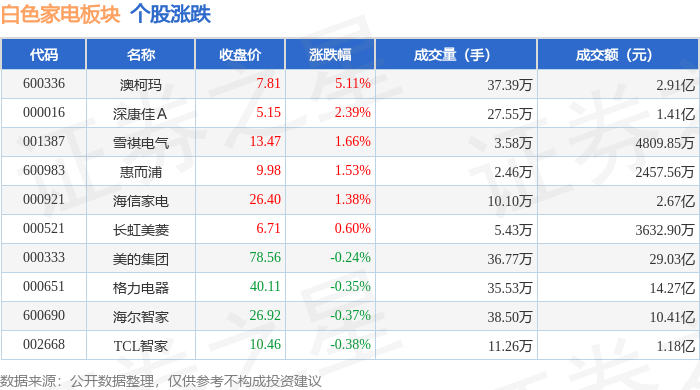
Market Overview - The white goods sector experienced a decline of 0.18% on November 24, with TCL leading the drop [1] - The Shanghai Composite Index closed at 3836.77, up 0.05%, while the Shenzhen Component Index closed at 12585.08, up 0.37% [1] Stock Performance - Notable gainers in the white goods sector included: - Aokema (600336) with a closing price of 7.81, up 5.11% and a trading volume of 373,900 shares, totaling 291 million yuan [1] - Deep Blue Technology (000016) closed at 5.15, up 2.39% with a trading volume of 275,500 shares [1] - Major decliners included: - Midea Group (000333) closed at 78.56, down 0.24% with a trading volume of 367,700 shares, totaling 2.903 billion yuan [1] - Gree Electric (000651) closed at 40.11, down 0.35% with a trading volume of 355,300 shares, totaling 1.427 billion yuan [1] Capital Flow - The white goods sector saw a net inflow of 423 million yuan from institutional investors, while retail investors experienced a net outflow of 271 million yuan [1] - Detailed capital flow for selected companies: - Midea Group had a net inflow of 34.3 million yuan from institutional investors, but a net outflow of 217 million yuan from retail investors [2] - Haier Smart Home (600690) recorded a net inflow of 42.8 million yuan from institutional investors and a net outflow of 72.9 million yuan from retail investors [2] - TCL Smart Home (002668) had a minor net inflow of 1.64 million yuan from institutional investors, with retail investors showing a net outflow of 1.06 million yuan [2]


家电行业周报(25 年第47 周):10 月家电内外销表现承压,12 月空调出口排产降幅收窄-20251124
Guoxin Securities· 2025-11-24 08:01
Investment Rating - The report maintains an "Outperform the Market" rating for the home appliance industry [6][7][14]. Core Views - The home appliance industry is experiencing pressure on both domestic and export sales due to high base effects, with October retail sales down 15% and exports down 13% [2][5][19]. - The small appliance segment is performing slightly better compared to larger appliances, with a smaller decline in sales [3][20]. - Air conditioning sales saw a significant drop of 20% in October, with production pressures continuing into December [4][45]. - Despite the challenges, leading companies in the industry are expected to maintain resilience and profitability due to ongoing cost reduction and efficiency improvements [14][15]. Summary by Sections 1. Investment Recommendations - Recommended companies include Midea Group, Haier Smart Home, TCL Smart Home, Gree Electric, and Hisense Home Appliances for white goods; Hisense Visual for black goods; and Roborock, Bear Electric, and Ecovacs for small appliances [6][14][15]. 2. Market Performance - In October, the retail sales of home appliances and audio-visual equipment fell by 14.6% year-on-year, while the overall retail sales in China grew by 2.9% [3][20]. - The report notes a relative performance of +1.47% for the home appliance sector compared to the broader market [5][60]. 3. Sales and Production Data - October saw a 20.1% year-on-year decline in total air conditioning sales, with domestic sales down 21.3% and exports down 19% [4][45]. - The report highlights that the export value of home appliances decreased by 13.3% in October, with washing machines and vacuum cleaners showing stable performance [5][47]. 4. Price Tracking - The report tracks raw material prices, noting a decrease in LME copper and aluminum prices by 1.4% and 2.2% respectively [60][62]. - The cold-rolled steel price increased by 1.9% week-on-week [62]. 5. Company Announcements and Industry Dynamics - The report includes updates on company management changes and highlights industry trends, such as the growth of the sweeping robot market led by Ecovacs [78][82].
2025年中国全屋智能行业财务指标分析 行业在发展过程中具备市场扩张的动力【组图】
Qian Zhan Wang· 2025-11-24 06:10
Core Insights - The Chinese whole-home smart industry is experiencing a growth trend in revenue, with a projected revenue of 211.85 billion in 2024, reflecting a growth rate of 10.6% [1] - The industry's sales gross margin shows a fluctuating trend, peaking at 34.8% in 2023 before declining to 33.5% in 2024 [2] - Inventory turnover rates are on a downward trend, decreasing from 5.14 times in 2020 to 4.64 times in 2024, attributed to changing consumer demands and rapid product updates [6] - Accounts receivable turnover rates have also shown a declining trend, from 17.53 times in 2020 to 15.23 times in 2024, indicating increasing management pressure [9] - The asset-liability ratio has fluctuated, decreasing to a low of 42.1% in 2022, then rising to 44.4% in the first half of 2025, reflecting dynamic adjustments in capital structure [11] Revenue Trends - The average revenue of representative companies in the Chinese whole-home smart industry is expected to grow significantly, reaching 211.85 billion in 2024, with a notable increase in the first half of 2025 at 116.69 billion [1] Profitability Analysis - The sales gross margin for the industry has shown volatility, starting at 33.9% in 2020, dropping to 32.2% in 2021, and then rising to 34.8% in 2023 before falling to 33.5% in 2024 [2] Inventory Management - The inventory turnover rate has decreased from 5.14 times in 2020 to 4.64 times in 2024, influenced by diverse consumer preferences and concerns over product depreciation [6] Accounts Receivable Management - The accounts receivable turnover rate has declined from 17.53 times in 2020 to 15.23 times in 2024, reflecting increased challenges in managing receivables [9] Capital Structure - The asset-liability ratio has shown a downward trend to 42.1% in 2022, followed by a rise to 44.4% in the first half of 2025, indicating changes in the industry's capital structure [11]



电子信息制造业投资增速现反弹 大企业对芯片领域投资加大出手
Mei Ri Jing Ji Xin Wen· 2025-11-24 04:09
Group 1 - ZTE has resumed operations after the lifting of restrictions, with all 5G field tests initiated with the three major domestic operators and international tests fully restored, accumulating over 500 million yuan in orders from domestic operators [1] - The Ministry of Industry and Information Technology reported a 14.6% year-on-year increase in fixed asset investment in the electronic information manufacturing industry from January to May, with semiconductor discrete device manufacturing seeing a notable growth of 33.1% [1][5] - The investment growth in the electronic information manufacturing sector has been driven by emerging applications such as automotive electronics, artificial intelligence, and 5G, with communication system equipment and integrated circuit manufacturing also showing strong investment momentum [5][6] Group 2 - The overall investment growth in the electronic information manufacturing industry has declined compared to last year, with a drop from 21% in early 2018 to 14.2% by April, although there was a slight recovery in May [2][4] - The significant increase in investment in the first half of 2017 was attributed to the approval of many large-scale projects, including infrastructure developments, which directly boosted the electronic information manufacturing sector [4] - The decline in investment growth in 2018 is seen as a normal process as the industry transitions towards high-quality development, with traditional manufacturing investment cooling while new information technology sectors are still in their infancy [4][6]


人形机器人产业周报:星动纪元完成近10亿元A+轮融资,Figure02已参与3万辆汽车生产-20251124
Guoyuan Securities· 2025-11-24 03:45
Investment Rating - The report maintains a "Recommended" investment rating for the humanoid robotics industry [7]. Core Insights - The humanoid robotics concept index experienced a decline of 5.68% from November 16 to November 21, 2025, underperforming the CSI 300 index by 1.91 percentage points. However, year-to-date, the humanoid robotics index has increased by 57.83%, outperforming the CSI 300 index by 41.26 percentage points [2][12]. - Notable stock performances include Weichuang Electric with a weekly increase of 18.56%, while Fangyuan Co. saw the largest decline at 21.32% [17]. Summary by Sections Weekly Market Review - The humanoid robotics index fell by 5.68% during the specified week, while year-to-date performance shows a significant increase of 57.83% [12][2]. - Weichuang Electric and Fangyuan Co. had the highest weekly gains and losses, respectively [17]. Weekly Highlights Policy Developments - Hubei's provincial leadership emphasized the need to enhance scene applications, particularly in integrating "Beidou + humanoid robots" and "Beidou + artificial intelligence" [20]. - Chongqing's Economic and Information Technology Commission released a plan to accelerate the application of embodied intelligent robots in enterprise digital transformation projects [21]. Product and Technology Iteration - Figure AI announced that its second-generation humanoid robot, Figure 02, has participated in the production of 30,000 vehicles at BMW's Spartanburg plant, loading over 90,000 components [22]. - UBTECH's annual production capacity for industrial humanoid robots is projected to reach 5,000 units by 2026 [22]. - Diguo Robotics partnered with Fourier to enhance humanoid robots' capabilities in emotional perception and semantic understanding [23]. Investment and Financing - The embodied intelligence company Star Epoch completed nearly 1 billion yuan in Series A+ financing, led by Geely Capital [25]. Key Company Announcements - GAC Group plans to initiate large-scale production of humanoid robots by 2027, aiming for a production value exceeding 1 billion yuan by 2030 [26]. - Gree Electric has developed core components for humanoid robots, including joint modules [27]. - Shengshi Technology is advancing the localization of the NAO robot supply chain and is set to launch the NAO7 model soon [27].
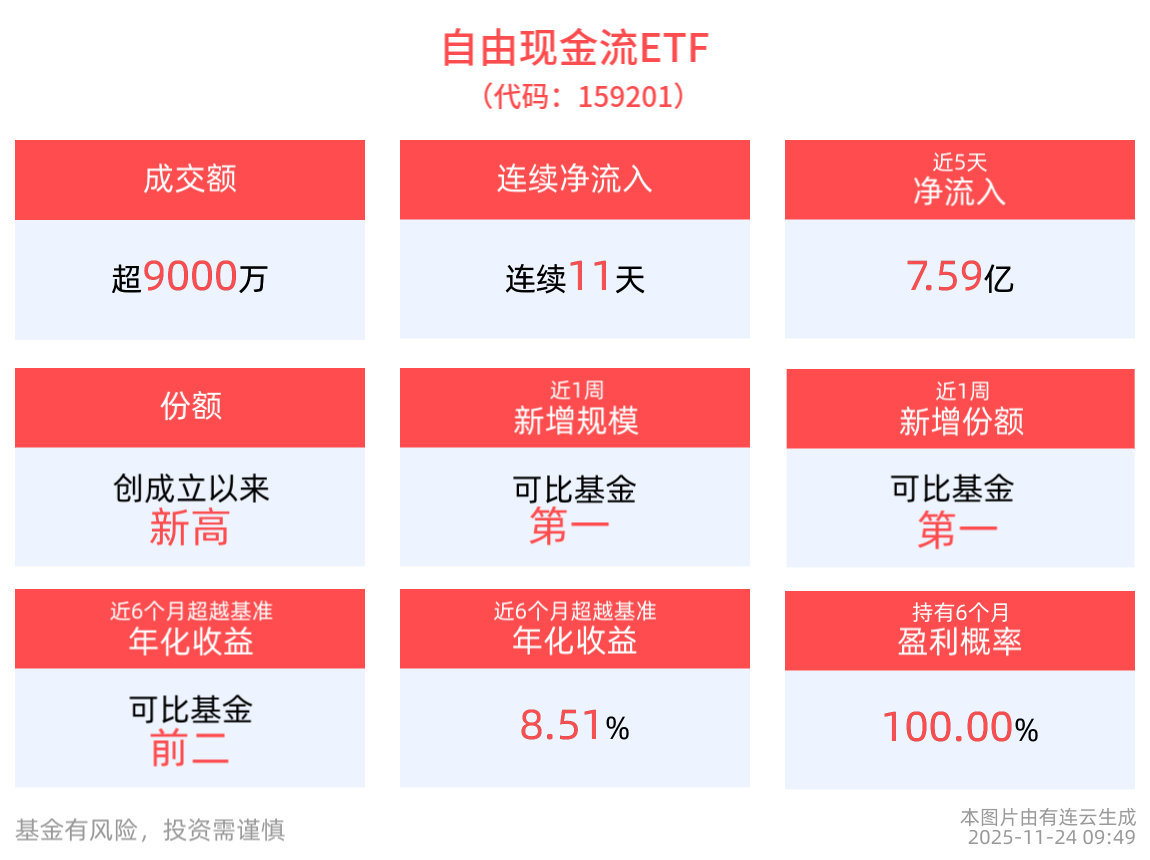
自由现金流ETF(159201)连续11天净流入,合计“吸金”16.46亿元
Xin Lang Cai Jing· 2025-11-24 02:17
Core Insights - The Guozheng Free Cash Flow Index has increased by 0.16% as of November 24, 2025, with leading stocks including Dongfang Tower, Nanjing Xinbai, ShouLiu Hotel, Shanghai Electric, and Zhenhua Heavy Industries [1] - The Free Cash Flow ETF (159201) has seen a price increase of 0.09%, currently priced at 1.15 yuan, with significant liquidity reflected in a weekly average trading volume of 536 million yuan [1] - The Free Cash Flow ETF has experienced continuous net inflows over the past 11 days, totaling 1.646 billion yuan, with a peak single-day net inflow of 253 million yuan [1][3] Fund Performance - The Free Cash Flow ETF has recorded a net value increase of 15.32% over the past six months, with the highest monthly return reaching 7% and the longest consecutive monthly gain lasting six months [3] - Historical performance indicates an 87.5% monthly profit percentage and a 100% probability of profit over a six-month holding period [3] - The management fee for the Free Cash Flow ETF is 0.15%, while the custody fee is 0.05% [3] Top Holdings - As of October 31, 2025, the top ten weighted stocks in the Guozheng Free Cash Flow Index account for 54.79% of the index, including China National Offshore Oil Corporation, SAIC Motor, Wuliangye, Gree Electric Appliances, and others [3] - The individual weightings of the top stocks are as follows: CNOOC (9.87%), SAIC Motor (8.71%), Wuliangye (7.32%), Gree Electric (6.54%), and others [5]
“全市场撒网”还是“主题深耕”?公募投资逻辑正深度重构
券商中国· 2025-11-24 01:33
Core Viewpoint - The investment style of public funds is shifting from "full market stock selection" to "thematic investment," driven by economic transformation and the emergence of high-growth stocks [1][3]. Group 1: Shift in Investment Strategies - Public funds previously favored "core assets" like large-cap stocks, but this strategy is losing traction as thematic investments gain popularity [2][3]. - Thematic investments allow for a more comprehensive layout of high-growth stocks and can enhance competitive rankings among funds [1][2]. - The shift is attributed to changes in the investment environment, including slower economic growth and the emergence of new industries, which have made traditional core assets less attractive [3][5]. Group 2: Characteristics of Thematic Investment - Thematic funds have been performing well, often ranking at the top in annual performance due to their focus on high-growth sectors like AI and innovative pharmaceuticals [4][5]. - The concentration on specific themes allows for greater potential returns, but also increases volatility and risk [5][11]. - Thematic investments help investors engage with long-term trends and direct capital towards state-supported sectors, fostering a positive cycle between capital markets and technological innovation [6][11]. Group 3: Challenges of Thematic Investment - Thematic investment requires deeper industry understanding and foresight, as it involves answering long-term questions about market dynamics and competition [7][8]. - The need for rigorous valuation discipline and risk management is heightened, as concentrated portfolios are more susceptible to individual stock performance and policy changes [8][9]. - The complexity of managing risks increases with thematic investments, necessitating precise control over concentration and liquidity [8][9]. Group 4: Future of Full Market Stock Selection - Despite the rise of thematic investments, "full market stock selection" is not expected to disappear, as it offers unique advantages in capturing structural opportunities across various sectors [10][11]. - The ability to conduct fundamental comparisons across industries will remain relevant, especially in a market characterized by frequent sector rotations [10][11]. - The long-term viability of "full market stock selection" will depend on its adaptation to new macroeconomic and industry conditions [10].

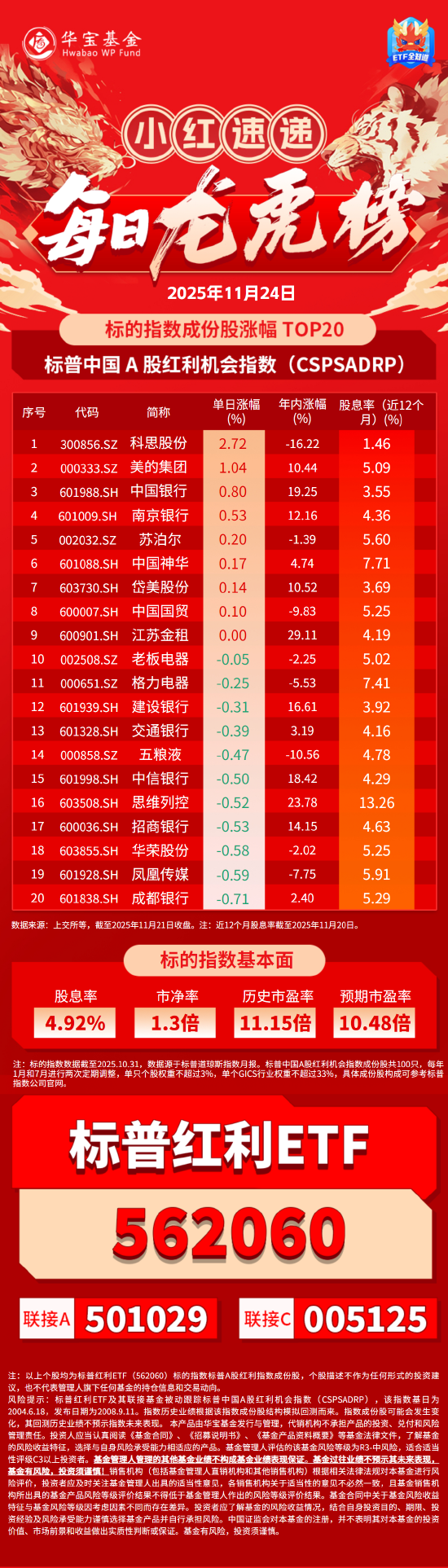
小红日报 | 标普红利ETF(562060)标的指数收跌-2.27%,资金逢跌积极布局
Xin Lang Ji Jin· 2025-11-24 01:11
Core Insights - The article presents the top 20 stocks in the S&P China A-Share Dividend Opportunity Index, highlighting their performance in terms of daily increase, year-to-date increase, and dividend yield [1] Group 1: Stock Performance - The top performer is Kesheng Co., Ltd. (300856.SZ) with a daily increase of 2.72% but a year-to-date decrease of 16.22% and a dividend yield of 1.46% [1] - Midea Group (000333.SZ) shows a daily increase of 1.04% and a year-to-date increase of 10.44%, with a dividend yield of 5.09% [1] - China Bank (601988.SH) has a daily increase of 0.80% and a year-to-date increase of 19.25%, with a dividend yield of 3.55% [1] Group 2: Dividend Yields - The highest dividend yield is from Siwei Liekong (603508.SH) at 13.26%, despite a daily decrease of 0.52% and a year-to-date increase of 23.78% [1] - Other notable dividend yields include China Shenhua (601088.SH) at 7.71% and Gree Electric Appliances (000651.SZ) at 7.41% [1] - Jiangsu Jinxiang (600901.SH) has a year-to-date increase of 29.11% with a dividend yield of 4.19% [1]