
零跑汽车

Search documents
车企KPI年末冲刺:谁领跑,谁掉队
3 6 Ke· 2025-12-09 10:24
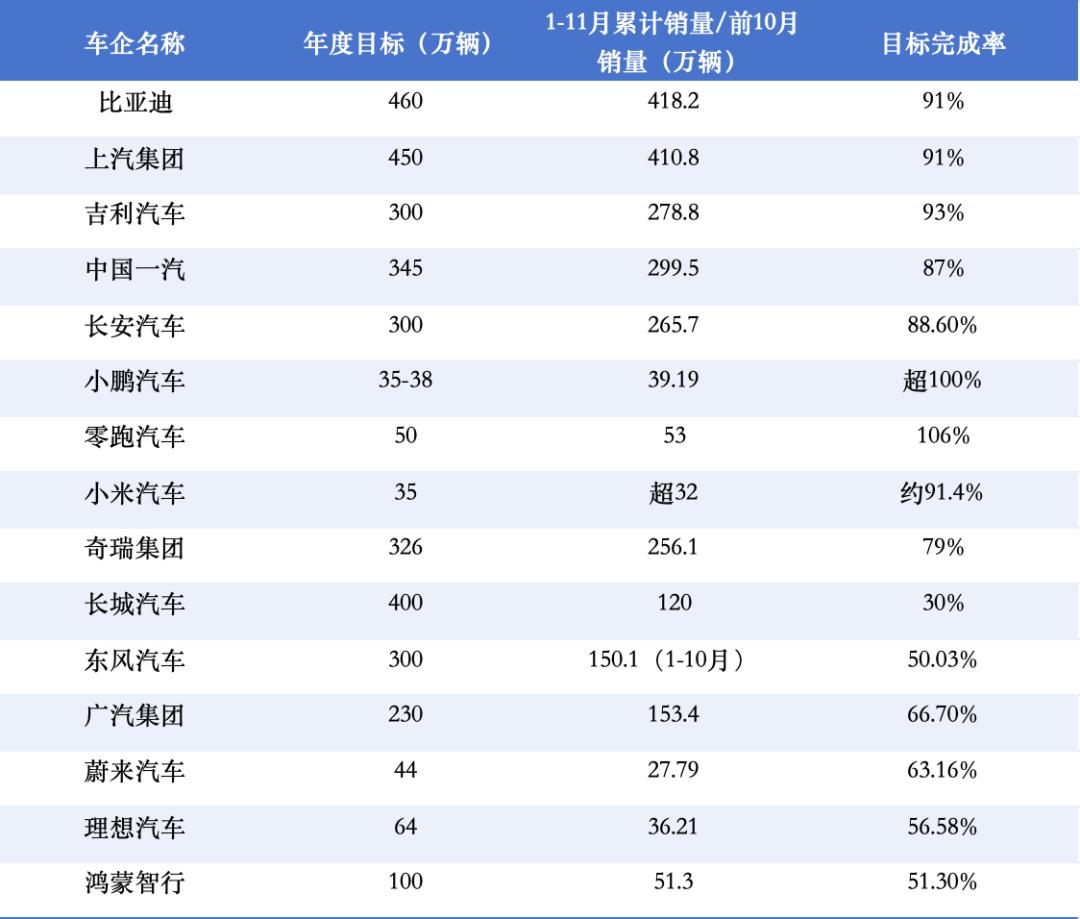
从全局看,车市全年销量预期保持平稳增长,但在新能源与燃油车格局重塑、价格战余波未平、供应链支撑强化的多重背景下,车企阵营的分化态势已达 近年峰值。 这场收官对决中,阵营差异已经分明:部分头部企业凭借前瞻布局提前锁定胜局,上演"年终狂欢";而不少玩家仍在目标线边缘全力突围,为最后的冲刺 发起总攻,车市的强弱格局在年末节点愈发清晰。 三家新势力提前完成KPI,阵营分化加剧 2025年,中国车市收官进入倒计时,整体销量预期平稳,但主流车企年度目标完成度呈现显著分化。自主头部车企稳扎稳打,新势力阵营涌现"提前达 标"黑马,而部分新势力以及合资及国企车企则深陷目标滞后困境,市场"冷热不均"态势凸显。 | 车企名称 | 年度目标(万辆) | 1-11月累计销量/前10月 | 目标完成率 | | --- | --- | --- | --- | | | | 销量(万辆) | | | 比亚迪 | 460 | 418.2 | 91% | | 上汽集团 | 450 | 410.8 | 91% | | 吉利汽车 | 300 | 278.8 | 93% | | 中国一汽 | 345 | 299.5 | 87% | | 长安汽车 | 3 ...

港股资金面的变化
Sou Hu Cai Jing· 2025-12-09 09:48
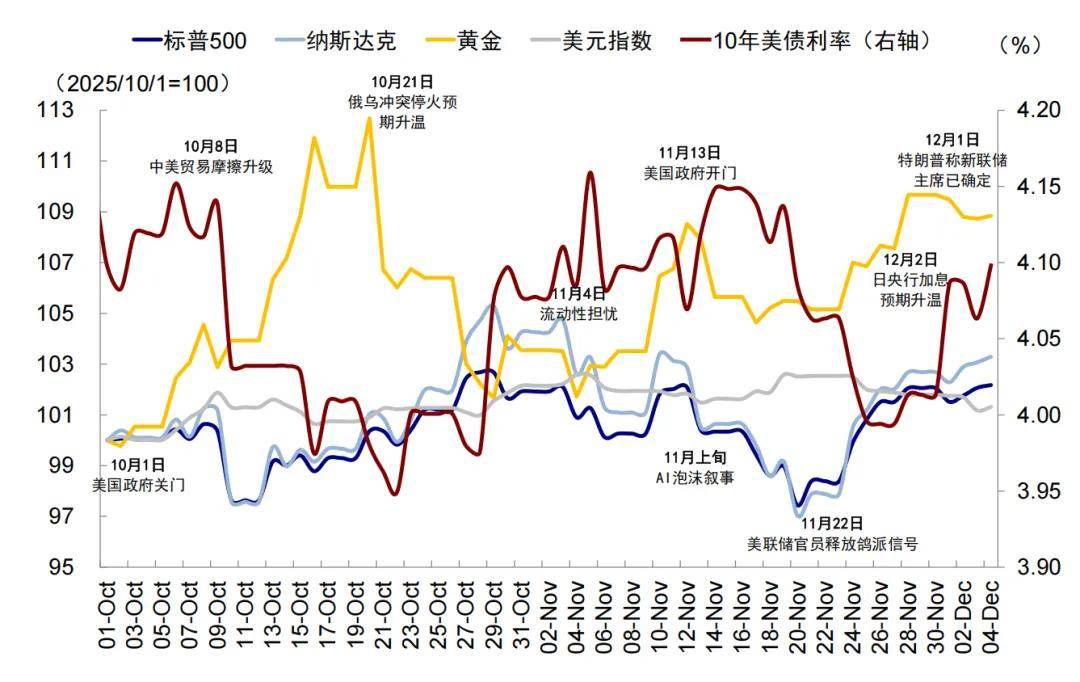
Market Overview - The Hong Kong stock market is experiencing weakness due to two main factors: concerns over public fund managers' performance being tied to returns, leading to potential sell-offs, and apprehension regarding the Federal Reserve's interest rate decisions [1][2] - The recent tightening of market liquidity has contributed to the decline, with the Nasdaq dropping by 7.3% and the Hang Seng Tech Index falling by 12.6% [2] Federal Reserve Impact - The Federal Reserve's upcoming statements on interest rates are crucial, with expectations that a dovish stance could boost market risk appetite and challenge historical highs [4] - Key economic indicators, such as the CPI and non-farm payroll data, will guide the Fed's future actions, particularly if unemployment rates weaken [4] Sector Analysis - The sectors most negatively impacting the Hang Seng Tech Index include food delivery and electric vehicles, particularly companies like Meituan and Xiaomi [7] - Meituan's performance expectations have been lowered, and competition in the food delivery sector is expected to ease in the coming quarters [7] - Xiaomi's weight in the Hang Seng Tech Index has fluctuated, with recent adjustments potentially attracting new investments [7][8] Corporate Actions - Companies like Xiaomi are beginning to repurchase shares, providing some support against further declines [8] - There is speculation that major shareholders of Tencent may slow down their selling, which could also stabilize the stock [8] Fund Flows - Recent net inflows from southbound funds indicate a growing interest in Hang Seng Tech stocks, with significant amounts flowing into Alibaba, Xiaomi, and Meituan [13][15] - Insurance companies are encouraged to invest in equities, with projections of an additional 550-600 billion yuan entering the market next year [13] AI Development - The recent lifting of export restrictions on Nvidia's H200 to China is seen as a positive development for internet companies, enhancing their capabilities in AI applications [16][18] - If major companies like Tencent and Alibaba are approved to purchase H200, it could lead to a revaluation of internet stocks in the market [18] Investment Opportunities - The Hang Seng Tech ETF (513010) is highlighted as a potential investment opportunity, especially if the Federal Reserve adopts a dovish tone [23] - The launch of the Hong Kong Stock Exchange's Technology 100 Index may provide new investment avenues in the tech sector [23]
公司问答丨江苏北人:公司直接客户多以汽车零部件厂商为主
Ge Long Hui· 2025-12-09 08:53
Core Viewpoint - Jiangsu Beiren is actively involved in providing intelligent manufacturing solutions, primarily serving automotive parts manufacturers, and has indirect connections with several well-known international electric vehicle brands and technology companies [1] Group 1: Company Engagement - Jiangsu Beiren offers "product + technology + service" turnkey solutions in the intelligent manufacturing sector [1] - The company's direct clients are mainly automotive parts manufacturers [1] Group 2: Clientele and Partnerships - Jiangsu Beiren indirectly serves notable international electric vehicle brands, including Tesla, as well as domestic companies such as Huawei, Xiaojun, Li Auto, NIO, Xpeng, Leap Motor, BMW, Volvo, Geely, Volkswagen, Hongqi, General Motors, Nissan, and Dongfeng [1]

【月度排名】2025年11月厂商销量排名快报
乘联分会· 2025-12-09 08:46
Core Viewpoint - The domestic narrow passenger car market in China experienced a retail sales decline in November 2025, with a total of 2.225 million units sold, representing a year-on-year decrease of 8.1% and a month-on-month decrease of 1.1%. However, the cumulative sales from January to November reached 21.483 million units, showing a year-on-year growth of 6.1% [2][3]. Sales Performance - In November 2025, the sales breakdown by vehicle type showed that sedans sold 1.007 million units (down 10.0% year-on-year), MPVs sold 86,000 units (down 16.8%), SUVs sold 1.132 million units (up 5.6%), and NEVs sold 1.321 million units (up 4.2%) [3][4]. - The cumulative sales for the year until November were 9.831 million sedans (up 5.3%), 953,000 MPVs (up 0.1%), 10.699 million SUVs (up 7.3%), and 11.472 million NEVs (up 19.6%) [3][4]. Market Trends - The penetration rate of new energy vehicles (NEVs) in the domestic market reached 59.4% in November, with a penetration rate of 79.6% among domestic brands and 38.8% in the luxury segment [4]. - The analysis indicates that the retail growth rate for the year has followed a "low in the beginning, high in the middle, and flat at the end" trend, with new policies stabilizing the market and controlling price competition [2][4]. Manufacturer Rankings - In November 2025, BYD led the sales with 474,921 units (down 5.8% year-on-year), followed by Geely with 310,428 units (up 24.1%), and Chery with 262,475 units (down 3.6%) [7][9]. - For the cumulative sales from January to November, BYD also ranked first with 4.131 million units (up 10.4%), followed by Geely with 2.788 million units (up 41.8%) [8][10]. NEV Manufacturer Performance - In November 2025, BYD again led the NEV wholesale sales with 474,921 units (down 5.8% year-on-year), while Geely and Chery followed with 187,798 units (up 53.4%) and 111,577 units (up 54.0%) respectively [11][13]. - Cumulatively, BYD maintained its lead in NEV sales with 4.131 million units (up 10.4%) from January to November, while Geely's NEV sales surged by 97.4% to 1.534 million units [13][15].





中金:11月乘用车出口续创新高 期待年末新能源“翘尾”收官
Zhi Tong Cai Jing· 2025-12-09 08:39
展望2026年,如果维持一定的央地补贴,预计国内需求有望保持平稳,国内新能源销量有望保持双位数 增长,自主车企海外销量有望继续增长。得益于头部自主品牌持续加码、第三方智驾供应商赋能车企, 2025年高阶智驾经历了发展拐点,预计2026年高阶智驾渗透率仍将持续提升,带动产业链软硬件供应商 放量。 11月狭义乘用车零售承压,环比下降主要系地方补贴收缩、电池供应紧缺的影响。1-11月狭义乘用车累 计零售销量2148.3万辆,同比+6.1%,据乘联会数据,前11个月以旧换新申请量达1120万辆,政策支持 对全年汽车消费起到了有力的支撑作用。11月乘用车出口续创月度新高,其中新能源乘用车出口同比增 长2.4倍,比亚迪单月出口量增至13.2万辆。 新能源同环比延续增长,12月有望"翘尾"收官 11月新能源乘用车批发170.6万辆,同比增长18.7%,环比增长5.8%;零售132.1万辆,同比+4.2%/环比 +3.0%,表现优于乘用车整体水平,零售口径新能源渗透率达59.3%,同比+7ppt。分车企看,鸿蒙智 行、零跑汽车(09863)、蔚来-SW(09866)、岚图同比增长亮眼。展望12月,伴随电池供应边际改善、新 车 ...
港交所科技100指数上线,易方达ETF同步落地,两地深化互联互通
Sou Hu Cai Jing· 2025-12-09 06:36
继11月28日推出恒生生物科技指数期货后,港交所(00388.HK)在指数业务拓展领域再添重要举措。 12月9日,港交所正式宣布推出科技100指数,同时授权内地综合性资产管理公司易方达基金,在国内推出追踪该指数的交易所买卖基金(ETF)。消息披露 后,港交所股价走势平稳,截至发稿时小幅下跌1.19%。 | 指数资料 | | | --- | --- | | 推出日期 | 2025年12月9日 | | 基日 | - 2020年12月31日 | | 基值 | 10,000 | | 货币 | 港元 | | 调整周期 | 每半年(6月及12月) | | 权重再平衡周期 | 每季度(3月、6月、9月及12月) | | 图源: 港交所官网 | | 此外,指数成份股必须符合港股通交易资格这一硬性要求。若在定期指数调整期间,某成份股不再满足港股通交易资格,将被从指数中剔除,以保障指数的 可投资性。 根据港交所披露的指数成份股名单,这100只标的全面覆盖了港股市场核心科技企业矩阵,包括腾讯(00700.HK)、阿里巴巴(09988.HK)、小米集团 (01810.HK)等互联网及科技龙头,宁德时代(03750.HK)、比亚迪(0 ...

南向资金跑步入场,有望与外资共振,支撑港股流动性
Xin Lang Cai Jing· 2025-12-09 06:19
Group 1 - Southbound capital is expected to continue flowing into the Hong Kong stock market in 2025, with a cumulative net purchase of nearly 1.4 trillion HKD in the current year, providing strong support for market liquidity and potentially resonating with the foreign capital returning during the Federal Reserve's interest rate cut cycle [1] - As of December 8, southbound capital has seen a net inflow for eight consecutive days, with the top ten individual stocks attracting this capital primarily focusing on technology, new consumption, and pharmaceuticals, including companies like Xiaomi Group, Meituan, Alibaba, Pop Mart, Leap Motor, and WuXi Biologics [1] - The Hang Seng Tech Index ETF (513180) tracks the Hang Seng Tech Index, covering 30 leading technology stocks in Hong Kong, combining both hardware and software technology, and is favored by overseas and southbound capital due to its focus on core assets in China's AI industry chain [1]
2025年前11月邮轮旅客运输量同比增长27.8%,聚焦港股消费ETF(513230)布局机遇
Mei Ri Jing Ji Xin Wen· 2025-12-09 06:13
Group 1 - The Hong Kong stock market indices faced pressure, with the Hang Seng Index down 0.84%, the Hang Seng China Enterprises Index down 1.12%, and the Hang Seng Tech Index down 1.32% as of midday [1] - The consumer sector in Hong Kong continued to decline, with the Hong Kong Consumer ETF (513230) dropping nearly 1.5%, indicating an ongoing opening for investment opportunities [1] - The cruise passenger transport volume reached 1.265 million from January to November, representing a year-on-year increase of 27.8%, contributing positively to tourism development and consumption [1] Group 2 - The Ministry of Transport and the Ministry of Culture and Tourism jointly issued measures to promote cruise transport and tourism services, proposing ten specific initiatives to enhance supply, improve services, and stimulate new demand [1] - According to Jianyin International, while the valuation repair of Hong Kong stocks is largely complete, the investment logic has shifted from traditional valuation repair to a revaluation based on new productive forces and high-quality development, with moderate expansion or improvement expected in valuation and earnings by 2026 [1] - According to Jiao Yin International, consumer spending is expected to see a slight recovery in 2025, with a continuation of moderate growth in 2026 characterized by slower overall demand growth and a structural shift in consumer behavior, which will drive important growth in niche markets [2]
11月国内乘用车零售销量同比下降8.1% 乘联分会预测:2026年车市增长面临压力
Mei Ri Jing Ji Xin Wen· 2025-12-09 06:13
Core Viewpoint - In November, the domestic passenger car market experienced a year-on-year decline in retail sales by 8.1%, contrasting with the typical year-end sales surge seen in previous years. The total retail sales for the year reached approximately 21.48 million units, reflecting a 6.1% increase year-on-year [1][10]. Group 1: Market Performance - The retail sales volume in November was about 2.225 million units, showing a month-on-month decrease of 1.1% [1]. - The cumulative growth rate of retail sales for the year showed fluctuations, with a 1.2% increase from January to February, a 15% increase from March to June, and a decline in growth to around 6% from July to September [3]. - The decline in November sales is attributed to a high base effect from previous quarters, aligning with earlier predictions of a "low-middle-high-flat" trend for the year [3]. Group 2: Policy Impact - The "old-for-new" vehicle replacement policy has been a significant factor in regulating market growth, with over 11.2 million applications for subsidies by October 22, 2023 [3]. - The average daily subsidy scale dropped to 30,000 units in November due to the suspension of subsidies in various regions, indicating a clear effect on growth adjustment [3]. Group 3: New Energy Vehicles (NEVs) - In November, the number of manufacturers with monthly sales exceeding 10,000 units for NEVs rose to 22, accounting for 94.2% of total NEV sales for the month [4]. - The total sales of NEVs reached 1.321 million units in November, marking a year-on-year increase of 4.2%, with a penetration rate of 59.3% in the overall passenger car market, up 7 percentage points from the previous year [4]. - The penetration rate for domestic brands' NEVs was 79.6%, while luxury brands and mainstream joint ventures had penetration rates of 38.8% and 8%, respectively [4]. Group 4: Export Trends - NEV exports reached 284,000 units in November, representing a year-on-year increase of 243.3%, making up 47.3% of the total export market [7]. - The share of pure electric vehicles in NEV exports decreased to 57%, while plug-in hybrid models increased to 42% [7]. - The export of complete vehicles has also driven growth in battery exports, with a total of 7.039 million kWh of electricity used for NEV exports and wholesale in November [8]. Group 5: Future Outlook - The retail share of new forces in the market reached 22.1% in November, an increase of 5.9 percentage points year-on-year, with pure electric models accounting for 72.8% of new force sales [9]. - Predictions for December suggest a relatively stable market, with potential for slight negative growth, influenced by consumer urgency due to upcoming changes in vehicle purchase tax policies [9]. - Looking ahead to 2026, the market is expected to face significant pressure due to changes in tax incentives, with a projected reduction in tax benefits leading to a potential decline in growth [9].

汽车:2026展望:鏖战升维,破界竞争
Zhao Yin Guo Ji· 2025-12-09 03:23
Investment Rating - The report assigns a "Buy" rating to several companies in the automotive sector, including Xpeng Motors, Geely Automobile, Great Wall Motors, BYD, GAC Group, and others, with target prices ranging from 2.5 to 125 [3][4]. Core Insights - The Chinese automotive industry is expected to achieve record-high retail and wholesale sales in 2025, with a more complex landscape anticipated in 2026 due to the phasing out of subsidies and tax incentives [2][4]. - The report expresses a more optimistic view on the resilience of the automotive sector compared to market expectations, predicting a slight decline in retail sales by 0.1% to 2,415 million units in 2026, while wholesale sales are expected to grow by 2.9% to 3,125 million units [4][22]. - The competition in the automotive sector is expected to intensify, with a record number of new models anticipated in 2026, leading to a potential increase in market share for domestic brands [4][24]. Summary by Sections Sales Forecast - Retail sales of passenger vehicles in China are projected to reach 2,418 million units in 2025, a 3.2% increase year-on-year, while wholesale sales are expected to exceed 3,000 million units for the first time [44][52]. - The report anticipates that the retail sales will remain stable in 2026, supported by the importance of automotive consumption to the Chinese economy and the introduction of new models [22][44]. Market Dynamics - The report highlights that the competition among automakers will become more fierce, with a record 173 new models expected to be launched in 2026 [23][24]. - The demand for electric vehicle batteries is expected to rise, potentially leading to increased battery prices, which could impact automaker profit margins [23][24]. Investment Strategy - The report recommends Geely Automobile as a top pick due to its solid fundamentals and attractive valuation, alongside the battery manufacturer Zhengli New Energy, which is expected to benefit from rising battery prices and a growing customer base [28][29]. - The report suggests that the valuation gap between traditional automakers and new entrants is likely to narrow as both groups adapt to market changes [25][26]. Export Potential - The report forecasts that China's passenger vehicle exports will increase by 16% in 2026, driven primarily by the growth in electric vehicle exports, which are expected to rise by 40% [61][62]. - The potential market for Chinese brands overseas is estimated at 7.8 million units, indicating significant growth opportunities in various regions [61][62].



