
卫龙

Search documents
作茧自缚是破茧而出前,必备一步
Ge Long Hui· 2025-06-02 01:26
Group 1 - The recent performance of Hong Kong and A-shares has been lackluster, with market movements heavily influenced by U.S. events, particularly Trump's tariff actions [1] - Trump's recent threats to impose tariffs on the EU and increase steel tariffs to 50% have created volatility in the markets, reflecting the uncertainty surrounding U.S. fiscal policy [1][2] - The 30-year U.S. Treasury yield remains above 5%, raising concerns about the stability of U.S. debt and its implications for the broader financial market [1][2] Group 2 - The new consumption sector in Hong Kong is gaining attention, characterized by a diverse range of companies from bubble tea to beauty products, indicating a broad interpretation of consumer spending [5][6] - Major internet companies in China, such as Meituan and Xiaomi, reported strong earnings, with Meituan exceeding revenue and profit expectations despite ongoing competition with JD.com [6] - PDD's financial performance has been mixed, with revenue growth but a significant drop in net profit, attributed to government subsidies and market conditions, leading to volatility in its stock price [6] Group 3 - The IPO market in Hong Kong has shown a positive trend, with a low first-day loss rate of 28.6% for new listings, the lowest since 2017 [7] - New stock performance varies significantly, with some companies like Ningde Times and Guanshi Shuduan showing substantial first-day gains, while others like Paige Biopharma experienced significant losses [8] - The strategy for participating in new stock offerings emphasizes quick exits within three days, suggesting a focus on short-term gains rather than long-term holdings [8][9]







健康成新消费趋势!有电商平台养生类粽子销量同比增长近2倍
Nan Fang Du Shi Bao· 2025-05-31 11:54
Core Insights - The annual Dragon Boat Festival has seen a rise in innovative rice dumpling flavors, with health-oriented options gaining popularity among consumers [1][3][10] - Online sales of rice dumplings have significantly outperformed traditional retail channels, with some platforms reporting sales increases of over 300% [10][11] - Major brands are focusing on health-conscious products, with sales of health-oriented rice dumplings increasing by 177% year-on-year [7][10] Product Innovations - Multiple brands have introduced new flavors, such as spicy meat dumplings and tea-infused dumplings, catering to diverse consumer preferences [3][5] - Health-focused products, including low-GI options and those made with nutritious ingredients, are becoming increasingly popular [7][9] Sales Trends - Online platforms like Tmall and Pinduoduo have reported substantial growth in rice dumpling sales, with Tmall noting a nearly 70% increase in transaction value compared to the previous year [10][11] - In contrast, traditional offline retail channels have experienced a decline, with sales dropping by over 34% in the weeks leading up to the festival [13] Consumer Preferences - Younger consumers (ages 16-30) are more inclined towards innovative flavors, while older demographics show a preference for traditional options [5][10] - The competition between sweet and savory rice dumplings reveals a trend where savory options are leading in sales on some platforms, while others still favor sweet varieties [9][10] Company Performance - Five Fang Zhai, known as the "first rice dumpling stock," reported a 20.92% decline in rice dumpling sales last year, despite a slight increase in gross margin [14][15] - Other companies like Huan Shang Huan and Sanquan Foods also reported declines in their rice dumpling sales, indicating a challenging market environment [16]


以技术升级为支撑 丰富产品种类与口味 魔芋休闲食品加速崛起
Zhong Guo Chan Ye Jing Ji Xin Xi Wang· 2025-05-30 00:49
Core Insights - The rise of konjac as a popular snack food in China's southwestern region is driven by increasing consumer health awareness and advancements in modern food technology [1][6] Market Growth - The konjac snack food market in China has experienced rapid growth, with a compound annual growth rate (CAGR) exceeding 20% from 2014 to 2023, reaching a market size of over 18.3 billion yuan in the previous year [4] - Konjac snacks, particularly konjac jelly, have become dominant, with the konjac jelly segment alone accounting for approximately 8.5 billion yuan [4] Product Innovation - Modern food technology has transformed konjac from a traditional ingredient to a versatile snack food, with innovative products like konjac jelly, konjac chips, and konjac noodles emerging [3][6] - The introduction of various flavors and forms caters to diverse consumer preferences, enhancing market share and expanding consumption scenarios [3][4] Consumer Demand - The health attributes of konjac, such as low calories and high dietary fiber, align well with contemporary consumer desires for healthy snacks, driving market expansion [6][8] - The current penetration rate of konjac snacks in the potential consumer base is only 15%, indicating significant room for growth [8] Industry Outlook - The konjac snack food market is projected to maintain a 20% CAGR over the next five years, with the industry size expected to grow twelvefold from its current level [8] - Companies are encouraged to invest in research and development to create unique and nutritious konjac products, enhancing their market position [8][9] Supply Chain and Marketing - The konjac snack industry has established a comprehensive supply chain, ensuring stable raw material supply and quality control [6][9] - Multi-channel sales strategies, including online and offline platforms, have increased market reach and sales volume [7][9] International Potential - As a major global producer of konjac, China has significant advantages in exporting konjac snack foods, with potential for increased international market presence [9]
新型“人类猫条”,征服刁嘴年轻人
3 6 Ke· 2025-05-29 10:49
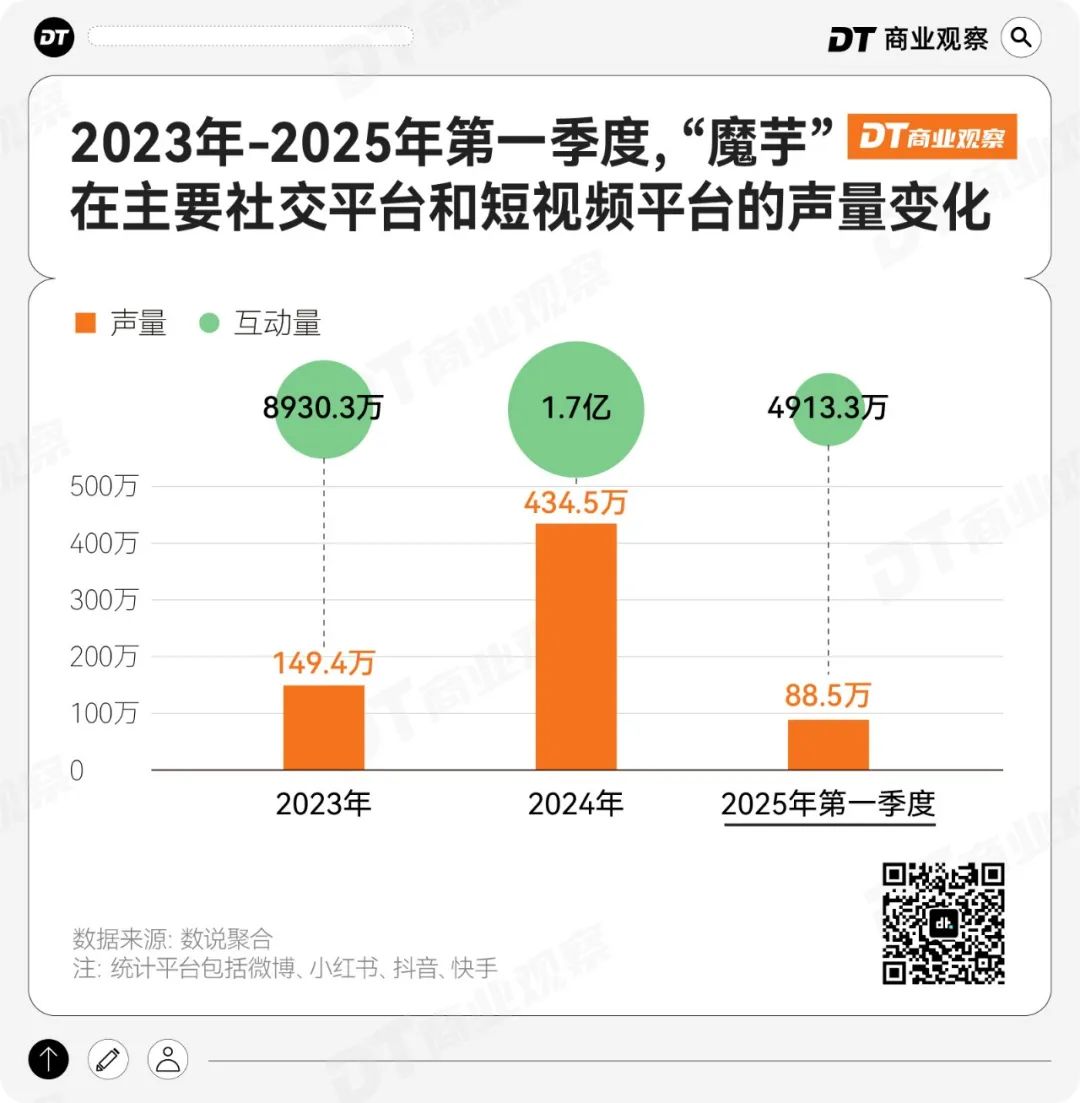
Core Insights - The article highlights the rising popularity of konjac products, particularly among young consumers, with significant growth in online engagement and sales expected in 2024 compared to 2023 [1][3]. Group 1: Market Performance - In 2024, the total engagement for "konjac" on platforms like Weibo, Xiaohongshu, Douyin, and Kuaishou increased by 191% compared to 2023, with Q1 2025 engagement reaching about 60% of the total for 2023 [1]. - The konjac snack "Konjac Shuang" has become a major revenue driver for companies like Weilong, contributing to a 59.1% year-on-year revenue growth, reaching 3.37 billion yuan in 2024, accounting for 53.79% of total revenue [4]. - Salted Snack Company reported a revenue of 838 million yuan from konjac products in 2024, a 76.09% increase, with konjac jelly pudding contributing 301 million yuan, up 39.1% [5]. Group 2: Product Innovation - Brands like Akwan Foods and Wild Man Diary are innovating by transforming konjac into noodles, dumplings, and rice noodles, thus redefining consumer perceptions of traditional staples [6][8]. - Akwan Foods launched convenient konjac cold noodles and established a sub-brand "Mo Xiaobao" in 2024, while Wild Man Diary's konjac products accounted for about 85% of its 300 million yuan sales in 2024 [8]. Group 3: Consumer Demand - The low-calorie, low-fat, and high-fiber characteristics of konjac align with young consumers' dietary preferences for weight loss, reducing market education costs [7]. - The popularity of "Konjac Shuang" is attributed to its taste and convenience, with consumers appreciating its low-calorie profile compared to traditional snacks [24][28]. Group 4: Competitive Landscape - The konjac market is becoming increasingly competitive, with brands like Weilong and Salted Snack Company leading the way, holding market shares of 42% and 13% respectively in 2024 [19]. - The introduction of new flavors and product variations by brands is enhancing consumer choice and driving growth in the konjac snack segment [27]. Group 5: Pricing Trends - The price of konjac has doubled in 2024, reaching over 7 yuan per kilogram, driven by reduced supply from major production areas and increased demand from snack and meal replacement sectors [35].
上榜的国民级消费品牌众多!河南“中”在哪儿?
Sou Hu Cai Jing· 2025-05-29 04:03
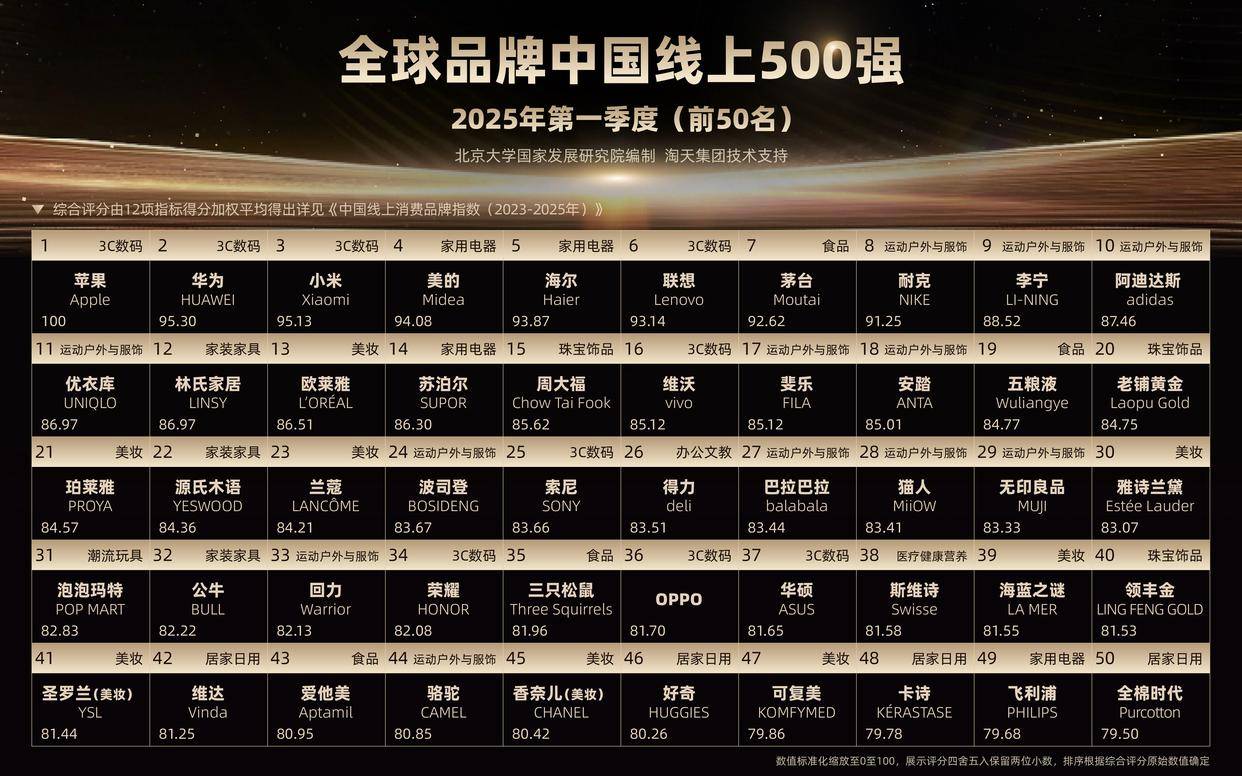
Group 1 - The article highlights the emergence of a new consumer landscape in China, showcasing the "Henan phenomenon" where 10 brands from Henan province made it to the top 1000 brands, ranking 11th among mainland provinces [1][3] - The CBI500 list, developed by Peking University and supported by Alibaba's Taotian Group, will be updated quarterly to reflect real-time quality consumption trends in China [1][9] - The index indicates a stable growth trend in Chinese online consumer brands, with the average score increasing from 59.42 in Q1 2023 to 63.38 in Q1 2025, suggesting an improvement in consumer purchasing quality [9][10] Group 2 - Henan's brands, including Deyou, Bai Xiang, and Shuanghui, dominate the food category, reflecting the province's status as a major grain production area, contributing about 10% of the national grain output [3][4] - The article emphasizes the innovative strategies of brands like Shuanghui and Wei Long, which have successfully transformed local snacks into nationally recognized products through standardization and branding [4][5] - The rise of local brands in Henan is attributed to their ability to adapt to consumer trends and leverage e-commerce platforms for broader market reach [6][8] Group 3 - The introduction of the "new sharpness" metric in the CBI500 list highlights the growth potential of local brands, with Deyou achieving a score of 72.87 and a significant increase in young consumer engagement [6][10] - Brands like Yunyima and Tiankongshu have successfully targeted niche markets, demonstrating the diverse innovation landscape in Henan beyond the food industry [7][8] - The article concludes that the combination of innovation, data utilization, and market diversification is driving the growth of Henan's brands, positioning them for both national and international success [6][10]


魔芋行业专题:利于健康,潜力逐渐释放
东方财富· 2025-05-28 00:45
Investment Rating - The report maintains a rating of "Outperform" for the konjac industry [5] Core Viewpoints - The konjac industry is recognized as a healthy superfood with broad applications, indicating significant growth potential [15][16] - The konjac snack segment is rapidly growing and has a high degree of market concentration, with leading companies like Wei Long and Yan Jin Pu Zi experiencing substantial growth [39][49] Summary by Sections 1. Konjac Industry Overview - Konjac is rich in soluble dietary fiber, beneficial for health, and is recognized as a superfood by the World Health Organization [16] - The internal composition of konjac includes up to 50% glucomannan, which can lower the risk of various diseases [16] - China is the leading producer of konjac and konjac powder, with a significant economic benefit compared to other mountainous crops [26] 2. Konjac Industry Chain Analysis - The konjac industry chain consists of upstream (planting and initial processing), midstream (deep processing), and downstream (various applications) [20] - Upstream konjac has a high yield value, but requires land rotation every three years due to soil depletion [23][24] - Midstream processing focuses on producing different grades of konjac powder, with a strong market for konjac gum [31] 3. Konjac Snacks - The konjac snack market is small but has high growth potential, with a market size exceeding 12 billion yuan in 2024 [42] - Compared to traditional spicy snacks, konjac snacks are healthier and have lower calories, making them appealing to consumers [42] - The competitive landscape is concentrated, with Wei Long holding a 70% market share in the konjac snack segment [49] 4. Key Companies in the Konjac Industry - **YI ZHI Konjac**: Focuses on konjac powder as its core product, with strong market demand and plans for capacity expansion [2] - **Wei Long**: Implements a multi-category strategy, with konjac products expected to become a major revenue driver [3][4] - **Yan Jin Pu Zi**: Known for its rapid growth in the konjac snack segment, leveraging a multi-channel distribution strategy [3][4]
“国家队”出手——道达投资手记
Mei Ri Jing Ji Xin Wen· 2025-05-27 12:28
Market Overview - The A-share market experienced a collective pullback, with the Shanghai Composite Index down by 0.18%, Shenzhen Component down by 0.61%, and ChiNext down by 0.68% [1] - The trading volume in the Shanghai and Shenzhen markets was 998.9 billion yuan, a slight decrease of 11 billion yuan from the previous day [1] - A total of 2,637 stocks rose while 2,576 stocks fell, indicating a mixed market sentiment [1] Fundraising and Investment - Recently, three ETFs managed by major funds such as Fuguo Fund, Jiashi Fund, and ICBC Credit Suisse Fund were established, with Beijing Chengtong Investment Co., Ltd. subscribing 600 million yuan in total, becoming the largest shareholder [1] - China Chengtong, a state-owned enterprise under the supervision of the State-owned Assets Supervision and Administration Commission, is committed to supporting the development of the capital market [2][3] Sector Performance New Consumption Sector - The food and beverage sector, particularly new consumption brands, showed strength, with stocks like Yong'an Pharmaceutical rising significantly by 111% over the last 12 trading days due to the popularity of its functional beverage [5] - The shift towards new consumption reflects a broader economic transformation, moving from traditional consumption to a focus on self-actualization needs [6] Pharmaceutical Sector - The pharmaceutical sector is gaining attention, driven by continuous innovation in drug development and a defensive shift in investment strategies [8] - There is a growing interest in traditional Chinese medicine brands from a long-term investment perspective [8] Chemical Sector - The chemical sector saw a rise due to an explosion incident at Shandong Youdao Chemical Co., which led to increased interest in pesticide and veterinary drug stocks [9] - The incident affected the stock performance of related companies, including Haomai Technology, which is associated with Youdao Chemical [10]
魔芋产业链的“三重考验”:原料缺口、价格波动与全球化采购路径
Xin Jing Bao· 2025-05-27 10:27
Core Insights - The konjac industry is experiencing significant growth, reshaping the snack food sector as consumer health awareness increases [1][2] - Major snack companies are investing heavily in konjac products, diversifying their offerings beyond traditional spicy snacks to include meal replacements and beverages [1][3] - Despite its growing popularity, the supply of konjac remains unstable, with production concentrated in specific regions of China [1][5] Industry Overview - The konjac market has seen a compound annual growth rate (CAGR) of 26% over the past decade, with the market size expected to expand significantly [7][13] - The total market size for konjac products is estimated at 26.9 billion yuan, with the snack segment alone accounting for 18.3 billion yuan [11] - The demand for konjac products is projected to continue rising, driven by health trends and consumer preferences for low-calorie, high-fiber foods [13] Company Developments - Weitong reported a revenue of 6.266 billion yuan in 2024, with a 28.6% year-on-year increase, largely driven by its konjac product line [2] - Salted Fish initiated a "new Chinese snack" strategy, launching the "Big Demon King" brand to capitalize on the konjac trend, with sales growing from 117 million yuan in 2021 to 838 million yuan in 2024 [3] - Companies like Weitong and Salted Fish are expanding their production capabilities and supply chains to meet the increasing demand for konjac products [10][12] Supply Chain Dynamics - The supply of konjac is currently insufficient to meet demand, leading to price volatility; prices for konjac have doubled from 2 yuan per jin in 2023 to 4 yuan per jin in 2024 [8][9] - The domestic konjac production is unable to satisfy the current market needs, prompting companies to source from international suppliers [9][10] - The industry is witnessing a trend towards vertical integration, with companies establishing processing facilities in key production areas to secure raw materials [10][12] Future Trends - The konjac product category is expected to diversify further, with increased industry concentration as more companies enter the market [11][13] - Government support through subsidies and research initiatives is anticipated to bolster the konjac industry, enhancing its status as a key agricultural product [13] - The growing consumer acceptance of konjac products is reflected in rising repurchase rates and average spending on these items [13]
市场爆发式增长的背后,关于魔芋的7个真相
Xin Jing Bao· 2025-05-27 10:27
Core Insights - The konjac food market has experienced explosive growth, with products like Wei Long's konjac snacks driving many food companies to enter the konjac product sector [1] - Konjac is diversifying into various forms, from traditional konjac tofu to innovative meal replacements, appealing to consumers' diverse dietary preferences [1] Group 1: Konjac Overview - Konjac, also known as konjac yam, belongs to the Araceae family and is cultivated in various regions of China, thriving in moist environments [2] - The konjac tuber can be processed into konjac tofu, which is a popular food item [2] Group 2: Nutritional Aspects - The entire konjac plant is toxic, particularly the tuber, which contains alkaloids and calcium oxalate crystals that can cause irritation and poisoning if not properly processed [3] - Proper detoxification methods have been used for centuries, such as soaking the konjac in alkaline solutions to make it safe for consumption [3] - Konjac products are primarily composed of water and water-soluble dietary fiber (glucomannan), lacking significant amounts of vitamins and minerals, making them a supplementary source of dietary fiber rather than a comprehensive nutritional food [4] Group 3: Product Variations and Processing - Konjac products vary in color from white to dark brown, with color differences reflecting processing methods rather than the addition of food additives [5] - Traditional handmade konjac products tend to be darker, while modern mechanical processing yields lighter, purer products [5] Group 4: Weight Management and Health Considerations - Konjac is perceived as an ideal weight-loss food due to its high fiber content and low calories, with products marketed as meal replacements claiming to reduce caloric intake significantly [6][7] - While konjac can provide a feeling of fullness, over-reliance on konjac products for weight loss can lead to nutritional imbalances, necessitating a balanced diet [7][9] - Processed konjac snacks may contain high levels of sodium due to added seasonings, which can negate their health benefits [8] Group 5: Consumption Recommendations - Konjac should be used as a low-calorie ingredient rather than a complete meal replacement to avoid nutritional deficiencies [9] - It is advisable to pair konjac with high-quality proteins and fresh vegetables to ensure a balanced diet [9]
“漯河味道”香飘世界第二十二届中国(漯河)食品节开幕
Zhong Guo Zhi Liang Xin Wen Wang· 2025-05-27 07:43
Group 1 - The 22nd China (Luohe) Food Festival opened in Luohe City, Henan Province, attracting 1,268 food enterprises and 25,000 professional buyers, showcasing the strength and innovation of the local food industry [1][2] - The theme of the festival is "World Vision, Chinese Classics, Henan Famous Products," with an exhibition area of 65,000 square meters, featuring various food products from 12 countries including Malaysia, Thailand, and Vietnam [1][2] - Notable brands such as Shuanghui, Charoen Pokphand, and Pizza Hut participated, with a special food experience area highlighting Luohe's local cuisine [1][2] Group 2 - Shuanghui, as a leading enterprise in Luohe's food industry, showcased a diverse product range from traditional ham sausages to innovative snacks, attracting significant visitor interest [2] - Local companies like Nanjie Village, Weilong, and Sanjianjieke displayed their flagship products, demonstrating the depth and innovation of Luohe's food enterprises [2] - Major retail companies such as Yonghui, Meituan, and JD Retail engaged in targeted cooperation with exhibitors, indicating a strong potential for market expansion and international development for Luohe's food industry [3]